2013 SKODA SUPERB battery
[x] Cancel search: batteryPage 238 of 274

WARNING■A discharged vehicle battery may already freeze at temperatures just below
0 °C. If the battery is frozen, do not jump start with the battery of another ve- hicle – there is a risk of explosion.■
Pay attention to the warning instructions relating to working in the engine
compartment » page 206.
■
The non-insulated parts of the terminal clamps must never touch each other
– there is a risk of short circuit.
■
The jump-start cable connected to the positive terminal of the battery must
not come into contact with electrically conducting parts of the vehicle – there is a risk of short circuit.
■
Do not clamp the jump-start cable to the negative terminal of the dis-
charged battery. There is the risk of detonating gas seeping out the battery
being ignited by the strong spark which results from the engine being started.
■
Route the jump-start cables so that they cannot be caught by any rotating
parts in the engine compartment.
■
Do not bend over the battery – there is a risk of caustic burns.
■
The vent screws of the battery cells must be tightened firmly.
■
Keep any sources of ignition (naked flame, lit cigarettes, etc.) away from the
battery – there is a risk of explosion.
■
Never jump-start vehicle batteries with insufficient acid levels – risk of ex-
plosion and chemical burns.
CAUTION
■ There must not be any contact between the two vehicles otherwise current
may flow as soon as the negative terminals are connected.■
The discharged battery must be properly connected to the system of the vehi-
cle.
■
We recommend you buy jump-start cables from a car battery specialist.
Jump-starting using the battery from another vehicleFig. 184
Jump-starting: A – flat battery, B
– battery providing current
First read and observe the introductory information and safety warn-
ings on page 234.
The battery of another vehicle can be used to jump-start your vehicle if the en-
gine will not start because the battery is flat. Jump-start cables are required for
this purpose.
The jump-start cables must be attached in the following sequence.
›
Attach clamp
1
to the positive terminal of the discharged battery
A
» Fig. 184 .
›
Attach clamp
2
to the positive terminal of the battery supplying power
B
.
›
Attach clamp
3
to the negative terminal of the battery supplying power
B
.
›
Attach the clamp
4
to a solid metal component firmly connected to the engine
block or to the engine block itself.
Starting engine
›
Start the engine on the vehicle providing the power and allow it to idle.
›
Start the engine of the vehicle with the discharged battery.
›
If the engine does not start, halt the attempt to start the engine after 10 sec- onds and wait for 30 seconds before repeating the process.
›
Disconnect the cables in exactly the reverse order
to the one described above.
Both batteries must have a rated voltage of 12 V. The capacity (Ah) of the battery
supplying the power must not be significantly less than the capacity of the dis-
charged battery in your vehicle.
Jump-start cables
Only use jump-start cables which have an adequately large cross-section and in-
sulated terminal clamps. Observe the instructions of the jumper lead manufactur-
er.
Positive cable - colour coding in the majority of cases is red.
235Emergency equipment and self-help
Page 239 of 274

Negative cable - colour coding in the majority of cases is black.
Jump-starting in vehicles with the START-STOP system
Fig. 185
Engine earth: START-STOP sys-
tem
First read and observe the introductory information and safety warn- ings on page 234.
On vehicles with the START-STOP system, the jump-start cable of the charger
must never be connected directly to the negative pole of the vehicle battery, but
only to the engine earth » Fig. 185.
Jump-starting vehicles with the vehicle battery in the boot
Fig. 186
Detail of the engine compart-
ment: Jump-starting pointFirst read and observe the introductory information and safety warn-
ings on page 234.
On vehicles with the vehicle battery in the boot, the positive terminal of the bat-
tery supplying the power can only be connected to the jump-starting point in the
engine compartment of the vehicle being started by means of a jump-start ca-
ble » Fig. 186 !
›
Open the protective cap of the jump-starting point in the direction of the ar-
row » Fig. 186 .
›
Connect the positive terminal of the battery supplying the power with the jump-
starting point.
›
Attach the negative terminal of the battery supplying the power to a solid metal
part firmly connected to the engine block or to the engine block itself.
›
Start the engine.
›
After starting the engine, close the protective cap of the jump-starting point.
Towing the vehicle
Introduction
This chapter contains information on the following subjects:
Front towing eye
237
Rear towing eye
238
Vehicles with a tow hitch
238
Vehicles with manual transmission may be towed in with a tow bar or a tow rope
or with the front or rear wheels raised.
Vehicles with automatic transmission may be towed in with a tow bar or a tow
rope or with the front wheels raised. If the vehicle is raised at rear, the automatic
gearbox is damaged!
A tow bar is the safest way of towing a vehicle and also minimises any shocks.
Only use a tow rope if a suitable tow bar is not available.
When towing, the following guidelines must be observed.
Driver of the tow vehicle
›
Release the clutch particularly gently when starting off or depress the accelera-
tor particularly gently if the vehicle is fitted with an automatic gearbox.
›
On vehicles with a manual transmission, only push down on the accelerator pedal once the rope is taught.
236Do-it-yourself
Page 240 of 274

The maximum towing speed is 50 km/h.
Driver of the towed vehicle›
Switch on the ignition so that the steering wheel is not locked and so that the turn signal lights, horn, windscreen wipers and windscreen washer system can
be used.
›
Take the vehicle out of gear or move the selector lever into position N if the ve-
hicle is fitted with an automatic gearbox.
Please note that the brake servo unit and power steering only operate if the en-
gine is running. If the engine is not running, significantly more physical force is re- quired to depress the brake pedal and steer the vehicle.
If using a tow rope, ensure that it is always kept taught.
CAUTION
■ Do not tow start the engine – there is a risk of damaging the engine and the
catalytic converter. The battery from another vehicle can be used as a jump-start
aid » page 234 , Jump-starting .■
If the gearbox no longer contains any oil because of a defect, your vehicle must
only be towed with the driven wheels raised clear of the ground or on a special
breakdown vehicle or trailer.
■
The vehicle must be transported on a special breakdown vehicle or trailer if it is
not possible to tow in the vehicle in the way described or if the towing distance is
greater than 50 km.
■
To protect both vehicles when tow-starting or towing, the tow rope should be
elastic. Thus one should only use plastic fibre rope or a rope made out of a simi-
larly elastic material.
■
While towing, take care to avoid impermissibly high tensile forces or jerky loads.
There is always a risk of excessive stresses and damage resulting at the points to
which you attach the tow rope or tow bar when you attempt to tow a vehicle
which is not standing on a paved road.
■
Attach the tow rope or the tow bar to the towing eyes » page 237 , Front tow-
ing eye or » page 238 , Rear towing eye to the detachable ball head of the towing
equipment » page 162 .
Note
■
We recommend using a tow rope from ŠKODA Original Accessories, which is
available from a ŠKODA Partner.■
Towing another vehicle requires a certain amount of practice. Both drivers
should be familiar with the particular points about towing a vehicle. Unskilled
drivers should not attempt to tow in another vehicle or to be towed in.
■ When towing, respect the national legal provisions, especially those which re-
late to the identification of the towing vehicle and the vehicle being towed.■
The tow rope must not be twisted as it may in certain circumstances result in
the front towing eye being unscrewed out of your vehicle.
Front towing eye
Fig. 187
Front bumper: Removing the cap/installing the towing eye
First read and observe the introductory information and safety warn- ings
on page 236.
›
Remove the cap from the front bumper » Fig. 187 -
.
›
Screw in the towing eye by turning to the left up to the stop » Fig. 187 -
and
tighten as much as possible. For tightening purposes, we recommend, for exam-
ple, using the wheel wrench, towing eye from another vehicle or a similar object
that can be pushed through the eye.
›
After unscrewing the towing eye, put the cap on and press into place. The cap
must engage firmly.
CAUTION
The towing eye must always be screwed in fully and firmly tightened, otherwise
the towing eye can tear when towing in or tow-starting.
237Emergency equipment and self-help
Page 241 of 274

Rear towing eyeFig. 188
Rear bumper: Removing the cap/installing the towing eye
First read and observe the introductory information and safety warn- ings
on page 236.
›
Press onto the bottom part of the cap in the rear bumper » Fig. 188 -
and re-
move it.
›
Screw in the towing eye by turning to the left up to the stop » Fig. 188 -
and
tighten as much as possible. For tightening purposes, we recommend, for exam-
ple, using the wheel wrench, towing eye from another vehicle or a similar object
that can be pushed through the eye.
›
After unscrewing the towing eye, put the cap on and press into place. The cap must engage firmly.
On vehicles with a factory-fitted towing device, there is no mount for the screw-
in towing eye behind the cap » page 238, Vehicles with a tow hitch .
CAUTION
The towing eye must always be screwed in fully and firmly tightened, otherwise
the towing eye can tear when towing in or tow-starting.
Vehicles with a tow hitch
First read and observe the introductory information and safety warn-
ings
on page 236.
On vehicles with a factory-fitted towing device, there is no mount for the screw-
in towing eye behind the cap.
Use the built-in detachable ball rod for towing » page 162, Towing device .
Towing the vehicle using the towing device is a viable alternative solution to us-
ing the towing eye.
If the towing device is removed completely, it must be replaced with the standard
reinforcement of the rear bumper which is part of the mount for the towing eye.
If this procedure is not observed, the vehicle may not meet the national legal pro- visions.
CAUTION
The detachable ball rod and/or the vehicle can be damaged if an unsuitable towbar is used.
Note
The detachable ball rod must always be in the vehicle so that it can be used for
towing, if necessary.
Radio remote control
Introduction
This chapter contains information on the following subjects:
Replacing the battery in the remote control key
239
Synchronising the remote control
239
Replace the battery in the remote control of the auxiliary heater (parking
heater)
239
CAUTION
■ The replacement battery must have the same specification as the original bat-
tery.■
When replacing the battery, pay attention to the correct polarity.
For the sake of the environment
Dispose of the used battery in accordance with national legal provisions.
238Do-it-yourself
Page 242 of 274
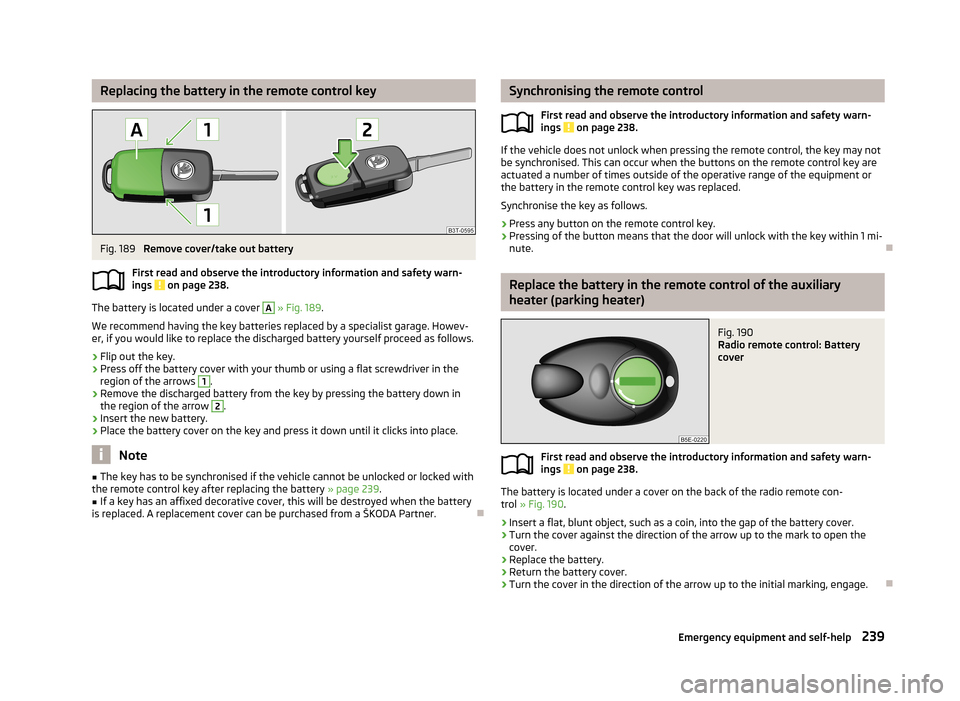
Replacing the battery in the remote control keyFig. 189
Remove cover/take out battery
First read and observe the introductory information and safety warn-
ings
on page 238.
The battery is located under a cover
A
» Fig. 189 .
We recommend having the key batteries replaced by a specialist garage. Howev- er, if you would like to replace the discharged battery yourself proceed as follows.
›
Flip out the key.
›
Press off the battery cover with your thumb or using a flat screwdriver in theregion of the arrows
1
.
›
Remove the discharged battery from the key by pressing the battery down inthe region of the arrow
2
.
›
Insert the new battery.
›
Place the battery cover on the key and press it down until it clicks into place.
Note
■ The key has to be synchronised if the vehicle cannot be unlocked or locked with
the remote control key after replacing the battery » page 239.■
If a key has an affixed decorative cover, this will be destroyed when the battery
is replaced. A replacement cover can be purchased from a ŠKODA Partner.
Synchronising the remote control
First read and observe the introductory information and safety warn-
ings
on page 238.
If the vehicle does not unlock when pressing the remote control, the key may not
be synchronised. This can occur when the buttons on the remote control key are actuated a number of times outside of the operative range of the equipment or
the battery in the remote control key was replaced.
Synchronise the key as follows.
›
Press any button on the remote control key.
›
Pressing of the button means that the door will unlock with the key within 1 mi-
nute.
Replace the battery in the remote control of the auxiliary
heater (parking heater)
Fig. 190
Radio remote control: Battery
cover
First read and observe the introductory information and safety warn-
ings on page 238.
The battery is located under a cover on the back of the radio remote con-
trol » Fig. 190 .
›
Insert a flat, blunt object, such as a coin, into the gap of the battery cover.
›
Turn the cover against the direction of the arrow up to the mark to open the
cover.
›
Replace the battery.
›
Return the battery cover.
›
Turn the cover in the direction of the arrow up to the initial marking, engage.
239Emergency equipment and self-help
Page 244 of 274

Unlocking the tailgateFig. 193
Emergency unlocking: Superb / Superb Combi
First read and observe the introductory information given on page 240.
Unlocking (Superb)
›
Fold the rear seat backrest forward » page 73, Seat backrests .
›
Insert the vehicle key into the slot in the trim panel as far as the stop » Fig. 193
-
.
›
Unlock the lid by moving it in the direction of the arrow.
›
Open the boot lid.
Unlocking (Superb Combi)
›
Fold the rear seat backrest forward » page 73, Seat backrests .
›
Insert a screwdriver or similar tool into the opening of the trim as far as it
goes » Fig. 193 -
.
›
Unlock the lid by moving it in the direction of the arrow.
›
Open the boot lid.
Selector lever-emergency unlockingFig. 194
Selector lever-emergency unlocking
First read and observe the introductory information given on page 240.
›
Firmly apply the handbrake.
›
Grasp the cover
1
in the area of arrow
2
» Fig. 194 and carefully pull upwards.
›
Also unlock the cover on the other side.
›
Use a finger to press the yellow plastic part in the direction of the arrow
3
.
›
At the same time, press the locking button in the selector lever and move the
selector lever to position N.
If the selector lever is moved again to position P, it is once again blocked.
Emergency operation of the sliding/tilting roof
Introduction
This chapter contains information on the following subjects:
Operation
242
Activation after un-clamping and re-clamping the battery
242
241Emergency equipment and self-help
Page 245 of 274

OperationFig. 195
Point for positioning screwdriver/opening for positioning the key
First read and observe the introductory information given on page 241.
The sliding/tilting roof can be closed or opened manually if a fault occurs. The emergency operation of the sliding/tilting roof is located underneath the glasses
storage box
1
» page 80 , Glasses storage box .
›
Open the glasses storage box.
›
Carefully insert an approximately 5 mm wide screwdriver into the slot in the po-
sitions shown by the arrows
1
» Fig. 195 .
›
Carefully fold the glasses storage box downwards by gently pressing down and
turning the screwdriver.
›
Insert an Allen key, SW 4, up to the stop into the opening
2
and close or open
the sliding/tilting roof.
›
Reinstall the glasses storage box by first inserting the plastic plugs and then pushing the entire part upwards.
Have the fault on the sliding tilting roof rectified as soon as possible by a special-
ist garage.
Note■ It is necessary after each emergency operation to move the sliding/tilting roof
into the basic position. 1)
This is why the rotary switch must be set to the switch
position A
» Fig. 27 on page 47 and pressed forward for about 10 seconds.
■
After each emergency operation, it is necessary to activate the
roof 2)
» page 242 .
Activation after un-clamping and re-clamping the battery
First read and observe the introductory information given on page 241.
The panoramic sliding/tilting roof (referred to form now on as just the sliding/til-
ing roof) and the sun screen must be activated after disconnecting and recon-
necting the battery.
To activate the sliding/tilting roof, press the notch on the control dial downwards
and forwards for approx. 10 seconds.
To activate the sun screen, press and hold the switch
G
» Fig. 29 on page 49 for
approx. 10 seconds.
If the sliding/tilting roof or sun screen is not fully closed or pushed shut when dis-
connecting and reconnecting the battery, they must first be closed or pushed
shut » page 49 , Opening/closing the sun screen » page 49 , Operation . Only then
is it possible to perform the activation.
Replacing windscreen wiper blades
Introduction
This chapter contains information on the following subjects:
Replacing the windscreen wiper blades
243
Replacing the rear window wiper blade
243
1)
Applies to emergency operation of the Superb sliding/tilting roof.
2)
Applies to emergency operation of the Superb Combi sliding/tilting roof.
242Do-it-yourself
Page 249 of 274

Fuses in the engine compartmentFig. 199
Cover for the fuse box in the en-
gine compartment
First read and observe the introductory information and safety warn-
ings on page 244.
On some vehicles, the battery cover must be removed before removing the cover
for the fuse box » page 216.
Replacing fuses
›
The safety catch of the cover of the fuse box
A
» Fig. 199 Move the arrow.
The symbol
is displayed behind the catches.
›
Remove the cover.
›
Replace the appropriate fuse.
›
Replace the cover on the fuse box and the safety clip
A
move against the ar-
row.
The symbol
is displayed behind the catches.
The cover is locked into position.
CAUTION
The cover for the fuse box in the engine compartment must always be applied
correctly. If the cover is not replaced properly, water may get into the fuse box -
leading to a risk of vehicle damage!
Assignment of fuses in the engine compartmentFig. 200
Fuses: Type A / Type B
First read and observe the introductory information and safety warn- ings
on page 244.
Fuse assignment in the engine compartment - version A
No.Power consumer1Front right main headlight, right tail light2Valves for ABS3-4Not assigned5Horn6-12Not assigned13Control unit for automatic gearbox14Not assigned15Coolant pump16Not assigned17Instrument cluster, windscreen wiper lever, and turn signal lever18Audio amplifier (sound system)19Radio20-22Not assigned23Engine control unit24Data bus control unit25-26Not assigned27Fuel dosage valve 246Do-it-yourself