2013 SKODA RAPID towing
[x] Cancel search: towingPage 186 of 226

fire extinguisherFig. 148
Fire extinguisher
First read and observe the introductory information given on page 182.
The fire extinguisher is attached by two straps in a holder underneath the driver's
seat.
Removing/attaching
›
Loosen the two straps by pulling the buckles in the direction of the ar- row » Fig. 148 .
›
Remove the fire extinguisher.
Follow these steps in the reverse order for attachment.
Please read carefully the instructions which are attached to the fire extinguish-
er.
The fire extinguisher must be checked by an authorised person once a year. The
national legal requirements must be observed.
WARNINGThe fire extinguisher must always be secured safely so that they do not come loose when making an emergency braking or in a vehicle collision which could
cause injuries to occupants.
Note
■ The fire extinguisher must comply with national legal requirements.■Pay attention to the expiration date of the fire extinguisher. Proper functioning
of the fire extinguisher is not assured once it has passed its expiry date.■
The fire extinguisher is part of the scope of delivery in certain countries only.
Vehicle tool kitFig. 149
Vehicle tool kit
First read and observe the introductory information given on page 182.
The vehicle tool kit and the lifting jack are housed in a plastic box in the spare
wheel or in the storage space for the spare wheel. There is also space here for
the removable ball rod for the trailer towing device. The box is attached with a
strap on the spare wheel.
The components of the vehicle tool kit (depending on vehicle equip-
ment) » Fig. 149 .
Screwdriver
Adapter for anti-theft wheel bolts
Towing eye
Clamps for removing the wheel trims
Car jack
Wheel wrench
Extraction pliers for wheel bolt caps
Replacement bulb set
Screw the car jack back into its initial position after use in order to store it back in the box with the vehicle tool kit.
12345678183Emergency equipment and self-help
Page 194 of 226

Jump-starting in vehicles with the START-STOP systemFig. 156
Engine earth: START-STOP system
First read and observe the introductory information and safety warn- ings
on page 189.
On vehicles with the START-STOP system, the jump-start cable of the charger must never be connected directly to the negative pole of the vehicle battery, but
only to the engine earth.
› 1.2 l/63 kW TSI and 1.2 l/77 kW TSI engines
» Fig. 156 -
› 1.4 l/90 kW engine
» Fig. 156 -
› 1.6 l/77 kW TDI CR engine
» Fig. 156 -
Towing the vehicle
Introduction
This chapter contains information on the following subjects:
Front towing eye
192
Rear towing eye
192
Vehicles with a tow hitch
192
Vehicles with manual transmission may be towed in with a tow bar or a tow rope
or with the front or rear wheels raised.
Vehicles with automatic transmission may be towed in with a tow bar or a tow
rope or with the front wheels raised. If the vehicle is raised at rear, the automatic
gearbox is damaged!
A tow bar is the safest way of towing a vehicle and also minimises any shocks.
Only use a tow rope if a suitable tow bar is not available.
When towing, the following guidelines must be observed.
Driver of the tow vehicle›
Release the clutch particularly gently when starting off or depress the accelera-
tor particularly gently if the vehicle is fitted with an automatic gearbox.
›
On vehicles with a manual transmission, only push down on the accelerator pedal once the rope is taught.
The maximum towing speed is 50 km/h.
Driver of the towed vehicle
›
Switch on the ignition so that the steering wheel is not locked and so that the turn signal lights, horn, windscreen wipers and windscreen washer system can
be used.
›
Take the vehicle out of gear or move the selector lever into position N if the ve-
hicle is fitted with an automatic gearbox.
Please note that the brake servo unit and power steering only operate if the en-
gine is running. If the engine is not running, significantly more physical force is re- quired to depress the brake pedal and steer the vehicle.
If using a tow rope, ensure that it is always kept taught.
CAUTION
■ Do not tow start the engine – there is a risk of damaging the engine and the
catalytic converter. The battery from another vehicle can be used as a jump-start
aid » page 189 , Jump-starting .■
If the gearbox no longer contains any oil because of a defect, your vehicle must
only be towed with the driven wheels raised clear of the ground or on a special
breakdown vehicle or trailer.
■
The vehicle must be transported on a special breakdown vehicle or trailer if it is
not possible to tow in the vehicle in the way described or if the towing distance is
greater than 50 km.
■
To protect both vehicles when tow-starting or towing, the tow rope should be
elastic. Thus one should only use plastic fibre rope or a rope made out of a simi-
larly elastic material.
■
While towing, take care to avoid impermissibly high tensile forces or jerky loads.
There is always a risk of excessive stresses and damage resulting at the points to
which you attach the tow rope or tow bar when you attempt to tow a vehicle
which is not standing on a paved road.
■
Attach the tow rope or the tow bar to the towing eyes » page 192
or » page 192 to the detachable ball head of the towing equipment » page 119 .
191Emergency equipment and self-help
Page 195 of 226
Note■We recommend using a tow rope from ŠKODA Original Accessories, which is
available from a ŠKODA Partner.■
Towing another vehicle requires a certain amount of practice. Both drivers
should be familiar with the particular points about towing a vehicle. Unskilled
drivers should not attempt to tow in another vehicle or to be towed in.
■
When towing, respect the national legal provisions, especially those which re-
late to the identification of the towing vehicle and the vehicle being towed.
■
The tow rope must not be twisted as it may in certain circumstances result in
the front towing eye being unscrewed out of your vehicle.
Front towing eye
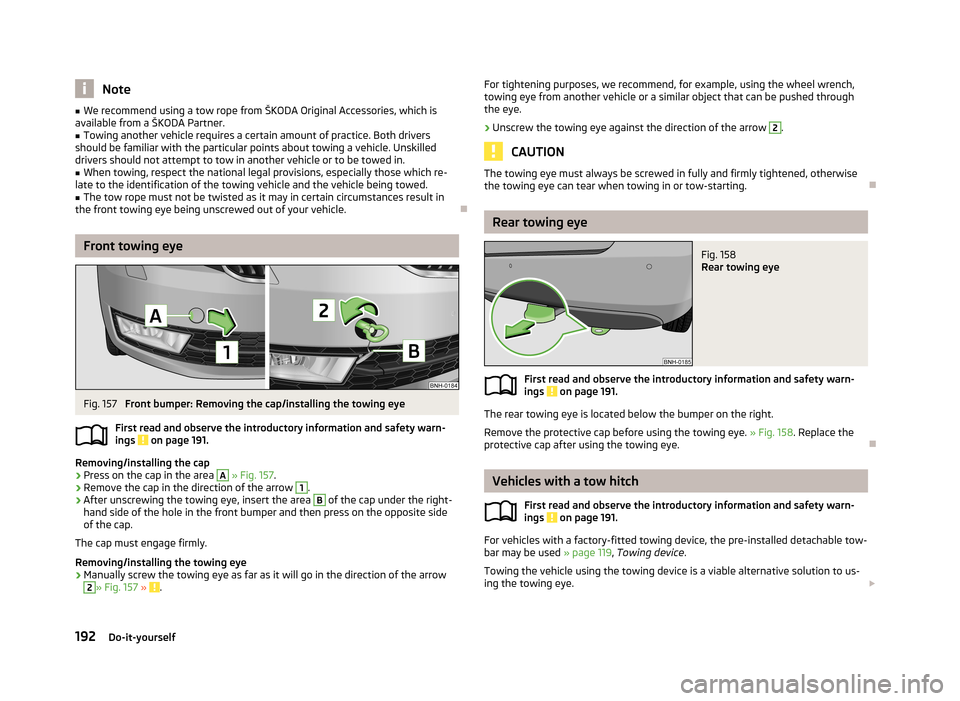
Fig. 157
Front bumper: Removing the cap/installing the towing eye
First read and observe the introductory information and safety warn- ings
on page 191.
Removing/installing the cap
›
Press on the cap in the area
A
» Fig. 157 .
›
Remove the cap in the direction of the arrow
1
.
›
After unscrewing the towing eye, insert the area
B
of the cap under the right-
hand side of the hole in the front bumper and then press on the opposite side
of the cap.
The cap must engage firmly.
Removing/installing the towing eye
›
Manually screw the towing eye as far as it will go in the direction of the arrow
2
» Fig. 157 » .
For tightening purposes, we recommend, for example, using the wheel wrench,
towing eye from another vehicle or a similar object that can be pushed through
the eye.›
Unscrew the towing eye against the direction of the arrow
2
.
CAUTION
The towing eye must always be screwed in fully and firmly tightened, otherwise
the towing eye can tear when towing in or tow-starting.
Rear towing eye
Fig. 158
Rear towing eye
First read and observe the introductory information and safety warn-
ings on page 191.
The rear towing eye is located below the bumper on the right.
Remove the protective cap before using the towing eye. » Fig. 158. Replace the
protective cap after using the towing eye.
Vehicles with a tow hitch
First read and observe the introductory information and safety warn-
ings
on page 191.
For vehicles with a factory-fitted towing device, the pre-installed detachable tow- bar may be used » page 119, Towing device .
Towing the vehicle using the towing device is a viable alternative solution to us- ing the towing eye.
192Do-it-yourself
Page 196 of 226

CAUTIONThe detachable ball rod and/or the vehicle can be damaged if an unsuitable towbar is used.
Note
The detachable ball rod must always be in the vehicle so that it can be used for
towing, if necessary.
Remote control
Introduction
This chapter contains information on the following subjects:
Replacing the battery in the remote control key
193
Synchronising the remote control
194
CAUTION
■ The replacement battery must have the same specification as the original bat-
tery.■
When replacing the battery, pay attention to the correct polarity.
For the sake of the environment
Dispose of the used battery in accordance with national legal provisions.
Replacing the battery in the remote control keyFig. 159
Remove cover/take out battery
First read and observe the introductory information and safety warn-
ings
on page 193.
The battery is located under a cover
A
» Fig. 159 .
We recommend having the key batteries replaced by a specialist garage. Howev- er, if you would like to replace the discharged battery yourself proceed as follows.
›
Flip out the key.
›
Press off the battery cover with your thumb or using a flat screwdriver in the region of the arrows
1
.
›
Remove the discharged battery from the key by pressing the battery down inthe region of the arrow
2
.
›
Insert the new battery.
›
Place the battery cover on the key and press it down until it clicks into place.
Note
■ The key has to be synchronised if the vehicle cannot be unlocked or locked with
the remote control key after replacing the battery » page 194.■
If a key has an affixed decorative cover, this will be destroyed when the battery
is replaced. A replacement cover can be purchased from a ŠKODA Partner.
193Emergency equipment and self-help
Page 210 of 226

Technical data
Technical data
Vehicle data
Introduction
This chapter contains information on the following subjects:
Vehicle identification data
207
Dimensions
208
Vehicle-specific details per engine type
209
Multi-purpose vehicles (AF)
211
The details given in the vehicle's technical documentation always take prece-
dence over the details in the Owner's Manual.
The listed performance values were determined without performance-reducing
equipment, e.g. air conditioning system.
Vehicle identification data
Fig. 183
Vehicle data sticker/type plate
First read and observe the introductory information given on page 207.
Vehicle data sticker
The vehicle data sticker » Fig. 183 - is located underneath the floor covering in
the boot.
The vehicle data sticker contains the following data: Vehicle identification number (VIN)
Vehicle type
Gearbox code/paint number/interior equipment/engine output/engine code Partial vehicle description
Operating weight (in kg)
Fuel consumption (in ltr./100 km) - intra-urban/extra-urban/combined
CO 2 emission levels - combined (in g/km)
The indicated positions
5
,
6
and
7
on the vehicle data sticker are only valid for
some countries.
Type plate
The type plate » Fig. 183 -
is located at the bottom of the B-pillar on the driver's
side.
The type plate lists the following weights: Maximum permissible gross weight
Maximum permissible towed weight (towing vehicle and trailer)
Maximum permissible front axle load
Maximum permissible rear axle load
Vehicle identification number (VIN)
The vehicle identification number - VIN (vehicle body number) is stamped into the
engine compartment on the right hand suspension strut dome. This number is al-so located on a sign on the lower left hand edge below the windscreen (together
with a VIN bar code).
Engine number
The engine number (three-digit identifier and serial number) is stamped on the
engine block.
Operating weight
The specified operating weight is for orientation purposes only. This value repre- sents the minimum operating weight without additional weight-increasing equip-
ment such as air conditioning system, spare wheel, or trailer hitch.
1234567891011207Technical data
Page 211 of 226

The operating weight also contains the weight of the driver (75 kg), the weight ofthe operating fluids, the tool kit, and a fuel tank filled to 90 % capacity.
It is possible to calculate the approximate loading capacity from the differencebetween the permissible total weight and the operating weight »
.
The payload consists of the following components: › Passengers
› All items of luggage and other loads
› Roof load including roof rack system
› Equipment not included in the operating weight
› Trailer drawbar load when towing a trailer (max. 50 kg).
Fuel consumption and CO 2 emissions according to ECE regulations and EU
directives
The measurement of the intra-urban cycle begins with a cold start of the engine. Afterwards standard urban driving is simulated.
In the extra-urban driving cycle, the vehicle is accelerated and decelerated in all
gears, corresponding to daily routine driving conditions. The driving speed varies
between 0 and 120 km/h.
The calculation of the combined fuel consumption considers a weighting of about 37 % for the intra-urban cycle and 63 % for the extra-urban cycle.
WARNINGDo not exceed the specified maximum permissible weights – risk of accident
and damage!
Note
■ If required, you can find out the precise weight of your vehicle at a specialist ga-
rage.■
The fuel consumption and emission values have been determined in accordance
with rules and under conditions set out by legal or technical requirements for de-
termining operational and technical data for motor vehicles.
■
Depending on the range of equipment, style of driving, traffic situation, weather
influences and vehicle condition, consumption values may deviate from the indi-
cated values.
Dimensions
First read and observe the introductory information given on page 207.
Vehicle dimensions (mm)
RapidRapid SpacebackLength44834304Width17061706Width including exterior mirror19401940Height1461/1488 a)
(1474/1500 a)
) b)1459/1471 a)
(1472/1484 a)
) b)Clearance136/143 b)134/141b)Wheel base26022602Track gauge front/rear1457/1494
(1463/1500) c)1457/1494
(1463/1500) c)a)
Valid for vehicles with the Amundsen+ navigation system.
b)
Applies to vehicles with a rough road package.
c)
Applies to cars fitted with the 1.2 l/55 kW MPI and 1.2 l/63 kW TSI engines and 14" wheel rims.
208Technical data
Page 217 of 226

Diesel particle filter19
Information messages19
Digital clock13
Dipstick167
Disconnecting and reconnecting vehicle battery
174
Display11
Compass points24
Coolant temperature11
Correct gear changes24
Fuel supply12
Service intervals28
Display of the second speed13
Distance driven12
Door Child safety lock
35
Closing35
Indicator light for an open door15
Opening35
Door locking Emergency
194
Doors Emergency locking
194
Double-sided floor covering70
Driving Abroad
110
Driving through water on streets109
Emissions207
Fuel consumption207
Maximum speed209
Driving economically Economical gear changing
106
Driving through water109
E
Economical and environmentally friendly driving 105
Economical driving Ballast
107
Driving at full throttle106
Idling106
Looking ahead106
Regular maintenance107
Saving energy108
Short distances107
Tyre inflation pressure107
EDL112
Electrical power windows Button in the driver's door
38, 39
Button in the rear door39
Electronic Differential Lock (EDL)112
Electronic immobiliser98
Electronic Stability Control (ESC)111
Emergency Changing a wheel
184
Door locking194
Hazard warning light system44
jump-starting190
Jump-starting189
Selector lever-unlocking195
Towing the using the tow hitch192
Towing the vehicle191
Tyre repair187
Unlocking the tailgate194
Emergency equipment Fire extinguisher
183
First aid kit182
Jack183
Vehicle tool kit183
Warning triangle182
Emissions207
Engine Running in
104
Switching off the engine99
Engine compartment162
Brake fluid170
Coolant169
Overview165
Vehicle battery171
Engine oil166
Capacity167
Changing168
Checking167
Indicator light16
Information messages16
Replenishing168
Specifications167
Environment105
Environmental compatibility108
Environmentally friendly driving105
EPC Indicator light
19
ESC Function
111
Warning light17
Exhaust inspection system Indicator light
18
F
Fastening elements
65
Films155
Fire extinguisher183
First aid kit182
Flashing43
Flexible storage compartment69
Fog lights43
Indicator light21
Fog lights with CORNER function43
Footmats101
see footmats101
Force limit Power windows
40
Front airbag137
Fuel160
Diesel162
Fuel gauge12
refer to Fuel160
Refuelling160
Unleaded petrol161
Fuel consumption105
214Index
Page 221 of 226

Side airbag138
Snow chains181
Spare wheel179
Speedometer11
See speedometer11
Speed symbol See Wheels
178
Spoiler151
START-STOP116
Manually activating/deactivating the system117
Operating conditions of the system117
Starting/shutting down the engine116
Starting and stopping the engine with the key97
Starting engine Jump-starting
189
Starting the engine Jump-starting
190
Key98
START STOP Information messages
118
Jump-starting191
Steering force assistance97
Steering wheel96
Storage compartment in centre console58
Storage compartment on the passenger side63
Storage compartments56
Storage compartments in the boot69
Storage compartments in the doors57
Storage pockets on the front seats64
sun roof48
sunshade48
Sun visors47
Switch See Ignition
98
Switching off the engine99
Switch light on/off41
T
Taking care of the vehicle Natural leather
158
Seat belts159
Taking care of your vehicle Automatic car wash system
153
Cavity protection156
Chrome parts155
Cleaning the wheels156
Decorative films155
Door lock cylinders156
Headlight lenses156
High-pressure cleaner153
Plastic parts154
Polishing the paintwork154
Rubber seals155
Taking care of the interior157
Taking care of your vehicle exterior153
Washing152
Washing by hand152
Wash system153
Wax treatment154
Taking care of your vehicles Fabric covers
159
TCS Operation
112
Technical data207
Telephone85
Temporary spare wheel179
Tiptronic103
Tools183
TOP TETHER146
Towing191
Towing a trailer119
Towing device Description
119
Drawbar load119
Use and care122
Towing eye Front192
Rear192
Towing protection36
Traction Control System (TCS)112
Trailer119, 123
13-pin power socket124
driving with a trailer124
Loading123
Safety eye124
Transport Luggage compartment
64
Roof rack system74
Transporting children safely142
Turn signal43
Turn signal system Indicator light
20
two-way radio systems85
Type plate207
Tyre inflation pressure Indicator light
20
Tyre load-bearing capacity See Wheels
177
Tyre pressure monitor Setting
178
Tyre repair Check pressure
189
Preparations188
Sealing and inflating the tyre188
Tyres175
Inflation pressure176
New177
See Wheels177
Sizes176
Tyre wear indicator176
U
Underbody protection
157
Unleaded petrol110
218Index