2013 SKODA CITIGO Vin plate
[x] Cancel search: Vin platePage 37 of 176

Headlight beam adjustmentFig. 23
Dash panel: Knob for headlamp
levelling
First read and observe the introductory information and safety warn-
ings on page 33.
Turning the rotary switch » Fig. 23 from position
to
gradually activates the
headlight beam adjustment, thereby shortening the beam of light.
The positions correspond approximately to the following car load. Front seats occupied, luggage compartment empty.All seats occupied, luggage compartment empty.All seats occupied, luggage compartment loaded.
Driver seat occupied, luggage compartment loaded.
WARNINGAlways adjust the headlight beam to meet the following conditions.■The vehicle does not dazzle other road users, especially oncoming vehicles.■
The beam range is sufficient for safe driving.
Note
We recommend you adjust the headlight beam when the low beam is switched
on.
Daytime running light (DAY LIGHT)
First read and observe the introductory information and safety warn-ings
on page 33.
The daytime running lights function provides the lighting of the front of the vehi-
cle.
Switching on daytime running lights
›
Turn the light switch into position » Fig. 22 on page 33 .
The daytime running lights are switched on automatically if the following condi- tions are met:
The ignition is switched on.
The light switch is in position
» Fig. 22 on page 33.
When the daytime running lights are switched on, the lighting for the instrument
cluster is switched off, and the parking lights and the license plate light do not light up.
Turn signal and main beam
Fig. 24
Operating lever: Turn signal and
main beam operation
First read and observe the introductory information and safety warn-
ings on page 33.
Lever positions » Fig. 24
Switch on right turn signal
Switch on left turn signal
Switch on high beam
Switch on high beam or headlamp flasher (spring-loaded position)
ABCD34Using the system
Page 148 of 176

WARNING■The factory-supplied lifting jack is only intended for your model of vehicle.
Under no circumstances use it to lift heavier vehicles or other loads – risk of
injury!■
Ensure that the vehicle tool kit is safely secured in the luggage compart-
ment.
■
Ensure that the box is always secured with the strap.
Changing a wheel
Introduction
This chapter contains information on the following subjects:
Preliminary work
145
Changing a wheel
146
Follow-up work
146
Loosening/tightening wheel bolts
146
Raising the vehicle
147
Securing wheels against theft
148WARNING■ If you are in flowing traffic, switch on the hazard warning light system and
set up the warning triangle at the prescribed distance! The national legal re-
quirements must be observed.■
Park the vehicle as far away as possible from the flow of traffic. Park on as
flat and firm a surface as possible.
■
The following instructions must be followed if the vehicle is subsequently
fitted with tyres or rims that differ from the factory-fitted ones » page 140,
New tyres .
WARNINGObserve the following instructions for lifting the vehicle.■If the wheel has to be changed on a slope, first of all block the opposite
wheel with a stone or similar object to prevent the vehicle from unexpectedly
rolling away.■
Secure the base plate of the lifting jack with suitable means to prevent pos-
sible moving. A soft and slippery ground under the base plate may move the lifting jack, causing the vehicle to fall down. It is therefore always necessary to
place the lifting jack on a solid surface or use a wide and stable base. Use a non-slip base (e.g. a rubber foot mat) if the surface is smooth, such as cobbled
stones, tiled floor, etc.
■
Only attach the lifting jack to the attachment points provided for this pur-
pose.
■
Always raise the vehicle with the doors closed.
■
Never position any body parts, such as arms or legs under the vehicle, while
the vehicle is raised with a lifting jack.
■
Never start the engine when the vehicle is raised – risk of injury.
CAUTION
■ The prescribed tightening torque of the wheel bolts for steel and light alloy
wheels is 110 Nm.■
If the wheel bolts are fastened too tightly, this can cause damage to the anti-
theft wheel bolt or the adapter.
Note
The national legal requirements must be observed when changing a wheel.
Preliminary work
First read and observe the introductory information and safety warn-ings
on page 145.
Always change a wheel on a level surface as far as possible.
The following steps must be carried out before actually changing the wheel:
›
Let all of the occupants get out. While changing a tyre, the occupants of the
vehicle should not stand on the road (instead they should remain behind a crash
barrier).
145Emergency equipment and self-help
Page 150 of 176

Tightening›Push the wheel wrench onto the wheel bolt up to the stop1)
.›
Grasp the end of the wrench and turn the bolt against the direction of the ar-
row » Fig. 116 - until it is tight.
For a wheel with full wheel trim, the anti-theft wheel bolt must be screwed in at
position
2
» Fig. 116 opposite the valve
1
. Otherwise the full wheel trim cannot
be installed.
WARNINGUndo the wheel bolts only a little (about one turn) provided that the vehicle
has not yet been jacked up. Otherwise the wheel could come off and fall down
– risk of injury!
Note
If it proves difficult to undo the bolts, carefully apply pressure to the end of the
wrench with your foot. Keep hold of the vehicle when doing so, and make sure
you keep your footing.
Raising the vehicle
Fig. 117
Jacking points for positioning
lifting jack
Fig. 118
Attach lifting jack
First read and observe the introductory information and safety warn-
ings
on page 145.
Position the car jack below the jacking point that is closest to the faulty wheel » Fig. 117 . The jacking point is located directly below the engraving in the
lower sill.
›
Position the lifting jack below the jacking point with the crank and move it up until its claw is positioned below the vertical web of the lower sill.
›
Align the lifting jack so that its claw grasps the web » Fig. 118 -
.
›
Support the base plate of the jack with its entire surface resting on level ground
and ensure that the lever is located in a vertical position to the area where the
claw grasps the web » Fig. 118 -
.
›
Continue turning up the jack until the wheel is just about lifted off the ground.
WARNING■
Only raise the vehicle at the attachment points.■Choose a flat and firm surface for jacking the vehicle.
1)
Use the appropriate adapter for undoing and tightening the anti-theft wheel bolts » page 148.
147Emergency equipment and self-help
Page 160 of 176
No.Power consumer11Starter12DC-DC voltage converter, ABS, instrument cluster, radio
Bulbs
Introduction
This chapter contains information on the following subjects:
Headlights
157
Replacing the bulb for the side turn signal lights
158
Replacing the bulb for the fog light
158
Replacing the bulb for the licence plate light
159
Tail light
159
Some manual skills are required to change a bulb. For this reason, we recommend
having bulbs replaced by a specialist garage or seeking other expert help in the
event of any uncertainties.
› Switch off the ignition and all of the lights before replacing a bulb.
› Faulty bulbs must only be replaced with the same type of bulbs. The designa-
tion is located on the light socket or the glass bulb.
› A stowage compartment for replacement bulbs is located in a plastic box in the
spare wheel or underneath the floor covering in the luggage compartment.
WARNING■ Always read and observe the warnings before completing any work in the
engine compartment » page 127, Engine compartment .■
Accidents can be caused if the road in front of the vehicle is not sufficiently
illuminated and the vehicle cannot or can only be seen with difficulty by other
road users.
■
The H4 bulb is pressurised and may explode during a bulb replacement - risk
of injury! We therefore recommended wearing gloves and safety glasses when changing a bulb.
CAUTIONDo not take hold of the glass bulb with naked fingers (even the smallest amountof dirt reduces the working life of the light bulb). Use a clean cloth, napkin, or sim-
ilar.
Note
■ This Owner's Manual only describes the replacement of bulbs where it is possi-
ble to replace the bulbs on your own without any complications arising. Other bulbs must be replaced by a specialist garage.■
We recommend that a box of replacement bulbs always be carried in the vehi-
cle. Replacement bulbs can be purchased from ŠKODAOriginal Accessories.
■
We recommend having the headlight settings checked by a specialist garage af-
ter replacing a bulb in the main or low beam.
■
In the case of a defective CD player, visit a specialist garage.
Headlights
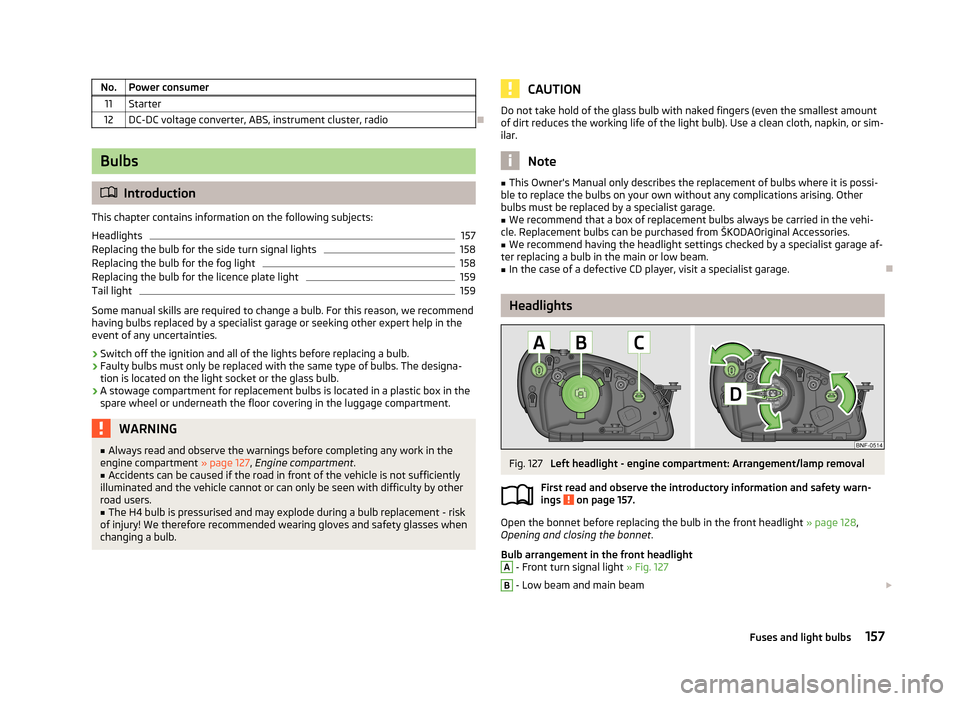
Fig. 127
Left headlight - engine compartment: Arrangement/lamp removal
First read and observe the introductory information and safety warn- ings
on page 157.
Open the bonnet before replacing the bulb in the front headlight » page 128,
Opening and closing the bonnet .
Bulb arrangement in the front headlight
A
- Front turn signal light » Fig. 127
B
- Low beam and main beam
157Fuses and light bulbs
Page 162 of 176

›Fold the wheel house trim back.›Insert the expanding rivet B again and screw in.›
Firmly tighten the two attachment bolts
A
with the screwdriver.
Replacing the bulb for the licence plate light
Fig. 130
Changing the bulb for the licence plate light
First read and observe the introductory information and safety warn- ings
on page 157.
›
Insert a suitable thin object, e.g. a screwdriver into the recess in the region of the arrow and carefully prise the number plate light out of the bumper » Fig. 130
-
.
›
Remove the lamp from the bumper.
›
Turn the bulb holder anti-clockwise and remove in the direction of the ar-
row » Fig. 130 -
.
›
Remove the faulty bulb from the socket.
›
Insert a new bulb into the socket.
›
Insert the bulb holder into the number plate light and turn clockwise as far as
the stop.
›
Insert the number plate light into the opening of the bumper at the left edge.
Lightly press it until the spring latches.
CAUTION
When removing and installing the number plate light and tail light make sure that
the paintwork of the vehicle and the tail light are not damaged.
Tail lightFig. 131
Removing the tail lamp assembly
Fig. 132
Tail light assembly: Replacing bulbs
First read and observe the introductory information and safety warn-
ings
on page 157.
Removing
›
Open the boot lid.
›
Fold the rear seat backrest forward » page 45, Folding the rear seats forward .
›
Remove the boot cover » page 48.
›
Pry off cover
1
» Fig. 131 in the arrow area.
›
Below locking edge
3
, insert the screwdriver » page 144, Vehicle tool kit and
pull the locking on connector
2
in the direction of the arrow.
›
Press the locking mechanism
4
and remove the connector
2
.
›
Hold the tail light assembly in the installation position with one hand, and re- move the plastic nut
5
with the other.
159Fuses and light bulbs
Page 164 of 176

Technical data
Technical data
Vehicle data
Introduction
This chapter contains information on the following subjects:
Vehicle identification data
161
Dimensions
162
Vehicle-specific information depending on engine type
163
The details given in the vehicle's technical documentation always take prece-
dence over the details in the Owner's Manual.
The listed performance values were determined without performance-reducing
equipment, e.g. air conditioning system.
Vehicle identification data
Fig. 133
Vehicle data sticker/type plate
First read and observe the introductory information given on page 161.
Vehicle data sticker
The vehicle data sticker » Fig. 133 - is located under the floor in the luggage
compartment.
The vehicle data sticker contains the following data: Vehicle identification number (VIN)
Vehicle type, engine power, transmission, paint number
Engine and gearbox code
Partial vehicle description
Operating weight (in kg) Fuel consumption (in ltr./100 km) - intra-urban/extra-urban/combinedCO 2 emission levels - combined (in g/km)
The indicated positions
5
,
6
and
7
on the vehicle data sticker are only valid for
some countries.
Type plate
The type plate » Fig. 133
is visible at the bottom of the door frame after open-
ing the driver's door.
The type plate lists the following weights: Maximum permissible gross weight
Maximum permissible front axle load
Maximum permissible rear axle load
Vehicle identification number (VIN)
The vehicle identification number - VIN (vehicle body number) is stamped into the
engine compartment on the right hand suspension strut dome. This number is al-
so located on a sign on the lower left hand edge below the windscreen (together
with a VIN bar code).
Engine number
The engine number (three-digit code letter and serial number) is stamped on the
engine block.
Operating weight
The specified operating weight is for orientation purposes only. This value repre- sents the minimum operating weight without additional weight-increasing equip-ment such as air conditioning system, spare wheel, or trailer hitch.
12345678910161Technical data
Page 171 of 176

R
Radiator fan
129
Raise vehicle147
Rear-view mirror Exterior mirrors
41
Rear fog light35
Rear mirror40
Interior mirror40
Rear seats45
Folding forward45
Rear window heating37
Rear windows Closing
31
Opening31
Recirculated air mode61
Recommended gear12
Refuelling122
Fuel122
Regulation Headlight beam
34
Remote control27
locking28
Synchronisation process28
unlocking28
Remote control key Replacing the battery
23
Repairs and technical alterations110
Replace vehicle battery
137
Replace vehicle battery
137
Replacing Bulb for the fog light
158
Bulb for the licence plate light159
Bulb for the side turn signal lights158
Bulbs157
Bulbs in the tail light159
Fuses154
Fuses in the dash panel156
Fuses in the engine compartment156
Windscreen wiper blade40
Windscreen wiper blades39
Replenishing Coolant
133
Engine oil131
Windscreen washer fluid129
Roof rack mounting points
50
Roof rack system Roof load
50
Running-in The first 1500 km
73
Running in Brake pads
74
Engine73
Tyres74
S
Safe securing system
26
Safety90
Child safety103
Child safety seats103
Correct seated position91
Head restraints45
ISOFIX106
TOP TETHER107
Safety belt Warning light
21
Saving electrical energy74
Seals Taking care of your vehicle
116
Seat Adjusting
43
Seat belts94
Belt tensioners97
Cleaning121
fastening and unfastening96
Inertia reels97
The physical principle of a frontal collision95
Warning light17
Seats Folding forwards
45
Head restraints45
Heating44
Seats and stowing42
Service111
Service display12
Service intervals108
Setting Air conditioning system
61
Heating59
Setting the clock Clock
14
Shifting gears Driving and saving energy
75
Side airbag100
Sliding/tilting roof31
Closing31
Opening and tilting31
Operation31
Snow chains143
Spare wheel141
Speedometer11
Speed symbol See Wheels
141
Spoiler112
START-STOP85
Manually activating/deactivating the system86
Operating conditions of the system85
Starting/shutting down the engine85
Starting and stopping the engine with the key67
Starting engine Jump-starting
150
Starting the engine Jump-starting
151
Key68
168Index
Page 172 of 176

START STOPJump-starting152
Warning light21
Steering force assistance66
Steering wheel66
Storage53
Storage compartment Bag holder
55
Storage compartment on the driver's side54
Storage compartment on the front passenger side
54
Storage compartment with lid on the front pas- senger side
54
Storage compartments53
Meshed pockets on the front seat rests56
Multimedia holder56
Photo holder55
Storage compartment in the front centre console 55 Storage compartments in front of the rear seats
56
Sun visors38
Switching off the engine68
T
Taking care of the vehicle Natural leather
119
Seat belts121
Taking care of your vehicle Automatic car wash system
114
Cavity protection117
Chrome parts116
Cleaning the wheels118
Decorative films116
Door lock cylinders117
Headlight lenses117
High-pressure cleaner114
Plastic parts116
Polishing the paintwork115
Rubber seals116
Taking care of the interior118
Taking care of your vehicle exterior115
Washing113
Washing by hand114
Wash system114
Wax treatment115
Taking care of your vehicles Fabric covers
120
TCS81
Technical data161
Tiptronic see automatic gearbox
72
Tools144
TOP TETHER107
Towing152
Towing device113
Towing eye153
Traction Control System81
Warning light19
Transport Luggage compartment
46
Roof rack system49
Transporting children safely103
Turn signal34
Two-way radio systems63
Type plate161
Tyre load-bearing capacity See Wheels
140
Tyre repair Check pressure
150
Preparations149
Sealing and inflating the tyre149
Tyres138
Inflation pressure139
New140
See Wheels140
Sizes139
Tyre wear indicator139
U
Underbody protection
118
Unleaded petrol79
unlock Central locking system
26
Unlocking Remote control
28
Vehicle key22
Unlocking and locking22
Useful equipment50
V
Vehicle battery Automatic load deactivation
137
charging136
Checking the electrolyte level135
Operation in winter136
Safety instructions134
Vehicle care108
Alcantara120
Artificial leather120
Cloths120
Vehicle data sticker161
Vehicle dimensions162
Vehicle height162
vehicle identification number - VIN161
Vehicle key locking
22
unlocking22
Vehicle length162
Vehicles with CNG mode See CNG
123
Vehicles with natural gas mode See CNG
123
Vehicle tool kit144
Vehicle width162
Visibility37
Visors see Sun visors
38
Visual parking system82
169Index