2013 Peugeot 508 RXH ECO mode
[x] Cancel search: ECO modePage 41 of 308

.
39
Hybrid system
ECO OFF switch
This function prevents the Diesel engine
being switched off and so ensures that a comfor table temperature can be maintained in
the passenger compar tment (air conditioningrunning continuously).
On pressing the switch, the engine restar ts
immediately.
To return to normal operation, press the switch
a
gain.
After switching off the ignition, the vehicle will
return to normal operation (lamp in the switch off).
*
Except in ZEV mode, which favours electricrunning over assuring a comfortable
temperature. Durin
g electric running and when the engine is
stopped, the hybrid system manages restarting automatically to assure comfor t levels in thepassenger compartment * .However, variations in temperature may stillbe felt in very hot climates. To avoid any
discomfort in these conditions you can operate
the E
CO OFF switch.
Page 42 of 308
40
Hybrid system
Eco-driving
Eco-driving is a range of everyday practices that allow the motorist to optimise their fuel consumption and CO2emissions.
Eco-driving suited to your
HYbrid4 vehicle
Use gear selector position A , as thisoptimises gear changes to suit the
circumstances and the AUTOmode of theHYbrid4 mode selector. When moving off, accelerate normally up tothe desired speed (POWER
zone between 20and 40 %).
At steady speeds, drive gently with smallmovements of the accelerator pedal (ECO
or CHARGEzone), run in electric mode as oftenas possible when driving at low speed. Anticipate the need to slow down and use engine braking ( CHARGE
zone), so as to make use of free energy recovery while keeping light pressure on the accelerator pedal.
Control the use of your
electrical equipment
Before moving off, if the passenger compartment is too warm, ventilate it byopening the windows and air vents before using the air conditioning.
Above 30 mph (50 km/h), close the windows and leave the air vents open.
Remember to make use of equipment that canhelp keep the temperature in the passenger compartment down (sun roof and windowblinds...). Switch off the air conditioning, unless it has automatic digital regulation, as soon as thedesired temperature is attained. Switch off the demisting and defrostingcontrols, if not automatic.
Switch off the heated seat as soon as possible.
Switch off the headlamps and front foglampswhen the level of light does not require their use.
Avoid running the Diesel engine when stationary, par ticularly in winter; your vehicle will warm up much faster while driving.
As a passenger, if you avoid connecting your multimedia devices (film, music, videogame...), you will contribute towards limitingthe consumption of electrical energy, and soof fuel.
Disconnect your por table devices beforeleaving the vehicle.
Page 45 of 308
.
43
Hybrid system
200 V high voltage battery
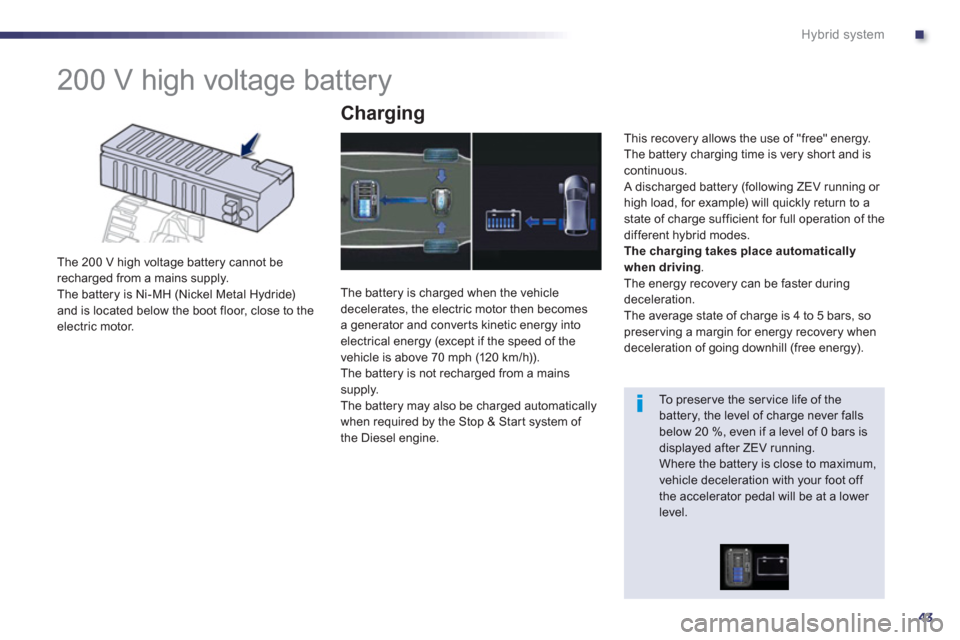
The 200 V high voltage battery cannot be
recharged from a mains supply.
The battery is Ni-MH (Nickel Metal Hydride)
and is located below the boot floor, close to the electric motor.
Charging
The battery is charged when the vehicledecelerates, the electric motor then becomesa generator and conver ts kinetic energy into
electrical energy (except if the speed of the
vehicle is above 70 mph (120 km / h)).
The battery is not recharged from a mains
supply.
The battery may also be charged automaticallywhen required by the Stop & Start system of
the Diesel engine.
This recover
y allows the use of "free" energy.
The battery charging time is very shor t and iscontinuous.
A discharged battery (following ZEV running or
high load, for example) will quickly return to astate of charge sufficient for full operation of the
different hybrid modes.
Thecharging takes place automatically
when driving.
The energy recovery can be faster during deceleration.
The average state of charge is 4 to 5 bars, so
preserving a margin for energy recovery when
deceleration of going downhill (free energy).
To preser ve the ser vice life of the battery, the level of charge never fallsbelow 20 %, even if a level of 0 bars isdisplayed after ZEV running. Where the battery is close to maximum,vehicle deceleration with your foot off the accelerator pedal will be at a lower level.
Page 49 of 308
.
47
Hybrid system
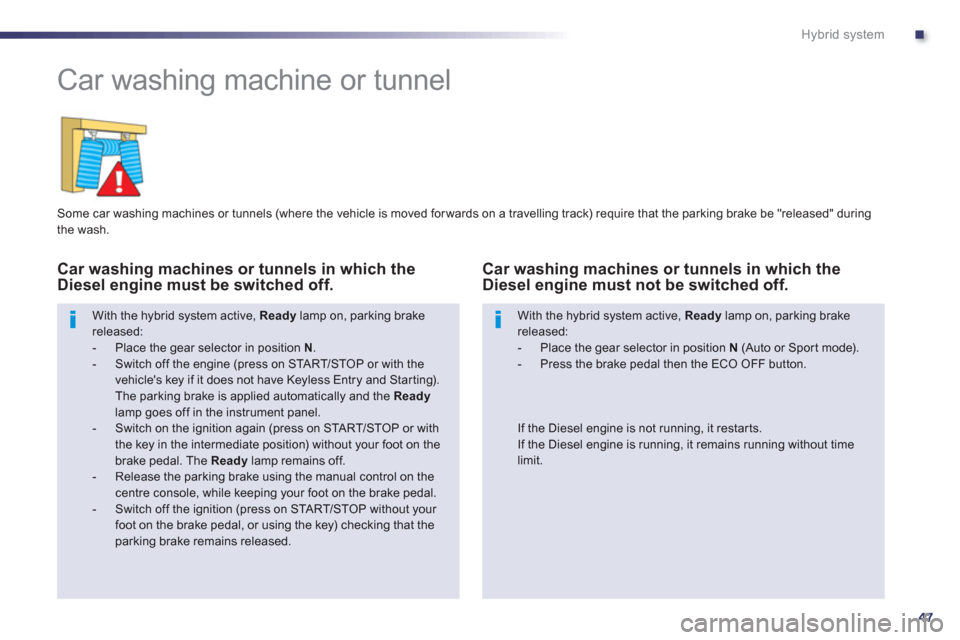
Car washing machine or tunnel
Some car washing machines or tunnels (where the vehicle is moved for wards on a travelling track) require that the parking brake be "released" during
th
e wash.
Car washing machines or tunnels in which theDiesel engine must be switched off.
With the hybrid system active, Readylamp on, parking brakereleased:- Place the gear selector in position N.- Switch off the engine (press on STA R T/STOP or with thevehicle's key if it does not have Keyless Entry and Starting).The parking brake is applied automatically and the Readylamp goes off in the instrument panel.- Switch on the ignition again (press on START/STOP or with
the key in the intermediate position) without your foot on the brake pedal. The Readylamp remains off. - Release the parking brake using the manual control on the centre console, while keeping your foot on the brake pedal.- Switch off the ignition (press on STA R T/STOP without your foot on the brake pedal, or using the key) checking that the parking brake remains released.
With the hybrid system active, Ready
lamp on, parking brake released:
- Place the gear selector in position N
(Auto or Sport mode).
- Press the brake pedal then the ECO OFF button.
Car washing machines or tunnels in which the Diesel engine must not be switched off.
If the Diesel engine is not running, it restar ts.
If the Diesel engine is running, it remains running without time limit.
Page 52 of 308
50
Instruments and controls
Indicator and warning
lamps
Visual indicators informing the driver that a system is in operation, switched off or has a
fault.
When the ignition is switched on
Certain warning lamps come on for a few seconds in the instrument panel and/or
instrument panel screen when the vehicle's
ignition is switched on.
When the engine is started, these same
warning lamps should go off.
If they remain on, before moving off, refer to the
information on the warning lamp concerned.
Associated warnings
The switching on of cer tain warning lamps maybe accompanied by an audible signal and a message in the instrument panel screen.
The warning lamps may come on continuously(fixed) or flash.
Certain warning lamps may come on inone of two modes. Only by relating thetype of lighting to the operating status
of the vehicle can it be ascertainedwhether the situation is normal or whether a fault has occurred.
1
2
2
2
3
3
3
2
3
3
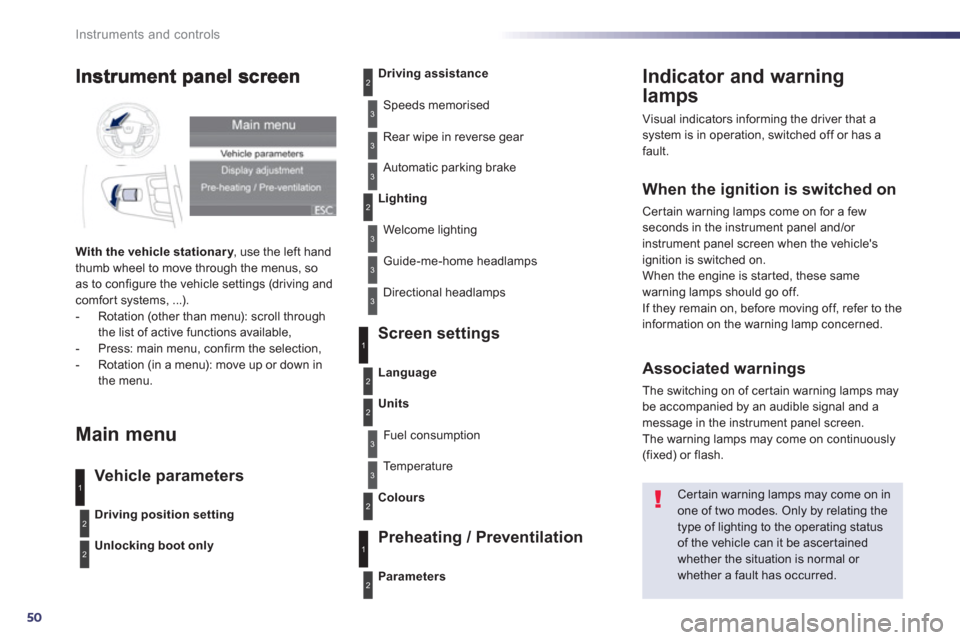
With the vehicle stationar y
, use the left handythumb wheel to move through the menus, so as to configure the vehicle settings (driving andcomfort systems, ...).
- Rotation (other than menu): scroll through
the list of active functions available,
- Press: main menu, confirm the selection,
- Rotation (in a menu): move up or down in
the menu.
Main menu
Vehicle parameters Screen settin
gs
Preheatin
g / Preventilation
Driving position setting
Unlocking boot only
Driving assistance
Speeds memorised
Rear wipe in reverse
gear
Automatic parkin
g brake
Lighting
Welcome lighting
Guide-me-home headlamps
Directional headlamps
Parameters
Language
Units
Fuel consumption
Te m p e r a t u r e
Colours
3
1
2
2
3
2
3
1
2
Page 94 of 308

92
Comfort
Electric adjustments
Switch on the ignition or star t the engine if the vehicle has gone into economy mode.
1.Adjustment of the seat cushion angleand height, and forwards-backwards
adjustment)Raise or lower the front of the control to adjust the seat cushion angle. )Raise or lower the rear of the control to raise or lower the seat.)Simultaneously raise or lower the frontand rear of the control in order to raise or lower the entire seat. 2.Adjustment of the backrest angle Move the control forwards or backwards to adjust the backrest angle. 3. Adjustment of lumbar support This function allows you to independentlyadjust the height and level of lumbar support.
The electric functions of the driver's seat are active for about a minute after opening the
front door. They are deactivated about a minute after switching off the ignition and in economy mode. To reactivate them, switch on the ignition.
M
ove the control:)Forwards or backwards to increase or reduce the lumbar suppor t. )Upwards or downwards to raise or lower
the lumbar suppor t zone.
Front seats
Page 114 of 308

112
Comfort
Dual-zone digital air conditioning
Automatic operation
1. Automatic comfort programme
)
Press this "AU TO "button. Theindicator lamp comes on.
We recommend that you use this mode. It automatically adjusts all settings to provide
optimum operation for the comfor t level chosen: passenger compar tment temperature, air flow, air distribution and air recirculation.
This system is designed to operate effectivelyin all seasons, with the windows closed.
When the engine is cold, to prevent too great a distribution of cold air, the air flow will reach its optimum levelgradually. In cold weather, it favours the distribution of warm air to the windscreen, side windows and footwells only.
2 - 3. Driver-passenger side adjustment
The driver and front passenger can each adjust
the temperature to their requirements.
The value indicated on the displa
y corresponds
to a level of comfor t and not to a temperature in
degrees Celsius or Fahrenheit.
) Turn control 2or 3to the left(blue) or to the right (red) respectively to decrease or increase this value.
A setting around the value 21 provides
optimum comfor t. However, depending on your
requirements, a setting between 18 and 24 isnormal.
It is recommended that the difference between
left and right should not be greater 3. The air conditionin
g can only operate when the hybrid system is active (Ready lamp on).
Its effectiveness will be reduced when in electric mode (see the ECO OFF section).
The ZEV mode gives preference to electric driving rather than maintaining a comfortable temperature.
Page 117 of 308
3
115
Comfort
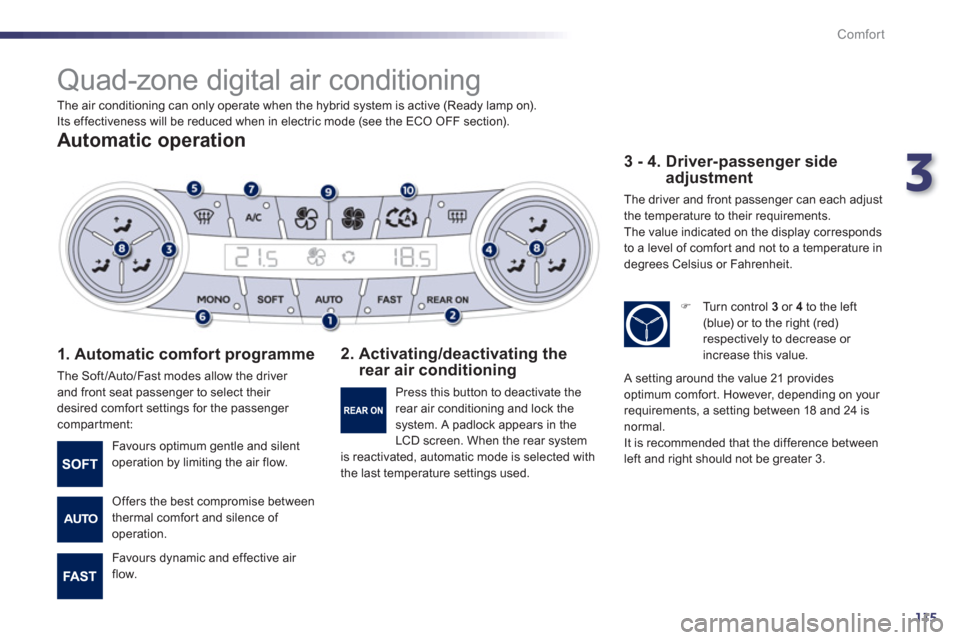
Quad-zone digital air conditioning
Automatic operation
1. Automatic comfort programme
The Soft/Auto/Fast modes allow the driver
and front seat passenger to select their
desired comfort settings for the passenger compartment:
2. Activating/deactivating the rear air conditioning
3 - 4. Driver-passenger side adjustment
The driver and front passenger can each adjust
the temperature to their requirements.
The value indicated on the display corresponds
to a level of comfor t and not to a temperature in
degrees Celsius or Fahrenheit.
Favours optimum gentle and silent
operation by limiting the air flow.
Offers the best compromise between
thermal comfort and silence of
operation.
Favours d
ynamic and effective air
flow. Pr
ess this button to deactivate the
rear air conditioning and lock thesystem. A padlock appears in the
LCD screen. When the rear system is reactivated, automatic mode is selected with
the last temperature settings used.
)
Turn control 3
or 4
to the left (blue) or to the right (red)respectively to decrease or
increase this value.
A setting around the value 21 providesoptimum comfort. However, depending on your
requirements, a setting between 18 and 24 is
normal.
It is recommended that the difference between
left and right should not be greater 3. The air conditionin
g can only operate when the hybrid system is active (Ready lamp on).
Its effectiveness will be reduced when in electric mode (see the ECO OFF section).