2013 Peugeot 508 Hybrid gearbox
[x] Cancel search: gearboxPage 119 of 340
4
117
Driving
6-speed electronic gear control gearbox
Six-speed electronic gear control gearbox
which offers a choice between the comfort of
fully automatic operation or the pleasure of manual gear changing.
There are two driving modes: -automatedmode for automatic control of
the gears by the gearbox,
-
manualmode for sequential gear changing
by the driver.
In automated mode, it remains possible to
change gear manually by using the steering mounted control paddles when required, when
over taking, for example.
This gearbox provides you with the benefit of additional functions:
- hill star t assist,
- the creep function (movement of the
vehicle on releasing the brake pedal)
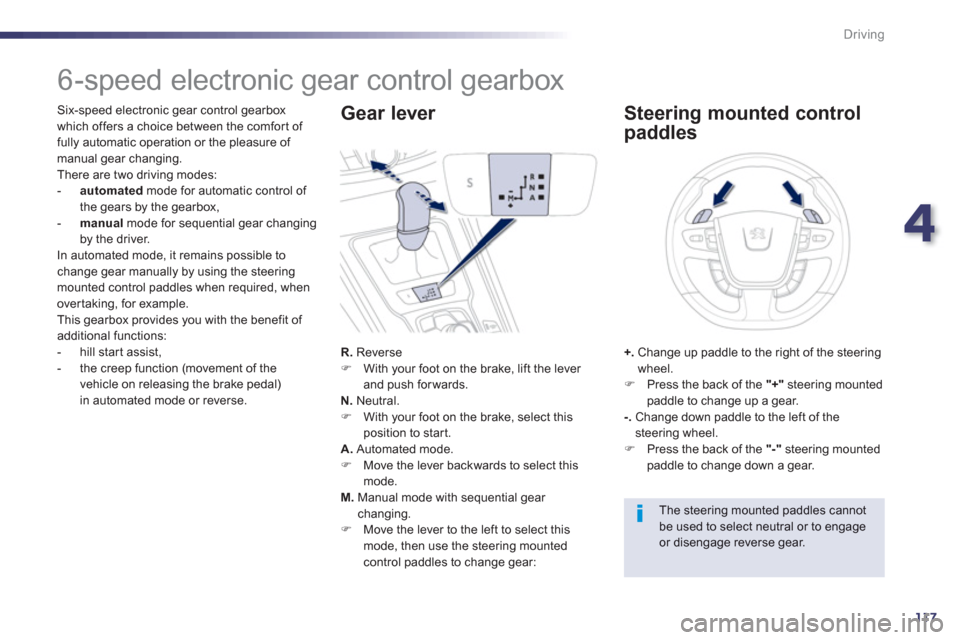
in automated mode or reverse.R
. ReverseFWith your foot on the brake, lift the lever
and push forwards.
N
.Neutral.FWith your foot on the brake, select this
position to start. A.
Automated mode. FMove the lever backwards to select this
mode. M.
Manual mode with sequential gear changing. FMove the lever to the left to select this
mode, then use the steering mounted control paddles to change gear:
Gear lever
+. Change up paddle to the right of the steeringwheel.F
Press the back of the "+"
steering mounted paddle to change up a gear. -.
Change down paddle to the left of thesteering wheel. F
Press the back of the "-"
steering mounted paddle to change down a gear.
Steering mounted control
paddles
The steering mounted paddles cannotbe used to select neutral or to engage or disengage reverse gear.
Page 120 of 340
118
Driving
Engagement of reverse gear is accompanied by an audible signal.
N
flashes in the instrument panel, accompanied by an audible signal and a message in the instrument panel screen, if the gear lever is not inposition N
on starting.Foot on brake
flashes on theinstrument panel, accompanied by anaudible signal and a message in theinstrument panel screen, if the brakepedal is not pressed on starting.
For optimum acceleration, for example when overtaking another vehicle, press the accelerator pedal firmly past the point of resistance.
Displays in the instrument
panel
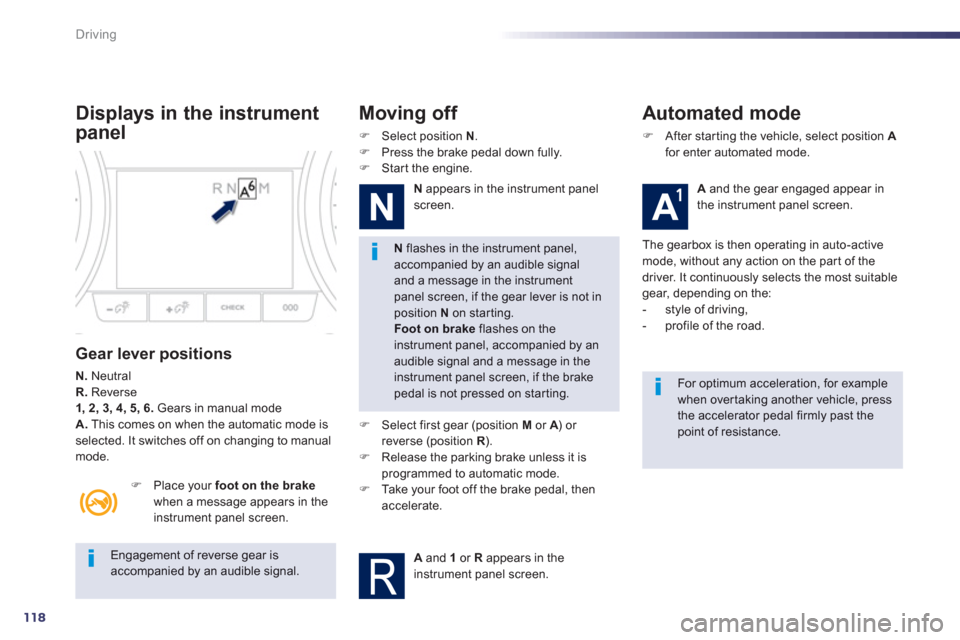
Gear lever positions
N.
Neutral R.Reverse1, 2, 3, 4, 5, 6.Gears in manual modeA.
This comes on when the automatic mode is selected. It switches off on changing to manualmode.
FPlace your foot on the brakewhen a message appears in the
instrument panel screen.
Moving off
F
Select position N . F
Press the brake pedal down fully.
F
Star t the engine.
Nappears in the instrument panel screen.
F
Select first gear (position Mor A
) or A
reverse (position R).RF
Release the parking brake unless it is
programmed to automatic mode. F Ta k e y o u r foot off the brake pedal, thenaccelerate.
Aand 1
or Rappears in the
instrument panel screen.
Automated mode
F
After star ting the vehicle, select position Afor enter automated mode.
A
and the gear engaged appear in
the instrument panel screen.
The
gearbox is then operating in auto-active mode, without any action on the par t of thedriver. It continuously selects the most suitable gear, depending on the:
- style of driving,
- profile of the road.
Page 121 of 340
4
119
Driving
Manual gear changing
FWhen the vehicle has moved off, select
position M to change to manual mode. F
Pull the lever towards the +sign to change up a gear. F
Push the lever towards the -sign to change down a gear.
At very low speed, if reverse gear is requested, this will only be takeninto account when the vehicle isimmobilised. A warning lamp appears in the instrument panel screen.
On sharp acceleration, the gearbox willnot change up unless the driver acts onthe gear lever or the steering mountedpaddles. Never select neutral N
while the vehicleis moving. Only engage reverse gear Rwhen thevehicle is immobilised with the brake pedal pressed.
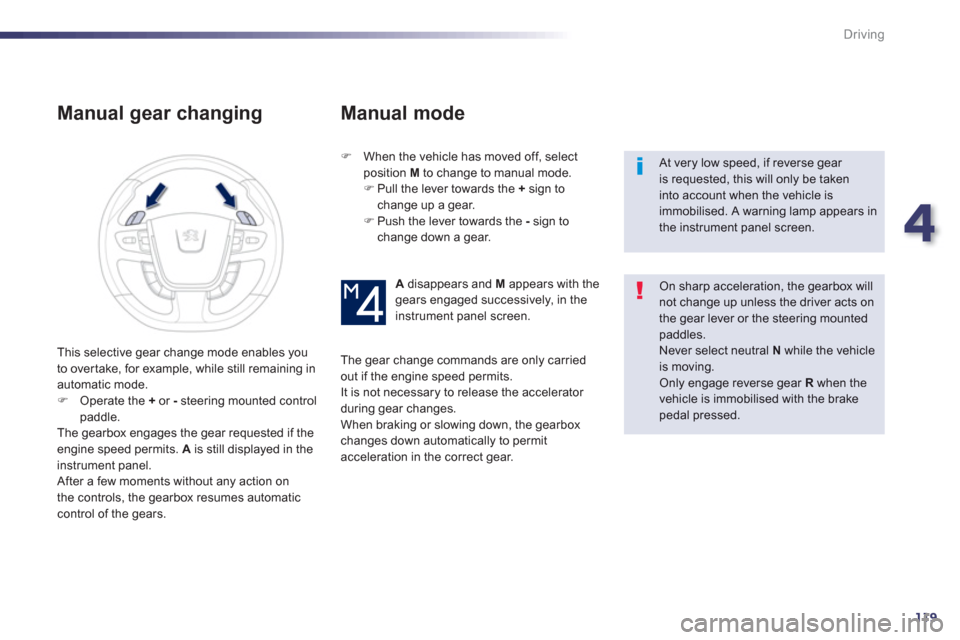
Adisappears and M
appears with thegears engaged successively, in the instrument panel screen.
The
gear change commands are only carried
out if the engine speed permits.It is not necessary to release the accelerator during gear changes. When braking or slowing down, the gearbox
changes down automatically to permitacceleration in the correct gear. This selective
gear change mode enables you
to over take, for example, while still remaining in automatic mode.F Operate the +
or -
steering mounted controlpaddle.
The gearbox engages the gear requested if the engine speed permits. A
is still displayed in theinstrument panel.
After a few moments without any action on
the controls, the gearbox resumes automaticcontrol of the gears.
Manual mode
Page 122 of 340
120
Driving
You must press the brake pedal when star ting the engine.
Whatever the circumstances, you must manually apply the parking brake when parking, unless the parking brake isprogrammed in automatic mode.
When immobilising the vehicle, with the engine running, you must place the gear lever in neutral N.Before carrying out any work in the engine compar tment, check that the
gear lever is in neutral N
and that the parking brake is applied.
Stopping the vehicle
With the ignition on, theflashing of this warning lamp, accompanied by an audiblesignal and a message in the instrument panelscreen, indicates a malfunction of the gearbox.
have it checked by PEUGEOT or a qualified
workshop. Be
fore switching off the engine, you can
choose to:
- move to position N
to engage neutral,
- leave the gear engaged; in this case, it will
not be possible to move the vehicle.
In both cases,
you must apply the parking brake to immobilise the vehicle.
Operating fault Creep function
(moving without pressing
the accelerator)
This function greatly facilitates manoeuvringof the vehicle at low speed (when parking, in a
traffic jam…).
With the engine at idle, parking brake released
and position A , M
or Rselected, the vehicle moves
as soon as you take your foot off
the brake pedal (even without pressing the accelerator pedal).
For your safety, this function is only activated
if you press the brake pedal when changing to forward drive or reverse. It is deactivated on opening the driver's door. Closing the door and then pressing the brake or accelerator pedal reactivates the function.
The vehicle does not move without pressing the accelerator pedal if the lever stays in position Nfor more than2 seconds
with the engine running,and the brake pedal is not pressed before selecting position A, M
or R
.
Never leave children inside the vehicle without supervision when the engine is running.
Page 123 of 340
4
121
Driving
Stop & Start
The Stop & Star t system puts the engine temporarily into standby - STOP mode - during stops in the traffic (red lights, traffic jams, or other...).
The engine restar ts automatically - START mode - as soon as you want to move off. The restart takes place instantly, quickly and silently.
Per fect for urban use, the Stop & Star t system reduces fuel consumption and exhaust emissions as well as the noise level when stationary.
Operation
Going into engine STOP mode
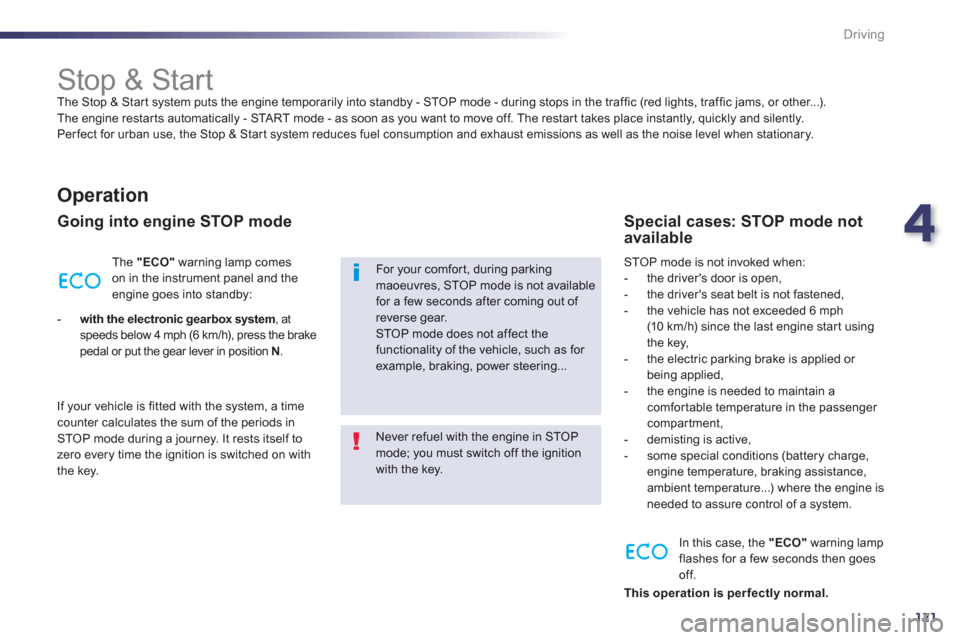
The "ECO"warning lamp comes
on in the instrument panel and the
engine goes into standby:
-
with the electronic gearbox system, at speeds below 4 mph (6 km/h), press the brakepedal or put the gear lever in position N.
I
f your vehicle is fitted with the system, a timecounter calculates the sum of the periods in
STOP mode during a journey. It rests itself to
zero every time the ignition is switched on with
the ke
y.
Never refuel with the engine in STOPmode; you must switch off the ignition with the key.
For your comfort, during parking maoeuvres, STOP mode is not available for a few seconds after coming out of reverse gear. STOP mode does not affect the functionality of the vehicle, such as for example, braking, power steering...
Special cases: STOP mode notavailable
STOP mode is not invoked when:
- the driver's door is open,
- the driver's seat belt is not fastened,
- the vehicle has not exceeded 6 mph (10 km/h) since the last engine star t using
the key,
- the electric parking brake is applied or
being applied,
- the engine is needed to maintain acomfor table temperature in the passenger compartment,
- demisting is active,
- some special conditions (battery charge, engine temperature, braking assistance,
ambient temperature...) where the engine isneeded to assure control of a system.
In this case, the
"ECO"
warning lamp
flashes for a few seconds then goesoff.
This operation is per fectly normal
.
Page 124 of 340
122
Driving
The "ECO"warning lamp goes
off and the engine star ts with the electronic gearboxsystem:
- gear lever in position Aor M
, release the
brake pedal,
- or
gear lever in position Nand the brake pedal released, move the gear lever toposition A
or M,- or engage reverse gear.
START mode is invoked automaticall
y when:
- the driver's door is open,
- the driver's seat belt is not fastened,
- the speed of the vehicle exceeds 7 mph(11 k m/h) with the electronic gearbox system,
- the electric parking brake is being applied,
- some special conditions (battery charge,engine temperature, braking assistance,
ambient temperature...) where the engine is
needed for control of a system.
Special cases: START invoked
automatically
In this case the "ECO"warning
lamp flashes for a few seconds, then goes off.
If the system has been deactivatedin STOP mode, the engine restartsimmediately.
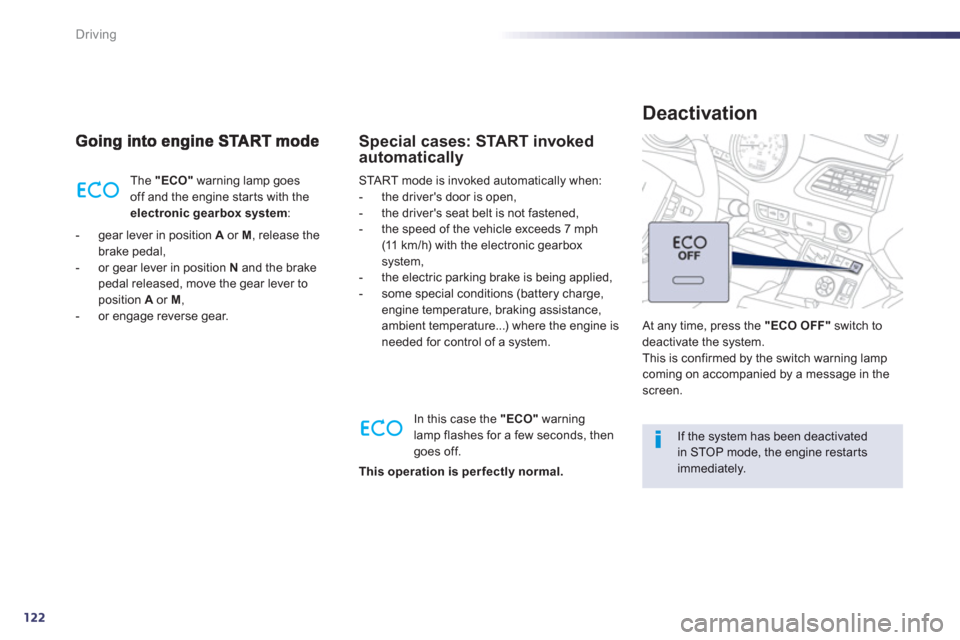
At any time, press the "ECO OFF"
switch todeactivate the system.
This is confirmed by the switch warning lampcoming on accompanied by a message in the screen.
Deactivation
This operation is per fectly normal.
Page 126 of 340
124
Driving
Hill start assist
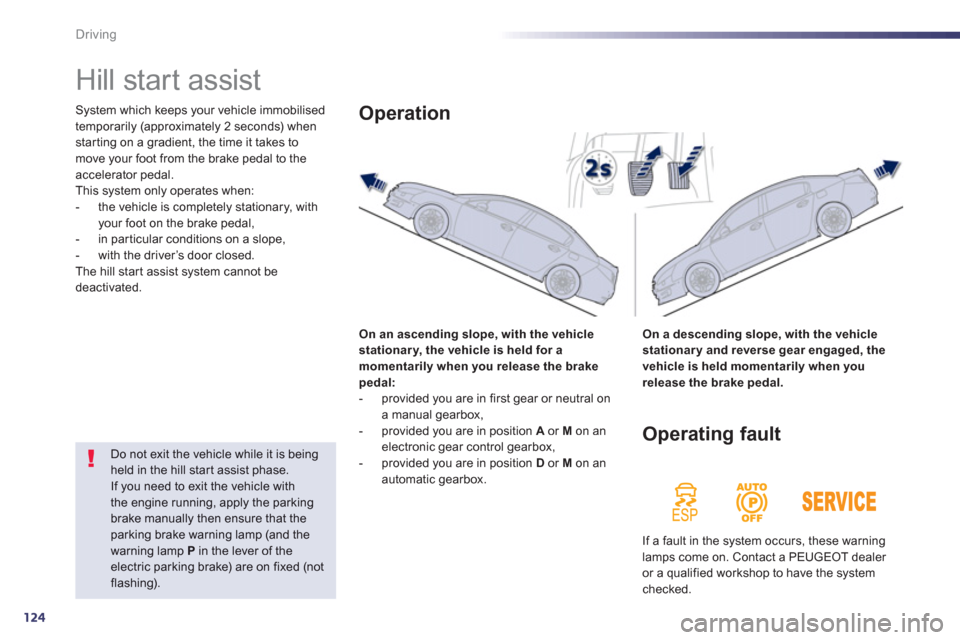
System which keeps your vehicle immobilised
temporarily (approximately 2 seconds) whenstarting on a gradient, the time it takes to move your foot from the brake pedal to the accelerator pedal. This system only operates when:
- the vehicle is completely stationary, withyour foot on the brake pedal,
- in par ticular conditions on a slope,
- with th
e driver’s door closed.
The hill star t assist system cannot be deactivated.
On an ascendin
g slope, with the vehiclestationary, the vehicle is held for amomentarily when you release the brakepedal:
- provided you are in first gear or neutral on
a manual gearbox,
- provided you are in position A
or M
on an electronic gear control gearbox,
- provided you are in position D
or M
on an
automatic gearbox.
Operation
On a descending slope, with the vehicle
stationary and reverse gear engaged, thevehicle is held momentarily when yourelease the brake pedal.
Do not exit the vehicle while it is beingheld in the hill star t assist phase.
If you need to exit the vehicle withthe engine running, apply the parkingbrake manually then ensure that theparking brake warning lamp (and the warning lamp P
in the lever of theelectric parking brake) are on fixed (not flashing).
Operating fault
If a fault in the system occurs, these warning
lamps come on. Contact a PEUGEOT dealer
or a qualified workshop to have the systemchecked.
Page 132 of 340
130
Driving
Cruise control
System which automatically maintains thespeed of the vehicle at the value programmed
by the driver, without any action on the
accelerator pedal. The cruise control is switched on
manually:
it requires a minimum vehicle speed of 25 mph(40 km/h) and the engaging:
- 4th gear or higher on a manual gearbox,
- 2nd
gear or higher on an electronic gear control gearbox or automatic gearbox,
- position A
on the electronic gear control gearbox or Don the automatic gearbox.
Th
e cruise control is switched offmanuallyfor by pressing the brake or clutch pedal or
on triggering of the ESC system for safety reasons.
It is possible to exceed the programmed speed
temporarily by pressing the accelerator pedal. To return to the programmed speed, simply release the accelerator pedal.
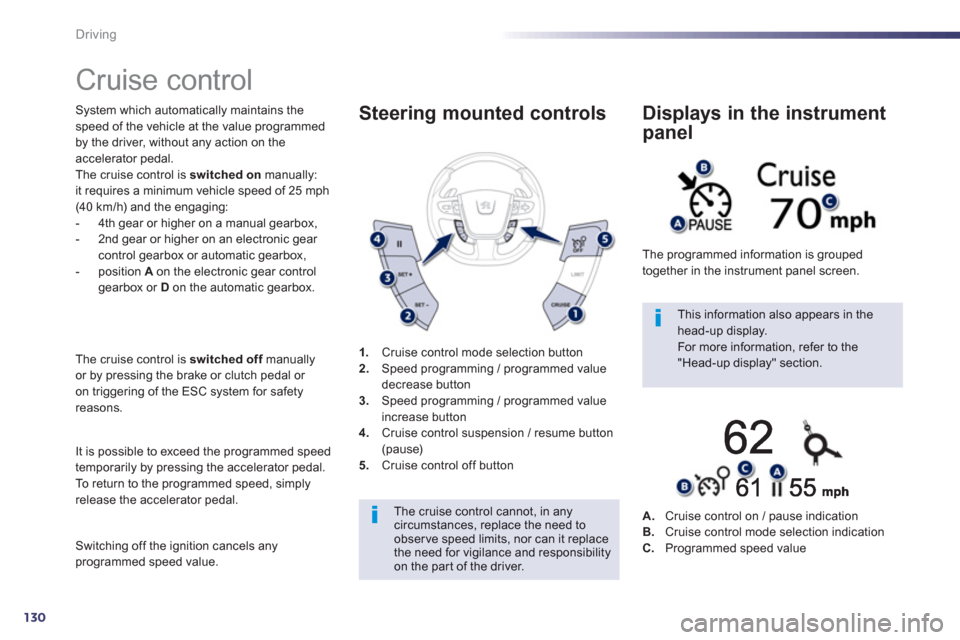
Switching off the ignition cancels any programmed speed value. 1
.Cruise control mode selection button
2. Speed programming / programmed value decrease button 3.
Speed programming / programmed value
increase button 4.Cruise control suspension / resume button (pause)5.Cruise control off button
Steering mounted controls
The cruise control cannot, in anycircumstances, replace the need to observe speed limits, nor can it replace the need for vigilance and responsibilityon the par t of the driver.
This information also appears in the head-up display.
For more information, refer to the "Head-up display" section. The pro
grammed information is grouped
together in the instrument panel screen.
Displays in the instrument
panel
A.Cruise control on / pause indicationB.Cruise control mode selection indication
C.Programmed speed value