2013 Peugeot 308 SW BL tyre pressure
[x] Cancel search: tyre pressurePage 26 of 382
Limit the causes of excess
consumption
Spread loads throughout the vehicle;
place the heaviest items in the bottom
of the boot, as close as possible to the
rear seats.
Limit the loads carried in the vehicle
and reduce wind resistance (roof bars,
roof rack, bicycle carrier, trailer...). Use
a roof box in preference.
Remove roof bars and roof racks after
use.
At the end of winter, remove snow
tyres and refi t your summer tyres.
Observe the recommendations
on maintenance
Check the tyre pressures regularly,
when cold, referring to the label in the
door aperture, driver's side.
Carry out this check in particular:
- before a long journey,
- at each change of season,
- after a long period out of use.
Don't forget the spare wheel and the
tyres on any trailer or caravan.
Have your vehicle serviced regularly
(engine oil, oil fi lter, air fi lter...) and ob-
serve the schedule of operations rec-
ommended by the manufacturer.
When refuelling, do not continue after
the 3 rd cut-off of the nozzle to avoid
any overfl ow.
At the wheel of your new vehicle,
it is only after the fi rst 1 800 miles
(3 000 kilometres) that you will see
the fuel consumption settle down to a
consistent average.
24
Page 33 of 382
1
31
INSTRUMENTS and CONTROLS
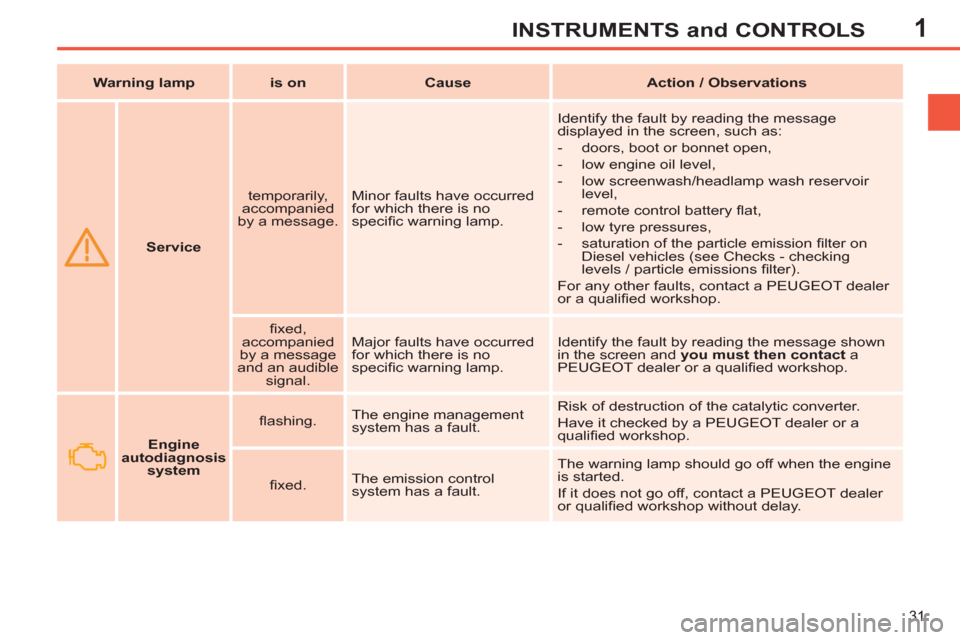
Service
temporarily,
accompanied
by a message. Minor faults have occurred
for which there is no
specifi c warning lamp. Identify the fault by reading the message
displayed in the screen, such as:
- doors, boot or bonnet open,
- low engine oil level,
- low screenwash/headlamp wash reservoir
level,
- remote control battery fl at,
- low tyre pressures,
- saturation of the particle emission fi lter on
Diesel vehicles (see Checks - checking
levels / particle emissions fi lter).
For any other faults, contact a PEUGEOT dealer
or a qualifi ed workshop.
fi xed,
accompanied
by a message
and an audible
signal. Major faults have occurred
for which there is no
specifi c warning lamp. Identify the fault by reading the message shown
in the screen and you must then contact
a
PEUGEOT dealer or a qualifi ed workshop.
Warning lamp
is on
Cause
Action / Observations
Engine
autodiagnosis
system
fl ashing. The engine management
system has a fault. Risk of destruction of the catalytic converter.
Have it checked by a PEUGEOT dealer or a
qualifi ed workshop.
fi xed. The emission control
system has a fault. The warning lamp should go off when the engine
is started.
If it does not go off, contact a PEUGEOT dealer
or qualifi ed workshop without delay.
Page 140 of 382

8
138
SAFETY
TYRE UNDER-INFLATIONDETECTION
System which automatically and contin-
uously checks the pressure of the tyres
while driving. All repairs and changing of tyres on
a wheel fi tted with this system must
be carried out by a PEUGEOT
dealer or a qualifi ed workshop.
If, when changing a tyre, you fi t a
wheel which is not detected by your
vehicle (example: fi tting of snow
tyres), you must have the system
reinitialised by a PEUGEOT dealer
or a qualifi ed workshop.
This system does not avoid the
need to have the tyre pressures
checked regularly (refer to the
"Identifi cation markings" section) to
ensure that the optimum dynamic
performance of the vehicle is main-
tained and prevent premature wear
of the tyres, particularly in arduous
driving conditions (heavy load, high
speed).
The tyre pressures must be checked
cold, at least once a month. Re-
member to check the pressure of
the spare wheel.
The tyre under-infl ation detection
system may experience temporary
interference due to electro-magnet-
ic emissions on a frequency close
to that used by the system.
Sensors fi tted in each valve trigger a
warning in the event of problem (speed
above 12 mph (20 km/h)).
This warning lamp is displayed
in the instrument panel and/or a
message appears in the screen,
accompanied by an audible signal,
to identify the wheel concerned.
)
Check the tyre pressures as soon
as possible.
This check must be carried out when the tyres are cold.
Under-infl ated tyre
The STOP
warning lamp comes
on and/or this warning lamp
is displayed in the instrument
panel, accompanied by an au-
dible signal and a message in
the screen identifying the wheel
concerned.
)
Stop as soon as it is safe to do so,
avoiding any sudden movement of
the steering wheel and the brakes.
)
Repair or change the damaged
wheel (punctured or very defl ated
tyre), and have the tyre pressure
checked as soon as possible.
Puncture
The tyre under-infl ation detection sys-
tem is an aid to driving which does not
replace the need for the driver to be
vigilant or to drive responsibly.
Sensor(s) not detected or faulty
This warning lamp is displayed
on the instrument panel and/
or a message appears in the
screen, accompanied by an
audible signal, to locate the wheel or
wheels which are not detected or to in-
dicate a malfunction of the system.
Contact a PEUGEOT dealer or a quali-
fi ed workshop to replace the faulty
sensor(s).
This message is also displayed
when one of the wheels is away
from the vehicle (being repaired) or
when one or more wheels without a
sensor are fi tted.
If your vehicle is equipped with a
spare wheel, this is not fi tted with
a sensor.
Page 141 of 382
8
139
SAFETY
BRAKING ASSISTANCE SYSTEMS
Group of supplementary systems which
help you to obtain optimum braking in
complete safety in emergency situa-
tions:
- anti-lock braking system (ABS),
- electronic brake force distribution
(EBFD),
- emergency braking assistance (EBA).
Anti-lock braking system
and electronic brake force
distribution
Linked systems which improve the stability
and manoeuvrability of your vehicle when
braking, in particular on poor or slippery
surfaces.
When braking in an emergency,
press very fi rmly without releasing
the pressure.
When replacing wheels (tyres and
rims), ensure that they conform to the
manufacturer's recommendations.
Operating fault
If this warning lamp comes on,
accompanied by an audible
signal and a message in the
screen, it indicates a malfunc-
tion of the anti-lock braking system
which could result in loss of control of
the vehicle when braking. If this warning lamp comes on,
together with the STOP
and
ABS
warning lamps, accompa-
nied by an audible signal and
a message in the screen, it indicates a
malfunction of the electronic brake force
distribution which could result in loss of
control of the vehicle when braking.
You must stop as soon as it is safe
to do so.
Emergency braking assistance
System which, in an emergency, en-
ables you to obtain the optimum braking
pressure more quickly, thus reducing
the stopping distance.
Activation
The anti-lock braking system comes
into operation automatically when there
is a risk of wheel lock.
Normal operation of the ABS may make
itself felt by slight vibration of the brake
pedal.
Activation
It is triggered by the speed at which the
brake pedal is pressed.
The effect of this is a reduction in the
resistance of the pedal and an increase
in braking effi ciency. In either case, contact a PEUGEOT
dealer or a qualifi ed workshop.
When braking in an emergency,
press fi rmly without releasing the
pressure.
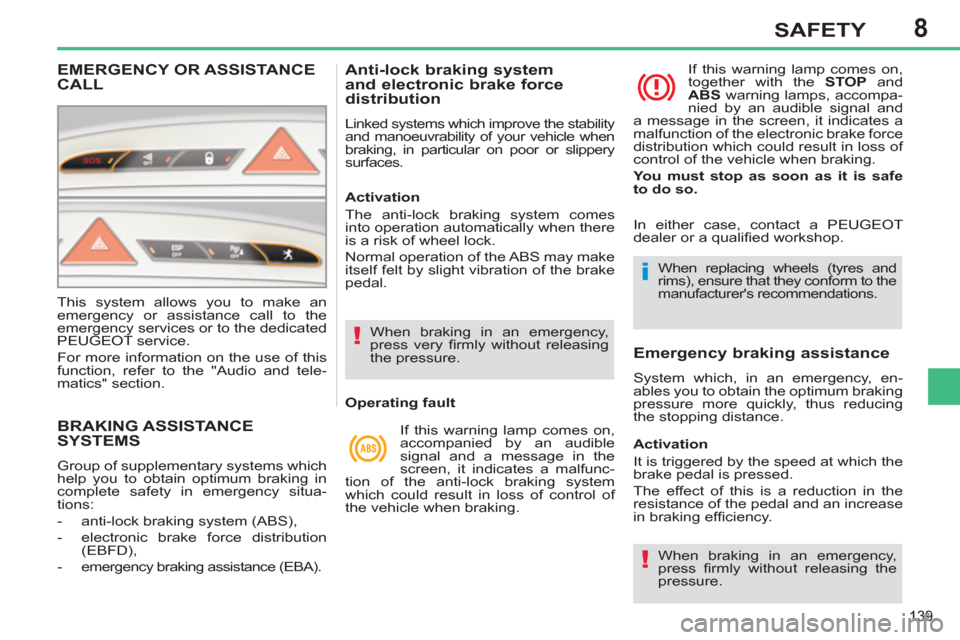
EMERGENCY OR ASSISTANCECALL
This system allows you to make an
emergency or assistance call to the
emergency services or to the dedicated
PEUGEOT service.
For more information on the use of this
function, refer to the "Audio and tele-
matics" section.
Page 181 of 382

11PRACTICAL INFORMATION
The speed limit sticker I
must be
affi xed to the vehicle's steering
wheel to remind you that a wheel is
in temporary use.
Do not exceed a speed of 50 mph
(80 km/h) when driving with a tyre
repaired using this type of kit.
Description of the kit
A.
"Sealant" or "Air" position selector.
B.
On "I"
/ off "O"
switch.
C.
Defl ation button.
D.
Pressure gauge (in bar or p.s.i.).
E.
Compartment housing:
- a cable with adaptor for 12 V socket,
- various infl ation adaptors for
accessories, such as balls, bicycle
tyres...
F.
Sealant cartridge.
G.
White pipe with cap for repair.
H.
Black pipe for infl ation.
I.
Speed limit sticker.
Page 183 of 382
11
181
PRACTICAL INFORMATION
If after around 5 to 7 minutes the
pressure is not attained, this indi-
cates that the tyre is not repairable;
contact a PEUGEOT dealer or a
qualifi ed workshop for assistance.
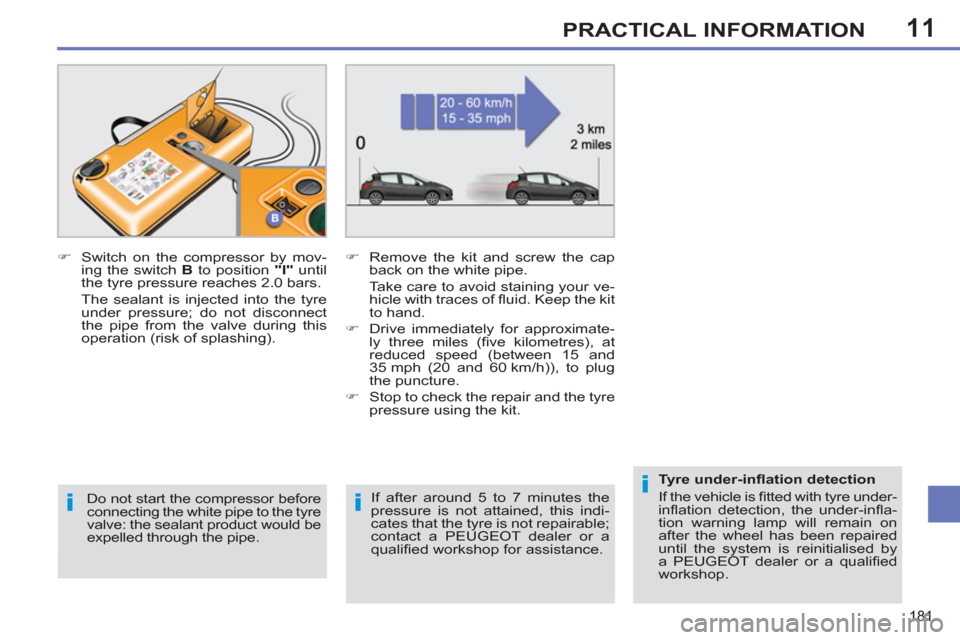
)
Switch on the compressor by mov-
ing the switch B
to position "I"
until
the tyre pressure reaches 2.0 bars.
The sealant is injected into the tyre
under pressure; do not disconnect
the pipe from the valve during this
operation (risk of splashing).
)
Remove the kit and screw the cap
back on the white pipe.
Take care to avoid staining your ve-
hicle with traces of fl uid. Keep the kit
to hand.
)
Drive immediately for approximate-
ly three miles (fi ve kilometres), at
reduced speed (between 15 and
35 mph (20 and 60 km/h)), to plug
the puncture.
)
Stop to check the repair and the tyre
pressure using the kit.
Tyre under-infl ation detection
If the vehicle is fi tted with tyre under-
infl ation detection, the under-infl a-
tion warning lamp will remain on
after the wheel has been repaired
until the system is reinitialised by
a PEUGEOT dealer or a qualifi ed
workshop.
Do not start the compressor before
connecting the white pipe to the tyre
valve: the sealant product would be
expelled through the pipe.
Page 184 of 382
11
182
PRACTICAL INFORMATION
)
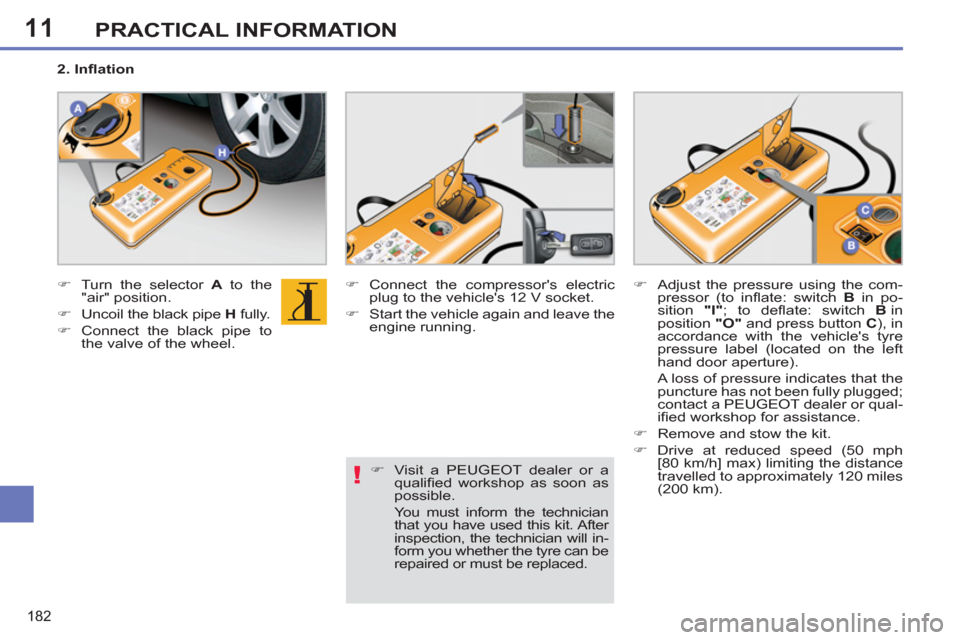
Turn the selector A
to the
"air" position.
)
Uncoil the black pipe H
fully.
)
Connect the black pipe to
the valve of the wheel.
)
Connect the compressor's electric
plug to the vehicle's 12 V socket.
)
Start the vehicle again and leave the
engine running.
)
Visit a PEUGEOT dealer or a
qualifi ed workshop as soon as
possible.
You must inform the technician
that you have used this kit. After
inspection, the technician will in-
form you whether the tyre can be
repaired or must be replaced.
2. Infl ation
)
Adjust the pressure using the com-
pressor (to infl ate: switch B
in po-
sition "I"
; to defl ate: switch B
in
position "O"
and press button C
), in
accordance with the vehicle's tyre
pressure label (located on the left
hand door aperture).
A loss of pressure indicates that the
puncture has not been fully plugged;
contact a PEUGEOT dealer or qual-
ifi ed workshop for assistance.
)
Remove and stow the kit.
)
Drive at reduced speed (50 mph
[80 km/h] max) limiting the distance
travelled to approximately 120 miles
(200 km).
Page 185 of 382
11
!
183
PRACTICAL INFORMATION
Beware of discharges of fl uid.
The expiry date of the fl uid is indi-
cated on the cartridge.
The sealant cartridge is designed
for single use; even if only partly
used, it must be replaced.
After use, do not discard the car-
tridge into the environment, take
it to an authorised waste disposal
site or a PEUGEOT dealer.
Do not forget to obtain a new sealant
cartridge, available from PEUGEOT
dealers or from a qualifi ed workshop.
Removing the cartridge
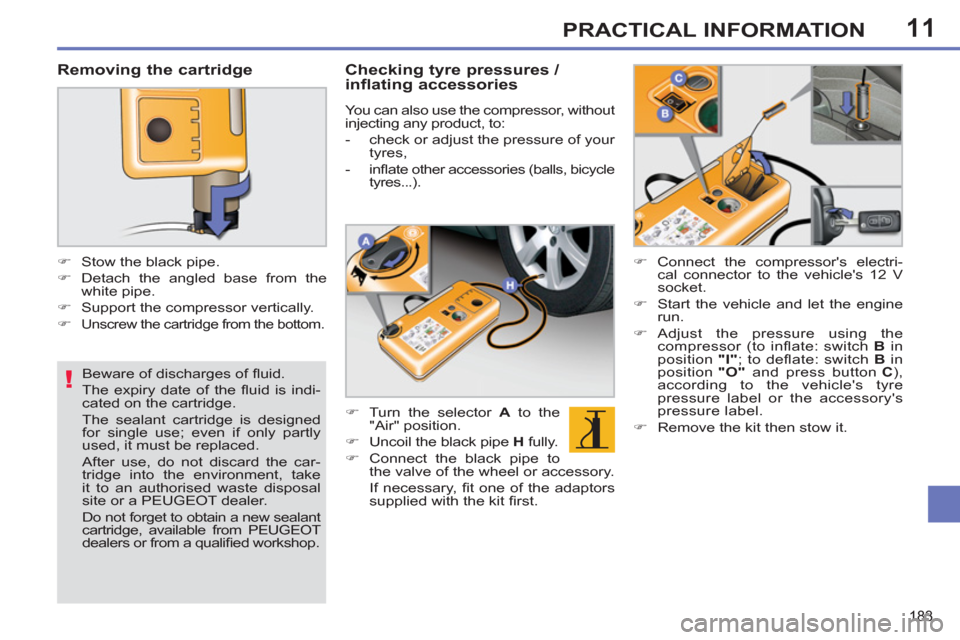
)
Stow the black pipe.
)
Detach the angled base from the
white pipe.
)
Support the compressor vertically.
)
Unscrew the cartridge from the bottom.
Checking tyre pressures /
inflating accessories
You can also use the compressor, without
injecting any product, to:
- check or adjust the pressure of your
tyres,
- infl ate other accessories (balls, bicycle
tyres...).
)
Turn the selector A
to the
"Air" position.
)
Uncoil the black pipe H
fully.
)
Connect the black pipe to
the valve of the wheel or accessory.
If necessary, fi t one of the adaptors
supplied with the kit fi rst.
)
Connect the compressor's electri-
cal connector to the vehicle's 12 V
socket.
)
Start the vehicle and let the engine
run.
)
Adjust the pressure using the
compressor (to infl ate: switch B
in
position "I"
; to defl ate: switch B
in
position "O"
and press button C
),
according to the vehicle's tyre
pressure label or the accessory's
pressure label.
)
Remove the kit then stow it.