2013 PEUGEOT 308 CC ESP
[x] Cancel search: ESPPage 130 of 268

8
!
128
DRIVING
PARKING SENSORS
This system indicates the proximity of an
obstacle (person, vehicle, tree, gate,
etc.) which comes within the fi eld of de-
tection of sensors located in the bumper.
Certain types of obstacle (stake, road-
works cone, etc.) detected initially will
no longer be detected at the end of the
manoeuvre due to the presence of blind
spots. This function cannot, in any cir-
cumstances, take the place of the
vigilance and responsibility of the
driver.
Rear parking sensors
Audible assistance
The proximity information is given by an
intermittent audible signal, the frequen-
cy of which increases as the vehicle ap-
proaches the obstacle.
The sound emitted by the speaker (right
or left) indicates the side on which the
obstacle is located.
When the distance between the vehicle
and the obstacle becomes less than ap-
proximately thirty centimetres, the audi-
ble signal becomes continuous. The system is switched on by engaging
reverse gear. This is accompanied by
an audible signal.
The system is switched off when you
come out of reverse gear. This supplements the audible signal
by displaying bars in the multifunction
screen which move progressively near-
er to the vehicle. When the obstacle is
near, the "Danger" symbol is displayed
in the screen. Visual assistance
Page 134 of 268

9
i
132
CHECKS
RUNNING OUT OF FUEL (DIESEL)
1.6 litre HDi engine
Fill the fuel tank with at least fi ve li-tres of diesel.
Open the bonnet.
If necessary, unclip the styling cover for access to the priming pump.
Squeeze and release the priming pump repeatedly until resistance is
felt (there may be resistance at the
fi rst press).
Operate the starter until the engine starts (if the engine does not start at
the fi rst attempt, wait around 15 sec-
onds before trying again).
If the engine does not start after a few attempts, operate the priming
pump again then start the engine.
Clip the styling cover back in place.
Close the bonnet.
2 litre HDi engine
Fill the fuel tank with at least fi ve li- tres of Diesel.
Open the bonnet.
If necessary, unclip the style cover for access to the priming pump.
Squeeze and release the priming pump repeatedly until fuel appears
in the transparent pipe.
Operate the starter until the engine starts (if the engine fails to start at
the fi rst attempt, wait around 15 sec-
onds before trying again).
If the engine fails to start after a few attempts, operate the priming pump
again, then the starter.
Put the style cover back in position and clip it in place, ensuring that it
has clipped correctly.
Close the bonnet.
If the engine does not start fi rst
time, don't keep trying but start the
procedure again from the begin-
ning.
On vehicles fi tted with HDi engines, the
fuel system must be primed if you run
out of fuel; refer to the corresponding
engine compartment view.
If the tank on your vehicle is fi tted with
a misfuel prevention device, refer to the
"Misfuel prevention (Diesel)" section.
Page 137 of 268

9
!
i
135
CHECKS
CHECKING LEVELS
Engine oil level
The check is carried out either
when the ignition is switched
on using the oil level indicator
in the instrument panel for ve-
hicles with and electric oil level gauge,
or using the dipstick. It is normal to top up the oil level
between two services (or oil chang-es). PEUGEOT recommends that
you check the level, and top up
if necessary, every 3 000 miles
(5 000 kms).
Take care when working under the
bonnet, as certain areas of the en-
gine may be extremely hot (risk of
burns) and the cooling fan could
start at any time (even with the igni-
tion off). A = MAX
To ensure that the reading is correct,
your vehicle must be parked on a level
surface and the engine having been off
for more than 30 minutes. Check all of these levels regularly, in
line with the warranty and maintenance
record. Top them up if necessary, un-
less otherwise indicated.
If a level drops signifi cantly, have the
corresponding system checked by a
PEUGEOT dealer or a qualifi ed work-
shop. Checking using the dipstick
Refer to the "Petrol engine" or "Diesel
engine" section for the location of the
dipstick in the engine compartment of
your vehicle.
Take the dipstick by its coloured grip and remove it completely.
Wipe the end of the dipstick using a clean non-fl uffy cloth.
Refi t the dipstick and push fully down, then pull it out again to make
the visual check: the correct level is
between the marks A and B . B = MIN
If you fi nd that the level is above the A
mark or below the B mark, do not start
the engine .
- If the level is above the MAX mark
(risk of damage to the engine), con-
tact a PEUGEOT dealer or a quali-
fi ed workshop.
- If the level is below the MIN mark,
you must top up the engine oil.
Oil grade
Before topping-up the oil or changing
the oil, check that the oil is the correct
grade for your engine and conforms to
the manufacturer's recommendations.
Page 157 of 268

10
!
i
155
PRACTICAL INFORMATION
PEUGEOT will not accept responsi-
bility for the cost incurred in repairing
your vehicle or for rectifying malfunc-
tions resulting from the installation
of accessories not supplied and not
recommended by PEUGEOT and
not installed in accordance with its
instructions, in particular when the
combined consumption of all of the
additional equipment connected ex-
ceeds 10 milliamperes. Installing electrical accessories
Your vehicle's electrical system is
designed to operate with standard
or optional equipment.
Before installing other electrical
equipment or accessories on your
vehicle, contact a PEUGEOT deal-
er or a qualifi ed workshop.
CHANGING A FUSE
Access to the tools
The extraction tweezer is fi tted to the
back of the dashboard fusebox cover.
To gain access to it:
open the glove box lid,
push the opening guide to the left past the fi rst notch,
open the glove box lid fully,
turn the screw a quarter of a turn to the left,
unclip the fusebox cover by pulling the top right,
disengage the fusebox cover com- pletely and turn it over,
extract the support, on the back of which is fi tted the tweezer.
Changing a fuse
Before changing a fuse, it is necessary
that:
the cause of the failure be identifi ed and rectifi ed,
all electrical consumers be switched off,
the vehicle be immobilised and the ignition switched off,
the failed fuse be identifi ed using the allocation tables and drawings
in the following pages. Good
Failed
Tweezer
To change a fuse, you must:
use the special tweezer to extract the fuse from its housing and check
the condition of its fi lament,
always replace the failed fuse with a fuse of the same rating (same co-
lour); a different rating may cause
malfunctions (risk of fi re).
If the fault occurs again soon after re-
placing the fuse, have the electrical sys-
tem checked by a PEUGEOT dealer or
a qualifi ed workshop.
Page 160 of 268
10
158
PRACTICAL INFORMATION
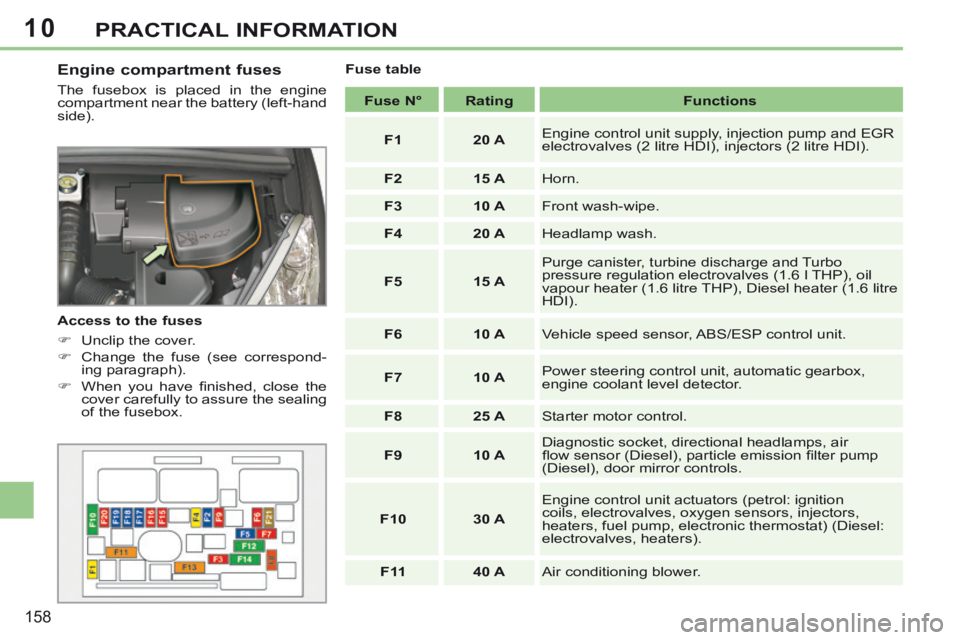
Engine compartment fuses
The fusebox is placed in the engine
compartment near the battery (left-hand
side).
Access to the fuses
Unclip the cover.
Change the fuse (see correspond-ing paragraph).
When you have fi nished, close the cover carefully to assure the sealing
of the fusebox. Fuse table
Fuse N° Rating Functions
F1 20 A Engine control unit supply, injection pump and EGR
electrovalves (2 litre HDI), injectors (2 litre HDI).
F2 15 A Horn.
F3 10 A Front wash-wipe.
F4 20 A Headlamp wash.
F5 15 A Purge canister, turbine discharge and Turbo
pressure regulation electrovalves (1.6 l THP), oil
vapour heater (1.6 litre THP), Diesel heater (1.6 litre
HDI).
F6 10 A Vehicle speed sensor, ABS/ESP control unit.
F7 10 A Power steering control unit, automatic gearbox,
engine coolant level detector.
F8 25 A Starter motor control.
F9 10 A Diagnostic socket, directional headlamps, air
fl ow sensor (Diesel), particle emission fi lter pump
(Diesel), door mirror controls.
F10 30 A Engine control unit actuators (petrol: ignition
coils, electrovalves, oxygen sensors, injectors,
heaters, fuel pump, electronic thermostat) (Diesel:
electrovalves, heaters).
F 11 40 A Air conditioning blower.
Page 162 of 268

10
!
160
PRACTICAL INFORMATION
Table of fuses above the battery Fuse N° Rating Functions
F1 - Not used.
F2 5 A Dual-function brake switch.
F3 5 A Battery charge unit.
F4 25 A ABS/ESP electrovalves.
F5 - Not used.
F6 15 A Automatic gearbox.
All work on the other type of fuses must only be done by a PEUGEOT dealer
or a qualifi ed workshop.
Page 165 of 268
10
i
i
!
!
i
163
PRACTICAL INFORMATION
With Stop & Start, the battery does
not have to be disconnected for
charging.
Charging the battery using
a battery charger
When your vehicle's battery is dis-
charged or when the vehicle is to be
out of use for a prolonged period, you
can charge the battery using a battery
charger.
Contact a PEUGEOT dealer or a quali-
fi ed workshop for the specifi cation of
chargers compatible with your battery.
Before disconnecting
Go to the battery.
Close the retractable roof.
Check that the doors and boot are closed but not locked.
Switch off the ignition and wait for at least four minutes.
If the vehicle is to not going to be used for
more than a month, it is recommended
that the battery be disconnected.
Charging
Disconnect the (+) terminal.
Follow the instructions for use pro-vided by the manufacturer of the
charger.
Connect the charger's red cable to the (+) terminal of the battery, then
the black cable to the (-) terminal.
Once the battery is fully charged, disconnect the charger cables in re-
verse order.
Charging should be carried out in
a well-ventilated area and away
from naked fl ames and sources of
sparks, so as to avoid any risk of
explosion and fi re.
Do not try to charge a frozen bat-
tery; fi rst thaw it out so as to avoid
the risk of explosion.
If the battery had frozen, before
charging, have it checked by a
PEUGEOT dealer or qualifi ed
workshop who will ensure that
the internal components have not
been damaged and that the casing
is not cracked, which would cause
a leak of toxic and corrosive acid.
Some functions are not available
if the battery is not suffi ciently
charged. Reinitialisation after
reconnection
After any reconnection of the battery,
switch on the ignition and wait at least
one minute before starting, to allow time
for the initialisation of the electronic sys-
tems.
By referring to the corresponding sec-
tions, you should set or initialise the fol-
lowing systems yourself:
- remote control,
- electric windows and automatic par- tial opening of door glasses,
- time and date,
- audio and navigation system set- tings.
Check that no alert message or
warning lamp comes on after
switching on the ignition.
However, if minor problems persist
after carrying out these operations,
contact a PEUGEOT dealer or a
qualifi ed workshop.
Page 167 of 268
10
i
165
PRACTICAL INFORMATION
CHANGING A WIPER BLADE
Removing
Raise the corresponding wiper arm.
Unclip the wiper blade and remove it.
Fitting
Put the corresponding new wiper blade in place and clip it.
Fold down the wiper arm carefully.
Before removing a front wiper
blade
Within one minute after switching off the ignition, operate the wiper stalk
to position the wiper blades verti-
cally on the windscreen.
After fitting a front wiper blade
Switch on the ignition.
Operate the wiper stalk again to park the wiper blades.
TOWING THE VEHICLE
Procedure for having your vehicle
towed or for towing another vehicle us-
ing a removable towing eye.
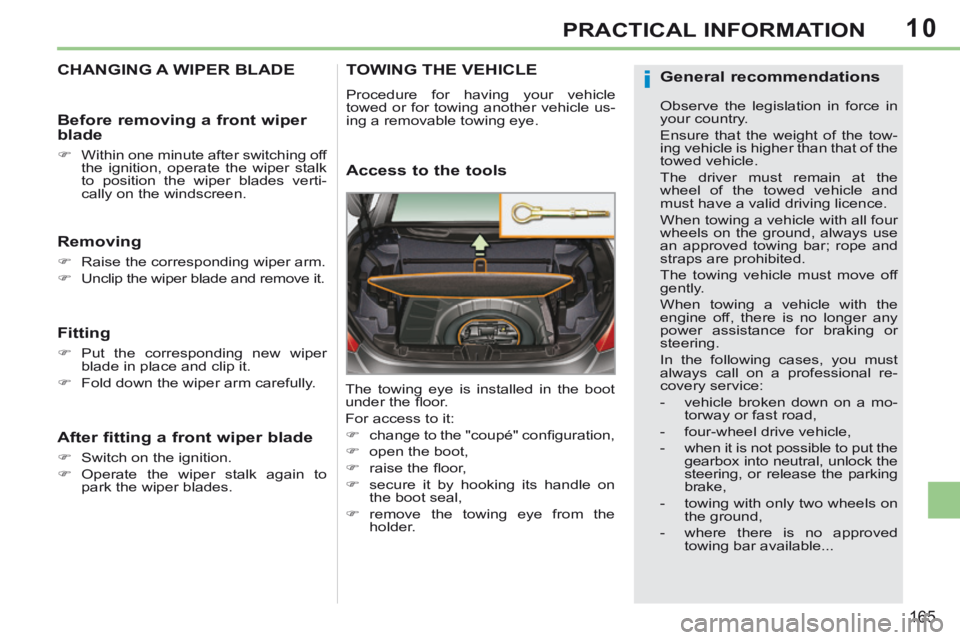
Access to the tools
The towing eye is installed in the boot
under the fl oor.
For access to it:
change to the "coupé" confi guration,
open the boot,
raise the fl oor,
secure it by hooking its handle on the boot seal,
remove the towing eye from the holder.
General recommendations
Observe the legislation in force in
your country.
Ensure that the weight of the tow-
ing vehicle is higher than that of the
towed vehicle.
The driver must remain at the
wheel of the towed vehicle and
must have a valid driving licence.
When towing a vehicle with all four
wheels on the ground, always use
an approved towing bar; rope and
straps are prohibited.
The towing vehicle must move off
gently.
When towing a vehicle with the
engine off, there is no longer any
power assistance for braking or
steering.
In the following cases, you must
a lways call on a professional re-
covery service:
- vehicle broken down on a mo-torway or fast road,
- four-wheel drive vehicle,
- when it is not possible to put the gearbox into neutral, unlock the
steering, or release the parking
brake,
- towing with only two wheels on the ground,
- where there is no approved towing bar available...