2013 NISSAN GT-R cooling
[x] Cancel search: coolingPage 13 of 346
GTR-6GT-R Overview
performed when a GT-R certified technician
determines that this is the correct repair.
If the inside of the disc rotors are cold during the
winter and the surface becomes hot due to a
heavy force being applied repeatedly to the
brakes, cracks may occur near the coolant hole
on the surface of the disc rotor. Cracks may also
occur due to a heavy force being repeatedly
applied to the brakes during high performance
driving. In these cases it may be necessary to
replace the disc rotors or brake pads depending
on the condition of the crack. Contact a GT-R
certified NISSAN dealer for replacement.
EXHAUST MUFFLER AND TRUNK
CARPET
Genuine GT-R special exhaust muffler and
trunk carpet.
Use only the genuine GT-R special exhaust
muffler and trunk carpet.
The GT-R exhaust system is designed to provide
the maximum vehicle performance and to
protect the vehicle from high exhaust gas
temperatures.
If non-genuine GT-R specification parts are
used it is possible that the muffler or other
exhaust system parts will deform and cause
damage to the underbody. Non-genuine GT-Rspecification parts can also affect vehicle
performance and possibly lead to turbocharger,
engine or power train related parts including
transmission, damage.
Also, do not remove the trunk carpet from the
vehicle for any reason. The carpet insulates the
vehicle interior from the heat of the muffler and
from the noise of the transmission.
EXTERIOR PARTS (spoiler, etc.)
Do not modify exterior parts.
The GT-R was developed using a special wind
tunnel to help make sure the vehicle is
aerodynamically balanced. Additionally, the wind
tunnel was used to help make sure cool air flows
to the brakes, radiator and other components.
Additions of non-genuine GT-R specific acces-
sory exterior parts can change the air flow over
and around the body. This can affect vehicle
balance and cooling of various systems.
For example, if the front bumper is modified,
there is a possibility that brake cooling perfor-
mance may be reduced due to the decrease of
the air flow to the brake system.
Use only GT-R special specification parts.
Front bumper
The shape of the bumper helps pull air into the
engine compartment through the front wheel
housing to cool the radiator and brakes. Instal-
ling an aftermarket bumper may affect the air
flow in the engine compartment and decrease
the brake and engine cooling performance. An
aftermarket bumper may also change vehicle
balance by reducing front down force.
Rear spoiler
Installing an aftermarket rear spoiler may change
the down force balance between front and rear
of the vehicle. This can affect the handling
characteristics of the vehicle and affect the
operation of the ABS and VDC systems.
NOTICE
Modifications to exterior parts may
affect engine and transmission cooling
performance which can increase the
temperature in the engine compart-
ment. This can affect the operation or
damage parts located in the engine
compartment.
Page 22 of 346
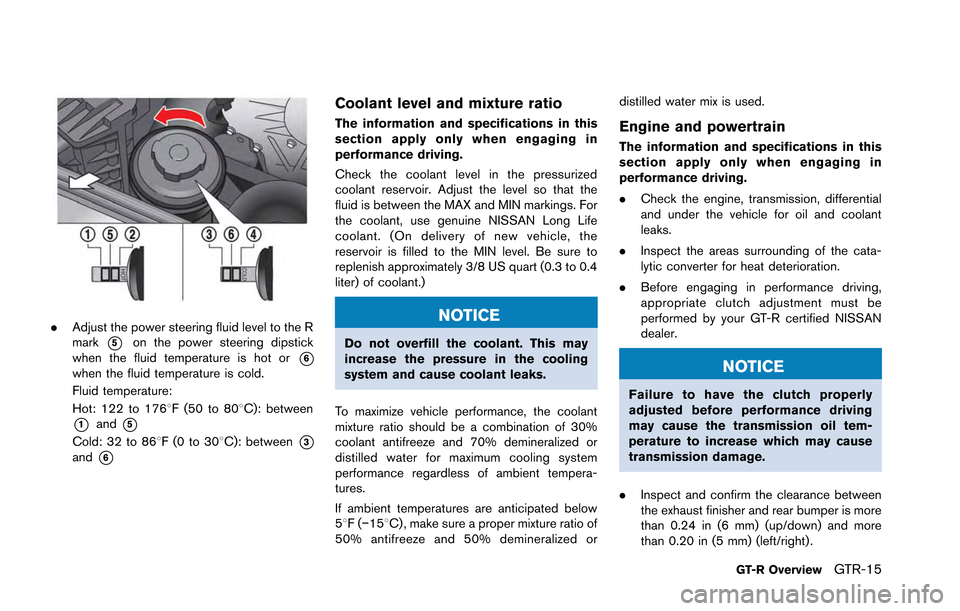
.Adjust the power steering fluid level to the R
mark
*5on the power steering dipstick
when the fluid temperature is hot or
*6when the fluid temperature is cold.
Fluid temperature:
Hot: 122 to 1768F (50 to 808C): between
*1and*5
Cold: 32 to 868F(0to30 8C): between*3and*6
Coolant level and mixture ratio
The information and specifications in this
section apply only when engaging in
performance driving.
Check the coolant level in the pressurized
coolant reservoir. Adjust the level so that the
fluid is between the MAX and MIN markings. For
the coolant, use genuine NISSAN Long Life
coolant. (On delivery of new vehicle, the
reservoir is filled to the MIN level. Be sure to
replenish approximately 3/8 US quart (0.3 to 0.4
liter) of coolant.)
NOTICE
Do not overfill the coolant. This may
increase the pressure in the cooling
system and cause coolant leaks.
To maximize vehicle performance, the coolant
mixture ratio should be a combination of 30%
coolant antifreeze and 70% demineralized or
distilled water for maximum cooling system
performance regardless of ambient tempera-
tures.
If ambient temperatures are anticipated below
58F( −158C) , make sure a proper mixture ratio of
50% antifreeze and 50% demineralized or distilled water mix is used.
Engine and powertrain
The information and specifications in this
section apply only when engaging in
performance driving.
.
Check the engine, transmission, differential
and under the vehicle for oil and coolant
leaks.
. Inspect the areas surrounding of the cata-
lytic converter for heat deterioration.
. Before engaging in performance driving,
appropriate clutch adjustment must be
performed by your GT-R certified NISSAN
dealer.
NOTICE
Failure to have the clutch properly
adjusted before performance driving
may cause the transmission oil tem-
perature to increase which may cause
transmission damage.
. Inspect and confirm the clearance between
the exhaust finisher and rear bumper is more
than 0.24 in (6 mm) (up/down) and more
than 0.20 in (5 mm) (left/right) .
GT-R OverviewGTR-15
Page 207 of 346
5-14Starting and driving
NOTE:
.If the engine is difficult to start, de-
press the accelerator pedal all the way
to the floor and hold it. Push the
ignition switch with the brake pedal
depressed to start cranking the engine.
After 5 or 6 seconds, stop cranking by
pushing the ignition switch to the OFF
position, and then release the accel-
erator pedal. Then perform steps 1 to 5
to start the engine. If the engine starts,
but fails to run, repeat this procedure.
. Starting and stopping the engine over a
short period of time may make the
vehicle more difficult to start. If this
occurs, wait for more than 3 minutes,
and then push the ignition switch again
to start the engine.
. To maintain high performance over a
long period of time, the engine speed is
limited to 5,000 rpm when the engine is
revved with the shift lever in the
&Nor
&Pposition, and to 4,000 rpm when the
engine oil or coolant temperature is
low or higher than normal.
. If the ignition switch is pushed before
the shift lever is moved to the
&Pposition, the ignition switch will not change to the OFF position. If this
occurs, the SHIFT
&Pwarning display
appears on the vehicle information
display. When stopping the engine, be
sure to move the shift lever to the
&Pposition and then push the ignition
switch. Failure to do so may result in
discharge of the battery. (
“Shift
“P” warning” page 2-42)
. If the shift lever was in the
&A↔&Mor&Rposition when the engine was stopped,
then be sure to move the shift lever to
the
&Pposition before starting the
engine the next time. If the engine is
started with the shift lever in the
&Nposition, then it may not be possible to
drive the vehicle even when the shift
lever is moved to the
&A↔&Mor&Rposition. If this occurs, the SHIFT&Pwarning appears on the vehicle infor-
mation display. (“Shift “P” warn-
ing” page 2-42)
CAUTION
If the engine was stopped soon when
the engine is hot, the cooling fan may
operate for approximately 2 minutes
after the engine was stopped to cool the components in the engine compart-
ment. When the cooling fan is operat-
ing, be sure that hands or other items
do not get caught in it.
Page 224 of 346
See your 2013 Warranty Information Booklet for
important related information and warranty
coverage exclusions. See also section 2 (page
2-29) and section 5 (page 5-49) of this Owner’s
Manual, “Transmission Clutch Temperature
High” and “Vehicle Dynamic Control (VDC)
System” for important additional related informa-
tion.The turbocharger system uses engine oil for
lubrication and cooling of its rotating compo-
nents. The turbocharger turbine turns at extre-
mely high speeds and it can get very hot. It is
essential to maintain a supply of oil flowing
through the turbocharger system. Therefore, a
sudden interruption of oil supply may cause a
malfunction in the turbocharger.
To ensure prolonged life and performance of the
turbocharger, it is essential to perform the
following maintenance procedure:
.Change your engine oil according to the
recommended intervals shown in the sepa-
rate Service and Maintenance Guide. Use
only the recommended engine oil.
. If the engine had been operating at high
engine speed for an extended period of time,
let it idle for a few minutes prior to shut-
down.
. Do not accelerate your engine to high
engine speed immediately after start.
NOTICE
.This vehicle includes spark plugs
that are designed for high perfor-
mance. For this reason, if the engine
is repeatedly started and stopped over a short time, the spark plugs
may become fouled, making the
engine difficult to start. To prevent
diminished starting performance,
avoid starting and stopping the
engine repeatedly during a short
period of time.
NOTE:
. When the vehicle is delivered, the
engine oil level is 0.39 in (10 mm)
below the H mark on the engine oil
dipstick for optimum high performance
driving. The engine oil can be filled up
to the H mark if not engaging in
performance driving.
. Because of the high performance char-
acteristics of the GT-R engine, more
frequent oil level inspections are ne-
cessary. Check the oil level every 1,800
miles (3,000km) and adjust as neces-
sary. Also, change the engine oil based
on the driving conditions. For the
information regarding oil replacement
intervals, refer to the 2013 NISSAN
GT-R Service and Maintenance Guide.
. Some amount of oil is consumed by
your engine under normal operating
Starting and driving5-31
TURBOCHARGER SYSTEM
Page 244 of 346
See your 2013 Warranty Information Booklet for
important related information and warranty
coverage exclusions. See also section 2 (page
2-29) and section 5 (page 5-49) of this Owner’s
Manual, “Transmission Clutch Temperature
High” and “Vehicle Dynamic Control (VDC)
System” for important additional related informa-
tion.
.Except for the emergency cases above,
any issues related to driving stability
(e.g., steering maneuvers and maneu-
vers during acceleration and decelera-
tion) and any damages to drivetrain
components (e.g., transfer, clutch, a
sort of gear, transaxle case) will not
be covered by warranty if there is a
record in the Vehicle Status Data
Recorder (VSDR) that the vehicle was
driven with VDC off.
. When attempting to free the vehicle
from mud or fresh snow, the VDC will
detect the tire slipping, and the engine
speed may not increase even when the
accelerator pedal is depressed. To raise
the engine speed, use the VDC set up
switch to turn the VDC system OFF and
select SAVE mode with the transmis-
sion switch. (
“VDC, transmission
and suspension setup switches” page 5-24)
. When the VDC system is turned OFF,
all VDC functions (including traction
control) , except for the ABS functions,
are deactivated.
FREEING A FROZEN DOOR LOCK
To prevent a door lock from freezing, apply
deicer through the key hole. If the lock becomes
frozen, heat the key before inserting it into the
key hole or use the Intelligent Key system.
ANTI-FREEZE
In the winter when it is anticipated that the
outside temperature will drop below 328F(0 8C) ,
check antifreeze to assure proper winter protec-
tion. (
“Engine cooling system” page 8-10)
BATTERY
If the battery is not fully charged during
extremely cold weather conditions, the battery
fluid may freeze and damage the battery. To
maintain maximum efficiency, the battery should
be checked regularly. (
“Battery” page 8-
17)
DRAINING OF COOLANT WATER
If the vehicle is to be left outside without
antifreeze, drain the cooling system, including
the engine block. Refill before operating the
vehicle. For details, contact a GT-R certified
NISSAN dealer.
Starting and driving5-51
COLD WEATHER DRIVING
Page 252 of 346
WARNING
.If done incorrectly, jump starting
can lead to a battery explosion,
resulting in severe injury or death.
It could also damage your vehicle.
. Explosive hydrogen gas is always
present in the vicinity of the battery.
Keep all sparks and flames away
from the battery.
. Do not allow battery fluid to come
into contact with eyes, skin, clothing
or painted surfaces. Battery fluid is
a corrosive sulphuric acid solution
which can cause severe burns. If the
fluid should come into contact with
anything, immediately flush the con-
tacted area with water.
. Keep the battery out of the reach of
children.
. The booster battery must be rated at
12 volts. Use of an improperly rated
battery can damage your vehicle.
. Whenever working on or near a
battery, always wear suitable eye
protectors (for example, goggles or
industrial safety spectacles) and remove rings, metal bands, or any
other jewelry. Do not lean over the
battery when jump starting.
. Do not attempt to jump start a
frozen battery. It could explode
and cause serious injury.
. Your vehicle has an automatic en-
gine cooling fan. It could come on at
any time. Keep hands and other
objects away from it.
If needed, Roadside Assistance is available.
Please see your Warranty Information Booklet
for the toll-free number to call (U.S.) or Warranty
Information Booklet (Canada).
In case of emergency6-5
Page 255 of 346
6-8In case of emergency
3. If engine overheating is caused by climbinga long hill on a hot day, run the engine at a
fast idle (approximately 1,500 rpm) until the
temperature gauge indication returns to
normal.
4. Get out of the vehicle. Look and listen for steam or coolant escaping from the radiator
before opening the hood. (If steam or
coolant is escaping, turn off the engine.)
Do not open the hood further until no steam
or coolant can be seen.
5. Open the engine hood.
WARNING
If steam or water is coming from the
engine, stand clear to prevent getting
burned.
6. Visually check drive belts for damage or looseness. Also check if the cooling fan is
running. The radiator hoses and radiator
should not leak water. If coolant is leaking,
the drive belts are missing or loose, or the
cooling fan does not run, stop the engine.
WARNING
Be careful not to allow your hands, hair,
jewelry or clothing to come into contact
with, or get caught in, engine belts or
the engine cooling fan. The engine
cooling fan can start at any time.
7. When the coolant temperature gauge goes down to the midpoint, stop the engine and
wait until the gauge goes down further to
“C” (cold).
8. After the engine cools down, check the coolant level in the reservoir tank. Add
coolant to the reservoir, if necessary, after
opening the coolant reservoir cap with a
heavy cloth covering it. (
“Engine cool-
ing system” page 8-10)
9. Have your vehicle repaired at the nearest GT-R certified NISSAN dealer.
If needed, Roadside Assistance is available.
Please see your Warranty Information Booklet
for the toll-free number to call (U.S.) or Warranty
& Roadside Assistance Information Booklet
(Canada) .
When towing your vehicle, all State (Provincial in
Canada) and local regulations for towing must
be followed. Incorrect towing equipment could
damage your vehicle. Towing instructions are
available from a GT-R certified NISSAN dealer.
Local service operators are familiar with the
applicable laws and procedures for towing. To
assure proper towing and to prevent accidental
damage to your vehicle, NISSAN recommends
that you have a service operator tow your
vehicle. It is advisable to have the service
operator carefully read the following precau-
tions.
WARNING
. Never ride in a vehicle that is being
towed.
. Never get under your vehicle after it
has been lifted by a tow truck.
CAUTION
Always attach safety chains before
towing.
If needed, Roadside Assistance is available.
Please see your Warranty Information Booklet
TOWING YOUR VEHICLE
Page 268 of 346
8 Maintenance and do-it-yourself
Maintenance requirement ....................................................... 8-3Scheduled maintenance ................................................... 8-3
General maintenance ........................................................ 8-3
Where to go for service ................................................... 8-3
General maintenance .............................................................. 8-4 Explanation of maintenance items ................................. 8-4
Maintenance precautions ....................................................... 8-6
Engine compartment check locations ................................. 8-8 Removing the cowl top cover ......................................... 8-9
Engine cooling system ......................................................... 8-10
Checking engine coolant level ..................................... 8-11
Changing engine coolant .............................................. 8-12
Engine oil ........................................................................\
........ 8-12
Checking engine oil level .............................................. 8-12
Changing engine oil and filter ...................................... 8-13
Transmission oil ..................................................................... 8-14
Power steering fluid .............................................................. 8-14
Brake fluid ........................................................................\
....... 8-15
Window washer fluid ........................................................... 8-16
Battery ........................................................................\
.............. 8-17
Precautions ....................................................................... 8-17
Fluid level check .............................................................. 8-17
Jump starting .................................................................... 8-18 Drive belts ........................................................................\
...... 8-19
Spark plugs ........................................................................\
.... 8-19
Replacing spark plugs ................................................. 8-20
Air cleaner ........................................................................\
...... 8-20
Windshield wiper blades .................................................... 8-21 Cleaning ........................................................................\
.. 8-21
Replacing the wiper blades ....................................... 8-21
Brakes ........................................................................\
............. 8-22 Self-adjusting brakes ................................................... 8-22
Brake pad wear warning ............................................. 8-22
High performance brake system ............................... 8-22
Replacing the brake pads ........................................... 8-23
Fuses ........................................................................\
............... 8-23
Engine compartment .................................................... 8-23
Passenger compartment ............................................. 8-24
Intelligent Key battery replacement .................................. 8-26
Lights ........................................................................\
............... 8-28 Headlights ....................................................................... 8-29Exterior and interior lights ........................................... 8-29
Wheels and tires .................................................................. 8-31
Tire pressure .................................................................. 8-31
Tire and loading information label ............................ 8-33
Checking the tire pressure ......................................... 8-34