Page 482 of 602
For emergencies6-7
6
Jack and tools
N00836600337
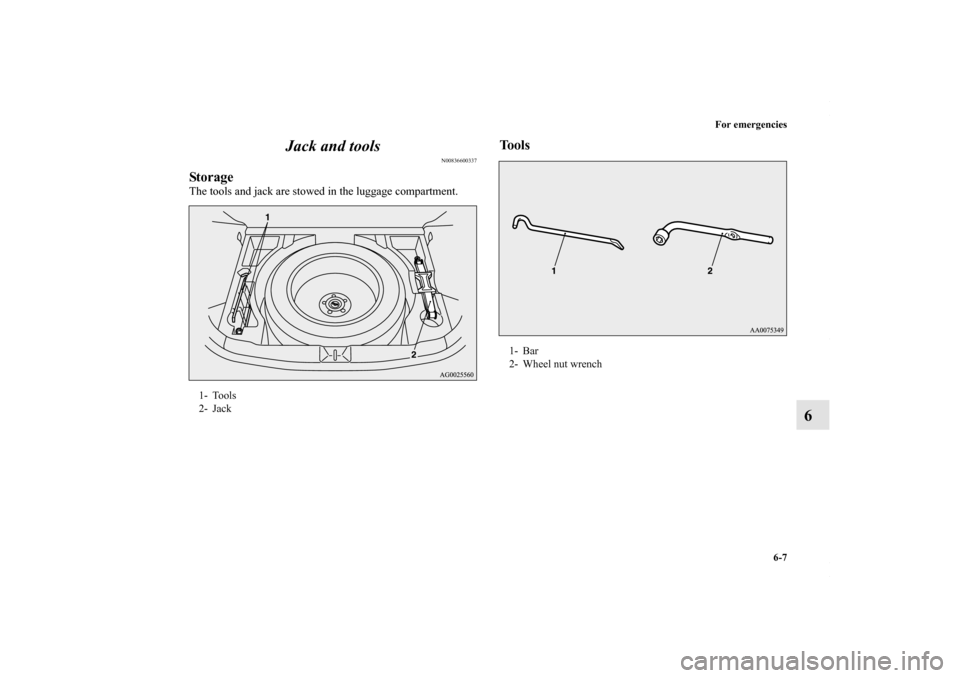
StorageThe tools and jack are stowed in the luggage compartment.
Tools
1- Tools
2- Jack
1- Bar
2- Wheel nut wrench
BK0150700US.book 7
ページ 2012年3月22日 木曜日 午後6時46分
Page 485 of 602
6-10 For emergencies
6
Spare tire information
N00849600331
Compact spare tireThe compact spare tire is stowed beneath the luggage floor
board of the luggage compartment. It is designed to save space
in the luggage compartment. Its lighter weight makes it easier
to use if a flat tire occurs.
WARNING
!�Tires, including spare tire, degrade over time with
age even when they are not being used. It is recom-
mended that tires over 6 years generally be replaced
even if damage is not obvious.
CAUTION
!�While the compact spare tire is stowed, the inflation
pressure should be checked at least once a month to
assure that it remains at the recommended inflation
pressure. See the tire and loading information plac-
ard attached to the driver’s door sill. Refer to “Tire
and loading information placard” on page 9-4.�Driving with an improperly inflated tire can cause
an accident. If you have no choice but to drive with
an under-inflated tire, keep your speed down and
avoid sudden steering or braking, if possible. Inflate
the tire to the correct pressure as soon as possible.
Refer to “Tire inflation pressures” on page 7-27.
� The compact spare tire should be used only tempo-
rarily. While the compact spare tire is being used,
the tire pressure monitoring system will not function
properly. Have the tire replaced or repaired at an
authorized Mitsubishi Motors dealer or a repair
facility of your choice as soon as possible.�Do not go over 50 mph (80 km/h) when driving with
the compact spare tire.�Avoid sudden starting and braking when driving
with the compact spare tire.�Do not drive through automatic car washes and over
obstacles that could possibly damage the underside
of your vehicle. Because the compact spare tire is
smaller than the original tire, there is less clearance
between the ground and your vehicle.�Because the compact spare tire is designed only for
your vehicle, do not use it on any other vehicle.�Do not put the compact spare tire on a different
wheel, and do not put standard tires, snow tires,
wheel covers or trim rings on the compact spare
wheel. Otherwise, you could damage these parts or
other parts on your vehicle.�Do not use tire chains with your compact spare tire.
Using a chain could cause damage to your vehicle
and loss of the chains.
CAUTION
!
BK0150700US.book 10 ページ 2012年3月22日 木曜日 午後6時46分
Page 496 of 602
For emergencies6-21
6
To w i n g
N00837000875
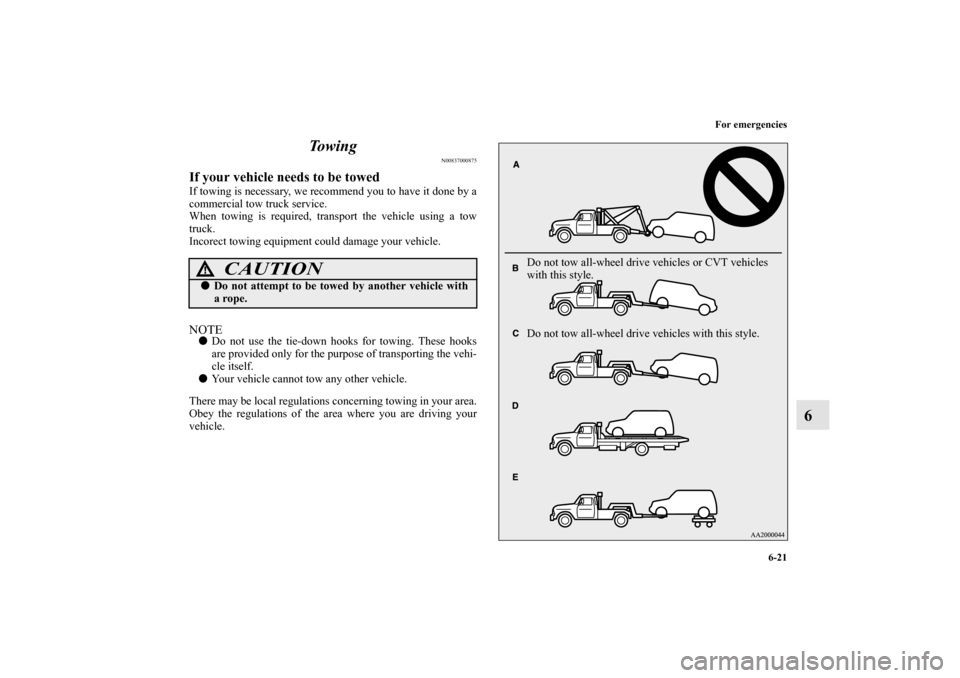
If your vehicle needs to be towedIf towing is necessary, we recommend you to have it done by a
commercial tow truck service.
When towing is required, transport the vehicle using a tow
truck.
Incorect towing equipment could damage your vehicle.NOTE�
Do not use the tie-down hooks for towing. These hooks
are provided only for the purpose of transporting the vehi-
cle itself.
� Your vehicle cannot tow any other vehicle.
There may be local regulations concerning towing in your area.
Obey the regulations of the area where you are driving your
vehicle.
CAUTION
!� Do not attempt to be towed by another vehicle with
a rope.
Do not tow all-wheel drive vehicles with this style. Do not tow all-wheel drive vehicles or CVT vehicles
with this style.
BK0150700US.book 21 ページ 2012年3月22日 木曜日 午後6時46分
Page 497 of 602
6-22 For emergencies
6
Towing the vehicle by a tow truck
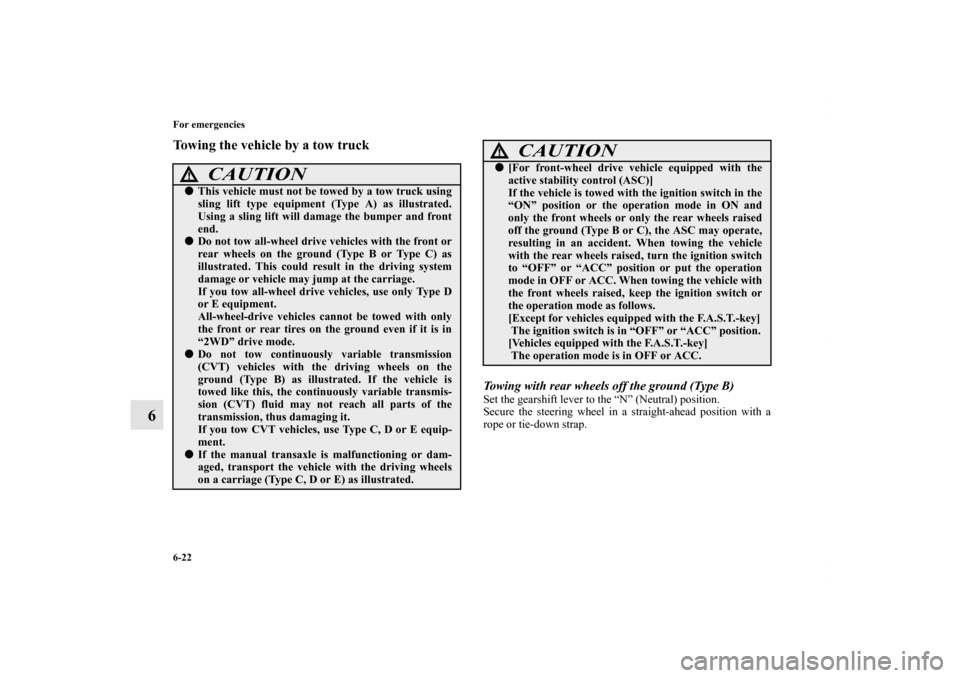
Towing with rear wheels off the ground (Type B)Set the gearshift lever to the “N” (Neutral) position.
Secure the steering wheel in a straight-ahead position with a
rope or tie-down strap.
CAUTION
!�This vehicle must not be towed by a tow truck using
sling lift type equipment (Type A) as illustrated.
Using a sling lift will damage the bumper and front
end.�Do not tow all-wheel drive vehicles with the front or
rear wheels on the ground (Type B or Type C) as
illustrated. This could result in the driving system
damage or vehicle may jump at the carriage.
If you tow all-wheel drive vehicles, use only Type D
or E equipment.
All-wheel-drive vehicles cannot be towed with only
the front or rear tires on the ground even if it is in
“2WD” drive mode.�Do not tow continuously variable transmission
(CVT) vehicles with the driving wheels on the
ground (Type B) as illustrated. If the vehicle is
towed like this, the continuously variable transmis-
sion (CVT) fluid may not reach all parts of the
transmission, thus damaging it.
If you tow CVT vehicles, use Type C, D or E equip-
ment.�If the manual transaxle is malfunctioning or dam-
aged, transport the vehicle with the driving wheels
on a carriage (Type C, D or E) as illustrated.
� [For front-wheel drive vehicle equipped with the
active stability control (ASC)]
If the vehicle is towed with the ignition switch in the
“ON” position or the operation mode in ON and
only the front wheels or only the rear wheels raised
off the ground (Type B or C), the ASC may operate,
resulting in an accident. When towing the vehicle
with the rear wheels raised, turn the ignition switch
to “OFF” or “ACC” position or put the operation
mode in OFF or ACC. When towing the vehicle with
the front wheels raised, keep the ignition switch or
the operation mode as follows.
[Except for vehicles equipped with the F.A.S.T.-key]
The ignition switch is in “OFF” or “ACC” position.
[Vehicles equipped with the F.A.S.T.-key]
The operation mode is in OFF or ACC.
CAUTION
!
BK0150700US.book 22 ページ 2012年3月22日 木曜日 午後6時46分
Page 498 of 602
For emergencies6-23
6
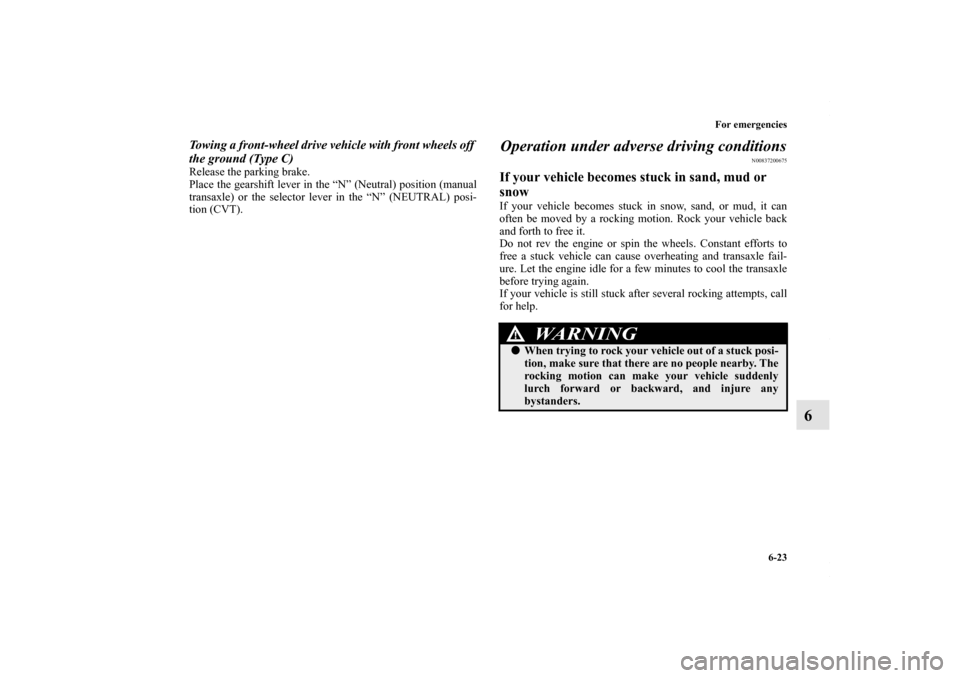
Towing a front-wheel drive vehicle with front wheels off
the ground (Type C)Release the parking brake.
Place the gearshift lever in the “N” (Neutral) position (manual
transaxle) or the selector lever in the “N” (NEUTRAL) posi-
tion (CVT).
Operation under adverse driving conditions
N00837200675
If your vehicle becomes stuck in sand, mud or
snowIf your vehicle becomes stuck in snow, sand, or mud, it can
often be moved by a rocking motion. Rock your vehicle back
and forth to free it.
Do not rev the engine or spin the wheels. Constant efforts to
free a stuck vehicle can cause overheating and transaxle fail-
ure. Let the engine idle for a few minutes to cool the transaxle
before trying again.
If your vehicle is still stuck after several rocking attempts, call
for help.
WARNING
!�When trying to rock your vehicle out of a stuck posi-
tion, make sure that there are no people nearby. The
rocking motion can make your vehicle suddenly
lurch forward or backward, and injure any
bystanders.
BK0150700US.book 23 ページ 2012年3月22日 木曜日 午後6時46分
Page 504 of 602
Vehicle care and maintenance7-3
7
Catalytic converter
N00937400447
The catalytic converter requires you to use unleaded fuel only.
Leaded gasoline will destroy the emission-control effective-
ness of the converter.
Normally, the catalytic converter does not require maintenance.
However, it is important to keep the engine properly tuned for
the converter to continue to work properly.
To reduce the possibility of catalytic converter damage:
� Use UNLEADED GASOLINE ONLY of the type of rec-
ommended in “Fuel selection”.
� Do not drive with an extremely low fuel level. Running
out of gas could damage the catalytic converter.
� Do not try to start the engine by pushing or towing the
vehicle. If the battery is weak or run down, use jumper
cables to properly start the engine.
� Do not idle the engine with any spark plug wires discon-
nected or removed, such as when performing diagnostic
tests.
� Do not idle the engine for a long time if it is idling
roughly or otherwise obviously malfunctioning.
� To prevent the catalytic converter from being damaged
from unburned gas, do not race the engine when stopping
the engine.
� Stop driving the vehicle if you think the performance is
noticeably low, or the engine has a malfunction such as
with the ignition, etc. If you are not able to stop driving
immediately, slow down and drive for only a short time.
Have your vehicle checked at an authorized Mitsubishi
Motors dealer or a repair facility of your choice as soon as
possible.
� In unusual situations involving major engine problems, a
burning odor may indicate severe and abnormal catalytic
converter overheating. If this occurs, stop in a safe place,
shut the engine off and let the vehicle cool. Once the
engine is cool, immediately take your vehicle to a dealer
or a repair facility of your choice for service.
CAUTION
!�Damage to the catalytic converter can result if your
vehicle is not kept in proper operating condition. If
the engine malfunctions or misfires, or if your vehi-
cle performance suffers, have it serviced promptly.
Running your vehicle when it is overheated may
result in damage to the converter and vehicle.
WARNING
!�Do not park or run your vehicle in areas where com-
bustible materials such as dry grass or leaves can
come in contact with a hot exhaust, since a fire could
occur.�Do not put undercoat paint on the catalytic con-
verter.
BK0150700US.book 3 ページ 2012年3月22日 木曜日 午後6時46分
Page 505 of 602
7-4 Vehicle care and maintenance
7Engine hood
N00937500477
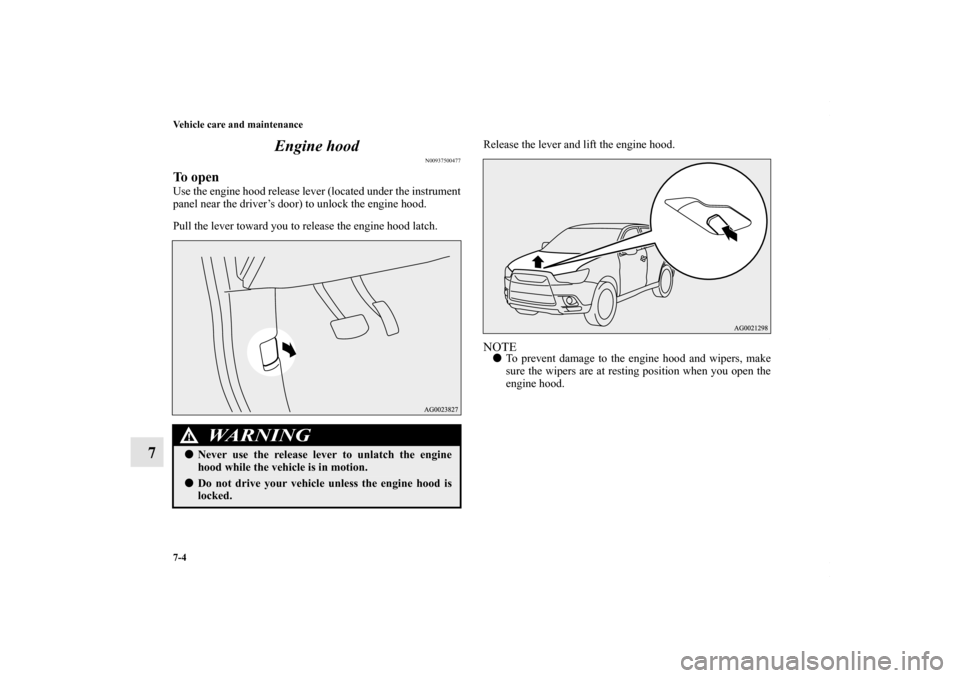
To openUse the engine hood release lever (located under the instrument
panel near the driver’s door) to unlock the engine hood.
Pull the lever toward you to release the engine hood latch.
Release the lever and lift the engine hood.
NOTE�
To prevent damage to the engine hood and wipers, make
sure the wipers are at resting position when you open the
engine hood.
WARNING
!�Never use the release lever to unlatch the engine
hood while the vehicle is in motion.�Do not drive your vehicle unless the engine hood is
locked.
BK0150700US.book 4 ページ 2012年3月22日 木曜日 午後6時46分
Page 517 of 602
7-16 Vehicle care and maintenance
7
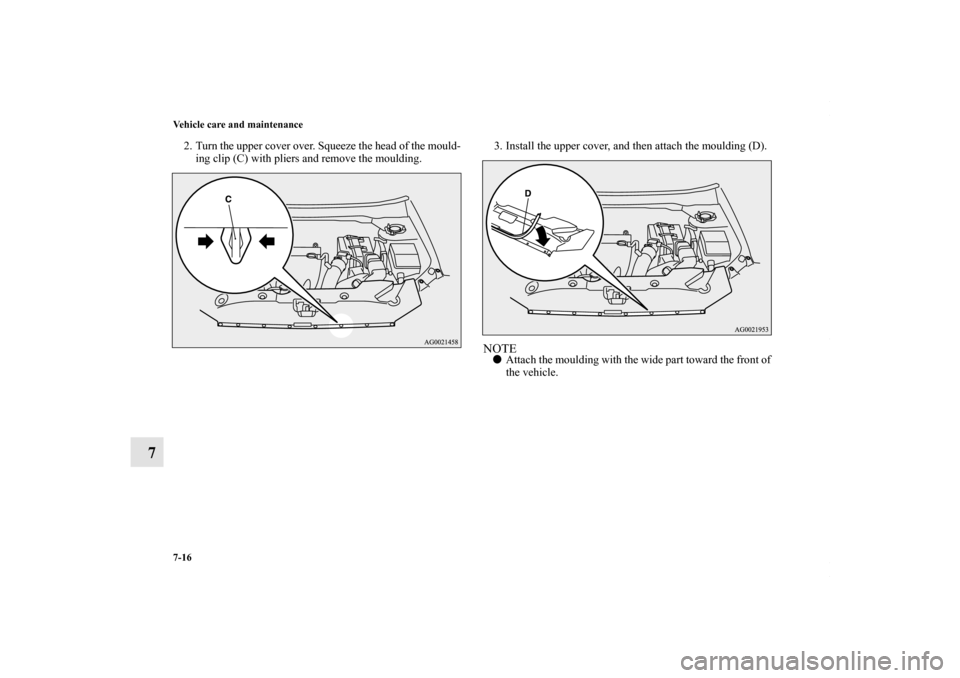
2. Turn the upper cover over. Squeeze the head of the mould-ing clip (C) with pliers and remove the moulding. 3. Install the upper cover, and then attach the moulding (D).
NOTE�
Attach the moulding with the wide part toward the front of
the vehicle.
BK0150700US.book 16 ページ 2012年3月22日 木曜日 午後6時46分