Page 206 of 626
Features and controls
3-119
3
To w i n g
CAUTION
!�Always use tires of the same size, same type, and
same brand, and which have no wear differences.
Using tires that differ in size, type, brands or the
degree of wear, will increase the differential oil tem-
perature, resulting in possible damage to the driving
system. Further, the drive train will be subjected to
excessive loading, possibly leading to oil leakage,
component seizure, or other serious problems.
CAUTION
!�Do not tow all-wheel drive vehicles with the front or
rear wheels on the ground (Type A or Type B) as
illustrated. This could result in damage to the driv-
etrain, or unstable towing.
If you tow all-wheel drive vehicles, use Type C or
Type D equipment.
BK0150900US.book 119 ページ 2012年5月7日 月曜日 午後12時9分
Page 295 of 626

3-208 Features and controls
3
Dimmer (high/low beam change)
N00549900142
To change the headlights from high beam to low beam and vice
versa, pull the turn signal lever to (1). Switch the headlights to
low beam as a courtesy whenever there are oncoming vehicles,
or when there is traffic moving ahead of you. An illuminated
blue light in the instrument cluster indicates when the head-
lights are on high beam.
Headlight flasher
N00550000185
You can flash the high beams by pulling the lever gently
toward you (2). The lights will go back to normal when you let
go. While the high beam is on, you will see a blue light on the
instrument panel.NOTE�You can flash the high beams by pulling the lever toward
you, even if the light switch is off.
�If you turn the lights off with the head lights set to high-
beam illumination, the headlights are automatically
returned to their low-beam setting when the light switch is
next turned to the “ ” position.
BK0150900US.book 208 ページ 2012年5月7日 月曜日 午後12時9分
Page 297 of 626
3-210 Features and controls
3
Coming home light
N00547300083
This function turns on the headlights in the low beam setting
for about 30 seconds after the ignition switch is turned to the
“LOCK” position.
1. Turn the combination headlights and dimmer switch to the
“OFF” or “AUTO” position (for vehicles equipped with
the automatic light control).
2. Turn the ignition switch to the “LOCK” position. Also, if
a key was used to start the engine, remove the key from
the ignition switch.
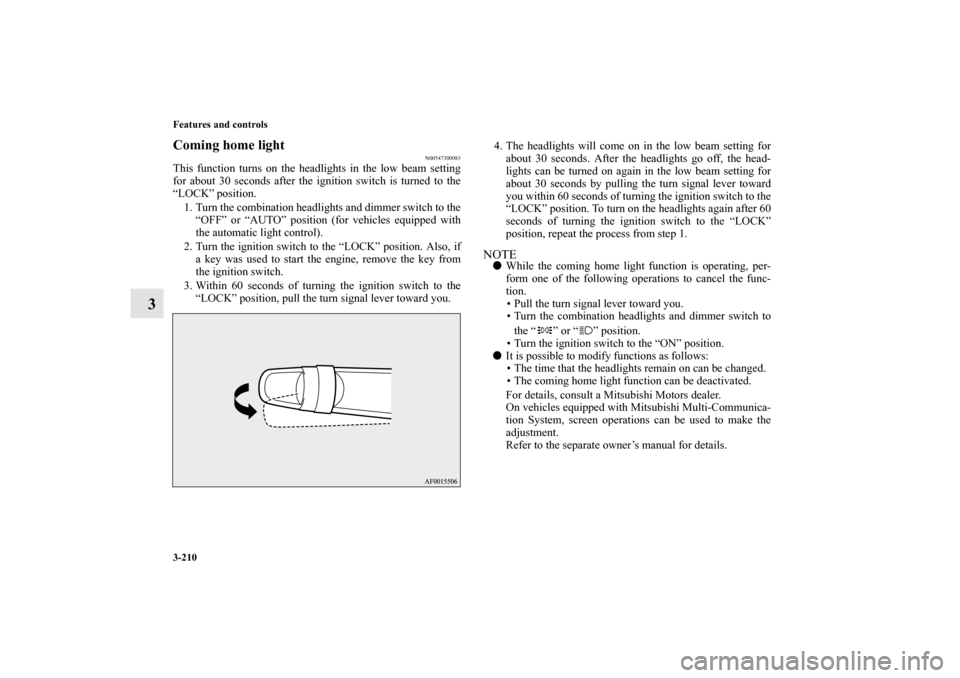
3. Within 60 seconds of turning the ignition switch to the
“LOCK” position, pull the turn signal lever toward you.4. The headlights will come on in the low beam setting for
about 30 seconds. After the headlights go off, the head-
lights can be turned on again in the low beam setting for
about 30 seconds by pulling the turn signal lever toward
you within 60 seconds of turning the ignition switch to the
“LOCK” position. To turn on the headlights again after 60
seconds of turning the ignition switch to the “LOCK”
position, repeat the process from step 1.
NOTE�While the coming home light function is operating, per-
form one of the following operations to cancel the func-
tion.
• Pull the turn signal lever toward you.
• Turn the combination headlights and dimmer switch to
the “ ” or “ ” position.
• Turn the ignition switch to the “ON” position.
�It is possible to modify functions as follows:
• The time that the headlights remain on can be changed.
• The coming home light function can be deactivated.
For details, consult a Mitsubishi Motors dealer.
On vehicles equipped with Mitsubishi Multi-Communica-
tion System, screen operations can be used to make the
adjustment.
Refer to the separate owner’s manual for details.
BK0150900US.book 210 ページ 2012年5月7日 月曜日 午後12時9分
Page 307 of 626
3-220 Features and controls
3
The wipers will operate once if the lever is moved to the
“AUTO” position and the knob (D) is turned in the “+” direc-
tion when the ignition switch is “ON” position.
Windshield washer
N00504600285
To turn on the windshield washer, pull the lever toward you
with the ignition switch in either the “ON” or “ACC” position.
The washer fluid will be sprayed onto the windshield by pull-
ing the lever toward you.
When the wipers are not in operation or in intermittent opera-
tion, by pulling the lever toward you, the wipers will operate
several times while the washer fluid is being sprayed.
Also, by releasing the lever soon after pulling it toward you,
the washer fluid will be sprayed several times while the wipers
are operating several times. (Intelligent washer)
Intelligent washer will stop operating with any operation of the
lever.
D
BK0150900US.book 220 ページ 2012年5月7日 月曜日 午後12時9分
Page 360 of 626
4
Driving safety
Fuel economy . . . . . . . . . . . . . . . . . . . . . . . . . . . . .4- 2
Driving, alcohol and drugs. . . . . . . . . . . . . . . . . . .4- 2
Floor mat . . . . . . . . . . . . . . . . . . . . . . . . . . . . . . . .4- 3
Vehicle preparation before driving. . . . . . . . . . . . .4- 5
Safe driving techniques . . . . . . . . . . . . . . . . . . . . .4- 6
Driving during cold weather . . . . . . . . . . . . . . . . .4- 6
Braking. . . . . . . . . . . . . . . . . . . . . . . . . . . . . . . . . .4- 7
Parking . . . . . . . . . . . . . . . . . . . . . . . . . . . . . . . . . .4- 8
Loading information . . . . . . . . . . . . . . . . . . . . . . .4- 9
Cargo loads . . . . . . . . . . . . . . . . . . . . . . . . . . . . . .4- 13
Trailer towing. . . . . . . . . . . . . . . . . . . . . . . . . . . . .4- 14
BK0150900US.book 1 ページ 2012年5月7日 月曜日 午後12時9分
Page 367 of 626
4-8 Driving safety
4Parking
N00629600320
Parking on a hillWhen parking on a hill, set the parking brake, and turn the
front wheels toward the curb on a downhill, or away from the
curb on an uphill.
If necessary, apply chocks to wheels.For vehicles with manual transaxlePlace the gearshift lever into the “R” (Reverse) position when
parking on a downhill slope, into the 1st position when parking
on an uphill slope.For vehicles with Twin Clutch SSTBe sure that the parking brake is firmly set when parked and
that the gearshift lever is in the “P” (PARK) position.
When parking on a hill, it is important to set the parking brake
before moving the gearshift lever to the “P” (PARK) position.
This prevents loading the parking brake against the transmis-
sion gear. When this happens, it is difficult to move the gear-
shift lever out of the “P” (PARK) position.
Parking with the engine runningNever leave the engine running while you take a short
sleep/rest. Also, never leave the engine running in a closed or
poorly ventilated place.Where you parkYour front bumper can be damaged if you scrape it over curbs
or parking stop blocks. Be careful when traveling up or down
steep slopes where your bumper can scrape the road.When leaving the vehicleWhen leaving the vehicle unattended, always carry the key and
lock all doors.
Always try to park your vehicle in a well lit area.
WA R N I N G
!�Leaving the engine running risks injury or death
from accidentally moving the gearshift lever (man-
ual transaxle) or the gearshift lever (Twin Clutch
SST) or from the accumulation of toxic exhaust
fumes in the passenger compartment.
WA R N I N G
!�Do not park your vehicle in areas where combustible
materials such as dry grass or leaves can come in
contact with a hot exhaust, since a fire could occur.
BK0150900US.book 8 ページ 2012年5月7日 月曜日 午後12時9分
Page 370 of 626

Driving safety
4-11
4
Ty p e 2
Steps for Determining Correct Load Limit
N00630200179
1. Locate the statement “The combined weight of occu-
pants and cargo should never exceed XXX kg or XXX
lbs.” on your vehicle’s placard.
2. Determine the combined weight of the driver and pas-
sengers that will be riding in your vehicle.
3. Subtract the combined weight of the driver and passen-
gers from XXX kg or XXX lbs.
4. The resulting figure equals the available amount of
cargo and luggage load capacity. For example, if the
“XXX” amount equals 1400 lbs. and there will be five
150 lbs. passengers in your vehicle, the amount of
available cargo and luggage load capacity is 650 lbs.
(1400 - 750 (5 x 150) = 650 lbs.)
5. Determine the combined weight of luggage and cargo
being loaded on the vehicle. That weight may not
safely exceed the available cargo and luggage load
capacity calculated in Step 4.
6. If your vehicle will be towing a trailer, load from your
trailer will be transferred to your vehicle. Consult this
manual to determine how this reduces the available
cargo and luggage load capacity of your vehicle.NOTE�The above steps for determining correct load limit were
written in accordance with U.S.A. regulations.
Your vehicle cannot tow a trailer, so step 6 is irrelevant.
BK0150900US.book 11 ページ 2012年5月7日 月曜日 午後12時9分
Page 373 of 626
4-14 Driving safety
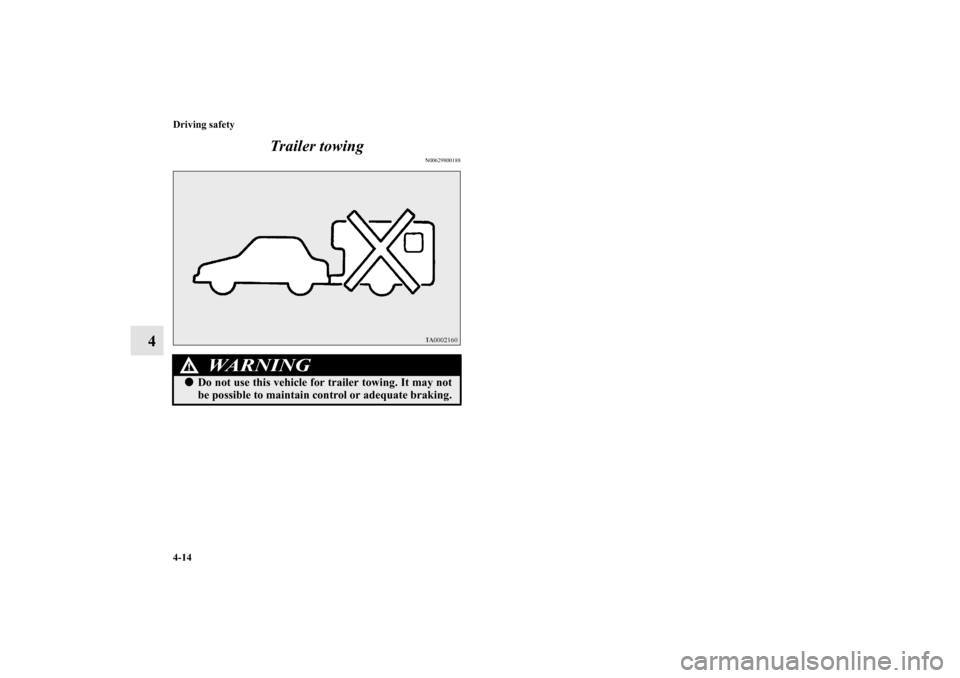
4Trailer towing
N00629800188
WA R N I N G
!�Do not use this vehicle for trailer towing. It may not
be possible to maintain control or adequate braking.
BK0150900US.book 14 ページ 2012年5月7日 月曜日 午後12時9分