2013 LINCOLN MKZ warning
[x] Cancel search: warningPage 35 of 474

•
Height adjuster at the front
outboard seating positions.
• Safety belt pretensioner at the
front outboard seating positions.
• Belt tension sensor at the front
outboard passenger seating
position. •
Safety belt warning light and
chime. •
Crash sensors and monitoring
system with readiness indicator.
The safety belt pretensioners at the
front seating positions are designed
to tighten the safety belts when
activated. In frontal and near-frontal
collisions, the safety belt
pretensioners may be activated alone
or, if the collision is of sufficient
severity, together with the front
airbags. The pretensioners may also
activate when a side curtain airbag is
deployed.
FASTENING THE SAFETY
BELTS
Standard belts shown, inflatable
belts similar
The front outboard and rear safety
restraints in the vehicle are
combination lap and shoulder belts. 1. Insert the belt tongue into the
proper buckle (the buckle closest
to the direction the tongue is
coming from) until you hear a snap
and feel it latch. Make sure the
tongue is securely fastened in the
buckle. 2. To unfasten, press the release
button and remove the tongue
from the buckle.
32
Safety Belts E142587 E142588
Page 36 of 474
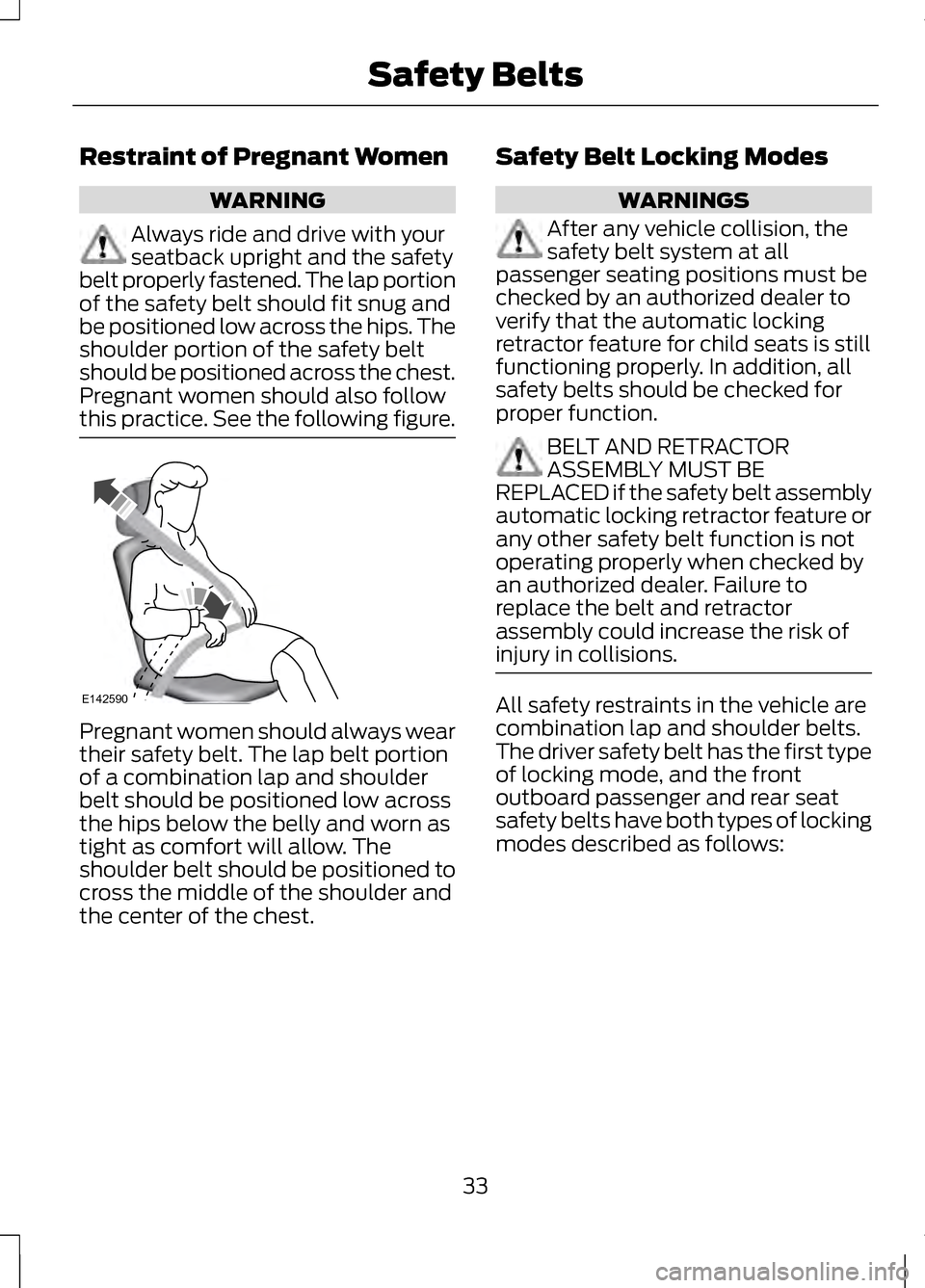
Restraint of Pregnant Women
WARNING
Always ride and drive with your
seatback upright and the safety
belt properly fastened. The lap portion
of the safety belt should fit snug and
be positioned low across the hips. The
shoulder portion of the safety belt
should be positioned across the chest.
Pregnant women should also follow
this practice. See the following figure. Pregnant women should always wear
their safety belt. The lap belt portion
of a combination lap and shoulder
belt should be positioned low across
the hips below the belly and worn as
tight as comfort will allow. The
shoulder belt should be positioned to
cross the middle of the shoulder and
the center of the chest. Safety Belt Locking Modes WARNINGS
After any vehicle collision, the
safety belt system at all
passenger seating positions must be
checked by an authorized dealer to
verify that the automatic locking
retractor feature for child seats is still
functioning properly. In addition, all
safety belts should be checked for
proper function. BELT AND RETRACTOR
ASSEMBLY MUST BE
REPLACED if the safety belt assembly
automatic locking retractor feature or
any other safety belt function is not
operating properly when checked by
an authorized dealer. Failure to
replace the belt and retractor
assembly could increase the risk of
injury in collisions. All safety restraints in the vehicle are
combination lap and shoulder belts.
The driver safety belt has the first type
of locking mode, and the front
outboard passenger and rear seat
safety belts have both types of locking
modes described as follows:
33
Safety BeltsE142590
Page 38 of 474

2. Grasp the lap portion of the belt
and pull upward until the entire
belt is pulled out.
3. Allow the belt to retract. As the belt retracts, you will hear a
clicking sound. This indicates the
safety belt is now in the automatic
locking mode.
How to Disengage the Automatic
Locking Mode
Disconnect the combination lap and
shoulder belt and allow it to retract
completely to disengage the
automatic locking mode and activate
the vehicle sensitive (emergency)
locking mode.
Rear Inflatable Safety Belt (If
Equipped) WARNING
Do not attempt to service, repair,
or modify the rear inflatable
safety belt. The rear inflatable safety belts are
fitted in the shoulder portion of the
safety belts of the second-row
outboard seating positions.
Note:
The rear inflatable safety belts
are compatible with most infant and
child safety car seats and belt
positioning booster seats when
properly installed. This is because they
are designed to fill with a cooled gas
at a lower pressure and at a slower rate
than traditional airbags. After inflation,
the shoulder portion of the safety belt
remains cool to the touch. The rear inflatable safety belt consists
of the following:
•
An inflatable bag located in the
shoulder safety belt webbing.
• Lap safety belt webbing with
automatic locking mode.
• The same warning light, electronic
control and diagnostic unit as used
for the front safety belts.
• Impact sensors located in various
parts of the vehicle.
How does the rear inflatable safety
belt system work?
The rear inflatable safety belts will
function like standard restraints in
everyday usage. During a collision of sufficient force,
the inflatable belt will inflate from
inside the webbing.
35
Safety BeltsE146364
Page 39 of 474

The fully inflated belt's increased
diameter more effectively holds the
occupant in the appropriate seating
position, and spreads crash forces
over more area of the body than
regular safety belts. This helps reduce
pressure on the chest and helps
control head and neck motion for
passengers.
WARNING
If the rear inflatable safety belt
has deployed, it will not function
again. The rear inflatable safety belt
system must be replaced by an
authorized dealer. The rear inflatable safety belts are
designed to inflate in frontal or
near-frontal collisions and some side
impact collisions. The fact that the
rear inflatable safety belt did not
inflate in a collision does not mean
that something is wrong with the
system. Rather, it means the forces
were not of the type sufficient to
cause activation. Safety Belt Extension
Assembly WARNINGS
Position the safety belt height
adjusters so that the belt rests
across the middle of your shoulder.
Failure to adjust the safety belt
properly could reduce the
effectiveness of the safety belt and
increase the risk of injury in a collision. Do not use extensions with an
inflatable safety belt.
If the safety belt is too short when
fully extended, a safety belt extension
assembly can be obtained from an
authorized dealer.
Use only extensions manufactured by
the same supplier as the safety belt.
Manufacturer identification is located
at the end of the webbing on the label.
A safety belt extension is not available
for the inflatable safety belt. Also, use
the safety belt extension only if the
safety belt is too short for you when
fully extended.
SAFETY BELT HEIGHT
ADJUSTMENT
WARNING
Position the safety belt height
adjusters so that the belt rests
across the middle of your shoulder.
Failure to adjust the safety belt
properly could reduce the
effectiveness of the safety belt and
increase the risk of injury in a collision. 36
Safety BeltsE146365
Page 40 of 474

Adjust the height of the shoulder belt
so the belt rests across the middle of
your shoulder.
To adjust the shoulder belt height,
press the button and slide the height
adjuster up or down. Release the
button and pull down on the height
adjuster to make sure it is locked in
place.
SAFETY BELT WARNING
LAMP AND INDICATOR
CHIME This lamp illuminates and an
audible warning will sound if
the driver's safety belt has
not been fastened when the vehicle's
ignition is turned on.
Conditions of operation Then...
If...
The safety belt warning light illumin-ates 1-2 minutes and the warning chime sounds 4-8 seconds.
The driver's safety belt is not buckled
before the ignition switch is turned to the on position...
The safety belt warning light andwarning chime turn off.
The driver's safety belt is buckled
while the indicator light is illuminated and the warning chime is sounding...
The safety belt warning light andindicator chime remain off.
The driver's safety belt is buckled
before the ignition switch is turned to the on position...
37
Safety BeltsE146191
Page 41 of 474

SAFETY BELT MINDER
Belt-Minder®
This feature supplements the safety
belt warning function by providing
additional reminders by intermittently
sounding a chime and illuminating the
safety belt warning light when the
driver's or front passenger's seat is
occupied and the safety belt is
unbuckled.
The system uses information from the
front passenger sensing system to
determine if a front seat passenger is
present and therefore potentially in
need of a warning. To avoid activating
the Belt-Minder feature for objects
placed in the front passenger seat,
warnings will only be given to front
seat occupants as determined by the
front passenger sensing system.
If the Belt-Minder warnings have
expired (warnings for approximately
five minutes) for one occupant (driver
or front passenger), the other
occupant can still activate the
Belt-Minder feature. Then...
If...
The Belt-Minder feature will notactivate.
The driver's and front passenger's
safety belts are buckled before the ignition switch is turned to the on
position or less than 1-2 minutes have elapsed since the ignition switch has been turned to on...
The Belt-Minder feature is activated -the safety belt warning light illumin-ates and the warning chime sounds for six seconds every 25 seconds,repeating for approximately five
minutes or until the safety belts are buckled.
The driver's or front passenger's safety
belt is not buckled when the vehicle
has reached at least 6 mph (9.7 km/
h) and 1-2 minutes have elapsed since
the ignition switch has been turned to on...
The Belt-Minder feature is activated -the safety belt warning light illumin-ates and the warning chime sounds for six seconds every 25 seconds,repeating for approximately five
minutes or until the safety belts are buckled.
The driver's or front passenger's safety
belt becomes unbuckled for approxim-
ately one minute while the vehicle istraveling at least 6 mph (9.7 km/h) and more than 1-2 minutes have
elapsed since the ignition switch has been turned to on...
38
Safety Belts
Page 42 of 474
Deactivating and Activating the
Belt-Minder Feature
WARNING
While the system allows you to
deactivate it, this system is
designed to improve your chances of
being safely belted and surviving an
accident. We recommend you leave
the system activated for yourself and
others who may use the vehicle. To
reduce the risk of injury, do not
deactivate or activate the system
while driving the vehicle. Note:
The driver and front passenger
warning are deactivated and activated
independently. When deactivating or
activating one seating position, do not
buckle the other position as this will
terminate the process.
Read Steps 1 - 4 thoroughly before
proceeding with the deactivation or
activation programming procedure.
The system can be deactivated or
activated by performing the following
procedure:
Before following the procedure, make
sure that:
• the parking brake is set
• the transmission selector lever is
in position P (automatic
transmission) or N (manual
transmission)
• the ignition is off
• the driver and front passenger
safety belts are unbuckled.
1. Turn the ignition on. DO NOT START THE ENGINE. 2. Wait until the safety belt warning
light turns off (approximately one
minute). After Step 2, wait an
additional five seconds before
proceeding with Step 3. Once Step
3 is started, the procedure must be
completed within 30 seconds.
3. For the seating position being disabled, buckle then unbuckle the
safety belt three times at a
moderate speed, ending in the
unbuckled state. After Step 3, the
safety belt warning light will turn
on.
4. While the safety belt warning light
is on, buckle and then unbuckle the
safety belt. After Step 4, the safety
belt warning light will flash for
confirmation.
• This will disable the feature for
that seating position if it is
currently enabled.
• This will enable the feature for that
seating position if it is currently
disabled.
39
Safety Belts
Page 44 of 474

The Personal Safety System provides
an improved overall level of frontal
crash protection to front seat
occupants and is designed to help
further reduce the risk of
airbag-related injuries. The system is
able to analyze different occupant
conditions and crash severity before
activating the appropriate safety
devices to help better protect a range
of occupants in a variety of frontal
crash situations.
Your vehicle's Personal Safety System
consists of:
•
Driver and passenger dual-stage
airbag supplemental restraints.
• Front outboard safety belts with
pretensioners, energy
management retractors (first row
only), and safety belt usage
sensors.
• Driver ’s seat position sensor.
• Front passenger sensing system.
• Passenger airbag off and on
indicator lamp.
• Front crash severity sensors.
• Restraints Control Module with
impact and safing sensors.
• Restraint system warning light and
backup tone.
• The electrical wiring for the
airbags, crash sensor(s), safety
belt pretensioners, front safety belt
usage sensors, driver seat position
sensor, front passenger sensing
system, and indicator lights. How Does the Personal Safety
System Work?
The Personal Safety System can
adapt the deployment strategy of
your vehicle
’s safety devices
according to crash severity and
occupant conditions. A collection of
crash and occupant sensors provides
information to the Restraints Control
Module. During a crash, the Restraints
Control Module may activate the
safety belt pretensioners and may
activate either one or both stages of
the dual-stage airbag supplemental
restraints based on crash severity and
occupant conditions.
41
Personal Safety System
™