Page 433 of 525
Once the engine is started, remove the jumper cables in
the reverse sequence:
6. Disconnect the negative(-)jumper cable from the
engine ground of the vehicle with the discharged
battery.
7. Disconnect the negative end (-)of the jumper cable
from the negative (-)post of the booster battery.
8. Disconnect the opposite end of the positive (+)jumper
cable from the positive (+)post of the booster battery.
9. Disconnect the positive (+)end of the jumper cable
from the positive (+)post of the discharged vehicle.
10. Reinstall the air intake duct.
If frequent jump-starting is required to start your vehicle
you should have the battery and charging system in-
spected at your authorized dealer.CAUTION!
Accessories that can be plugged into the vehicle
power outlets draw power from the vehicle’s battery,
even when not in use (i.e., cellular phones, etc.).
Eventually, if plugged in long enough, the vehicle’s
battery will discharge sufficiently to degrade battery
life and/or prevent the engine from starting.
FREEING A STUCK VEHICLE
If your vehicle becomes stuck in mud, sand or snow, it
can often be moved using a rocking motion. Turn the
steering wheel right and left to clear the area around
the front wheels. Then shift back and forth between
DRIVE and REVERSE (with automatic transmission) or
2nd gear and REVERSE (with manual transmission),
while gently pressing the accelerator. Use the least
amount of accelerator pedal pressure that will maintain6
WHAT TO DO IN EMERGENCIES 431
Page 441 of 525
ENGINE COMPARTMENT — 2.0L
1 — Washer Fluid Reservoir6 — Air Cleaner Filter
2 — Power Steering Fluid Reservoir 7 — Coolant Pressure Cap
3 — Engine Oil Fill 8 — Engine Oil Dipstick
4 — Brake Fluid Reservoir 9 — Engine Coolant Reservoir
5 — Integrated Power Module (Fuses)
7
MAINTAINING YOUR VEHICLE 439
Page 442 of 525
ENGINE COMPARTMENT — 2.4L
1 — Washer Fluid Reservoir6 — Air Cleaner Filter
2 — Power Steering Fluid Reservoir 7 — Coolant Pressure Cap
3 — Engine Oil Fill 8 — Engine Oil Dipstick
4 — Brake Fluid Reservoir 9 — Engine Coolant Reservoir
5 — Integrated Power Module (Fuses) 440 MAINTAINING YOUR VEHICLE
Page 447 of 525
CAUTION!(Continued)
•Your vehicle has been built with improved fluids
that protect the performance and durability of your
vehicle and also allow extended maintenance inter-
vals. Do not use chemical flushes in these compo-
nents as the chemicals can damage your engine,
transmission, power steering or air conditioning.
Such damage is not covered by the New Vehicle
Limited Warranty. If a flush is needed because of
component malfunction, use only the specified
fluid for the flushing procedure.
Engine Oil
Checking Oil Level
To assure proper engine lubrication, the engine oil must
be maintained at the correct level. Check the oil level at
regular intervals, such as every fuel stop. The best time to
check the engine oil level is about five minutes after a fully warmed engine is shut off. Do not check oil level
before starting the engine after it has sat overnight.
Checking engine oil level when the engine is cold will
give you an incorrect reading.
Checking the oil while the vehicle is on level ground and
only when the engine is hot, will improve the accuracy of
the oil level readings. Maintain the oil level between the
range markings on the dipstick. The range markings will
consist of a crosshatch zone that says SAFE or a crosshatch
zone that says MIN at the low end of the range and MAX at
the high end of the range. Adding 1 qt (1L) of oil when the
reading is at the low end of the indicated range will result
in the oil level at the full end of the indicator range.
CAUTION!
Do not overfill the engine. Overfilling the engine
will cause oil aeration, which can lead to loss of oil
(Continued)
7
MAINTAINING YOUR VEHICLE 445
Page 476 of 525
identifies each component may be printed on the inside
of the cover. Refer to “Engine Compartment” in “Main-
taining Your Vehicle” for further information.Cavity Car-tridgeFuse Mini-
Fuse Description
1 Empty Empty
2 15 Amp
Lt Blue AWD/4WD Control
Module – If Equipped
3 10 Amp
Red Rear Center Brake
Light Switch
4 10 Amp
Red Ignition Switch/
Occupant Classifica- tion Module
5 20 Amp
Yellow Trailer Tow –
If Equipped
6 10 Amp
Red Power Mirror/
Steering Control Satellite Radio/
Hands-Free Phone
Integrated Power Module
474 MAINTAINING YOUR VEHICLE
Page 485 of 525
Chassis
ComponentFluid, Lubricant, or Genuine Part
Automatic Transmission (CVT) – If Equipped We recommend you use MOPAR �CVTF+4� Continuously
Variable Transmission Fluid.
Manual Transmission – If Equipped We recommend you use MOPAR�ATF+4� Automatic Transmis-
sion Fluid.
Rear Drive Assembly (RDA) We recommend you use MOPAR�Gear & Axle Lubricant
SAE 80W-90 API GL 5.
Power Transfer Unit (PTU) We recommend you use MOPAR�Gear & Axle Lubricant
SAE 80W-90 API GL 5.
Brake Master Cylinder We recommend you use MOPAR�DOT 3, SAE J1703 should
be used. If DOT 3, SAE J1703 brake fluid is not available, then
DOT 4 is acceptable.
Power Steering Reservoir We recommend you useMOPAR�Power Steering Fluid +4,
MOPAR� ATF+4�Automatic Transmission Fluid.
7
MAINTAINING YOUR VEHICLE 483
Page 489 of 525

NOTE:Under no circumstances should oil change inter-
vals exceed 10,000 miles (16,000 km) or twelve months,
whichever comes first.
Once A Month Or Before A Long Trip:
• Check engine oil level
• Check windshield washer fluid level
• Check the tire inflation pressures and look for unusual
wear or damage
• Check the fluid levels of the coolant reservoir, brake
master cylinder, power steering and transmission as
needed
• Check function of all interior and exterior lights
Required Maintenance Intervals.
Refer to the maintenance schedules on the following
page for the required maintenance intervals.At Every Oil Change Interval As Indicated By Oil Change Indicator System:
•Change oil and filter
• Rotate the tires. Rotate at the first sign of irregu-
lar wear, even if it occurs before the oil indicator
system turns on.
• Inspect battery and clean and tighten terminals as
required
• Inspect brake pads, shoes, rotors, drums, hoses
and park brake
• Inspect engine cooling system protection and
hoses
• Inspect exhaust system
• Inspect engine air cleaner if using in dusty or
off-road conditions
8
M
A I
N T
E
N
A
N
C E
S
C
H E
D
U L
E
SMAINTENANCE SCHEDULES 487
Page 507 of 525
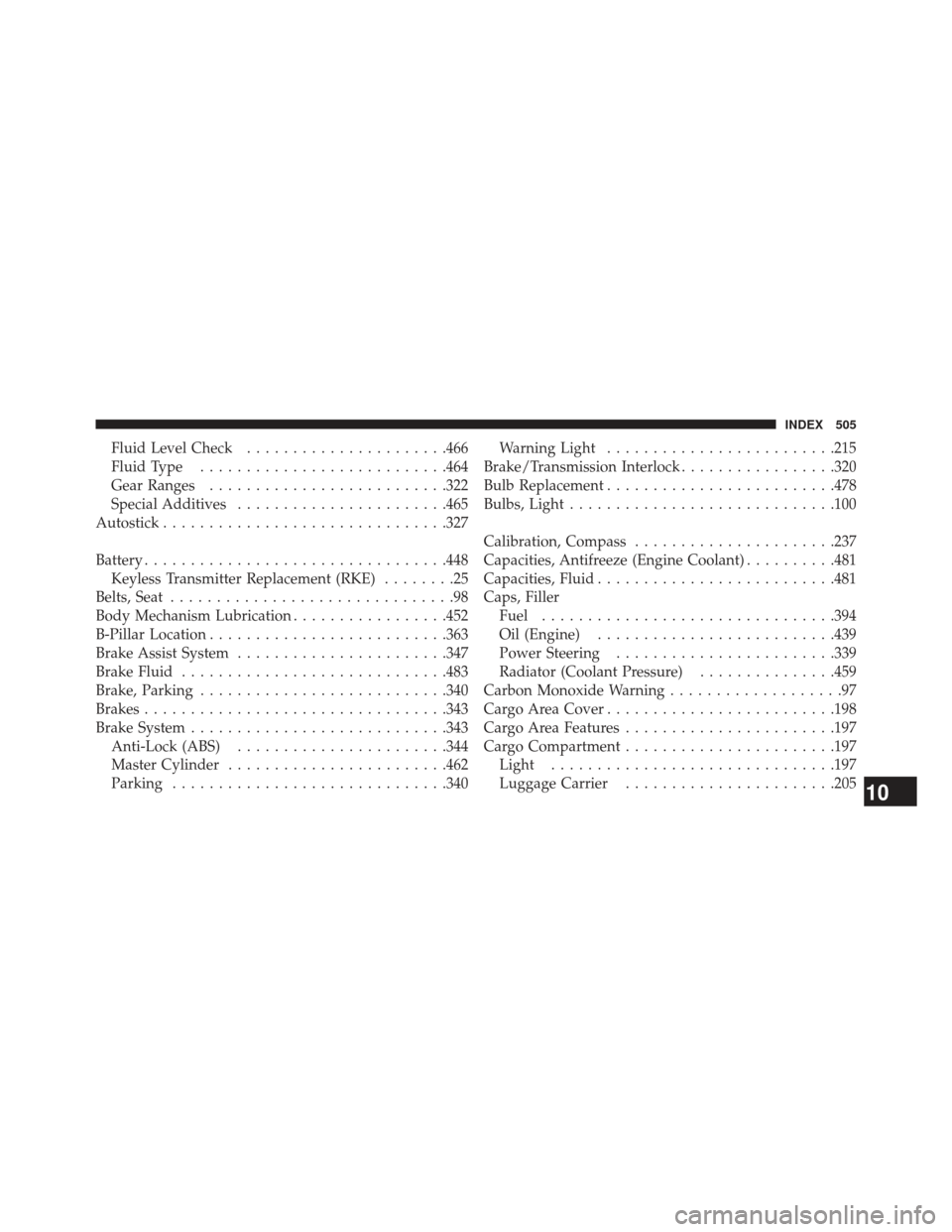
Fluid Level Check..................... .466
Fluid Type .......................... .464
Gear Ranges ......................... .322
Special Additives ...................... .465
Autostick .............................. .327
Battery ................................ .448
Keyless Transmitter Replacement (RKE) ........25
Belts, Seat ...............................98
Body Mechanism Lubrication .................452
B-Pillar Location ......................... .363
Brake Assist System ...................... .347
Brake Fluid ............................ .483
Brake, Parking .......................... .340
Brakes ................................ .343
Brake System ........................... .343
Anti-Lock (ABS) ...................... .344
Master Cylinder ....................... .462
Parking ............................. .340Warning Light
........................ .215
Brake/Transmission Interlock .................320
Bulb Replacement ........................ .478
Bulbs, Light ............................ .100
Calibration, Compass ..................... .237
Capacities, Antifreeze (Engine Coolant) ..........481
Capacities, Fluid ......................... .481
Caps, Filler Fuel ............................... .394
Oil (Engine) ......................... .439
Power Steering ....................... .339
Radiator (Coolant Pressure) ...............459
Carbon Monoxide Warning ...................97
Cargo Area Cover ........................ .198
Cargo Area Features ...................... .197
Cargo Compartment ...................... .197
Light .............................. .197
Luggage Carrier ...................... .205
10
INDEX 505