2013 HONDA CROSSTOUR ignition
[x] Cancel search: ignitionPage 518 of 573

517
Continued
Handling the Unexpected
If a Tire Goes Flat
Changing a Flat Tire
If a tire goes flat while driving, grasp the steering wheel firmly, and brake gradually
to reduce speed. Then, stop in a safe place. Replace the flat tire with a compact
spare tire. Go to a dealer as soon as possible to have the full-size tire repaired or
replaced. 1.
Park the vehicle on firm, level, and non-slippery surface and apply the parking
brake.
2. Move the shift lever to
(P .
3. Turn on the hazard warning lights and turn the ignition switch to LOCK (0*1
.
*1: Models with the smart entry system have an ENGINE START/STOP button instead of an
ignition switch.
1Changing a Flat Tire
Periodically check the tire pressure of the compact
spare. It should be set to the specified pressure.
Specified Pressure: 60 psi (420 kPa, 4.2 kgf/cm 2
)
When driving with the compact spare tire, keep the
vehicle speed under 50 mph (80 km/h). Replace with
a full-size tire as soon as possible.
The compact spare tire and wheel in your vehicle are
specifically for this model.
Do not use them with another vehicle.
Do not use another type of compact spare tire or
wheel with your vehicle.
Do not mount tire chains on a compact spare tire.
If a chain-mounted front tire goes flat, remove one of
the full-size rear tires and replace it with the compact
spare tire. Remove the flat front tire and replace it
with the full-size tire that was removed from the rear.
Mount the tire chains on the front tire.
Do not use a puncture-repairing agent on a flat tire,
as it can damage the tire pressure sensor.
Main MenuTable of contents
Page 526 of 573
525
Handling the Unexpected
Engine Does Not Start
Checking the Engine
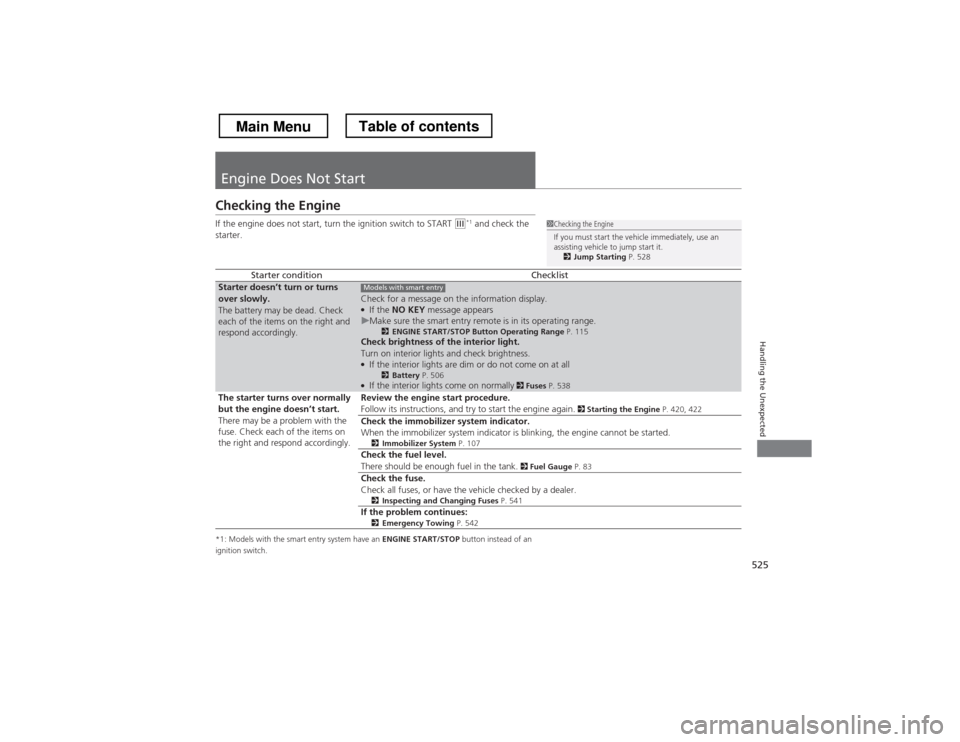
If the engine does not start, turn the ignition switch to START
(e*1
and check the
starter.
*1: Models with the smart entry system have an ENGINE START/STOP button instead of an
ignition switch.
Starter conditionChecklistStarter doesn
Page 532 of 573
531
Handling the Unexpected
Shift Lever Does Not Move
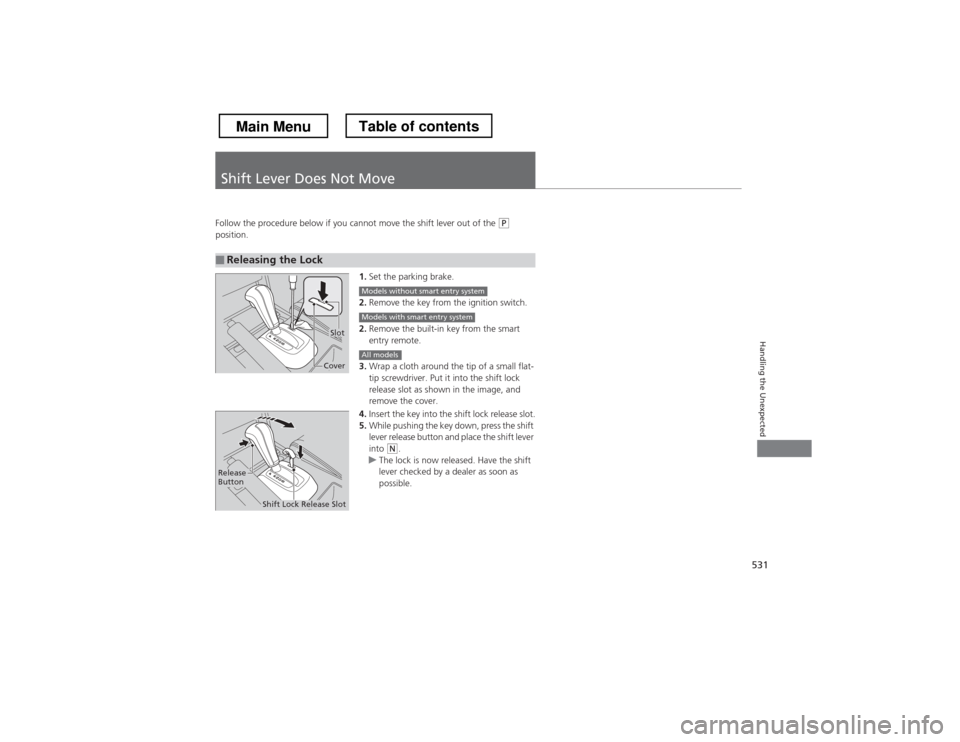
Follow the procedure below if you cannot move the shift lever out of the (P
position.
1.Set the parking brake.
2. Remove the key from the ignition switch.
2. Remove the built-in key from the smart entry remote.
3. Wrap a cloth around the tip of a small flat-
tip screwdriver. Put it into the shift lock
release slot as shown in the image, and remove the cover.
4. Insert the key into the shift lock release slot.
5. While pushing the key down, press the shift
lever release button and place the shift lever
into
(N .uThe lock is now released. Have the shift
lever checked by a dealer as soon as
possible.
■Releasing the Lock
Slot
Cover
Models without smart entry system
Models with smart entry system
All models
Release
Button
Shift Lock Release Slot
Main MenuTable of contents
Page 539 of 573

538
Handling the Unexpected
Fuses
Fuse Locations
If any electrical devices are not working,
turn the ignition switch to LOCK
(0*1
and
check to see if any applicable fuse is blown.
Located near the brake fluid reservoir. Push
the tabs to open the box.
Fuse locations are shown on the fuse box
cover. Locate the fuse in question by the
fuse number and box cover number.
■Engine Compartment Fuse Box
■ Circuit protected and fuse rating
Circuit ProtectedAmps
1Battery120 A *3Battery100 A
*2Passenger’s Fuse Box40 A
2
ESP MTR70 AVSA SFR40 AVSA Motor30 AAS F/B OP40 AHeadlight washer *30 A−−
3
IG Main50 A−−Passenger Side Light Main30 ADR F/B STD60 ADriver Side Light Main30 AMain Fan30 AWiper Motor30 ASub Fan30 A
4 Fan Relay 7.5 A
5Rear Defroster40 A
6 Sub Fan Motor *2
20 A
*1:Models with the smart entry system have an
ENGINE START/STOP button instead of an
ignition switch.
*2:4-cylinder models
*3:6-cylinder models
7Hazard15 A
8 Horn, STOP 20 A
9−−
10 Trailer 15 A
11IG Coil15 A
12 FI Sub 15 A
13IGI Main 1 *330 A
14 IGI Main 2 *3
30 A
15Back up10 A
16 Interior Lights 7.5 A
17FI Main15 A
18 DBW 15 A
19ACM *320 A
20 Heater Motor 40 A
21MG Clutch7.5 A
Circuit ProtectedAmps
* Not available on all models
Main MenuTable of contents
Page 542 of 573

541
uuFusesuInspecting and Changing Fuses
Handling the Unexpected
Inspecting and Changing Fuses1.Turn the ignition switch to LOCK
(0 *1
. Turn
headlights and all accessories off.
2. Remove the fuse box cover.
3. Check the large fuse in the engine
compartment.
uIf the fuse is blown, use a Phillips-head
screwdriver to remove the screw and
replace it with a new one.
4. Inspect the small fuses in the engine
compartment and the vehicle interior.
uIf there is a burned out fuse, remove it
with the fuse puller and replace it with a
new one.
*1: Models with the smart entry system have an ENGINE START/STOP button instead of an
ignition switch.
1Inspecting and Changing Fuses
NOTICEReplacing a fuse with one that has a higher rating
greatly increases the chances of damaging the
electrical system.
Replace fuse with a spare fuse of the same specified
amperage.
Confirm the specified amperage using the charts on
P. 538 to 540.
There is a fuse puller on the back of the engine compartment fuse box cover.
Combined Fuse Blown Fuse
Fuse Puller
Main MenuTable of contents
Page 554 of 573
553
Continued
Information
Emissions Testing
Testing of Readiness Codes
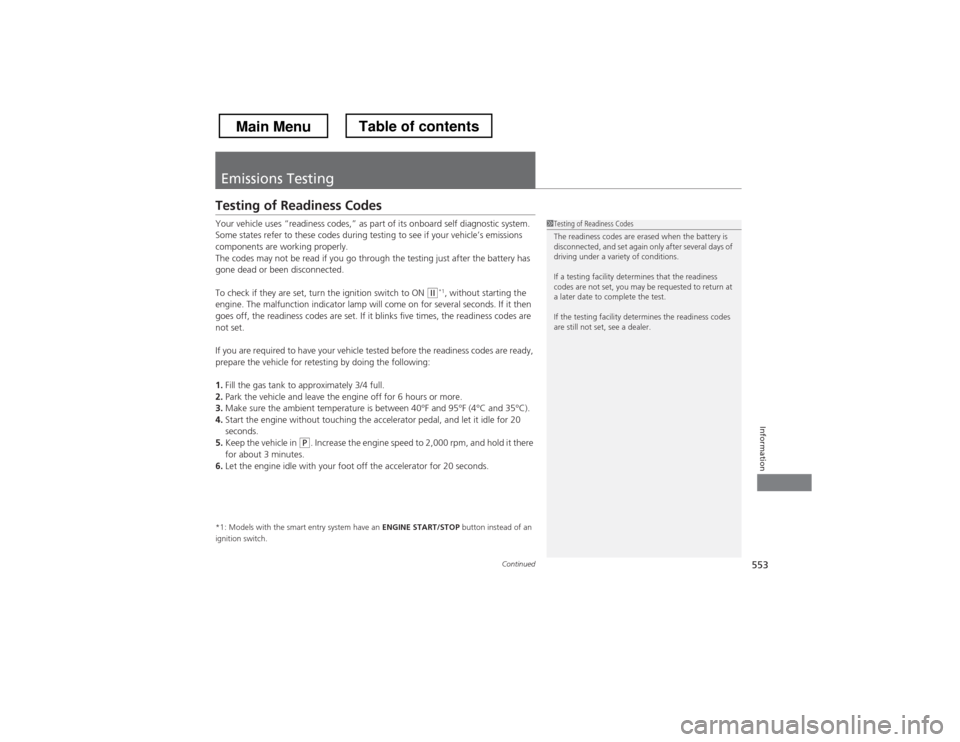
Your vehicle uses “readiness codes,” as part of its onboard self diagnostic system.
Some states refer to these codes during testing to see if your vehicle’s emissions
components are working properly.
The codes may not be read if you go through the testing just after the battery has
gone dead or been disconnected.
To check if they are set, turn the ignition switch to ON
(w *1
, without starting the
engine. The malfunction indicator lamp will come on for several seconds. If it then
goes off, the readiness codes are set. If it blinks five times, the readiness codes are not set.
If you are required to have your vehicle tested before the readiness codes are ready,
prepare the vehicle for retesting by doing the following: 1. Fill the gas tank to approximately 3/4 full.
2. Park the vehicle and leave the engine off for 6 hours or more.
3. Make sure the ambient temperature is between 40°F and 95°F (4°C and 35°C).
4. Start the engine without touching the accelerator pedal, and let it idle for 20
seconds.
5. Keep the vehicle in
(P . Increase the engine speed to 2,000 rpm, and hold it there
for about 3 minutes.
6. Let the engine idle with your foot off the accelerator for 20 seconds.
*1: Models with the smart entry system have an ENGINE START/STOP button instead of an
ignition switch.
1Testing of Readiness Codes
The readiness codes are erased when the battery is
disconnected, and set again only after several days of
driving under a variety of conditions.
If a testing facility determines that the readiness
codes are not set, you may be requested to return at
a later date to complete the test.
If the testing facility determines the readiness codes
are still not set, see a dealer.
Main MenuTable of contents
Page 566 of 573
565
Index
Glass (care)............................................... 513
Glove Box ................................................. 144
H
Halogen Bulbs .......................................... 486
Handling the Unexpected ....................... 515
HandsFreeLink ® (HFL) .............. 320, 332, 367
Auto Answer .................................. 347, 382
Automatic Import of Cellular
Phonebook and Call History .......... 349, 384
Automatic Transferring ................... 347, 382
Displaying Messages ....................... 362, 401
Editing User Name .................................. 381
HFL Buttons ............................ 320, 332, 367
HFL Menus.............................. 322, 334, 369
HFL Status Display ................... 321, 333, 368
Limitations for Manual Operation.... 333, 368
Making a Call ................................. 353, 393
Options During a Call...................... 359, 398
Phone Setup ........................... 324, 339, 373
Phonebook Phonetic Modification........... 388
Receiving a Call............................... 358, 397
Receiving a Text Message/E-mail ..... 360, 399
Ring Tone ....................................... 348, 383
Selecting a Mail Account................. 361, 400
Speed Dial ...................................... 350, 385
To Create a Security PIN .................. 346, 380
To Set Up a Text Message/E-mail Options ......................................... 344, 378
Hard Disc Drive (HDD) Audio .................. 242Hazard Warning Button
............................... 2
Head Restraints ......................................... 136
Headlights ................................................. 119
Aiming .................................................... 484
Automatic Operation ............................... 120
Dimming ......................................... 119, 122
Operating ................................................ 119
Heaters (Seat) ........................................... 153
Heating and Cooling System ................... 154
Cooling ................................................... 156
Defrosting the Windshield and Windows ............................................... 156
Dust and Pollen Filter ............................... 509
Heating ................................................... 155
HFL (HandsFreeLink ®)............... 320, 332, 367
High Beam Indicator .................................. 79
HomeLink ® Universal Transceiver ............ 318
I
Identification Numbers Engine and Transmission ......................... 550
Vehicle Identification ............................... 550
Ignition Switch .......................................... 114
Illumination Control ................................. 125
Knob ....................................................... 125
Immobilizer System .................................. 107
Indicator .................................................... 80
Indicators .................................................... 70
ABS (Anti-lock Brake System) ..................... 73
Charging System ............................... 71, 534 CRUISE CONTROL ............................. 81, 433
CRUISE MAIN .................................... 81, 432
Door and Trunk Open ............................... 74
Door Open ................................................ 31
EPS (Electric Power Steering) System .. 74, 536
Fog Light ................................................... 79
Forward Collision Warning (FCW) .............. 76
High Beam ................................................ 79
Immobilizer System ................................... 80
Lane Departure Warning (LDW) ................. 77
Lights On .................................................. 79
Low Fuel ................................................... 72
Low Oil Pressure ................................ 70, 534
Low Tire Pressure ...................... 75, 446, 447
Maintenance Minder ......................... 81, 465
Malfunction Indicator Lamp............... 71, 535
Parking Brake and Brake System ........ 70, 536
Seat Belt Reminder .............................. 33, 71
Security System Alarm ............................... 80
Side Airbag Off ................................... 52, 79
Smart Entry System ................................... 78
Starter System ........................................... 78
Supplemental Restraint System ............ 50, 73
TPMS ................................................ 75, 448
Transmission ............................................. 72
Turn Signal ................................................ 78
VSA
® (Vehicle Stability Assist)
System ............................................ 73, 442
VSA ® OFF .......................................... 73, 443
Washer Level ............................................. 81
Information .............................................. 545
Main Menu