2013 HONDA CROSSTOUR Fuel
[x] Cancel search: FuelPage 498 of 573
497
Maintenance
Checking and Maintaining Tires
Checking Tires
To safely operate your vehicle, your tires must be of the proper type and size, in
good condition with adequate tread, and properly inflated. ■Inflation guidelines
Properly inflated tires provide the best combination of handling, tread life, and comfort.
Refer to the driver’s doorjamb label or sp ecification’s page for the specified pressure.
Underinflated tires wear unevenly, adversely affect handling and fuel economy, and
are more likely to fail from overheating.
Overinflated tires make your vehicle ride harshly, are more prone to road hazards, and wear unevenly.
Every day before you drive, look at each of the tires. If one looks lower than the
others, check the pressure with a tire gauge.
At least once a month or before long trips, use a gauge to measure the pressure in
all tires, including the spare. Even tires in good condition can lose 1 to 2 psi (10 to
20 kPa, 0.1 to 0.2 kgf/cm 2
) per month.
■ Inspection guidelines
Every time you check inflation, also examine the tires and valve stems.
Look for:• Bumps or bulges on the side or in the tread. Replace the tire if you find any cuts,
splits, or cracks in the side of the tire. Replace it if you see fabric or cord.
• Remove any foreign objects and inspect for air leaks.
• Uneven tread wear. Have a dealer check the wheel alignment.
• Excessive tread wear.
2 Wear Indicators P. 502
• Cracks or other damage around valve stem.
1Checking Tires
Measure the air pressure when tires are cold. This
means the vehicle has been parked for at least three
hours, or driven less than 1 mile (1.6 km). If
necessary, add or release air until the specified
pressure is reached.
If checked when hot, tire pressure can be as much as
4–6 psi (30–40 kPa, 0.3–0.4 kgf/cm 2
) higher than if
checked when cold.
Have a dealer check the tires if you feel a consistent
vibration while driving. New tires and any that have
been removed and reinstalled should be properly balanced.
3WARNING
Using tires that are excessively worn or
improperly inflated can cause a crash in
which you can be seriously hurt or killed.
Follow all instruction s in this owner
Page 516 of 573
515
Handling the UnexpectedThis chapter explains how to h andle unexpected troubles.
Tools
Types of Tools .................................. 516
If a Tire Goes Flat Changing a Flat Tire ......................... 517
Engine Does Not Start Checking the Engine ........................ 525
If the Smart Entry Remote Battery is
Weak ..........................................526
Emergency Engine Stop ................... 527
Jump Starting .................................... 528
Shift Lever Does Not Move .............. 531Overheating
How to Handle Overheating............. 532
Indicator, Coming On/Blinking If the Low Oil Pressure Indicator Comes
On................................................ 534
If the Charging System Indicator Comes On ................................................. 534
If the Malfunction Indicator Lamp Comes On or Blinks ................................... 535
If the Brake System Indicator (Red) Comes
On ................................................... 536
If the EPS System Indicator Comes On... 536 If the Low Tire Pressure Indicator Comes
On ................................................. 537
If the TPMS Indicator Comes On ...... 537
Fuses
Fuse Locations ................................. 538
Inspecting and Changing Fuses ........ 541
Emergency Towing ........................... 542
When You Cannot Unlock the Fuel Fill Door ................................................. 543
When You Cannot Open the Tailgate .. 544
Main Menu
Page 536 of 573
535
uuIndicator, Coming On/BlinkinguIf the Malfunction Indicator Lamp Comes On or Blinks
Handling the Unexpected
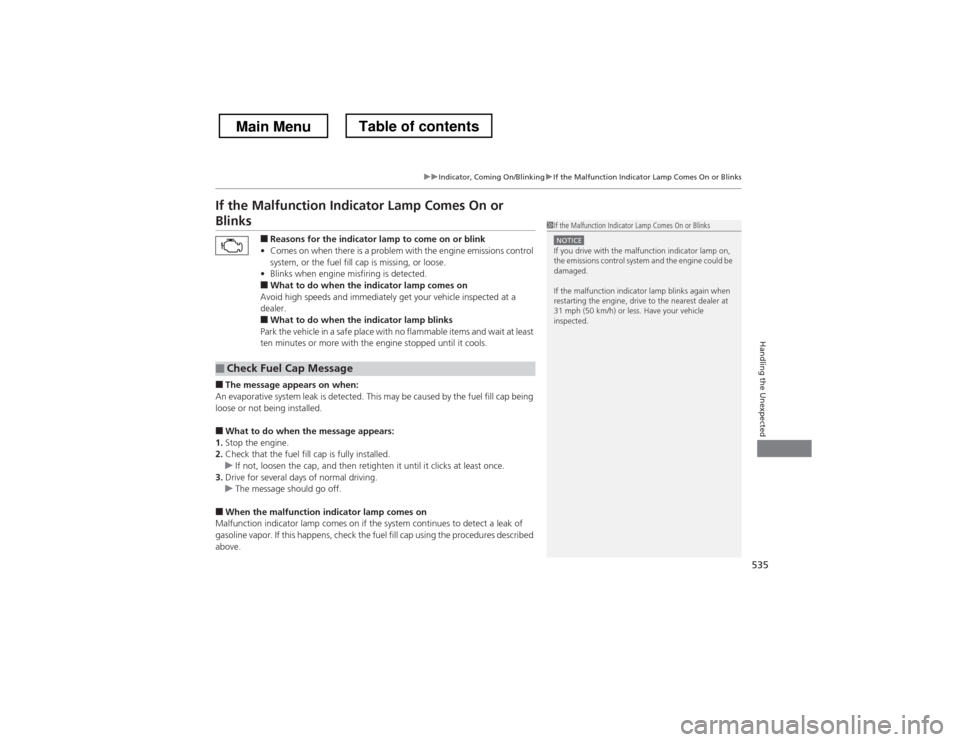
If the Malfunction Indicator Lamp Comes On or
Blinks■Reasons for the indicator lamp to come on or blink
• Comes on when there is a problem with the engine emissions control
system, or the fuel fill cap is missing, or loose.
• Blinks when engine misfiring is detected.
■ What to do when the indicator lamp comes on
Avoid high speeds and immediately get your vehicle inspected at a dealer.
■ What to do when the indicator lamp blinks
Park the vehicle in a safe place with no flammable items and wait at least
ten minutes or more with the engine stopped until it cools.
■ The message appears on when:
An evaporative system leak is detected. This may be caused by the fuel fill cap being
loose or not being installed.
■ What to do when the message appears:
1. Stop the engine.
2. Check that the fuel fill cap is fully installed.
uIf not, loosen the cap, and then retighten it until it clicks at least once.
3. Drive for several days of normal driving.
uThe message should go off.
■ When the malfunction indicator lamp comes on
Malfunction indicator lamp comes on if the system continues to detect a leak of
gasoline vapor. If this happens, check the fuel fill cap using the procedures described above.
■Check Fuel Cap Message
1If the Malfunction Indicator Lamp Comes On or Blinks
NOTICEIf you drive with the malfunction indicator lamp on,
the emissions control system and the engine could be damaged.
If the malfunction indicator lamp blinks again when
restarting the engine, drive to the nearest dealer at
31 mph (50 km/h) or less. Have your vehicle
inspected.
Main MenuTable of contents
Page 540 of 573

539
uuFusesuFuse Locations
Continued
Handling the Unexpected
Locate the fuse in question by the fuse
number and label number.
Located under the dashboard.
Fuse locations are shown on the label under the dashboard.
■Interior Fuse Box
Fuse Label
Fuse Box
Driver side
Located on the lower side panel. Take off the cover to open.
Fuse locations are shown on the fuse box
cover.Passenger side
■Circuit protected and fuse rating
Circuit ProtectedAmps1−−2Seat Memory *7.5 A3Washer15 A4Wiper10 A5ODS7.5 A6ABS/VSA7.5 A7−−8−−9Fuel Pump20 A10VB SOL 210 A11Meter7.5 A12ACG15 A13SRS10 A14−−15Daytime Running Lights7.5 A16A/C7.5 A
Driver side
* Not available on all models
Main MenuTable of contents
Page 544 of 573
543
Handling the Unexpected
When You Cannot Unlock the Fuel Fill Door
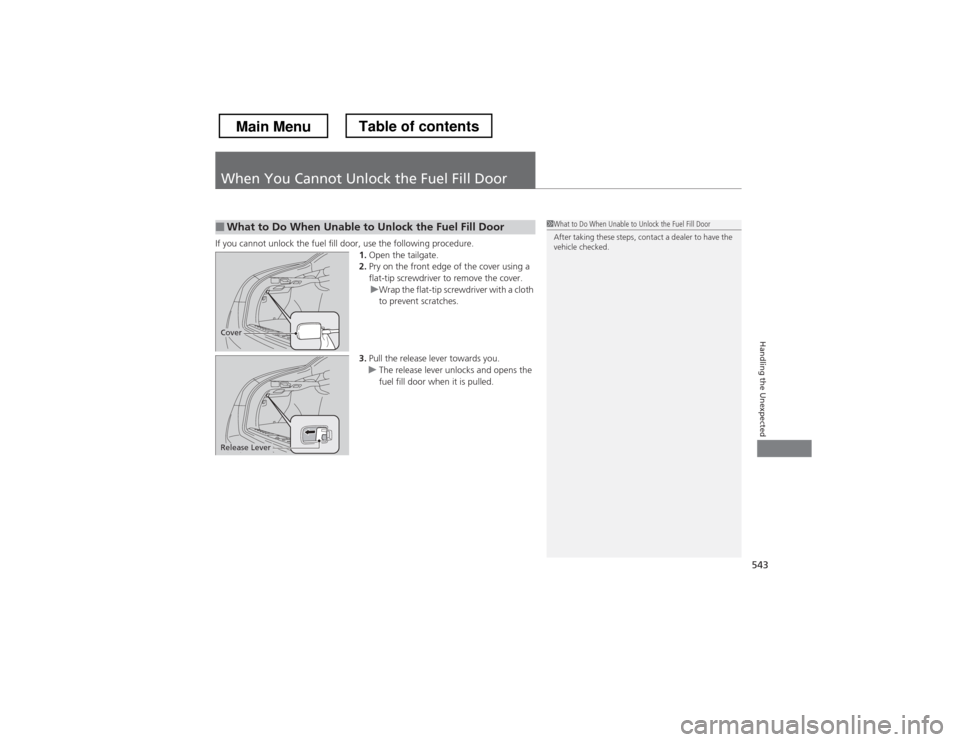
If you cannot unlock the fuel fill door, use the following procedure.1.Open the tailgate.
2. Pry on the front edge of the cover using a
flat-tip screwdriver to remove the cover.
uWrap the flat-tip screwdriver with a cloth
to prevent scratches.
3. Pull the release lever towards you.
uThe release lever unlocks and opens the
fuel fill door when it is pulled.
■What to Do When Unable to Unlock the Fuel Fill Door1What to Do When Unable to Unlock the Fuel Fill Door
After taking these steps, contact a dealer to have the
vehicle checked.
Cover
Release Lever
Main MenuTable of contents
Page 547 of 573
546
Information
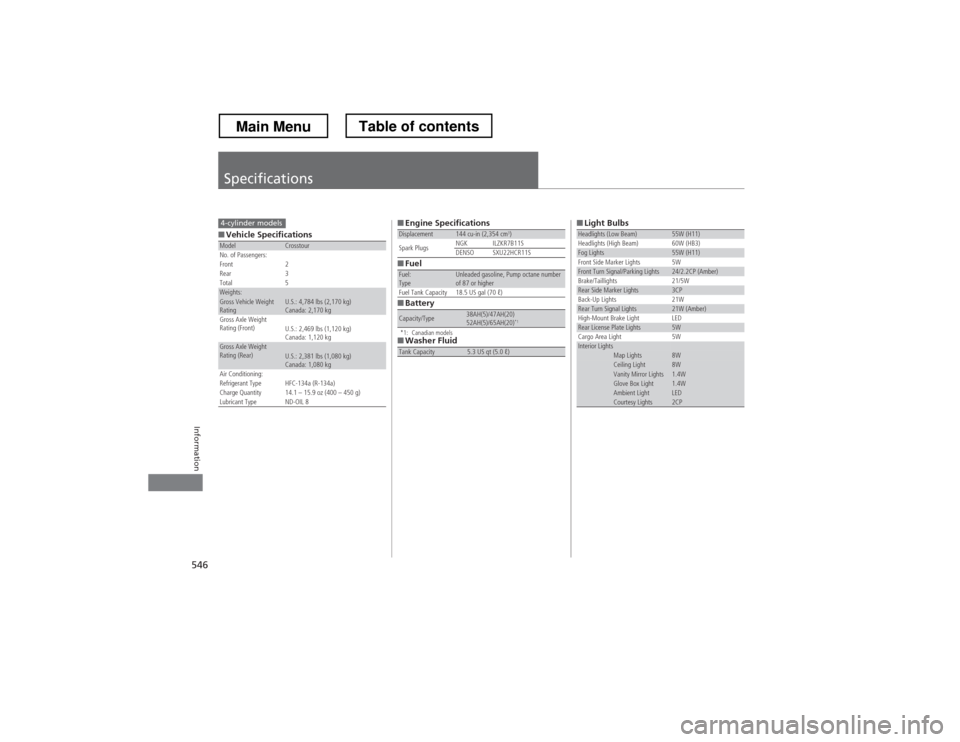
Specifications
■Vehicle SpecificationsModelCrosstour
No. of Passengers:
Front 2
Rear 3
Total 5
Weights:Gross Vehicle Weight
Rating U.S.: 4,784 lbs (2,170 kg)
Canada: 2,170 kg
Gross Axle Weight
Rating (Front)U.S.: 2,469 lbs (1,120 kg)
Canada: 1,120 kg
Gross Axle Weight
Rating (Rear)U.S.: 2,381 lbs (1,080 kg)
Canada: 1,080 kg
Air Conditioning:
Refrigerant Type HFC-134a (R-134a)
Charge Quantity 14.1 – 15.9 oz (400 – 450 g)
Lubricant Type ND-OIL 8
4-cylinder models■Engine Specifications
■Fuel
■Battery
*1: Canadian models
■Washer Fluid
Displacement144 cu-in (2,354 cm 3
)
Spark Plugs NGK ILZKR7B11S
DENSO SXU22HCR11S
Fuel: TypeUnleaded gasoline, Pump octane number
of 87 or higher
Fuel Tank Capacity 18.5 US gal (70 ℓ)
Capacity/Type38AH(5)/47AH(20)
52AH(5)/65AH(20) *1
Tank Capacity5.3 US qt (5.0 ℓ)
■Light BulbsHeadlights (Low Beam)55W (H11)
Headlights (High Beam) 60W (HB3)
Fog Lights55W (H11)
Front Side Marker Lights 5W
Front Turn Signal/Parking Lights24/2.2CP (Amber)
Brake/Taillights 21/5W
Rear Side Marker Lights3CP
Back-Up Lights 21W
Rear Turn Signal Lights21W (Amber)
High-Mount Brake Light LED
Rear License Plate Lights5W
Cargo Area Light 5W
Interior LightsMap Lights8WCeiling Light8WVanity Mirror Lights1.4WGlove Box Light1.4WAmbient LightLEDCourtesy Lights2CP
Main MenuTable of contents
Page 549 of 573
548
uuSpecificationsu
Information
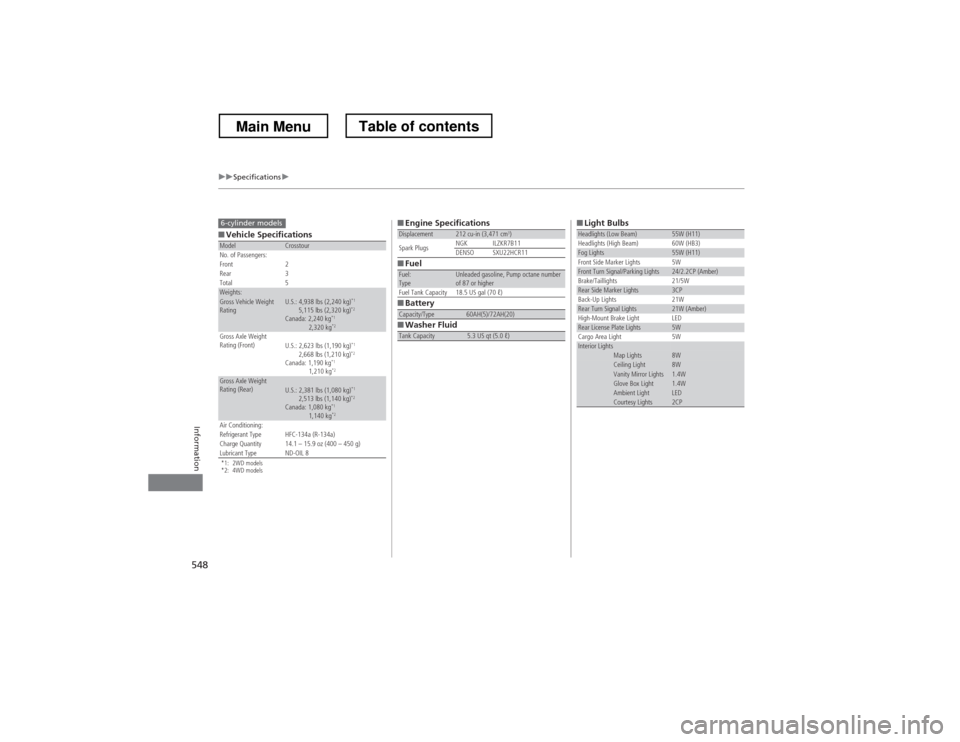
■Vehicle Specifications
*1: 2WD models
*2: 4WD modelsModelCrosstour
No. of Passengers:
Front 2
Rear 3
Total 5
Weights:Gross Vehicle Weight
Rating U.S.: 4,938 lbs (2,240 kg) *1
5,115 lbs (2,320 kg) *2
Canada: 2,240 kg *1
2,320 kg *2
Gross Axle Weight
Rating (Front)U.S.: 2,623 lbs (1,190 kg)
*1
2,668 lbs (1,210 kg) *2
Canada: 1,190 kg *1
1,210 kg *2
Gross Axle Weight
Rating (Rear)U.S.: 2,381 lbs (1,080 kg) *1
2,513 lbs (1,140 kg) *2
Canada: 1,080 kg *1
1,140 kg *2
Air Conditioning:
Refrigerant Type HFC-134a (R-134a)
Charge Quantity 14.1 – 15.9 oz (400 – 450 g)
Lubricant Type ND-OIL 8
6-cylinder models■Engine Specifications
■Fuel
■Battery
■Washer Fluid
Displacement212 cu-in (3,471 cm 3
)
Spark Plugs NGK ILZKR7B11
DENSO SXU22HCR11
Fuel: TypeUnleaded gasoline, Pump octane number
of 87 or higher
Fuel Tank Capacity 18.5 US gal (70 ℓ)
Capacity/Type60AH(5)/72AH(20)
Tank Capacity5.3 US qt (5.0 ℓ)
■Light BulbsHeadlights (Low Beam)55W (H11)
Headlights (High Beam) 60W (HB3)
Fog Lights55W (H11)
Front Side Marker Lights 5W
Front Turn Signal/Parking Lights24/2.2CP (Amber)
Brake/Taillights 21/5W
Rear Side Marker Lights3CP
Back-Up Lights 21W
Rear Turn Signal Lights21W (Amber)
High-Mount Brake Light LED
Rear License Plate Lights5W
Cargo Area Light 5W
Interior LightsMap Lights8WCeiling Light8WVanity Mirror Lights1.4WGlove Box Light1.4WAmbient LightLEDCourtesy Lights2CP
Main MenuTable of contents
Page 566 of 573
565
Index
Glass (care)............................................... 513
Glove Box ................................................. 144
H
Halogen Bulbs .......................................... 486
Handling the Unexpected ....................... 515
HandsFreeLink ® (HFL) .............. 320, 332, 367
Auto Answer .................................. 347, 382
Automatic Import of Cellular
Phonebook and Call History .......... 349, 384
Automatic Transferring ................... 347, 382
Displaying Messages ....................... 362, 401
Editing User Name .................................. 381
HFL Buttons ............................ 320, 332, 367
HFL Menus.............................. 322, 334, 369
HFL Status Display ................... 321, 333, 368
Limitations for Manual Operation.... 333, 368
Making a Call ................................. 353, 393
Options During a Call...................... 359, 398
Phone Setup ........................... 324, 339, 373
Phonebook Phonetic Modification........... 388
Receiving a Call............................... 358, 397
Receiving a Text Message/E-mail ..... 360, 399
Ring Tone ....................................... 348, 383
Selecting a Mail Account................. 361, 400
Speed Dial ...................................... 350, 385
To Create a Security PIN .................. 346, 380
To Set Up a Text Message/E-mail Options ......................................... 344, 378
Hard Disc Drive (HDD) Audio .................. 242Hazard Warning Button
............................... 2
Head Restraints ......................................... 136
Headlights ................................................. 119
Aiming .................................................... 484
Automatic Operation ............................... 120
Dimming ......................................... 119, 122
Operating ................................................ 119
Heaters (Seat) ........................................... 153
Heating and Cooling System ................... 154
Cooling ................................................... 156
Defrosting the Windshield and Windows ............................................... 156
Dust and Pollen Filter ............................... 509
Heating ................................................... 155
HFL (HandsFreeLink ®)............... 320, 332, 367
High Beam Indicator .................................. 79
HomeLink ® Universal Transceiver ............ 318
I
Identification Numbers Engine and Transmission ......................... 550
Vehicle Identification ............................... 550
Ignition Switch .......................................... 114
Illumination Control ................................. 125
Knob ....................................................... 125
Immobilizer System .................................. 107
Indicator .................................................... 80
Indicators .................................................... 70
ABS (Anti-lock Brake System) ..................... 73
Charging System ............................... 71, 534 CRUISE CONTROL ............................. 81, 433
CRUISE MAIN .................................... 81, 432
Door and Trunk Open ............................... 74
Door Open ................................................ 31
EPS (Electric Power Steering) System .. 74, 536
Fog Light ................................................... 79
Forward Collision Warning (FCW) .............. 76
High Beam ................................................ 79
Immobilizer System ................................... 80
Lane Departure Warning (LDW) ................. 77
Lights On .................................................. 79
Low Fuel ................................................... 72
Low Oil Pressure ................................ 70, 534
Low Tire Pressure ...................... 75, 446, 447
Maintenance Minder ......................... 81, 465
Malfunction Indicator Lamp............... 71, 535
Parking Brake and Brake System ........ 70, 536
Seat Belt Reminder .............................. 33, 71
Security System Alarm ............................... 80
Side Airbag Off ................................... 52, 79
Smart Entry System ................................... 78
Starter System ........................................... 78
Supplemental Restraint System ............ 50, 73
TPMS ................................................ 75, 448
Transmission ............................................. 72
Turn Signal ................................................ 78
VSA
® (Vehicle Stability Assist)
System ............................................ 73, 442
VSA ® OFF .......................................... 73, 443
Washer Level ............................................. 81
Information .............................................. 545
Main Menu