2013 HONDA CIVIC HYBRID tire pressure
[x] Cancel search: tire pressurePage 303 of 346
uuIf a Tire Goes FlatuTemporarily Repairing a Flat Tire
302Handling the Unexpected
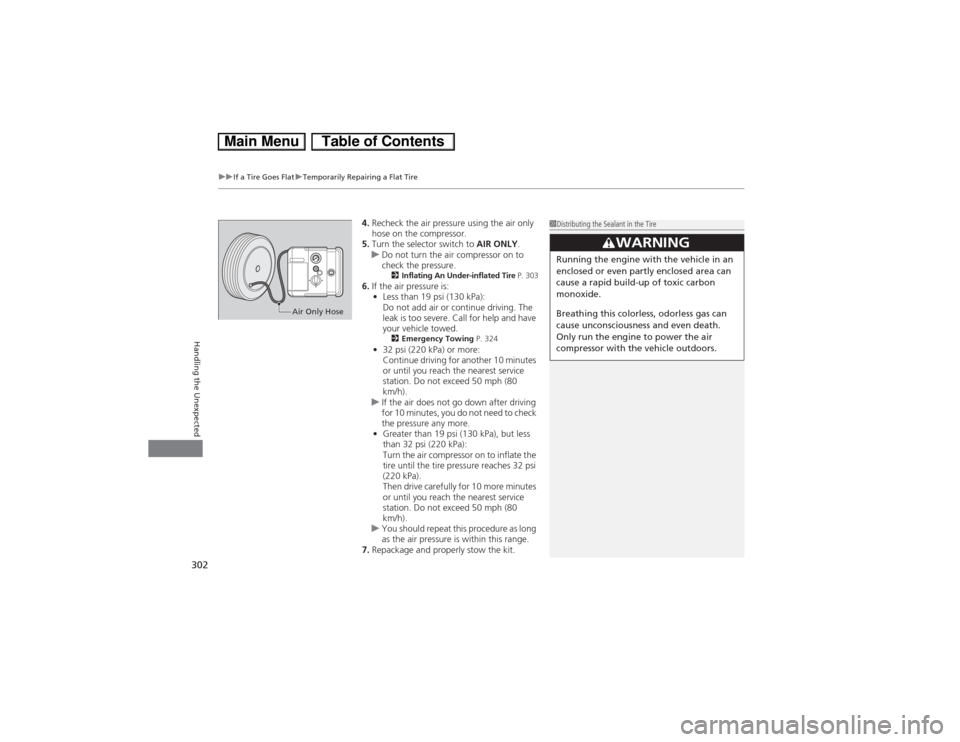
4.Recheck the air pressure using the air only
hose on the compressor.
5.Turn the selector switch to AIR ONLY.
uDo not turn the air compressor on to
check the pressure.
2Inflating An Under-inflated Tire P. 303
6.If the air pressure is:
•Less than 19 psi (130 kPa):
Do not add air or continue driving. The
leak is too severe. Call for help and have
your vehicle towed.
2Emergency Towing P. 324
•32 psi (220 kPa) or more:
Continue driving for another 10 minutes
or until you reach the nearest service
station. Do not exceed 50 mph (80
km/h).
uIf the air does not go down after driving
for 10 minutes, you do not need to check
the pressure any more.
•Greater than 19 psi (130 kPa), but less
than 32 psi (220 kPa):
Turn the air compressor on to inflate the
tire until the tire pressure reaches 32 psi
(220 kPa).
Then drive carefully for 10 more minutes
or until you reach the nearest service
station. Do not exceed 50 mph (80
km/h).
uYou should repeat this procedure as long
as the air pressure is within this range.
7.Repackage and properly stow the kit.
1Distributing the Sealant in the Tire
3
WARNING
Running the engine with the vehicle in an
enclosed or even partly enclosed area can
cause a rapid build-up of toxic carbon
monoxide.
Breathing this colorless, odorless gas can
cause unconsciousness and even death.
Only run the engine to power the air
compressor with the vehicle outdoors.
Air Only Hose
Page 305 of 346
uuIf a Tire Goes FlatuTemporarily Repairing a Flat Tire
304Handling the Unexpected
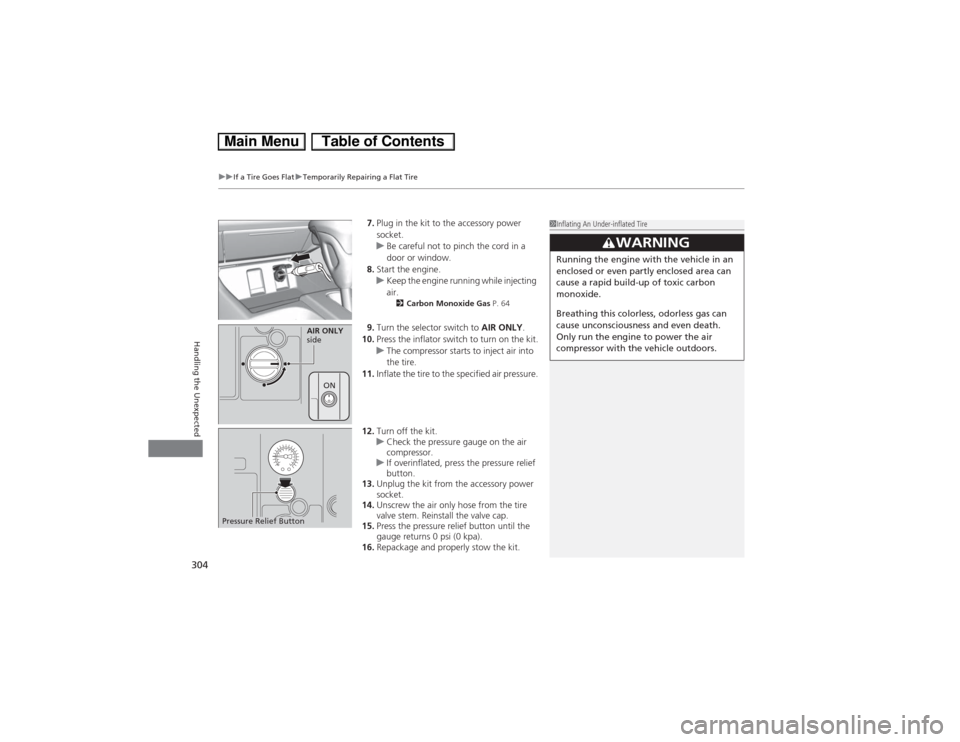
7.Plug in the kit to the accessory power
socket.
uBe careful not to pinch the cord in a
door or window.
8.Start the engine.
uKeep the engine running while injecting
air.
2Carbon Monoxide Gas P. 64
9.Turn the selector switch to AIR ONLY.
10.Press the inflator switch to turn on the kit.
uThe compressor starts to inject air into
the tire.
11.Inflate the tire to the specified air pressure.
12.Turn off the kit.
uCheck the pressure gauge on the air
compressor.
uIf overinflated, press the pressure relief
button.
13.Unplug the kit from the accessory power
socket.
14.Unscrew the air only hose from the tire
valve stem. Reinstall the valve cap.
15.Press the pressure relief button until the
gauge returns 0 psi (0 kpa).
16.Repackage and properly stow the kit.
1Inflating An Under-inflated Tire
3
WARNING
Running the engine with the vehicle in an
enclosed or even partly enclosed area can
cause a rapid build-up of toxic carbon
monoxide.
Breathing this colorless, odorless gas can
cause unconsciousness and even death.
Only run the engine to power the air
compressor with the vehicle outdoors.
AIR ONLY
side
ON
Pressure Relief Button
Page 306 of 346
305
uuIf a Tire Goes FlatuChanging a Flat Tire
Continued
Handling the Unexpected
Changing a Flat TireIf a tire goes flat while driving, grasp the steering wheel firmly, and brake gradually
to reduce speed. Then, stop in a safe place. Replace the flat tire with a compact
spare tire. Go to a dealer as soon as possible to have the full-size tire repaired or
replaced.
1.Park the vehicle on firm, level, non-slippery surface, and apply the parking brake.
2.Move the shift lever to
(P.
3.Set the parking brake.
4.Turn on the hazard warning lights and turn the ignition switch to LOCK
(0.
Models with optional compact spare tire
1Changing a Flat Tire
Follow compact spare precautions:
Periodically check the tire pressure of the compact
spare. It should be set to the specified pressure.
Specified Pressure: 60 psi (420 kPa, 4.2 kgf/cm
2)
When driving with the compact spare tire, keep the
vehicle speed under 50 mph (80 km/h). Replace with
a full-size tire as soon as possible.
The compact spare tire and wheel in your vehicle are
specifically for this model.
Do not use them with another vehicle.
Do not use another type of compact spare tire or
wheel with your vehicle.
Do not mount tire chains on a compact spare tire.
If a chain-mounted front tire goes flat, remove one of
the full-size rear tires and replace it with the compact
spare tire. Remove the flat front tire and replace it
with the full-size tire that was removed from the rear.
Mount the tire chains on the front tire.
Do not use a puncture-repairing agent other than the
Tire Repair Kit provided with your vehicle, as some
tire repair agents can cause damage to the pressure
sensors.
U.S. models only
Page 311 of 346

uuIf a Tire Goes FlatuChanging a Flat Tire
310Handling the Unexpected
1.Remove the center cap.
2.Place the flat tire face down in the compact
spare tire well.
3.Remove the spacer cone from the wing
bolt, flip it over, and insert it back on the
bolt. Secure the flat tire with the wing bolt.
4.Securely put the jack and wheel nut wrench
back in the tool case. Store the case in the
trunk.
If you replace a flat tire with the compact spare tire, the low tire pressure/TPMS
indicator comes on while you are driving. After driving for a few miles (kilometers),
the indicator will start blinking for a short time and then stay on. CHECK TPMS
SYSTEM appears on the intelligent multi-information display (i-MID), but this is
normal.
If you replace the tire with a specified regular tire, the warning message on the i-MID
and the low tire pressure/TPMS indicator will go off after a few miles (kilometers).
■Storing the Flat Tire
1Storing the Flat Tire
3
WARNING
Loose items can fly around the interior in a
crash and can seriously injure the
occupants.
Store the wheel, jack, and tools securely
before driving.
Spacer
Cone Wing Bolt
For compact spare tireFor normal
tire■TPMS and the Compact Spare Tire
1TPMS and the Compact Spare Tire
The system cannot monitor the pressure of the
compact spare tire. Manually check the compact
spare tire pressure to be sure that it is correct.
Use TPMS specific wheels. Each is equipped with a
tire pressure sensor mounted inside the tire behind
the valve stem.
U.S. models
Page 321 of 346
320
uuIndicator, Coming On/BlinkinguIf the IMA Indicator Comes On
Handling the Unexpected
If the IMA Indicator Comes On
■Reasons for the indicator to come on
Comes on when there is a problem with the IMA system.■What to do when the indicator come on
Avoid high speeds and immediately get your vehicle inspected by a
dealer.
If the Low Tire Pressure/TPMS Indicator Comes On or Blinks
■Reasons for the indicator to come on or blink
A tire pressure is significantly low. If there is a problem with the TPMS or
the compact spare tire is installed, the indicator blinks for about one
minute, and then stays on.■What to do when the indicator comes on
Stop your vehicle in a safe place. Check the tire pressure and adjust the
pressure to the specified level. The specified tire pressure is on a label on
the driver side doorjamb.■What to do when the indicator blinks
Have the tire inspected by a dealer as soon as possible. If the compact
spare tire
* causes the indicator to blink, change the tire to a full-size tire.
The indicator goes off after driving for a few miles (kilometers).
U.S. models
1If the Low Tire Pressure/TPMS Indicator Comes On or BlinksNOTICEDriving on an extremely underinflated tire can cause
it to overheat. An overheated tire can fail. Always
inflate your tires to the prescribed level.
* Not available on all models
Page 328 of 346
327
uuSpecificationsu
Information
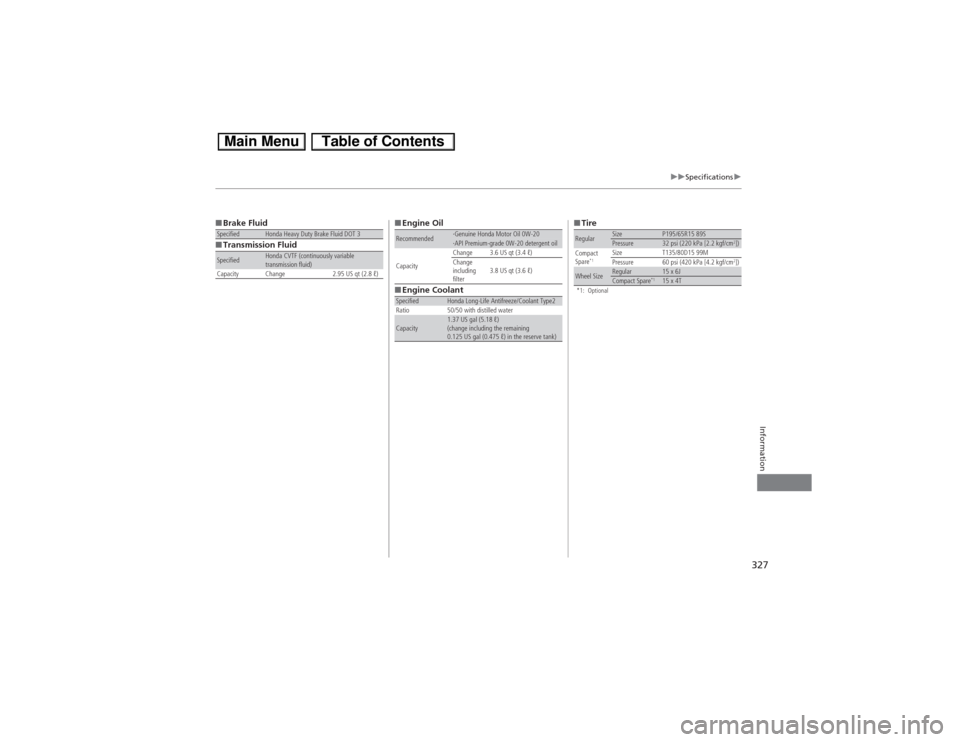
■Brake Fluid
■Transmission FluidSpecified
Honda Heavy Duty Brake Fluid DOT 3
Specified
Honda CVTF (continuously variable
transmission fluid)
Capacity Change 2.95 US qt (2.8 ℓ)
■Engine Oil
■Engine CoolantRecommended
·Genuine Honda Motor Oil 0W-20·API Premium-grade 0W-20 detergent oil
CapacityChange 3.6 US qt (3.4 ℓ)
Change
including
filter3.8 US qt (3.6 ℓ)
Specified
Honda Long-Life Antifreeze/Coolant Type2
Ratio 50/50 with distilled water
Capacity
1.37 US gal (5.18 ℓ)
(change including the remaining
0.125 US gal (0.475 ℓ) in the reserve tank)
■Tire*1: OptionalRegular
Size
P195/65R15 89S
Pressure
32 psi (220 kPa [2.2 kgf/cm
2])
Compact
Spare
*1
Size T135/80D15 99M
Pressure 60 psi (420 kPa [4.2 kgf/cm
2])
Wheel Size
Regular
15 x 6J
Compact Spare
*115 x 4T
Page 330 of 346
329Information
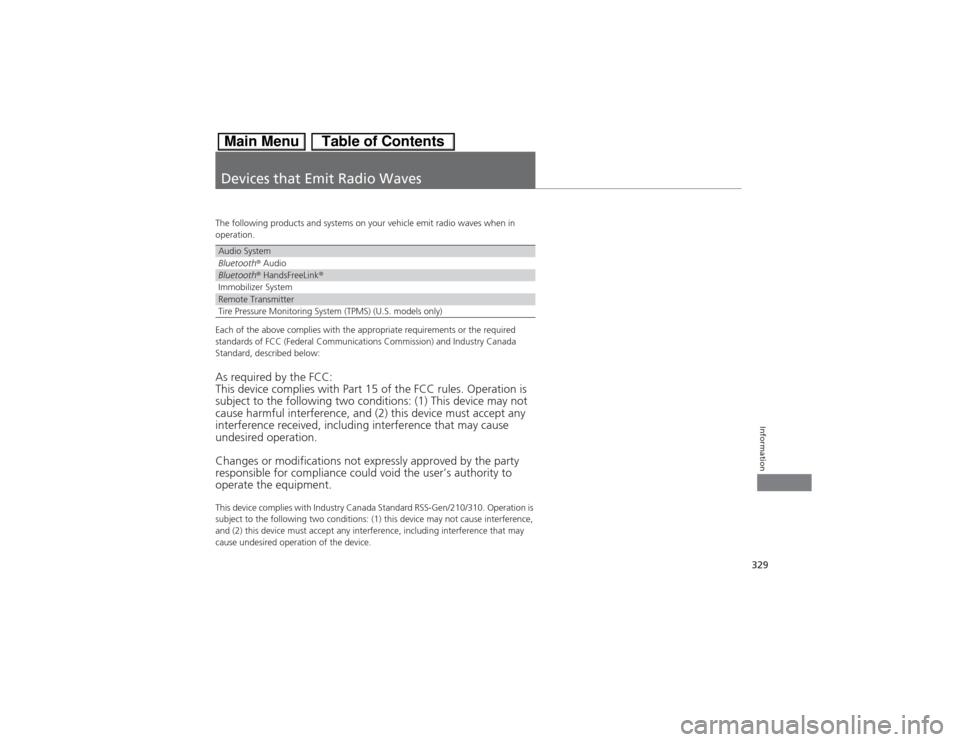
Devices that Emit Radio WavesThe following products and systems on your vehicle emit radio waves when in
operation.
Each of the above complies with the appropriate requirements or the required
standards of FCC (Federal Communications Commission) and Industry Canada
Standard, described below:As required by the FCC:
This device complies with Part 15 of the FCC rules. Operation is
subject to the following two conditions: (1) This device may not
cause harmful interference, and (2) this device must accept any
interference received, including interference that may cause
undesired operation.
Changes or modifications not expressly approved by the party
responsible for compliance could void the user’s authority to
operate the equipment.This device complies with Industry Canada Standard RSS-Gen/210/310. Operation is
subject to the following two conditions: (1) this device may not cause interference,
and (2) this device must accept any interference, including interference that may
cause undesired operation of the device.Audio SystemBluetooth® AudioBluetooth® HandsFreeLink®Immobilizer SystemRemote TransmitterTire Pressure Monitoring System (TPMS) (U.S. models only)
Page 340 of 346
339Index
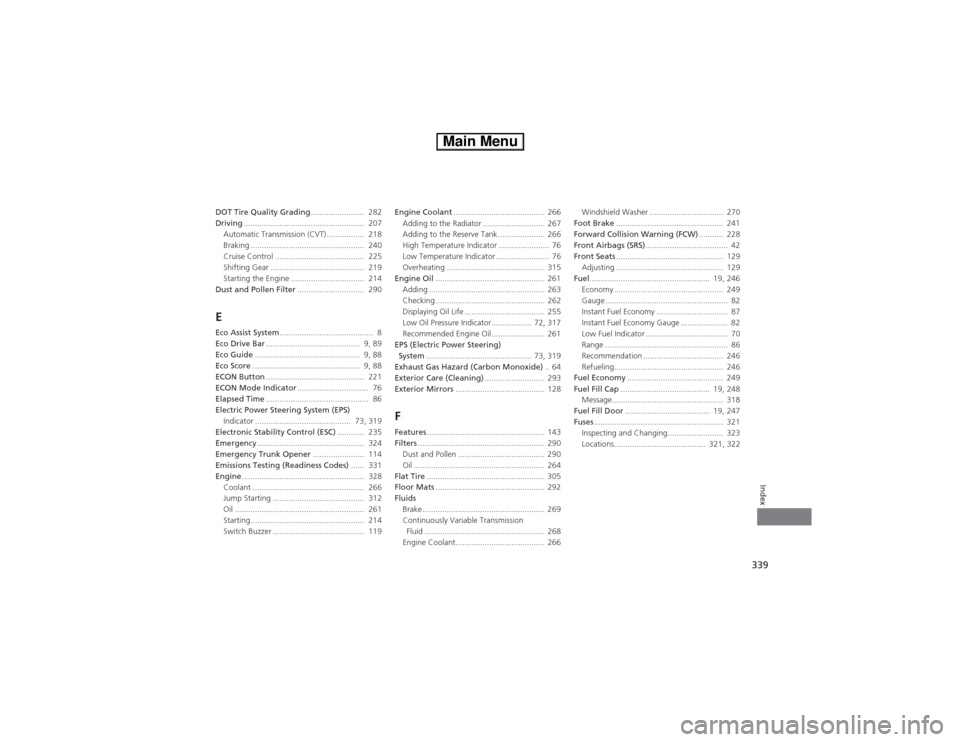
DOT Tire Quality Grading........................ 282
Driving...................................................... 207
Automatic Transmission (CVT)................. 218
Braking ................................................... 240
Cruise Control ........................................ 225
Shifting Gear .......................................... 219
Starting the Engine ................................. 214
Dust and Pollen Filter.............................. 290EEco Assist System.......................................... 8
Eco Drive Bar.......................................... 9, 89
Eco Guide............................................... 9, 88
Eco Score................................................ 9, 88
ECON Button............................................ 221
ECON Mode Indicator................................ 76
Elapsed Time.............................................. 86
Electric Power Steering System (EPS)
Indicator ........................................... 73, 319
Electronic Stability Control (ESC)............ 235
Emergency................................................ 324
Emergency Trunk Opener....................... 114
Emissions Testing (Readiness Codes)...... 331
Engine....................................................... 328
Coolant .................................................. 266
Jump Starting ......................................... 312
Oil .......................................................... 261
Starting................................................... 214
Switch Buzzer ......................................... 119Engine Coolant......................................... 266
Adding to the Radiator ............................ 267
Adding to the Reserve Tank ..................... 266
High Temperature Indicator ....................... 76
Low Temperature Indicator ........................ 76
Overheating ............................................ 315
Engine Oil................................................. 261
Adding .................................................... 263
Checking ................................................. 262
Displaying Oil Life .................................... 255
Low Oil Pressure Indicator.................. 72, 317
Recommended Engine Oil........................ 261
EPS (Electric Power Steering)
System............................................... 73, 319
Exhaust Gas Hazard (Carbon Monoxide).. 64
Exterior Care (Cleaning)........................... 293
Exterior Mirrors........................................ 128
FFeatures..................................................... 143
Filters......................................................... 290
Dust and Pollen ....................................... 290
Oil ........................................................... 264
Flat Tire..................................................... 305
Floor Mats................................................. 292
Fluids
Brake....................................................... 269
Continuously Variable Transmission
Fluid ...................................................... 268
Engine Coolant........................................ 266Windshield Washer ................................. 270
Foot Brake................................................ 241
Forward Collision Warning (FCW)........... 228
Front Airbags (SRS)..................................... 42
Front Seats................................................ 129
Adjusting ................................................ 129
Fuel...................................................... 19, 246
Economy ................................................. 249
Gauge ....................................................... 82
Instant Fuel Economy ................................ 87
Instant Fuel Economy Gauge ..................... 82
Low Fuel Indicator ..................................... 70
Range ....................................................... 86
Recommendation .................................... 246
Refueling................................................. 246
Fuel Economy........................................... 249
Fuel Fill Cap........................................ 19, 248
Message.................................................. 318
Fuel Fill Door...................................... 19, 247
Fuses.......................................................... 321
Inspecting and Changing......................... 323
Locations......................................... 321, 322