Page 270 of 563

Snowplowing with your Air Bag Equipped Vehicle
WARNING:Do not attempt to service, repair, or modify the air
bag supplemental restraint system (SRS) or its fuses. See your
Ford or Lincoln Mercury dealer.
WARNING:Additional equipment such as snowplow equipment
may effect the performance of the air bag sensors increasing the
risk of injury. Please refer to theBody Builders Layout Bookfor
instructions about the appropriate installation of additional equipment.
WARNING:All occupants of the vehicle, including the driver,
should always properly wear their safety belts, even when an air
bag supplemental restraint system (SRS) is provided.
Your vehicle is equipped with a driver and passenger air bag
supplemental restraint system. The supplemental restrain system is
designed to activate in certain frontal and offset frontal collisions when
the vehicle sustains sufficient longitudinal deceleration.
Careless or high speed driving while plowing snow which results in
sufficient vehicle decelerations can deploy the air bag. Such driving also
increases the risk of accidents.
Never remove or defeat the tripping mechanisms designed into the snow
removal equipment by its manufacturer. Doing so may cause damage to
the vehicle and the snow removal equipment as well as possible air bag
deployment.
Engine temperature while plowing
When driving with a plow, your engine may run at a higher temperature
than normal because the attached snowplow blade will restrict airflow to
the radiator.
If you are driving more than 15 miles (24 kilometers) at temperatures
above freezing, angle the plow blade either full left or full right to
provide maximum airflow to the radiator.
If you are driving less than 15 miles (24 kilometers) at speeds up to
45 mph (72 km/h) in cold weather, you will not need to worry about
blade position to provide maximum airflow.
Driving Hints269
2013 F-250/350/450/550(f23)
Owners Guide gf, 1st Printing
USA(fus)
Page 286 of 563
CHANGING A FUSE
Fuses
WARNING:Always replace a fuse with one that has the
specified amperage rating. Using a fuse with a higher amperage
rating can cause severe wire damage and could start a fire.
If electrical components in the vehicle
are not working, a fuse may have
blown. Blown fuses are identified by a
broken wire within the fuse. Check
the appropriate fuses before replacing
any electrical components.
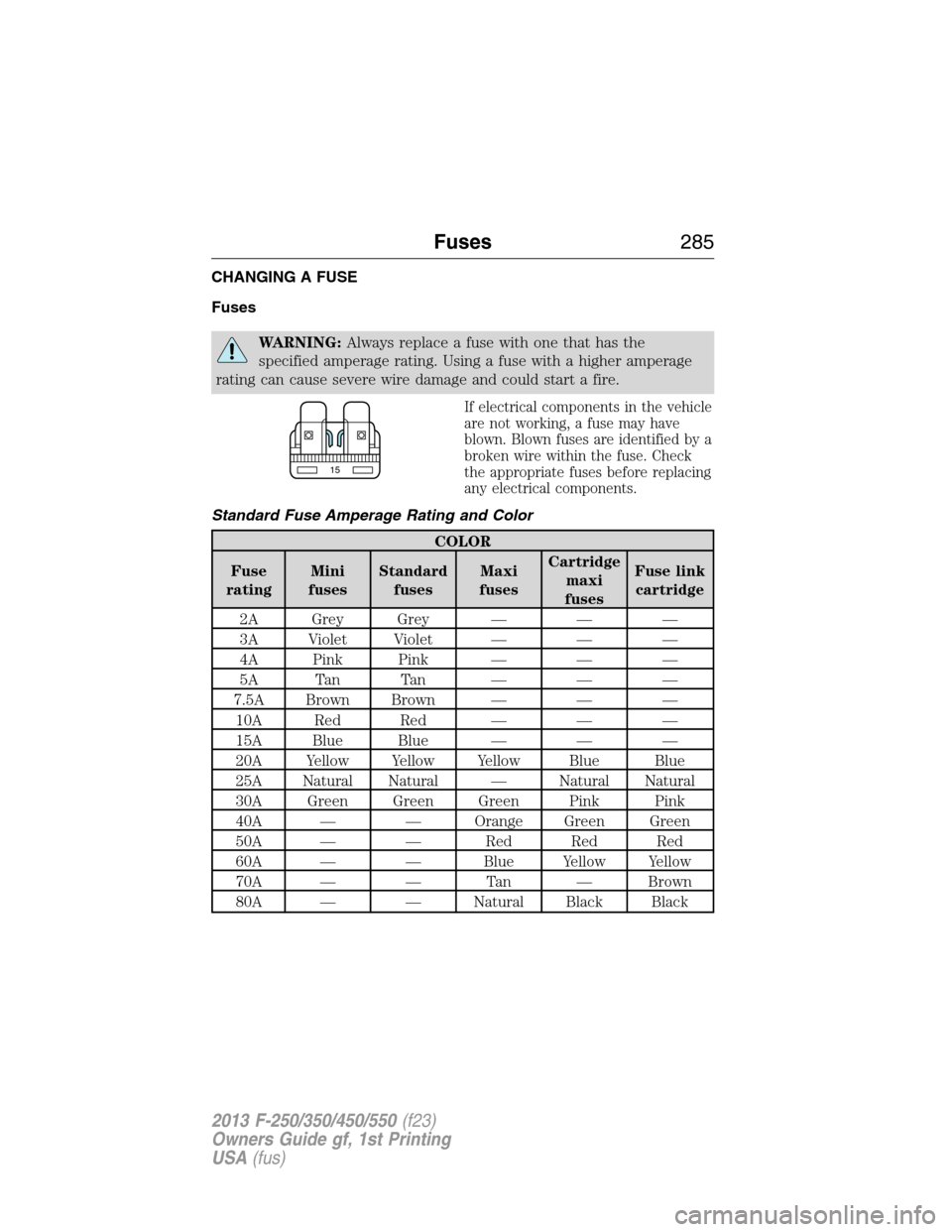
Standard Fuse Amperage Rating and Color
COLOR
Fuse
ratingMini
fusesStandard
fusesMaxi
fusesCartridge
maxi
fusesFuse link
cartridge
2A Grey Grey — — —
3A Violet Violet — — —
4A Pink Pink — — —
5A Tan Tan — — —
7.5A Brown Brown — — —
10A Red Red — — —
15A Blue Blue — — —
20A Yellow Yellow Yellow Blue Blue
25A Natural Natural — Natural Natural
30A Green Green Green Pink Pink
40A — — Orange Green Green
50A — — Red Red Red
60A — — Blue Yellow Yellow
70A — — Tan — Brown
80A — — Natural Black Black
15
Fuses285
2013 F-250/350/450/550(f23)
Owners Guide gf, 1st Printing
USA(fus)
Page 287 of 563
FUSE SPECIFICATION CHART
Power Distribution Box
WARNING:Always disconnect the battery before servicing high
current fuses.
WARNING:To reduce risk of electrical shock, always replace the
cover to the power distribution box before reconnecting the
battery or refilling fluid reservoirs.
The power distribution box is located in the engine compartment. It has
high-current fuses that protect your vehicle’s main electrical systems
from overloads.
If the battery has been disconnected and reconnected, seeChanging the
Vehicle Batteryin theMaintenancechapter.
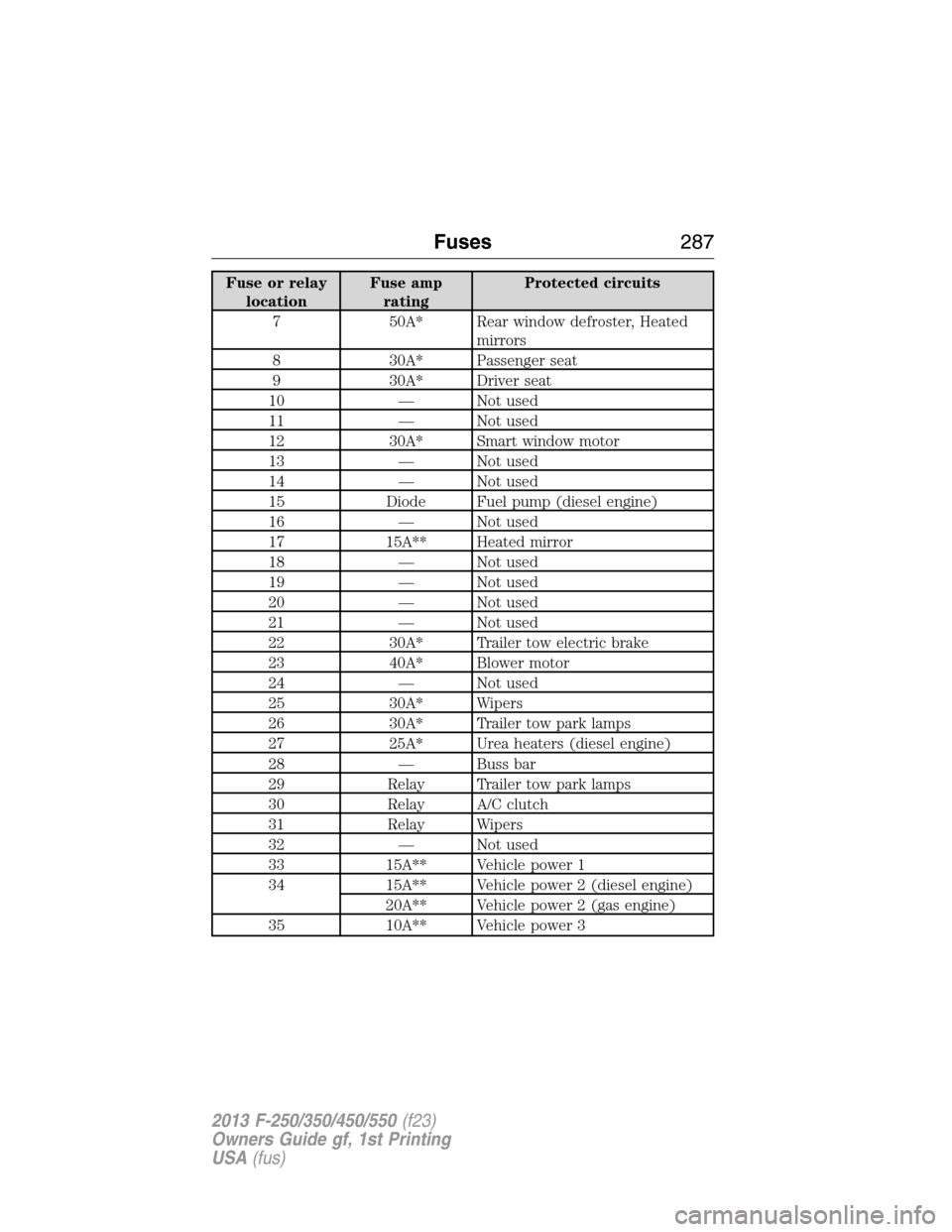
The high-current fuses are coded as follows:
Fuse or relay
locationFuse amp
ratingProtected circuits
1 Relay Blower motor
2 — Not used
3 Relay Urea heaters (diesel engine)
4 — Not used
5 Relay Rear window defroster, Heated
mirrors
6 — Not used
286Fuses
2013 F-250/350/450/550(f23)
Owners Guide gf, 1st Printing
USA(fus)
Page 288 of 563
Fuse or relay
locationFuse amp
ratingProtected circuits
7 50A* Rear window defroster, Heated
mirrors
8 30A* Passenger seat
9 30A* Driver seat
10 — Not used
11 — Not used
12 30A* Smart window motor
13 — Not used
14 — Not used
15 Diode Fuel pump (diesel engine)
16 — Not used
17 15A** Heated mirror
18 — Not used
19 — Not used
20 — Not used
21 — Not used
22 30A* Trailer tow electric brake
23 40A* Blower motor
24 — Not used
25 30A* Wipers
26 30A* Trailer tow park lamps
27 25A* Urea heaters (diesel engine)
28 — Buss bar
29 Relay Trailer tow park lamps
30 Relay A/C clutch
31 Relay Wipers
32 — Not used
33 15A** Vehicle power 1
34 15A** Vehicle power 2 (diesel engine)
20A** Vehicle power 2 (gas engine)
35 10A** Vehicle power 3
Fuses287
2013 F-250/350/450/550(f23)
Owners Guide gf, 1st Printing
USA(fus)
Page 289 of 563
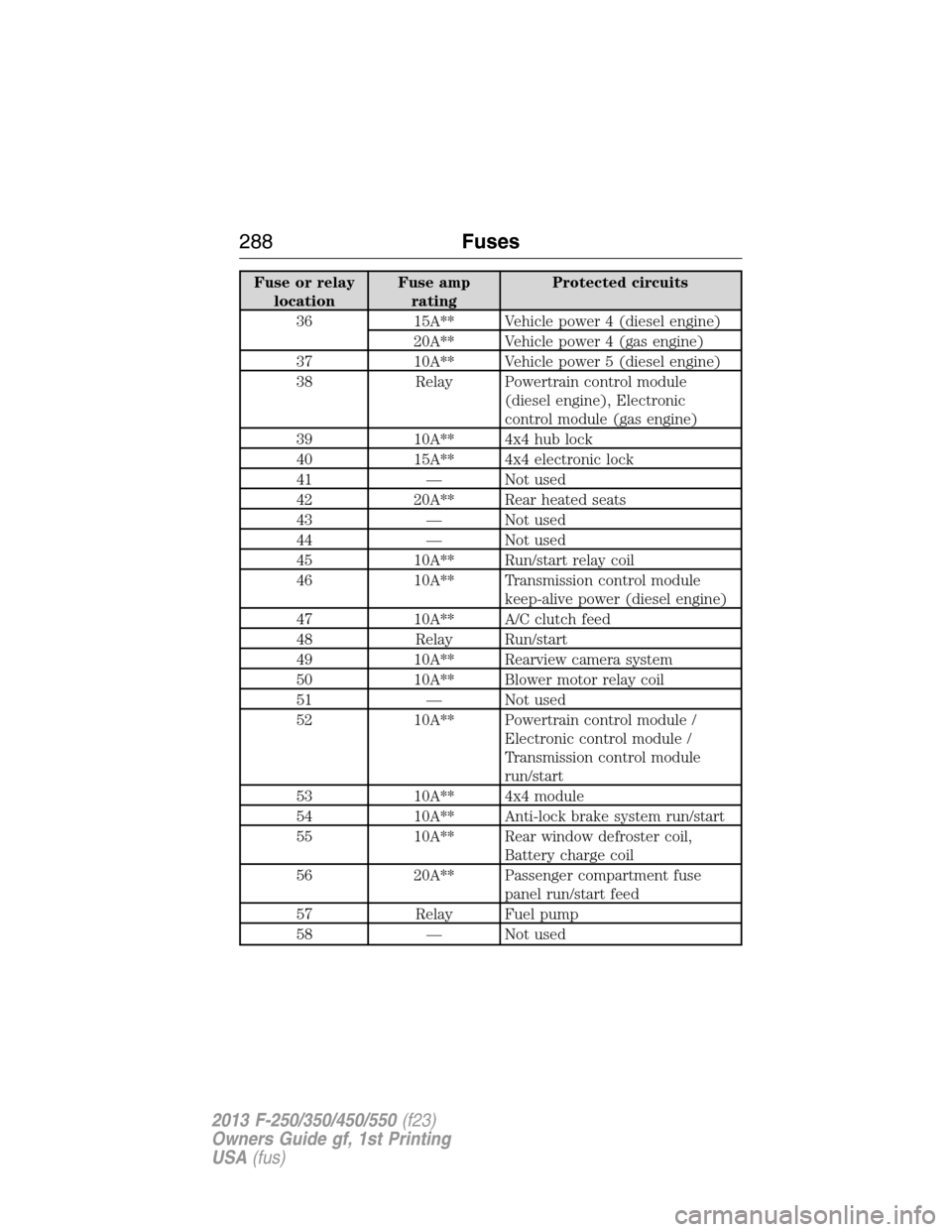
Fuse or relay
locationFuse amp
ratingProtected circuits
36 15A** Vehicle power 4 (diesel engine)
20A** Vehicle power 4 (gas engine)
37 10A** Vehicle power 5 (diesel engine)
38 Relay Powertrain control module
(diesel engine), Electronic
control module (gas engine)
39 10A** 4x4 hub lock
40 15A** 4x4 electronic lock
41 — Not used
42 20A** Rear heated seats
43 — Not used
44 — Not used
45 10A** Run/start relay coil
46 10A** Transmission control module
keep-alive power (diesel engine)
47 10A** A/C clutch feed
48 Relay Run/start
49 10A** Rearview camera system
50 10A** Blower motor relay coil
51 — Not used
52 10A** Powertrain control module /
Electronic control module /
Transmission control module
run/start
53 10A** 4x4 module
54 10A** Anti-lock brake system run/start
55 10A** Rear window defroster coil,
Battery charge coil
56 20A** Passenger compartment fuse
panel run/start feed
57 Relay Fuel pump
58 — Not used
288Fuses
2013 F-250/350/450/550(f23)
Owners Guide gf, 1st Printing
USA(fus)
Page 290 of 563
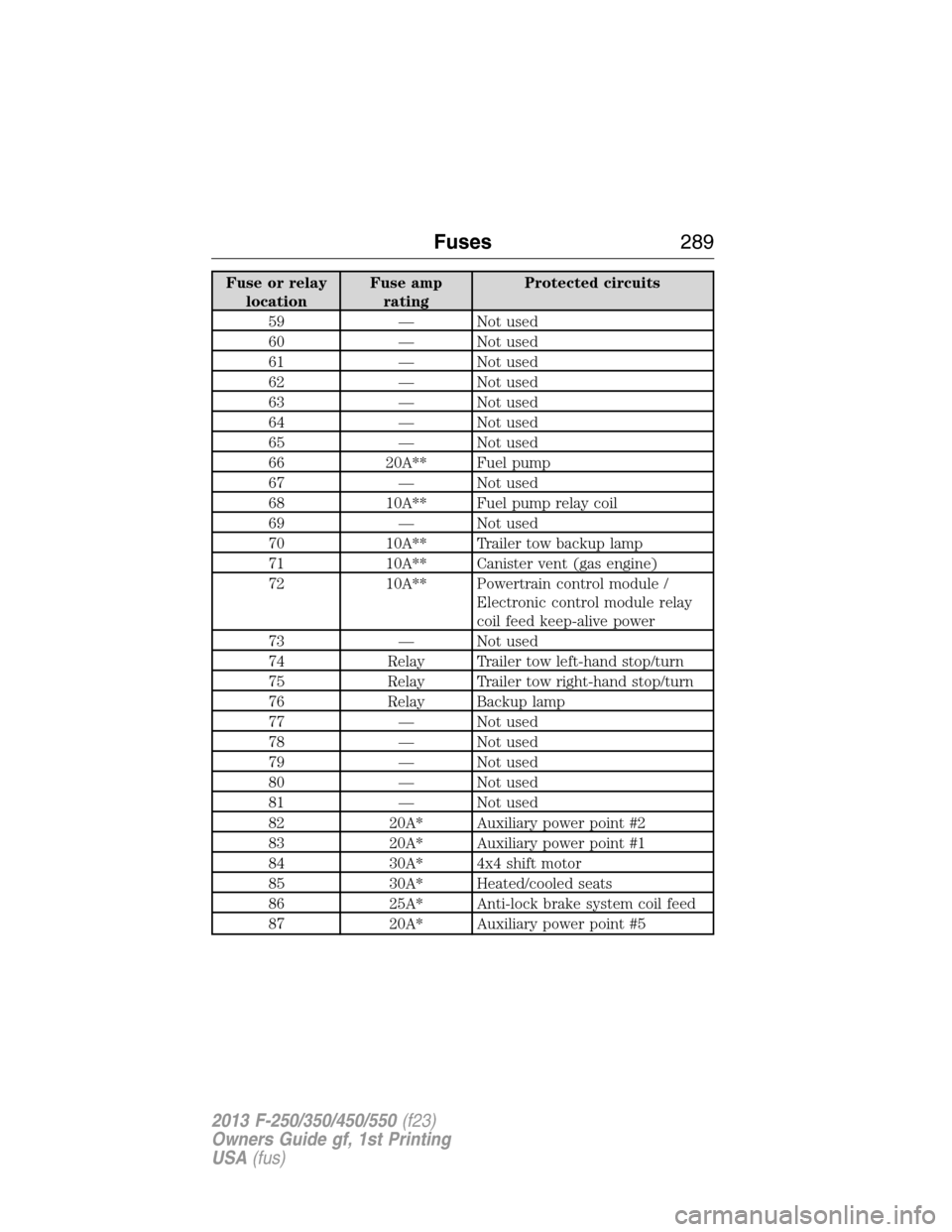
Fuse or relay
locationFuse amp
ratingProtected circuits
59 — Not used
60 — Not used
61 — Not used
62 — Not used
63 — Not used
64 — Not used
65 — Not used
66 20A** Fuel pump
67 — Not used
68 10A** Fuel pump relay coil
69 — Not used
70 10A** Trailer tow backup lamp
71 10A** Canister vent (gas engine)
72 10A** Powertrain control module /
Electronic control module relay
coil feed keep-alive power
73 — Not used
74 Relay Trailer tow left-hand stop/turn
75 Relay Trailer tow right-hand stop/turn
76 Relay Backup lamp
77 — Not used
78 — Not used
79 — Not used
80 — Not used
81 — Not used
82 20A* Auxiliary power point #2
83 20A* Auxiliary power point #1
84 30A* 4x4 shift motor
85 30A* Heated/cooled seats
86 25A* Anti-lock brake system coil feed
87 20A* Auxiliary power point #5
Fuses289
2013 F-250/350/450/550(f23)
Owners Guide gf, 1st Printing
USA(fus)
Page 291 of 563
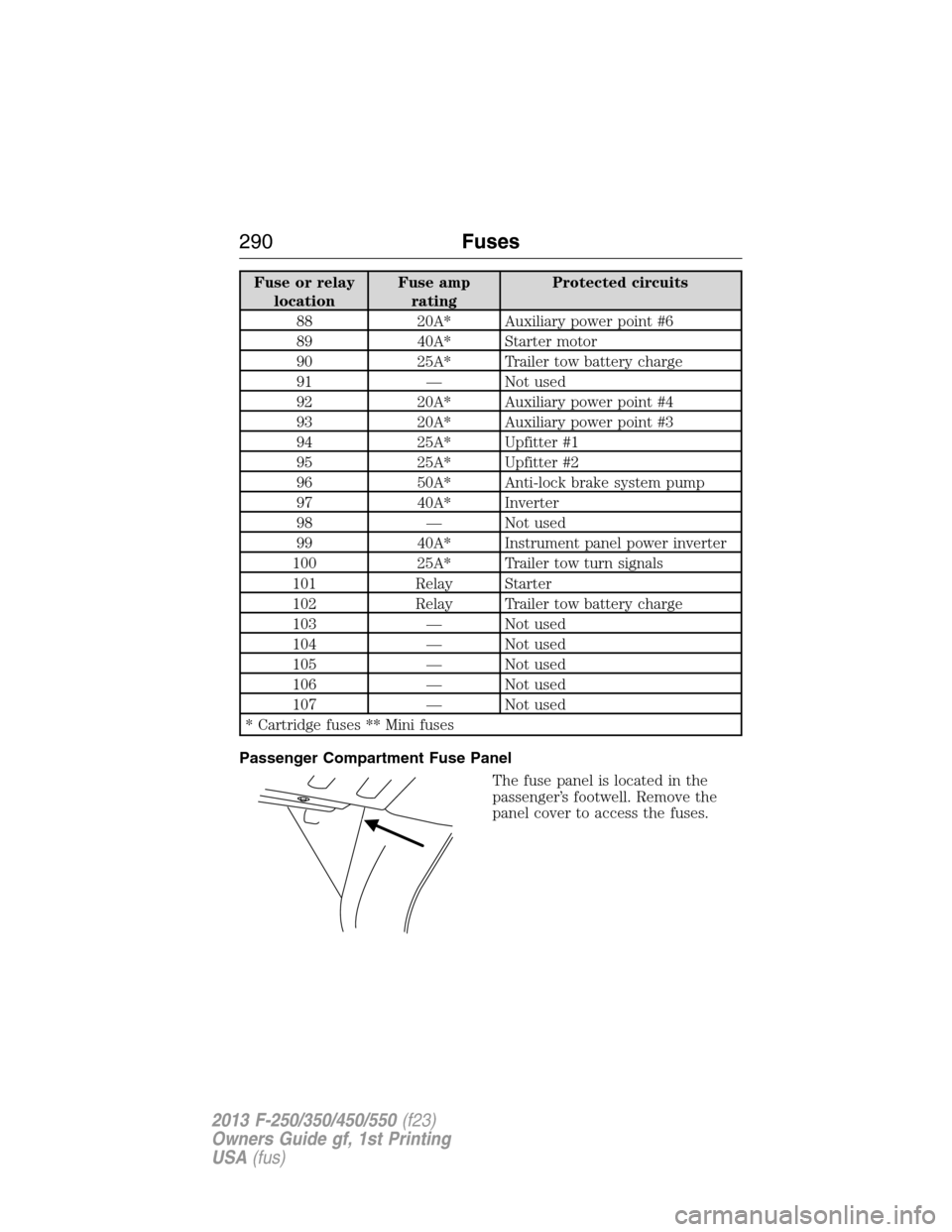
Fuse or relay
locationFuse amp
ratingProtected circuits
88 20A* Auxiliary power point #6
89 40A* Starter motor
90 25A* Trailer tow battery charge
91 — Not used
92 20A* Auxiliary power point #4
93 20A* Auxiliary power point #3
94 25A* Upfitter #1
95 25A* Upfitter #2
96 50A* Anti-lock brake system pump
97 40A* Inverter
98 — Not used
99 40A* Instrument panel power inverter
100 25A* Trailer tow turn signals
101 Relay Starter
102 Relay Trailer tow battery charge
103 — Not used
104 — Not used
105 — Not used
106 — Not used
107 — Not used
* Cartridge fuses ** Mini fuses
Passenger Compartment Fuse Panel
The fuse panel is located in the
passenger’s footwell. Remove the
panel cover to access the fuses.
290Fuses
2013 F-250/350/450/550(f23)
Owners Guide gf, 1st Printing
USA(fus)
Page 292 of 563
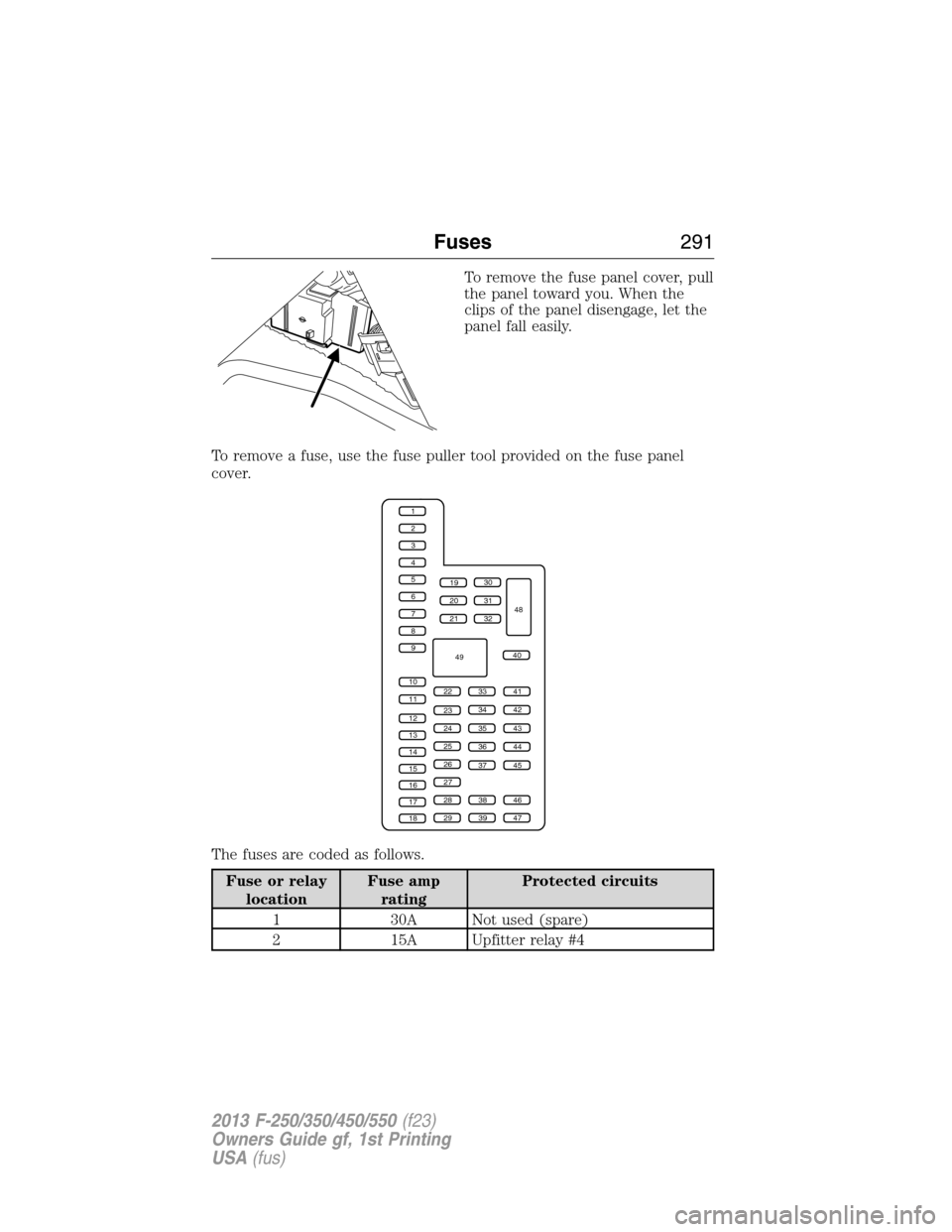
To remove the fuse panel cover, pull
the panel toward you. When the
clips of the panel disengage, let the
panel fall easily.
To remove a fuse, use the fuse puller tool provided on the fuse panel
cover.
The fuses are coded as follows.
Fuse or relay
locationFuse amp
ratingProtected circuits
1 30A Not used (spare)
2 15A Upfitter relay #4
1
2
3
4
5
6
7
8
9
10
11
12
13
14
15
16
17
18
19
20
21
223341
42
43
44
45
34
35
36
37
23
24
25
26
27
283846
394729
32
40
31
30
48
49
Fuses291
2013 F-250/350/450/550(f23)
Owners Guide gf, 1st Printing
USA(fus)