Introduction 9
Child Safety 18
Child seats...........................................20
Child seat positioning...................................20
Booster seats.........................................22
Installing child safety seats...............................25
Child safety locks......................................35
Safety Belts 36
Fastening the safety belts................................38
Safety belt height adjustment.............................42
Safetybeltwarninglightandindicatorchime..................43
Safety belt-minder.....................................43
Child restraint and safety belt maintenance...................45
Supplementary Restraints System 46
Driver and passenger airbags.............................48
Side airbags..........................................55
Safety canopy curtain airbags.............................56
Crash sensors and airbag indicator.........................58
Airbag disposal........................................59
Keys and Remote Control 60
General information on radio frequencies.....................60
Remote control.......................................61
Keys...............................................61
Replacing a lost key or remote control.......................65
MyKey 66
Settings, MyKey.......................................66
Creating.............................................67
Clearing.............................................68
System status.........................................68
Remote start, MyKey...................................69
Troubleshooting, MyKey.................................69
Table of Contents1
2013 F-250/350/450/550(f23)
Owners Guide gf, 1st Printing
USA(fus)
All safety restraints in the vehicle are combination lap and shoulder
belts. The driver safety belt has the first type of locking mode, and the
front outboard passenger and rear seat safety belts have both types of
locking modes described as follows:
Vehicle Sensitive Mode
This is the normal retractor mode, which allows free shoulder belt length
adjustment to your movements and locking in response to vehicle
movement. For example, if the driver brakes suddenly or turns a corner
sharply, or the vehicle receives an impact of approximately 5 mph
(8 km/h) or more, the combination safety belts will lock to help reduce
forward movement of the driver and passengers.
In addition, the retractor is designed to lock if the webbing is pulled out
too quickly. If this occurs, let the belt retract slightly and pull webbing
out again in a slow and controlled manner.
Automatic Locking Mode
In this mode, the shoulder belt is automatically pre-locked. The belt will
still retract to remove any slack in the shoulder belt. The automatic
locking mode is not available on the driver safety belt.
When to Use the Automatic Locking Mode
This mode should be used any time a child safety seat, except a booster,
is installed in passenger front or rear seating positions. Children 12 years
old and under should be properly restrained in a rear seating position
whenever possible. See theChild Safetychapter.
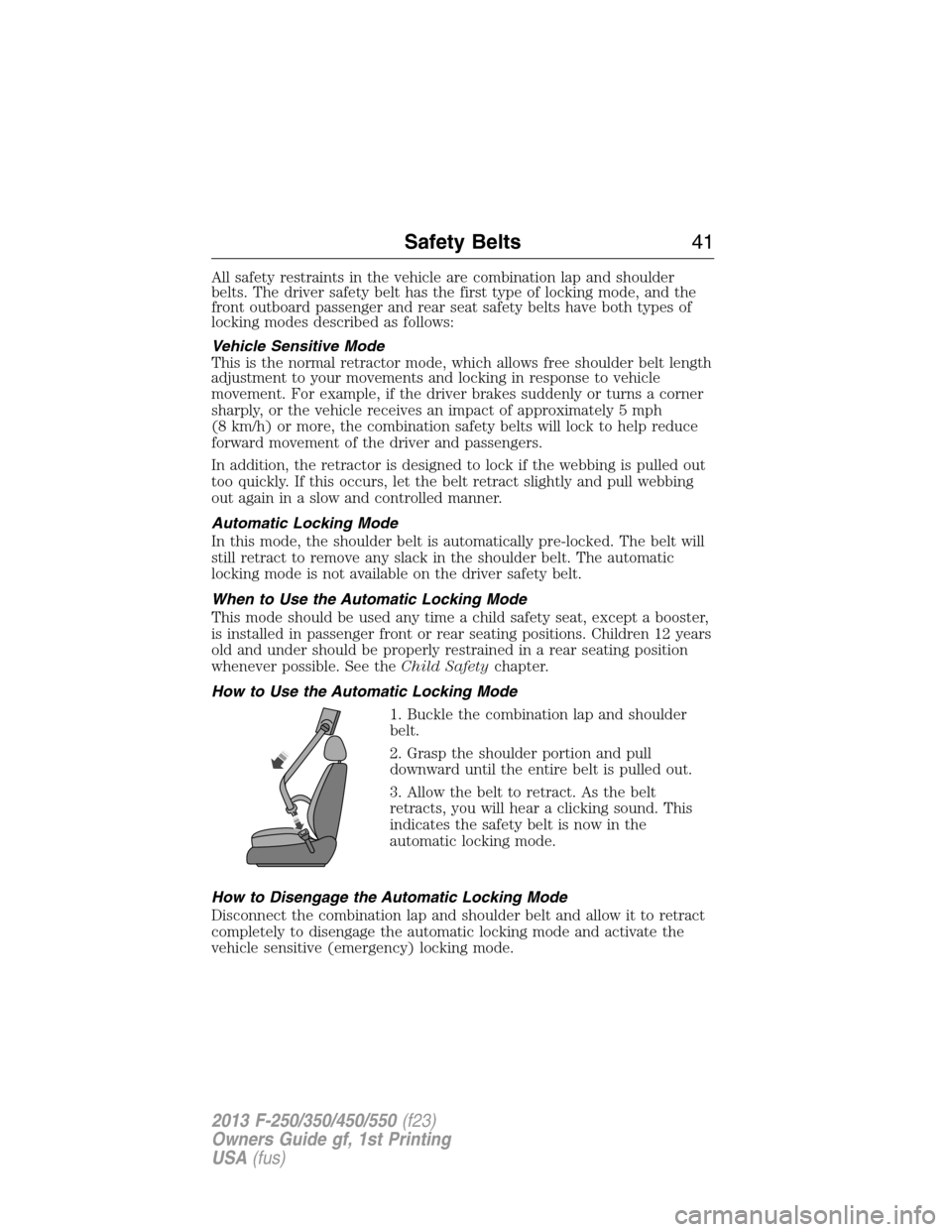
How to Use the Automatic Locking Mode
1. Buckle the combination lap and shoulder
belt.
2. Grasp the shoulder portion and pull
downward until the entire belt is pulled out.
3. Allow the belt to retract. As the belt
retracts, you will hear a clicking sound. This
indicates the safety belt is now in the
automatic locking mode.
How to Disengage the Automatic Locking Mode
Disconnect the combination lap and shoulder belt and allow it to retract
completely to disengage the automatic locking mode and activate the
vehicle sensitive (emergency) locking mode.
Safety Belts41
2013 F-250/350/450/550(f23)
Owners Guide gf, 1st Printing
USA(fus)
DRIVER AND PASSENGER AIRBAGS
WARNING:Never place your arm or any objects over an airbag
module. Placing your arm over a deploying airbag can result in
serious arm fractures or other injuries. Objects placed on or over the
airbag inflation area may cause those objects to be propelled by the
airbag into your face and torso causing serious injury.
WARNING:Airbags can kill or injure a child in a child seat.
Never place a rear-facing child seat in front of an active airbag. If
you must use a forward-facing child seat in the front seat, move the
seat all the way back.
The driver and front passenger
airbags will deploy during significant
frontal and near frontal crashes.
The driver and passenger front airbag system consists of:
•Driver and passenger airbag modules
•Crash sensors and monitoring system with readiness
indicator. SeeCrash Sensors and Airbag Indicatorlater in
this chapter.
Proper Driver and Front Passenger Seating Adjustment
WARNING:The National Highway Traffic Safety Administration
recommends a minimum distance of at least 10 inches (25
centimeters) between an occupant’s chest and the driver airbag
module.
To properly position yourself away from the airbag:
•Move your seat to the rear as far as you can while still reaching the
pedals comfortably.
48Supplementary Restraints System
2013 F-250/350/450/550(f23)
Owners Guide gf, 1st Printing
USA(fus)