2013 FORD SUPER DUTY service schedule
[x] Cancel search: service schedulePage 4 of 95
BREAKING-IN YOUR VEHICLE
Your vehicle does not need an extensive break-in. Try not to drive
continuously at the same speed for the first 1,000 miles
(1,600 kilometers) of new vehicle operation. Vary your speed to allow
parts to adjust themselves to other parts.
Drive your new vehicle at least 500 miles (800 kilometers) before towing
a trailer. Make sure you use the specified engine oil by checking the
engine oil specification chart underEngine oilin theMaintenance
chapter.
Do not add friction modifier compounds or special break-in oils during
the first few thousand miles (kilometers) of operation, since these
additives may prevent piston ring seating. SeeEngine oilin the
Maintenancechapter of this supplement for more information on oil
usage.
DIESEL ENGINE INFORMATION
The diesel engine fuel system is a pressurized two-stage filtration system
and consists of:
•a frame-mounted diesel fuel conditioner module (DFCM) / primary
filter with an electric fuel pump and water drain,
•an engine-mounted secondary fuel filter,
•a fuel injector for each cylinder (8 total),
•a high-pressure fuel pump,
•a high-pressure fuel rail for each cylinder bank (2 total) and
•numerous high-pressure pipes from the high-pressure pump to the
rails, and rails to the injectors.
The DFCM acts as a primary fuel filter/water separator which removes
both water and impurities from the fuel. The engine mounted filter filters
finer impurities from the diesel fuel. The engine-mounted fuel filter and
the DFCM filter should be changed at the recommended service interval
or when indicated by the information displayLOW FUEL PRESSURE
message. Refer to thescheduled maintenance informationin this
supplement for more information.
The DFCM should be drained at regular intervals (recommended at
every oil change) or when indicated by the information display and water
in fuel indicator light. SeeFuel filter/water separatorin theFuel and
refuelingchapter.
Introduction
3
2013 Diesel(67l)
Supplement, 1st Printing
USA(fus)
Page 17 of 95
To help achieve acceptable engine performance and durability when
using biodiesel in your vehicle:
•Confirm the biodiesel content of the fuel to be B20 (20% biodiesel) or
less.
•Only use biodiesel fuel of good quality that complies with industry
standards.
•Follow the recommended service maintenance intervals section in the
Schedule Maintenancechapter.
•Do not store biodiesel fuel in the fuel tank for more than 1 month.
•Consider changing brands or reducing biodiesel content if you have
cold temperature fuel gelling issues or a frequentLOW FUEL
PRESSUREmessage appearing.
•Do NOT use raw oils, fats or waste cooking greases.
Use of biodiesel in concentrations greater than 20% may cause damage
to your vehicle, including engine and/or exhaust after-treatment
hardware (exhaust catalyst and particulate filter) failures. Concentrations
greater than 20% can also cause fuel filter restrictions that may result in
a lack of power and / or damage to fuel system components, including
fuel pump and fuel injector failures.
SAE 5W-40 or SAE 15W-40 oil is recommended for fuels with greater than
5% biodiesel (B5). Refer to theSpecial operating conditionssection
under theSchedule Maintenancechapter for more information about oil
change intervals and other maintenance when operating on biodiesel.
Look for a label on the fuel pump to confirm the amount of biodiesel
contained in a diesel fuel. Biodiesel content is often indicated with the
letter “B” followed by the percent of biodiesel in the fuel. For example,
B20 indicates a fuel containing 20% biodiesel. Ask the service station
attendant to confirm the biodiesel content of a diesel fuel if you do not
see a label on the fuel pump.
Biodiesel fuels degrade more easily than diesel fuels not containing
biodiesel and should not be stored in the fuel tank for more than 1 month.
If your vehicle will be parked or stored for more than 1 month, then your
vehicle fuel tank should be emptied of biodiesel fuel, filled with a pure
petroleum-based diesel fuel, and run for a minimum of 30 minutes.
Note:Degraded or oxidized biodiesel can damage fuel system seals and
plastics and corrode steel parts.
During cold weather, if you have problems operating on biodiesel, you
may need to use a diesel fuel with lower biodiesel content, try another
brand, or discontinue the use of biodiesel.
Fuel and Refueling
16
2013 Diesel(67l)
Supplement, 1st Printing
USA(fus)
Page 20 of 95
SELECTIVE CATALYTIC REDUCTION (SCR) SYSTEM
Your vehicle is equipped with a selective catalytic reduction (SCR)
system to help reduce emission levels of oxides of nitrogen from the
exhaust of the diesel engine. The system automatically injects diesel
exhaust fluid (DEF) into the exhaust system to enable proper SCR
function.
Importance of maintaining the DEF level
In order for the SCR system to operate properly, the DEF level must be
maintained. Generally, the DEF tank should be filled during the oil
change service interval. See thescheduled maintenance informationin
this supplement for more information. However, certain conditions or
driving styles, such as trailer towing or fast rates of acceleration, will
require the refilling of the DEF tank more often.
The engine control unit will monitor the amount of fluid available in the
DEF tank. Running a system check in the message center will indicate
whether the DEF level is ok or if it is less than 1/2 full. A message will
automatically be displayed in the message center when the DEF level is
low and needs to be refilled. When you see this message you should refill
your tank. See theInformation displayschapter of yourOwner’s
Manualfor information display functions. For instructions on refilling
your DEF tank, seeFilling the DEF tankin theFuel and Refueling
chapter.
DEF warning messages and vehicle operations
WARNING:Diesel Exhaust Fluid (DEF) must be refilled when
low or replaced when contaminated or the vehicle speed will be
speed limited to 50 mph (80 km/h). In these conditions, drive with
caution and refill DEF immediately. If the DEF becomes empty or
contaminated fluid is not replaced, the vehicle will become limited to
idle speed only once stopped. In these conditions, be cautious where
you stop the vehicle because you may not be able to drive long
distances and will not be able to maintain highway speeds until DEF is
refilled or replaced.
WARNING:Tampering or disabling your vehicle’s exhaust
aftertreatment system will result in severe vehicle performance
limitation including eventual speed limiting to 5 mph.
Fuel and Refueling
19
2013 Diesel(67l)
Supplement, 1st Printing
USA(fus)
Page 50 of 95
SCHEDULED MAINTENANCE
The scheduled maintenance services in thescheduled maintenance
informationof this supplement are required because they are
considered essential to the life and performance of your vehicle.
Use only recommended fuel, lubricants, fluids and service parts
conforming to Ford specifications. Motorcraft® parts are designed and
built for best performance in your vehicle.
ENGINE OIL
Checking the engine oil level
Because it is normal to add some oil between oil changes, check your
engine oil level each time you stop for fuel. To check the engine oil level
consistently and accurately, the following procedure is recommended:
1. Have engine at normal operating temperature (at least into the
NORMAL range on the engine coolant temperature gauge).
2. Park the vehicle on a level surface, then turn off the engine and open
the hood.
3. Allow at least20 minutesafter engine shutdown to ensure that the oil
contained in the upper parts of the engine has returned to the oil pan.
4. Protecting yourself from engine heat, pull out the dipstick, wipe it
clean and reinsert fully.
5. Read oil level on both sides of dipstick and use highest level (reading)
for the actual engine oil level.
6. Maintain the oil level within the
crosshatch area on the dipstick by
adding oil as required. Do not
overfill the oil past the maximum
line as depicted by the arrow.
Engine oil specifications
It is important that only quality engine oils are used in your diesel engine
and it is changed at the recommended service interval. For normal or
severe service, use Motorcraft® oil or an equivalent oil conforming to
Ford specifications or API service categories CJ-4 as listed in the
Capacities and Specificationschapter. It is important to use the
Maintenance
49
2013 Diesel(67l)
Supplement, 1st Printing
USA(fus)
Page 62 of 95
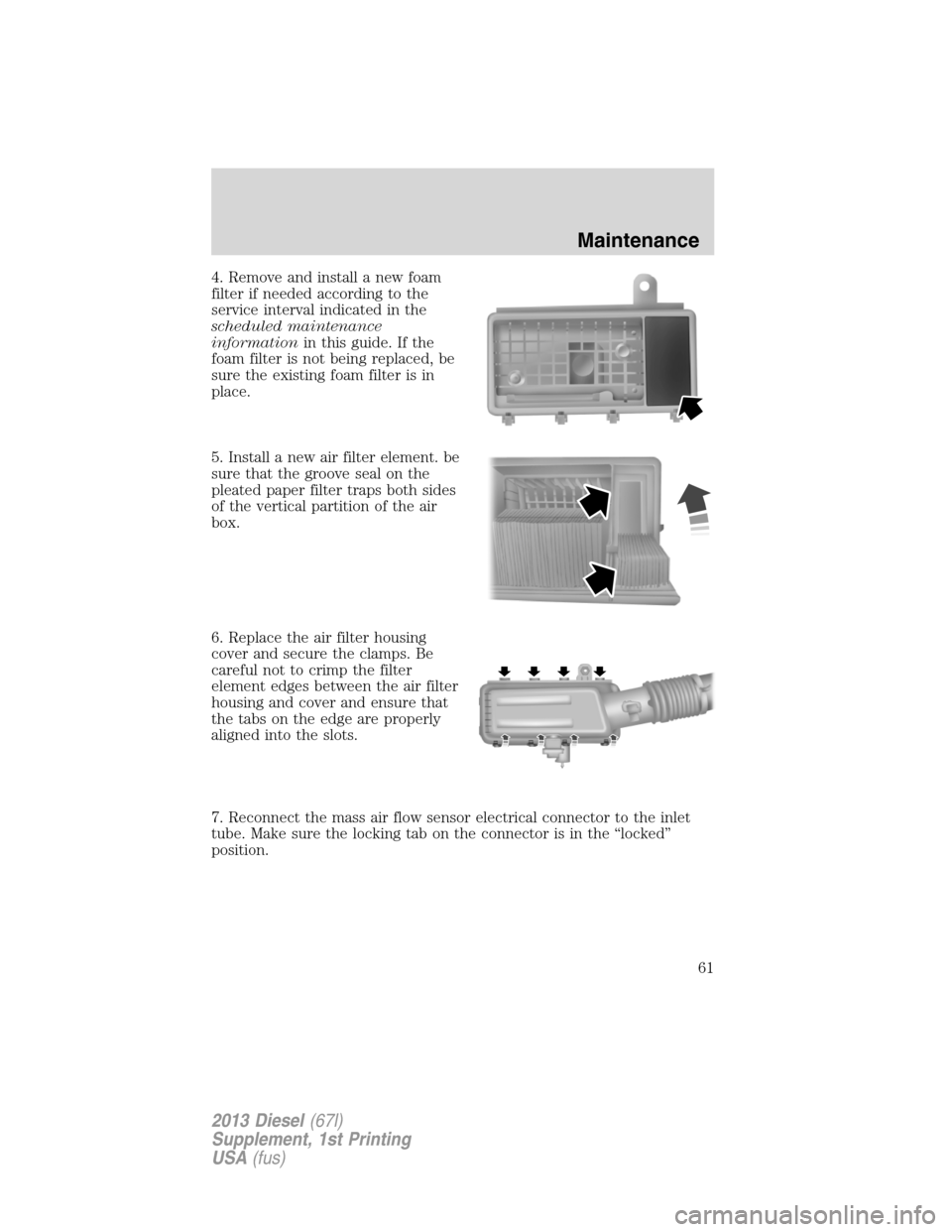
4. Remove and install a new foam
filter if needed according to the
service interval indicated in the
scheduled maintenance
informationin this guide. If the
foam filter is not being replaced, be
sure the existing foam filter is in
place.
5. Install a new air filter element. be
sure that the groove seal on the
pleated paper filter traps both sides
of the vertical partition of the air
box.
6. Replace the air filter housing
cover and secure the clamps. Be
careful not to crimp the filter
element edges between the air filter
housing and cover and ensure that
the tabs on the edge are properly
aligned into the slots.
7. Reconnect the mass air flow sensor electrical connector to the inlet
tube. Make sure the locking tab on the connector is in the “locked”
position.
Maintenance
61
2013 Diesel(67l)
Supplement, 1st Printing
USA(fus)
Page 71 of 95
GENERAL MAINTENANCE INFORMATION
Why Maintain Your Vehicle?
Carefully following the maintenance schedule helps protect against major
repair expenses resulting from neglect or inadequate maintenance and
may also help to increase the value of your vehicle when you sell or
trade it. Keep all receipts for completed maintenance with the vehicle.
Regular maintenance intervals for your vehicle have been established
based upon rigorous testing. It is important that you have your vehicle
serviced at the proper times. These intervals serve two purposes; one is
to maintain the reliability of your vehicle and the second is to keep your
cost of owning the vehicle down.
It is your responsibility to see that all scheduled maintenance is
performed and that the materials used meet the specifications identified
in theCapacities and Specificationschapter. Failure to perform
scheduled maintenance invalidates warranty coverage on parts affected
by the lack of maintenance.
Why Maintain Your Vehicle at Your Dealership?
Factory-Trained Technicians
Service technicians participate in extensive factory-sponsored
certification training to help them become experts on the operation of
your vehicle. Ask your dealership about the training and certification
their technicians have received.
Genuine Ford and Motorcraft® Replacement Parts
Dealerships stock Ford, Motorcraft® and Ford-authorized branded
remanufactured replacement parts. These parts meet or exceed Ford
Motor Company’s specifications. Parts installed at your dealership carry a
nationwide, 12 month/12000 mile (20000 kilometer) parts and labor
limited warranty. If you do not use Ford authorized parts, they may not
meet Ford specifications and, depending on the part, it could affect
emissions compliance.
Convenience
Many dealerships have extended evening and Saturday hours to make
your service visit more convenient and they offer one stop shopping.
They can perform any services that are required on your vehicle, from
general maintenance to collision repairs.
Note:Not all dealers have extended hours or bodyshops. Please contact
your dealer for details.
Scheduled Maintenance
70
2013 Diesel(67l)
Supplement, 1st Printing
USA(fus)
Page 72 of 95
Protecting Your Investment
Maintenance is an investment that will pay dividends in the form of
improved reliability, durability and resale value. To maintain the proper
performance of your vehicle and its emission control systems, it is
imperative that scheduled maintenance be completed at the designated
intervals.
Your vehicle is equipped with the Intelligent Oil-Life Monitor® (IOLM)
system which displays a message in the information display at the proper
oil change service interval; this interval may be up to one year or
10000 miles (16000 kilometers). When ENGINE OIL CHANGE DUE or
OIL CHANGE REQUIRED appears in the information display, it is time
for an oil change; the oil change must be done within two weeks or
500 miles (800 kilometers) of the ENGINE OIL CHANGE DUE or OIL
CHANGE REQUIRED message appearing. The Intelligent Oil-Life
Monitor® must be reset after each oil change; see theInformation
Displayschapter of yourOwner’s Manual.
If your information display is prematurely reset or becomes inoperative,
you should perform the oil change interval at six months or 5000 miles
(8000 kilometers) from your last oil change. Never exceed one year or
10000 miles (16000 kilometers) between oil change intervals.
Your vehicle is very sophisticated and built with multiple, complex,
performance systems. Every manufacturer develops these systems using
different specifications and performance features. That is why it is
important to rely upon your dealership to properly diagnose and repair
your vehicle.
Ford Motor Company has recommended maintenance intervals for
various parts and component systems based upon engineering testing.
Ford Motor Company relies upon this testing to determine the most
appropriate mileage for replacement of oils and fluids to protect your
vehicle at the lowest overall cost to you and recommends against
maintenance schedules that deviate from the scheduled maintenance
information.
Ford strongly recommends the use of only genuine Ford, Motorcraft® or
Ford-authorized remanufactured replacement parts because they are
engineered for your vehicle.
Additives and Chemicals
Ford Motor Company recommended additives and chemicals are listed in
the owner manual and in the Ford Workshop Manual. Additional
chemicals or additives not approved by Ford Motor Company are not
recommended as part of normal maintenance. Please consult your
warranty information.
Scheduled Maintenance
71
2013 Diesel(67l)
Supplement, 1st Printing
USA(fus)
Page 73 of 95
Oils, Fluids and Flushing
In many cases, fluid discoloration is a normal operating characteristic
and, by itself, does not necessarily indicate a concern or that the fluid
needs to be changed. However, discolored fluids that also show signs of
overheating and foreign material contamination should be inspected
immediately by a qualified expert, such as the factory-trained technicians
at your dealership. Your vehicle’s oils and fluids should be changed at the
specified intervals or in conjunction with a repair. Flushing is a viable
way to change fluid for many vehicle sub-systems during scheduled
maintenance. It is critical that systems are flushed only with new fluid
that is the same as that required to fill and operate the system, or using
a Ford-approved flushing chemical.
Owner Checks and Services
Certain basic maintenance checks and inspections should be performed by
the owner or a service technician at the intervals indicated. Service
information and supporting specifications are provided in theOwner’s Guide.
Any adverse condition should be brought to the attention of your dealer
or qualified service technician as soon as possible for the proper service
advice. The owner maintenance service checks are generally not covered
by warranties so you may be charged for labor, parts or fluids used.
Check Every Month
Engine air filter restriction gauge.
Fuel filter/water separator. Drain if necessary (or if indicated by the
information display).
Holes/Slots in the tail pipe to make sure they are functional and clear
of debris.
Retightening Lug Nuts*
Vehicles with
single rear wheelsRetighten the lug nuts to the specified torque at
500 miles (800 km) after any wheel disturbance (tire
rotation, changing a flat tire, wheel removal, etc.)
Vehicles with dual
rear wheelsRetighten the wheel lug nuts to the specified torque
at 100 miles (160 km), and again at 500 miles
(800 km) of new vehicle operation and after any
wheel disturbance (tire rotation, changing a flat tire,
wheel removal, etc.)
*SeeWheel lug nut torque specificationsin yourOwner’s Manualfor
the proper lug nut torque specification.
Scheduled Maintenance
72
2013 Diesel(67l)
Supplement, 1st Printing
USA(fus)