2013 FORD SUPER DUTY engine
[x] Cancel search: enginePage 38 of 95
OCR precautions and safe exhaust position
WARNING:Failure to comply with the following instructions for
operator commanded regeneration (OCR) may result in fire,
serious injury, death and/or property damage.
Before you start OCR, observe/do the following:
•Place the vehicle in P (Park) with the parking brake set on stable,
level ground.
•The vehicle must not be parked in a structure.
•The vehicle must be 10 – 15 feet (3 – 5 meters) away from any
obstructions,
•and must be away from materials that can easily combust or melt such
as: paper, leaves, petroleum products, fuels, plastics and other dry
organic material, such as grass.
•Make sure there is a minimum of 1/8 tank of fuel.
•Make sure all fluids are at proper levels.
Make sure that the louvers (holes) located at the tip of the exhaust are
also clear of any obstructions as they are used to introduce fresh air into
the tailpipe to cool the exhaust gas as it leaves. SeeExhaustunder the
Cleaningchapter for more information.
How to start operator commanded regeneration (OCR)
WARNING:Stay clear of exhaust tip during regeneration. You or
others can be burned.
Note:OCR will not be allowed until DPF load percentage has reached
100% (Full). The DPF load percentage will fluctuate up and down when
driving your vehicle due to active and passive regenerations.
Note:During the use of OCR, you may observe a light amount of white
smoke. This is normal.
OCR will not be allowed to operate
if the service engine soon light is
illuminated
Fuel and Refueling
37
2013 Diesel(67l)
Supplement, 1st Printing
USA(fus)
Page 39 of 95
Base information display procedure
1. Start with the vehicle engine fully warmed.
2. Press the Info button on the steering wheel until the information
display reads one of the following choices:
•If the DPF needs cleaning and the vehicle is warmed up, a message
requesting permission to initiate filter cleaning will be displayed
EXHST XX% FULL CLEAN Y/NorEXHAUST FILTER FULL.
Answer yes to this prompt and then follow the prompts regarding
exhaust position as needed to initiate OCR. Be sure to understand
each prompt. If you are not sure what is being asked by each prompt,
contact your authorized dealer. The display will confirm the operation
has started and when it has finished.
•If the vehicle is warmed up, the
powertrain fault indicator will
illuminate and messages
requesting permission to initiate filter cleaning will be displayed
DRIVE TO CLEAN EXHAUST FILTER+EXH OVERLOADED
CLEAN? Y/N. Answer yes to this prompt and then follow the
prompts regarding exhaust position as needed to initiate OCR. Be sure
to understand each prompt. If you are not sure what is being asked by
each prompt, contact your authorized dealer. The display will confirm
the operation has started and when it has finished. You can also drive
to clean the filter. SeeActive regenerationearlier in this chapter.
•The service engine soon light will
illuminate and the following
messagesEXH OVERLOADED
CLEAN? Y/N+REDUCED ENGINE POWERwill appear when the
system is at the point of oversaturation you will not be able to allow
cleaning . The vehicle must be serviced by an authorized dealer.
3. Once OCR starts, the engine’s rpm will rise to approximately 2,000 -
2,400 rpm and the cooling fan will increase speed; you will hear a change
in audible sound due to the fan and engine speed increase.
It is not necessary to open the hood on the engine compartment. Once
OCR is complete, the engine rpm and fan will return to normal idling.
The exhaust system will remain very hot for several minutes even after
regeneration is complete. Do not reposition the vehicle over materials
that could burn until the exhaust system has had sufficient time to
cool. Depending on the amount of soot collected by the DPF, ambient
temperature, and altitude, OCR may last from 10 to 25 minutes.
Fuel and Refueling
38
2013 Diesel(67l)
Supplement, 1st Printing
USA(fus)
Page 40 of 95
Optional information display procedure
1. Start with the vehicle engine fully warmed.
2. From the main menu, select Gauge Mode and scroll through until one
of the following options appear:
•If the DPF needs cleaning and the vehicle is warmed up, you will be
prompted to hold OK to cleanExhaust xx% FullorExhaust Filter
Full. Press OK and then follow the prompts regarding exhaust
position as needed to initiate OCR. Be sure to understand each
prompt. If you are not sure what is being asked by each prompt,
contact your authorized dealer. The display will confirm the operation
has started and when it has finished.
•When the exhaust system is
overloaded cleaning will be
allowed until a certain saturation
level. If the vehicle is warmed up and ready the powertrain fault
indicator will illuminate and you will be prompted to hold OK to clean
Drive to Clean Exhaust System+Exhaust Filter Overloaded.
Press OK and then follow the prompts regarding exhaust position as
needed to initiate OCR. Be sure to understand each prompt. If you are
not sure what is being asked by each prompt, contact your authorized
dealer. The display will confirm the operation has started and when it
has finished. You can also drive to clean the filter. SeeActive
regenerationearlier in this chapter.
•The service engine soon light will
illuminate and the following
messagesExhaust Filter
Overloaded+Reduced Engine PowerorReduced Engine Power
will appear when the system is at the point of oversaturation you will
not be able to allow cleaning . The vehicle must be serviced by an
authorized dealer.
3. Once OCR starts, the engine’s rpm will rise to approximately 2,000 -
2,400 rpm and the cooling fan will increase speed; you will hear a change
in audible sound due to the fan and engine speed increase.
It is not necessary to open the hood on the engine compartment. Once
OCR is complete, the engine rpm and fan will return to normal idling.
The exhaust system will remain very hot for several minutes even after
regeneration is complete. Do not reposition the vehicle over materials
that could burn until the exhaust system has had sufficient time to
cool. Depending on the amount of soot collected by the DPF, ambient
temperature, and altitude, OCR may last from 10 to 25 minutes.
Fuel and Refueling
39
2013 Diesel(67l)
Supplement, 1st Printing
USA(fus)
Page 41 of 95
How to interrupt/cancel OCR
If OCR needs to be cancelled, pressing the brake, accelerator, or shutting
off the vehicle will stop OCR. Depending on the amount of time OCR was
allowed to operate, soot may not have had sufficient time to be
eliminated, but the exhaust system and exhaust gas may still be hot. If
the vehicle is shut off during OCR, you will notice turbo flutter. This is a
normal consequence caused by shutting off a diesel engine during
boosted operation and is considered normal.
Filter service/maintenance
Over time a slight amount of ash will build up in the DPF which is not
removed during the regeneration process. The DPF may need to be
removed for ash cleaning at approximately 120,000 miles (193,000 km)
or greater (actual mileage can vary greatly depending upon
engine/vehicle operating conditions) and replaced with a new or
remanufactured (ash cleaned) part. The filter may need to be replaced
at approximately 250,000 miles (400,000 km) depending upon
engine/vehicle operating conditions.
In both cases the engine control
system will set a service light to
inform you to bring the vehicle to
the dealer for service.
If there are any issues with the
oxidation catalyst/DPF system a
service light will be set by the
engine control system to inform you
to bring the vehicle into your
authorized dealer for service.
Fuel and Refueling
40
2013 Diesel(67l)
Supplement, 1st Printing
USA(fus)
Page 42 of 95
Resonator/Tailpipe assembly maintenance
WARNING:Failure to maintain the functional holes, in the
tailpipe section of the exhaust, clean and free of debris or
foreign material may result in the holes becoming blocked or plugged.
Do not modify or remove the tail-pipe section. Blocked or plugged
holes or removal/modification of the system could result in elevated
exhaust gas temperatures which may result in vehicle/property damage
or personal injury.
WARNING:The normal operating temperature of the exhaust
system is very high. Never work around or attempt to repair any
part of the exhaust system until it has cooled. Use special care when
working around the diesel oxidation catalytic converter and/or the
diesel particulate filter (DPF). The diesel oxidation catalytic converter
and/or the DPF heats up to a high temperature after only a short
period of engine operation and can stay hot even after the engine is
turned off. Failure to follow these instructions may result in personal
injury.
Note:Additions of aftermarket devices or modifications to the exhaust
system can reduce the effectiveness of the exhaust system as well as
cause damage to the exhaust system and/or engine. These actions may
also affect the vehicle’s warranty. See theWarranty Guidefor more
information.
The diesel resonator tail-pipe assembly is a uniquely functioning device
that accompanies the Oxidation Catalyst/DPF assembly. The assembly
serves multiple functions. First it serves as an acoustic device to
attenuate exhaust noise. Second it provides an exit path for the exhaust
from the vehicle. It also is designed to help control the temperature of
the exhaust during DPF regeneration events. The visible holes in each
leg of the twin tip and the holes under the shield just inboard of the
right rear tire(s) are functional. The holes need to be kept clear of
mud/debris or foreign material to maintain proper function of the
exhaust system. Clean and remove debris or foreign material if present
as needed. Spraying with a hose during regular washing of vehicle should
help keep holes clean and clear of debris or foreign material.
Fuel and Refueling
41
2013 Diesel(67l)
Supplement, 1st Printing
USA(fus)
Page 43 of 95
EMISSION CONTROL SYSTEM(S) LAWS
WARNING:Do not remove or alter the original equipment floor
covering or insulation between it and the metal floor of the
vehicle. The floor covering and insulation protect occupants of the
vehicle from the engine and exhaust system heat and noise. On
vehicles with no original equipment floor covering insulation, do not
carry passengers in a manner that permits prolonged skin contact with
the metal floor. Provide adequate insulation. Failure to follow these
instructions may result in fire or personal injury.
In the U.S. federal law and certain state laws prohibit removing or
rendering inoperative emission control system(s). Similar federal or
provincial laws may apply in Canada. Ford recommends against any
vehicle modification without determining applicable law.
Tampering with emissions control
systems (including related sensors
and the diesel exhaust fluid (DEF)
injection system) can result in reduced engine power and the
illumination of the service engine soon light.
NOISE EMISSIONS WARRANTY, PROHIBITED TAMPERING ACTS
AND MAINTENANCE
On January 1, 1978, Federal regulation became effective governing the
noise emission on trucks over 10,000 lbs. (4,536 kg) GVWR (Gross
Vehicle Weight Rating). The following statements concerning prohibited
tampering acts and maintenance, and the noise warranty found in the
Warranty Guide, are applicable to complete chassis cabs over
10,000 lbs. (4,536 kg) GVWR.
Tampering with noise control system prohibited
Federal law prohibits the following acts or the causing thereof: (1) The
removal or rendering inoperative by any person other than for purposes
of maintenance, repair or replacement of any device or element of design
incorporated into any new vehicle for the purpose of noise control prior
to its sale or delivery to the ultimate purchaser or while it is in use, or
(2) the use of the vehicle after such device or element of design has
been removed or rendered inoperative by any person.
Fuel and Refueling
42
2013 Diesel(67l)
Supplement, 1st Printing
USA(fus)
Page 44 of 95
Among those acts which the U.S. Environmental Protection Agency may
presume to constitute tampering are the acts listed below:
•Removal of hood blanket, fender apron absorbers, fender apron
barriers, underbody noise shields or acoustically absorptive material.
•Tampering or rendering inoperative the engine speed governor, so as
to allow engine speed to exceed manufacturer’s specifications.
The complexity of the diesel engine makes it so the owner is discouraged
from attempting to perform maintenance other than the services
described in this supplement.
If you experience difficult starting, rough idling, excessive exhaust
smoke, a decrease in engine performance or excess fuel consumption,
perform the following checks:
•a plugged or disconnected air inlet system or engine air filter element.
•water in the fuel filter/water separator.
•a clogged fuel filter.
•contaminated fuel.
•air in the fuel system, due to loose connections.
•an open or pinched sensor hose.
•check engine oil level.
•wrong fuel or oil viscosity for climactic conditions.
If these checks do not help you correct the engine performance problem
you are experiencing, consult an authorized dealer.
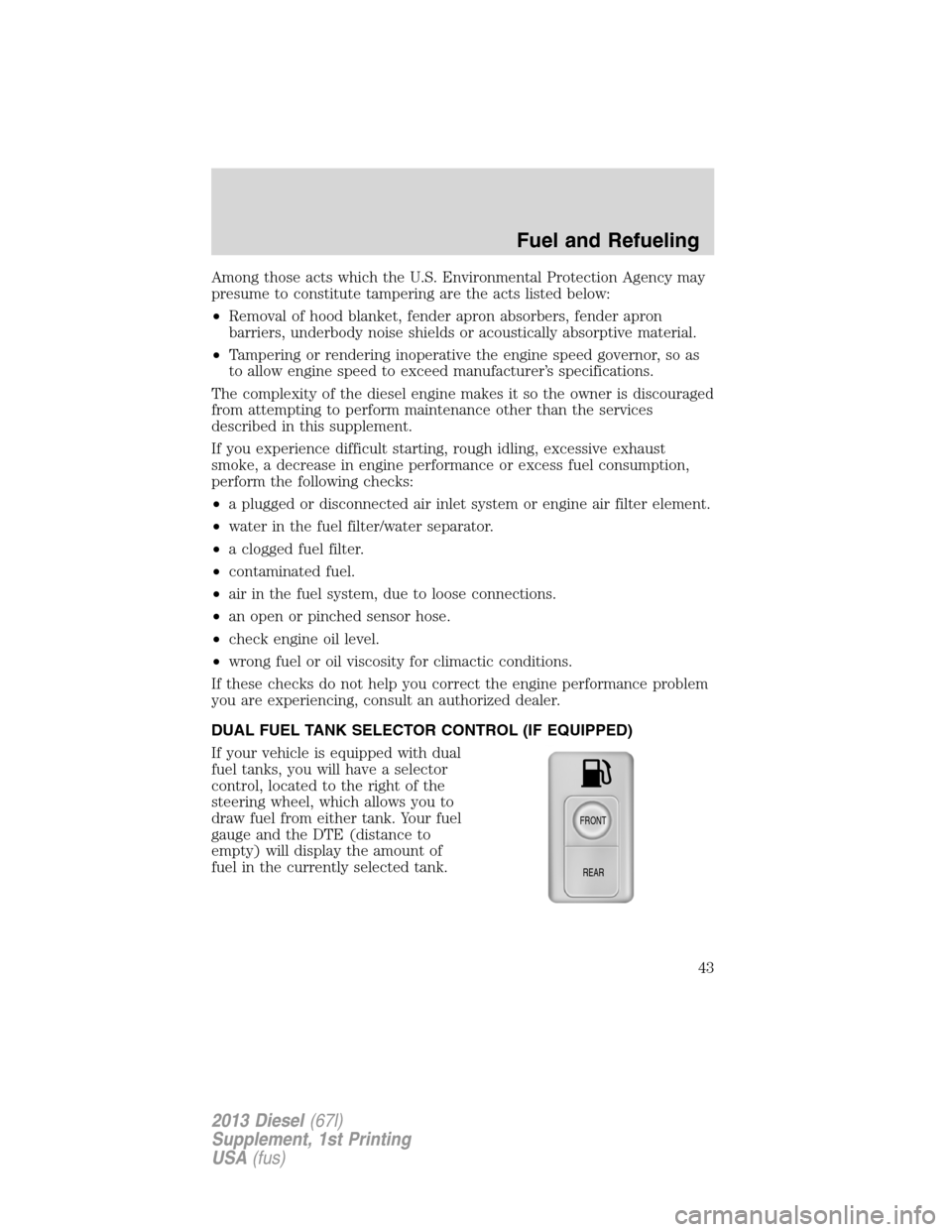
DUAL FUEL TANK SELECTOR CONTROL (IF EQUIPPED)
If your vehicle is equipped with dual
fuel tanks, you will have a selector
control, located to the right of the
steering wheel, which allows you to
draw fuel from either tank. Your fuel
gauge and the DTE (distance to
empty) will display the amount of
fuel in the currently selected tank.
FRONT
REAR
Fuel and Refueling
43
2013 Diesel(67l)
Supplement, 1st Printing
USA(fus)
Page 45 of 95
INTEGRATED ENGINE BRAKING
This feature increases engine braking at higher engine speeds to provide
better grade descent control with less brake and transmission wear and
tear.
This feature is integrated with the tow/haul mode feature. When tow/haul
mode is switched on, the integrated engine braking feature will also be
active. For more information on tow/haul, seeAutomatic transmission
operationin theOwner Manual.
Brakes
44
2013 Diesel(67l)
Supplement, 1st Printing
USA(fus)