Page 64 of 95
If the engine runs hot
The following could cause the engine to overheat:
•Lack of coolant.
•Dirty cooling system.
•Plugged radiator fins, A/C condenser and/or oil cooler.
•Malfunctioning fan drive.
•Driving with frozen coolant.
•Sticking thermostat.
•Overloading or pulling heavy trailers during hot weather.
•Grill or radiator air blockage.
•Slipping or missing drive belt.
•Plugged or very dirty air filter.
If fuses burn out
WARNING:Replacement fuses and circuit breakers must always
be the same rating as the original equipment shown. Never
replace a fuse or circuit breaker with one of a higher rating. Higher
rated fuses or circuit breakers could allow circuit overloading in the
event of a circuit malfunction, resulting in severe vehicle damage or
personal injury due to fire.
Burned-out or blown fuses usually indicate an electrical short-circuit,
although a fuse may occasionally burn out from vibration. Insert a second
fuse. If this fuse immediately burns out and you cannot locate the cause,
return your vehicle to your dealer for a circuit check.
Refer to theOwner’s Manualfor replacement of fuses.
Selective catalytic reduction (SCR) system speed limit and
Idle-only modes
If the vehicle’s speed is limited or in an idle-only mode, the SCR system
may be limiting the vehicle’s functions due to low or contaminated diesel
exhaust fluid (DEF). Check the DEF. SeeSelective catalytic reduction
(SCR) systemin theFuel and Refuelingchapter for more information.
Maintenance
63
2013 Diesel(67l)
Supplement, 1st Printing
USA(fus)
Page 65 of 95
ENGINE
Engines are more efficient when they are clean because grease and dirt
buildup keep the engine warmer than normal. When washing:
•Take care when using a power washer to clean the engine. The
high-pressure fluid could penetrate the sealed parts and cause
damage.
•Do not spray a hot engine with cold water to avoid cracking the
engine block or other engine components.
•Spray Motorcraft® Engine Shampoo and Degreaser (ZC-20) on all
parts that require cleaning and pressure rinse clean.
•Never wash or rinse the engine while it is running; water in the
running engine may cause internal damage.
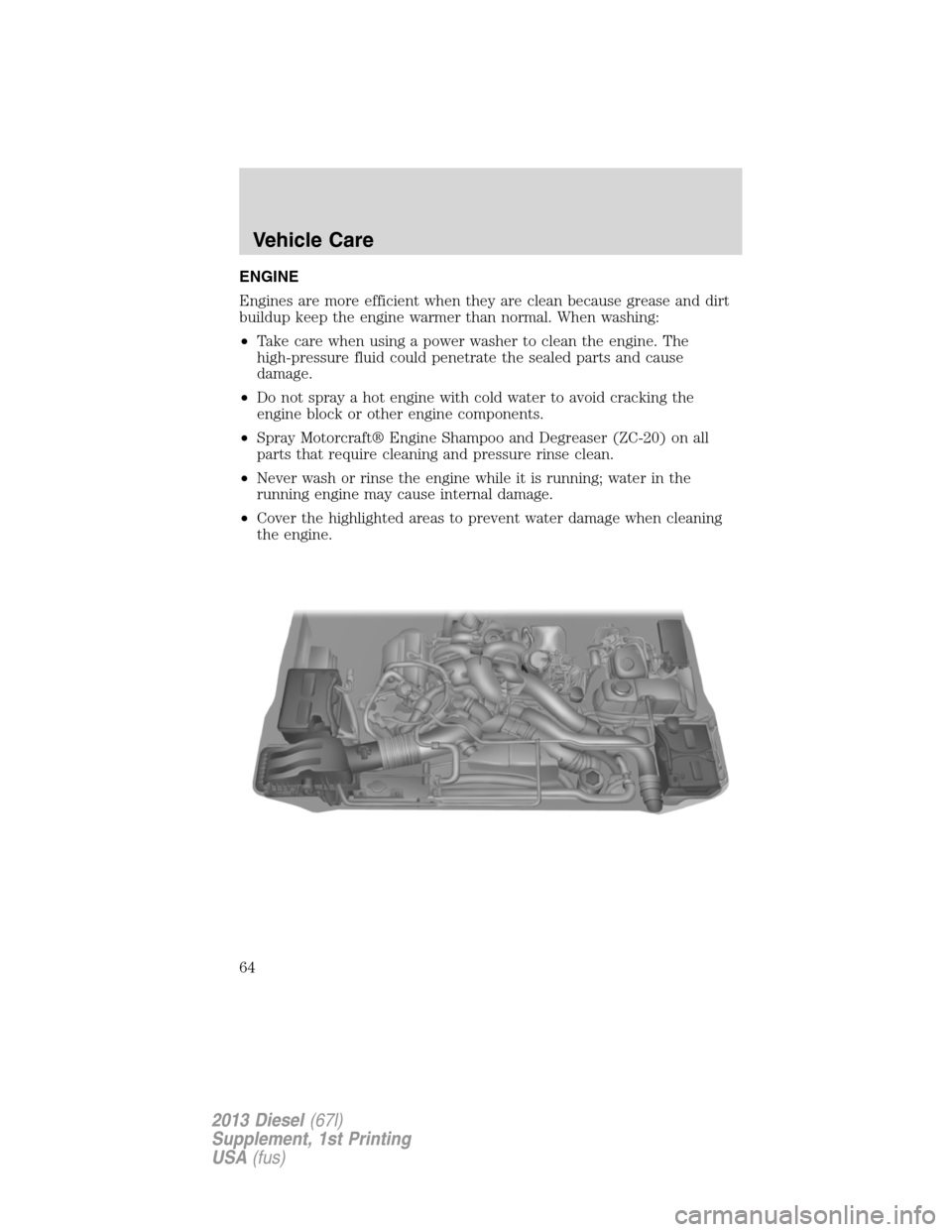
•Cover the highlighted areas to prevent water damage when cleaning
the engine.
Vehicle Care
64
2013 Diesel(67l)
Supplement, 1st Printing
USA(fus)
Page 66 of 95
EXHAUST
WARNING:Failure to maintain the functional holes, in the
tailpipe section of the exhaust, clean and free of debris or
foreign material may result in the holes becoming blocked or plugged.
Do not modify or remove the tail-pipe section. Blocked or plugged
holes or removal/modification of the system could result in elevated
exhaust gas temperatures which may result in vehicle/property damage
or personal injury
WARNING:The normal operating temperature of the exhaust
system is very high. Never work around or attempt to repair any
part of the exhaust system until it has cooled. Use special care when
working around the diesel oxidation catalytic converter and/or the
diesel particulate filter (DPF). The diesel oxidation catalytic converter
and/or the DPF heats up to a high temperature after only a short
period of engine operation and can stay hot even after the engine is
turned off. Failure to follow these instructions may result in personal
injury.
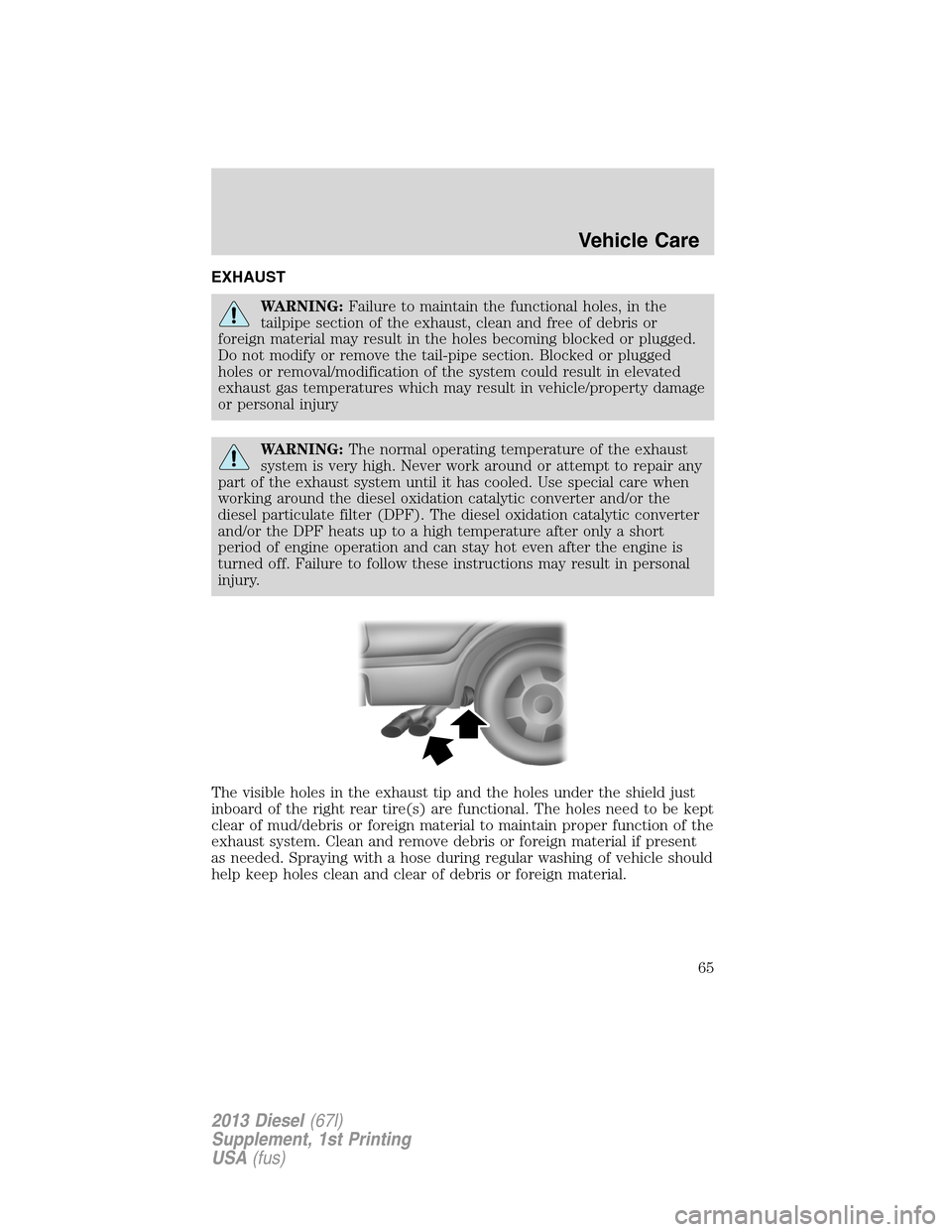
The visible holes in the exhaust tip and the holes under the shield just
inboard of the right rear tire(s) are functional. The holes need to be kept
clear of mud/debris or foreign material to maintain proper function of the
exhaust system. Clean and remove debris or foreign material if present
as needed. Spraying with a hose during regular washing of vehicle should
help keep holes clean and clear of debris or foreign material.
Vehicle Care
65
2013 Diesel(67l)
Supplement, 1st Printing
USA(fus)
Page:
< prev 1-8 9-16 17-24