Page 229 of 437
UNDER HOOD OVERVIEW
3.7L V6 engine
A. Battery
B. Engine oil dipstick
C. Engine oil filler cap
D. Brake fluid reservoir
E. Air filter assembly
F. Engine coolant reservoir
G. Windshield washer fluid reservoir
H. Power distribution box
A
GFEH
DCB
Maintenance229
2013 05+ Mustang(197)
Owners Guide gf, 1st Printing
USA(fus)
Page 230 of 437
5.0L V8 engine
A. Battery
B. Engine oil filler cap
C. Engine oil dipstick
D. Brake fluid reservoir
E. Air filter assembly
F. Engine coolant reservoir
G. Windshield washer fluid reservoir
H. Power distribution box
230Maintenance
2013 05+ Mustang(197)
Owners Guide gf, 1st Printing
USA(fus)
Page 236 of 437

WARNING:Fail-safe mode is for use during emergencies only.
Operate the vehicle in fail-safe mode only as long as necessary to
bring the vehicle to rest in a safe location and seek immediate repairs.
When in fail-safe mode, the vehicle will have limited power, will not be
able to maintain high-speed operation, and may completely shut down
without warning, potentially losing engine power, power steering assist,
and power brake assist, which may increase the possibility of a crash
resulting in serious injury.
WARNING:Never remove the coolant reservoir cap while the
engine is running or hot. The hot coolant is under pressure and
may cause serious burns.
5. Re-start the engine and take your vehicle to an authorized dealer.
Note:Driving the vehicle without repairing the engine problem increases
the chance of engine damage. Take your vehicle to an authorized dealer
as soon as possible.
TRANSMISSION FLUID CHECK
Checking automatic transmission fluid
Note:Transmission fluid should be checked and, if required, added by an
authorized dealer.
The automatic transmission does not have an underhood transmission
fluid dipstick.
Refer to yourscheduled maintenance informationfor scheduled
intervals for fluid checks and changes. Your transmission does not
consume fluid. However, the fluid level should be checked if the
transmission is not working properly, (i.e., if the transmission slips or
shifts slowly) or if you notice some sign of fluid leakage.
Do not use supplemental transmission fluid additives, treatments or
cleaning agents. The use of these materials may affect transmission
operation and result in damage to internal transmission components.
236Maintenance
2013 05+ Mustang(197)
Owners Guide gf, 1st Printing
USA(fus)
Page 237 of 437
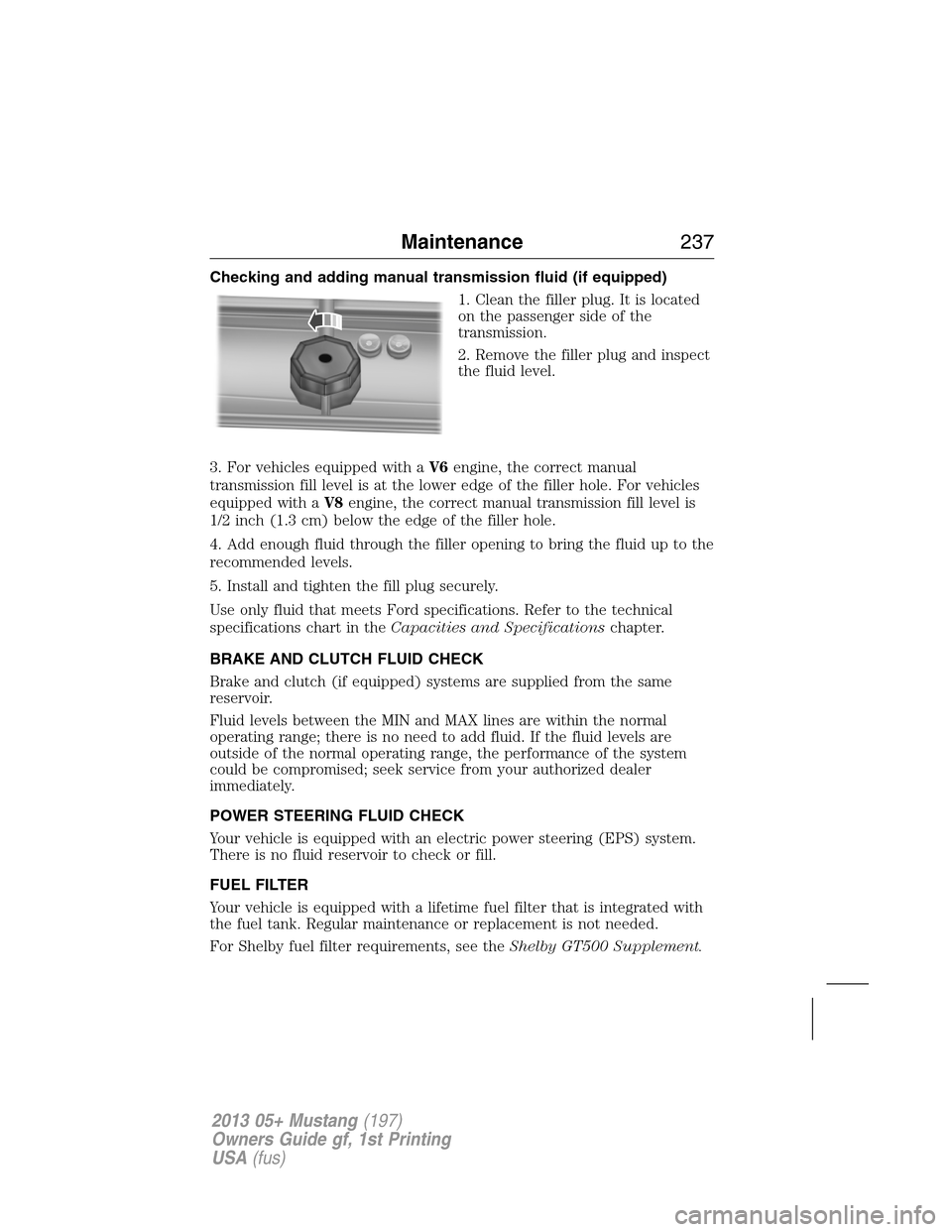
Checking and adding manual transmission fluid (if equipped)
1. Clean the filler plug. It is located
on the passenger side of the
transmission.
2. Remove the filler plug and inspect
the fluid level.
3. For vehicles equipped with aV6engine, the correct manual
transmission fill level is at the lower edge of the filler hole. For vehicles
equipped with aV8engine, the correct manual transmission fill level is
1/2 inch (1.3 cm) below the edge of the filler hole.
4. Add enough fluid through the filler opening to bring the fluid up to the
recommended levels.
5. Install and tighten the fill plug securely.
Use only fluid that meets Ford specifications. Refer to the technical
specifications chart in theCapacities and Specificationschapter.
BRAKE AND CLUTCH FLUID CHECK
Brake and clutch (if equipped) systems are supplied from the same
reservoir.
Fluid levels between the MIN and MAX lines are within the normal
operating range; there is no need to add fluid. If the fluid levels are
outside of the normal operating range, the performance of the system
could be compromised; seek service from your authorized dealer
immediately.
POWER STEERING FLUID CHECK
Your vehicle is equipped with an electric power steering (EPS) system.
There is no fluid reservoir to check or fill.
FUEL FILTER
Your vehicle is equipped with a lifetime fuel filter that is integrated with
the fuel tank. Regular maintenance or replacement is not needed.
For Shelby fuel filter requirements, see theShelby GT500 Supplement.
Maintenance237
2013 05+ Mustang(197)
Owners Guide gf, 1st Printing
USA(fus)
Page 239 of 437

Your vehicle is equipped with a Motorcraft�maintenance-free battery which
normally does not require additional water during its life of service.
Note:If your battery has a cover/shield, make sure it is reinstalled after
the battery has been cleaned or replaced.
For longer, trouble-free operation, keep the top of the battery clean and
dry. Also, make certain the battery cables are always tightly fastened to
the battery terminals.
If you see any corrosion on the battery or terminals, remove the cables
from the terminals and clean with a wire brush. You can neutralize the
acid with a solution of baking soda and water.
It is recommended that the negative battery cable terminal be
disconnected from the battery if you plan to store your vehicle for an
extended period of time.
Battery relearn
Because your vehicle’s engine is electronically controlled by a computer,
some control conditions are maintained by power from the battery. When
the battery is disconnected or a new battery is installed, the engine must
relearn its idle and fuel trim strategy for optimum driveability and
performance. To begin this process:
1. With the vehicle at a complete stop, set the parking brake.
2. Put the gearshift in P (Park) (automatic transmission) or the neutral
position (manual transmission), turn off all accessories and start the engine.
3. Run the engine until it reaches normal operating temperature.
4. Allow the engine to idle for at least one minute.
5. Turn the A/C on and allow the engine to idle for at least one minute.
6. Drive the vehicle to complete the relearning process.
•The vehicle may need to be driven 10 miles (16 km) or more to
relearn the idle and fuel trim strategy.
•Note:If you do not allow the engine to relearn its idle trim, the idle
quality of your vehicle may be adversely affected until the idle trim is
eventually relearned.
When the battery is disconnected or a new battery installed, the
transmission must relearn its adaptive strategy. As a result of this, the
transmission may shift firmly. This operation is considered normal and
will not affect function or durability of the transmission. Over time the
adaptive learning process will fully update transmission operation to its
optimum shift feel.
Maintenance239
2013 05+ Mustang(197)
Owners Guide gf, 1st Printing
USA(fus)
Page 245 of 437

5. Carefully pull the bulb straight
out of socket.
Replacing fog lamp bulbs (V6) (if equipped)
1. Make sure the headlamp control is in the off position and open the hood.
2. Remove the hex head screws
attaching the underbody forward
aeroshield.
3. Remove the underbody forward
aeroshield to gain access to the fog
lamp assembly.
4. Disconnect the electrical
connector from the bulb by pulling
it straight off.
5. Rotate the bulb counterclockwise and remove from the lamp assembly.
Install the new bulb in reverse order.
Replacing fog lamp bulbs (GT)
Your vehicle is equipped with LED fog lamp bulbs. It is designed to last
the life of the vehicle. If replacement is required, it is recommended that
you see your authorized dealer.
Replacing tail lamp/brake/rear turn signal lamps
Your vehicle is equipped with LED tail lamp/brake/rear turn signal lamps.
It is designed to last the life of the vehicle. If replacement is required, it
is recommended that you see your authorized dealer.
Replacing backup bulbs
Your vehicle is equipped with LED backup lamps. They are designed to
last the life of the vehicle. If replacement is required, it is recommended
that you see your authorized dealer.
Maintenance245
2013 05+ Mustang(197)
Owners Guide gf, 1st Printing
USA(fus)
Page 247 of 437
BULB SPECIFICATION CHART
Replacement bulbs are specified in the chart below. Headlamp bulbs
must be marked with an authorized “D.O.T.” for North America and an
“E” for Europe to ensure lamp performance, light brightness and pattern
and safe visibility. The correct bulbs will not damage the lamp assembly
or void the lamp assembly warranty and will provide quality bulb burn
time.
Function Trade Number
* HID (high intensity discharge) headlamp D3S
Front park/turn lamp 7444NA (amber)
Sidemarker (front/rear) 194
Fog lampLED (GT)
H11 (V6)
* Tail lamp, brake lamp, turn lamp (LED) LED
* High-mount stoplamp (LED) LED
* Backup lamp LED
License plate lamp C5WL
Dome/Map lamp 168
All replacement bulbs are clear in color except where noted.
To replace all instrument panel lights - see your authorized dealer.
* To replace these lamps - see your authorized dealer.
Maintenance247
2013 05+ Mustang(197)
Owners Guide gf, 1st Printing
USA(fus)
Page 254 of 437

CLEANING THE ALLOY WHEELS
Note:Do not use chrome cleaner, metal cleaner or polish on wheels and
wheel covers.
Aluminum wheels and wheel covers are coated with a clear coat paint
finish. In order to maintain their shine:
•Clean weekly with Motorcraft�Wheel and Tire Cleaner. Heavy dirt and
brake dust accumulation may require agitation with a sponge. Rinse
thoroughly with a strong stream of water.
•Never apply any cleaning chemical to hot or warm wheel rims or
covers.
•Some automatic car washes may cause damage to the finish on your
wheel rims or covers. Industrial-strength (heavy-duty) cleaners, or
cleaning chemicals, in combination with brush agitation to remove
brake dust and dirt, could wear away the clear coat finish over time.
•Do not use hydrofluoric acid-based or high caustic-based wheel
cleaners, steel wool, fuels or strong household detergent.
•To remove tar and grease, use Motorcraft�Bug and Tar Remover.
VEHICLE STORAGE
If you plan on storing your vehicle for an extended period of time
(30 days or more), read the following maintenance recommendations to
make sure your vehicle stays in good operating condition.
All motor vehicles and their components were engineered and tested for
reliable, regular driving. Long term storage under various conditions may
lead to component degradation or failure unless specific precautions are
taken to preserve the components.
General
•Store all vehicles in a dry, ventilated place.
•Protect from sunlight, if possible.
•If vehicles are stored outside, they require regular maintenance to
protect against rust and damage.
Body
•Wash vehicle thoroughly to remove dirt, grease, oil, tar or mud from
exterior surfaces, rear-wheel housing and underside of front fenders.
•Periodically wash vehicles stored in exposed locations.
•Touch-up raw or primed metal to prevent rust.
254Vehicle Care
2013 05+ Mustang(197)
Owners Guide gf, 1st Printing
USA(fus)


