Page 257 of 558

System Limitations
WARNING:The collision warning system’s brake support can
only help reduce the speed at which a collision occurs if the
driver applies the vehicle’s brakes. The brake pedal must be pressed
just like any typical braking situation.
Due to the nature of radar technology, there may be certain instances
where vehicles do not provide a collision warning. These include:
•Stationary vehicles or vehicles moving below 6 mph (10 km/h).
•Pedestrians or objects in the roadway.
•Oncoming vehicles in the same lane.
•Severe weather conditions (see blocked sensor section).
•Debris build-up on the grille near the headlamps (see blocked sensor
section).
•Small distance to vehicle ahead.
•Steering wheel and pedal movements are large (very active driving
style).
•High interior temperatures, which may deactivate the illumination or
the warning lamps until the interior temperature reduces (audible
warning still sounds).
Certain conditions may reduce the visibility of the warning lamp;
therefore, it is recommended to keep the audible warning on.
If the front end of the vehicle is hit or damaged, the radar sensing zone
may be altered causing missed or false collision warnings. See your
authorized dealer to have your collision warning radar checked for proper
coverage and operation.
Driving Aids257
2013 Flex(471)
Owners Guide gf, 1st Printing
USA(fus)
Page 258 of 558
STEERING
Electric Power Steering
WARNING:The electric power steering system has diagnostic
checks that continuously monitor the system to ensure proper
operation. When a system error is detected the following message
Service Power Steering, Service Power Steering Now or Power Steering
Assist Fault may appear in the information display.
WARNING:The electric power steering system has diagnostics
checks that continuously monitor the system to ensure proper
operation of the electronic system. When an electronic error is
detected, Power Steering Assist Fault will be displayed in the
information display. If this happens, stop the vehicle in a safe place, and
turn off the engine. After at least 10 seconds, reset the system by
restarting the engine, and watch the information display for Power
Steering Assist Fault. If the message returns, or returns while driving,
take the vehicle to your dealer to have it checked. With the message
displayed, the steering assist is turned off, making the vehicle harder to
steer.
WARNING:If Service Power Steering is displayed in the
information display, a problem with the system function has been
detected. On the next key cycle Service Power Steering Now will be
displayed and steering assist will be removed until the steering system
is serviced. Have your vehicle taken to the nearest dealer as soon as
possible.
WARNING:Obtain immediate service if a system error is
detected. You may not notice any difference in the feel of your
steering, but a serious condition may exist. Failure to do so may result
in loss of steering control.
258Driving Aids
2013 Flex(471)
Owners Guide gf, 1st Printing
USA(fus)
Page 259 of 558

Your vehicle is equipped with an electric power-assisted steering system.
There is no fluid reservoir to check or fill.
If your vehicle loses electrical power while you are driving (or if the
ignition is turned off), you can steer the vehicle manually, but it takes
more effort. Extreme continuous steering may increase the effort it takes
for you to steer. This occurs to prevent internal overheating and
permanent damage to your steering system. If this should occur, you will
neither lose the ability to steer the vehicle manually nor will it cause
permanent damage. Typical steering and driving maneuvers will allow the
system to cool and steering assist will return to normal.
When a steering system error is detected, the following messages may
appear in the information display:
•Service Power Steering
•Service Power Steering Now
•Power Steering Assist Fault
Steering Tips
If the steering wanders or pulls, check for:
•an improperly inflated tire
•uneven tire wear
•loose or worn suspension components
•loose or worn steering components
•improper vehicle alignment
A high crown in the road or high crosswinds may also make the steering
seem to wander/pull.
Driving Aids259
2013 Flex(471)
Owners Guide gf, 1st Printing
USA(fus)
Page 299 of 558
Fuse/Relay
NumberFuse Amp
RatingProtected Components
78 20A* Right high-intensity discharge
headlamps
79 10A* Adaptive cruise control
80 — Not used
81 — Not used
82 15A* Rear washer
83 — Not used
84 20A* Trailer tow park lamps
85 — Not used
86 5A* Powertrain control module —
keep-alive power, Powertrain
control module relay, Canister
vent solenoid (non-EcoBoost
engines)
87 5A* Run/start
88 — Not used
89 10A* Anti–lock brake system module
90 10A* Powertrain control module
run/start
91 10A* Adaptive cruise control
92 5A* Front blower relay coil, Power
steering module
93 5A* Auxiliary blower, Rear defroster,
Battery charge relays
94 30A** Body control module run/start
95 5A* Front passenger window switch
96 — Not used
97 — Not used
98 — Not used
*Mini Fuses **Cartridge Fuses
Fuses299
2013 Flex(471)
Owners Guide gf, 1st Printing
USA(fus)
Page 300 of 558
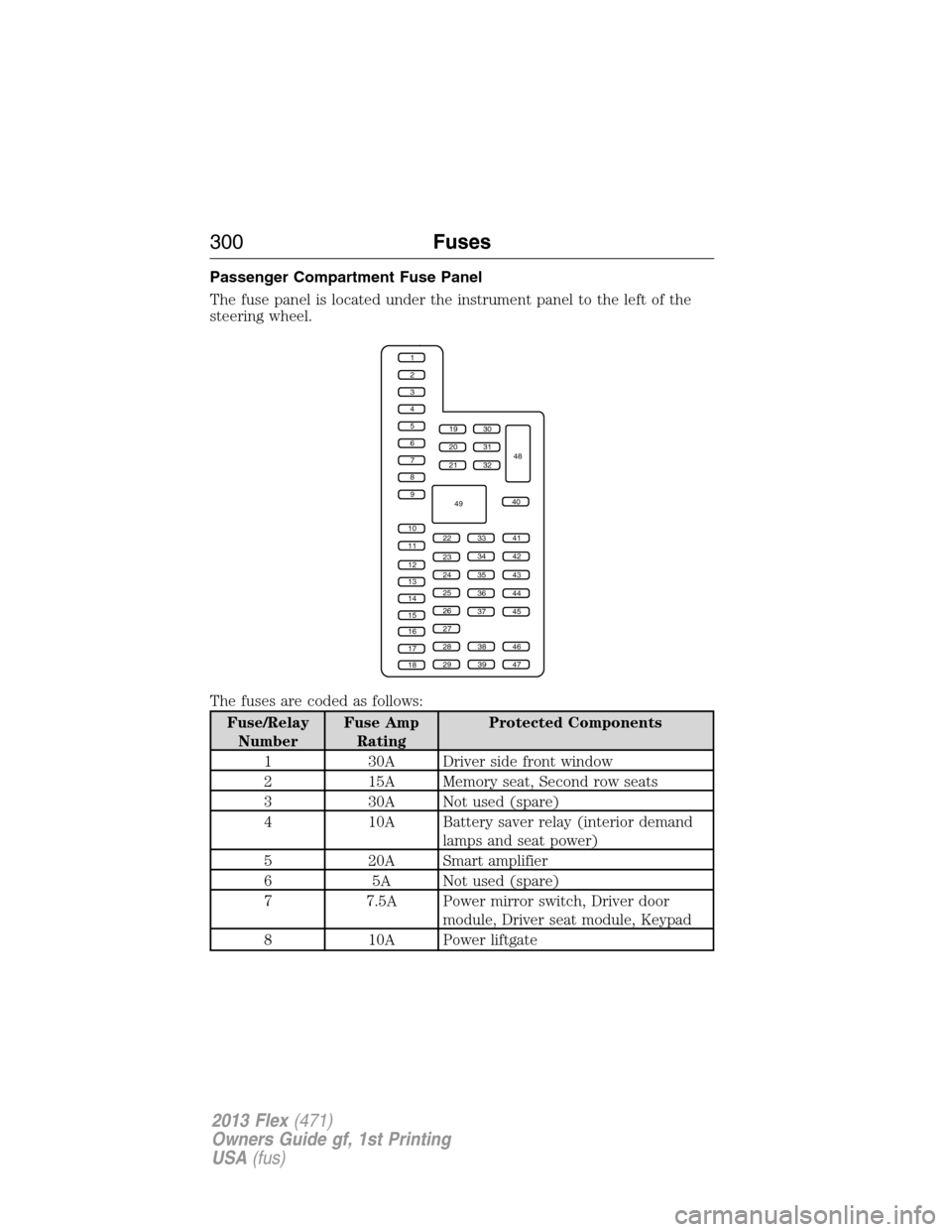
Passenger Compartment Fuse Panel
The fuse panel is located under the instrument panel to the left of the
steering wheel.
The fuses are coded as follows:
Fuse/Relay
NumberFuse Amp
RatingProtected Components
1 30A Driver side front window
2 15A Memory seat, Second row seats
3 30A Not used (spare)
4 10A Battery saver relay (interior demand
lamps and seat power)
5 20A Smart amplifier
6 5A Not used (spare)
7 7.5A Power mirror switch, Driver door
module, Driver seat module, Keypad
8 10A Power liftgate
1
2
3
4
5
6
7
8
9
10
11
12
13
14
15
16
17
18
19
20
21
223341
42
43
44
45
34
35
36
37
23
24
25
26
27
283846
394729
32
40
31
30
48
49
300Fuses
2013 Flex(471)
Owners Guide gf, 1st Printing
USA(fus)
Page 301 of 558
Fuse/Relay
NumberFuse Amp
RatingProtected Components
9 10A SYNC�, Electronic finish panel, Radio
transceiver module
10 10A Run/accessory relay, Front wiper
motor relay
11 10A Intelligent access module, Heads-up
display
12 15A Interior lighting, Puddle lamps,
Backlighting
13 15A Right turn signals
14 15A Left turn signals
15 15A Center high mounted stop lamp,
Backup lamp
16 10A Low beam headlamps (right)
17 10A Low beam headlamps (left)
18 10A
Third row power seats, Start button run
indicator, Keypad illumination, Brake
shift interlock, Powertrain control
module wake-up, Anti-theft system
19 20A Not used (spare)
20 20A Locks
21 10A Not used (spare)
22 20A Horn relay
23 15A Steering wheel control module,
Instrument cluster
24 15A Datalink connector, Steering wheel
control module
25 15A Liftgate release
26 5A Ignition switch, Push button start
switch
27 20A Intelligent access module
28 15A Not used (spare)
Fuses301
2013 Flex(471)
Owners Guide gf, 1st Printing
USA(fus)
Page 304 of 558
OPENING AND CLOSING THE HOOD
1. Inside the vehicle, pull the hood
release handle located under the
bottom of the instrument panel near
the steering column.
2. Go to the front of the vehicle and
release the auxiliary latch that is
located under the front center of
the hood.
3. Lift the hood.
P
U
S
H
O
N
O
F
F
304Maintenance
2013 Flex(471)
Owners Guide gf, 1st Printing
USA(fus)
Page 312 of 558

What you should know about fail-safe cooling
If the engine coolant supply is depleted, this feature allows the vehicle to
be driven temporarily before incremental component damage is incurred.
The “fail-safe” distance depends on ambient temperatures, vehicle load
and terrain.
How fail-safe cooling works
If the engine begins to overheat, the engine coolant temperature gauge
will move to the red (hot) area and:
The coolant temperature warning light will illuminate.
The service engine soon indicator will illuminate.
If the engine reaches a preset over-temperature condition, the engine will
automatically switch to alternating cylinder operation. Each disabled
cylinder acts as an air pump and cools the engine.
When this occurs the vehicle will still operate. However:
•The engine power will be limited.
•The air conditioning system will be disabled.
Continued operation will increase the engine temperature and the engine
will completely shut down, causing steering and braking effort to
increase.
Once the engine temperature cools, the engine can be re-started. Take
your vehicle to an authorized dealer as soon as possible to minimize
engine damage.
When fail-safe mode is activated
WARNING:Fail-safe mode is for use during emergencies only.
Operate the vehicle in fail-safe mode only as long as necessary to
bring the vehicle to rest in a safe location and seek immediate repairs.
When in fail-safe mode, the vehicle will have limited power, will not be
able to maintain high-speed operation, and may completely shut down
without warning, potentially losing engine power, power steering assist,
and power brake assist, which may increase the possibility of a crash
resulting in serious injury.
312Maintenance
2013 Flex(471)
Owners Guide gf, 1st Printing
USA(fus)