Page 53 of 341
Children 12 years old and under should always be properly restrained in
the back seats. The side curtain airbags will not interfere with children
restrained using a properly installed child or booster seat because it is
designed to inflate downward from the headliner above the doors along
the side window opening.
The design and development of the side curtain airbags included
recommended testing procedures that were developed by a group of
automotive safety experts known as the Side Airbag Technical Working
Group. These recommended testing procedures help reduce the risk of
injuries related to the deployment of side curtain airbags.
CRASH SENSORS AND AIRBAG INDICATOR
WARNING:Modifying or adding equipment to the front end of
the vehicle (including frame, bumper, front end body structure
and tow hooks) may affect the performance of the airbag system,
increasing the risk of injury. Do not modify the front end of the vehicle.
The vehicle has a collection of crash and occupant sensors which provide
information to the Restraints Control Module (RCM) which deploys
(activates) the front safety belt pretensioners, driver airbag, passenger
airbag, knee airbag, seat mounted side airbags, and the side curtain
airbags. Based on the type of collision (frontal impact or side impact) the
restraints control module will deploy the appropriate safety devices.
The restraints control module also monitors the readiness of the above
safety devices plus the crash and occupant sensors. The readiness of the
safety system is indicated by a warning indicator light in the instrument
cluster or by a backup tone if the warning light is not working. Refer to
Warning lamps and indicatorsin theInstrument Clusterchapter.
Routine maintenance of the airbag is not required.
A difficulty with the system is indicated by one or more of the following:
•The readiness light will either flash or stay lit.
•The readiness light will not illuminate immediately after the
ignition is turned on.
•A series of five beeps will be heard. The tone pattern will repeat
periodically until the problem and/or light are repaired.
Supplementary Restraints System53
2013 Fiesta(fie)
Owners Guide gf, 1st Printing
USA(fus)
Page 72 of 341
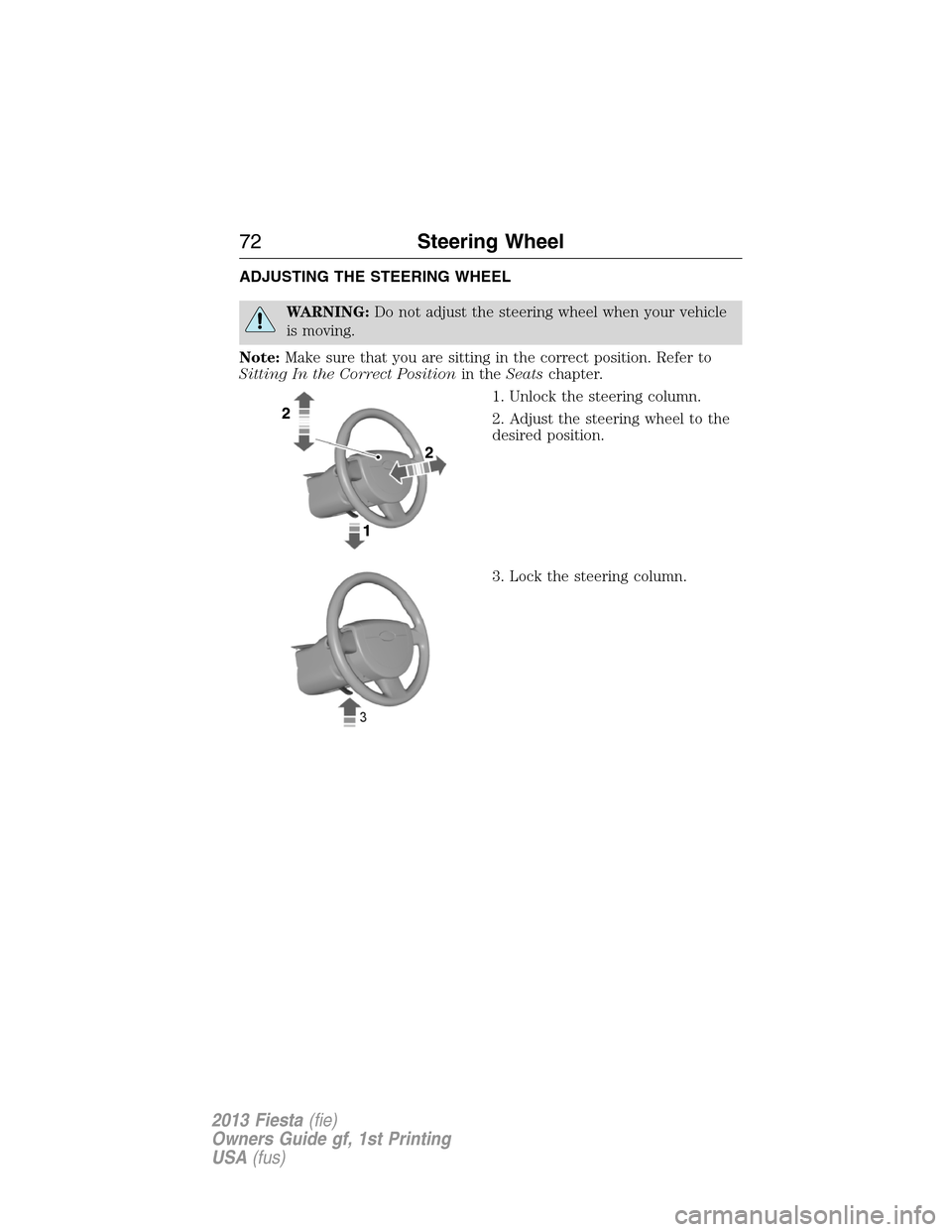
ADJUSTING THE STEERING WHEEL
WARNING:Do not adjust the steering wheel when your vehicle
is moving.
Note:Make sure that you are sitting in the correct position. Refer to
Sitting In the Correct Positionin theSeatschapter.
1. Unlock the steering column.
2. Adjust the steering wheel to the
desired position.
3. Lock the steering column.
72Steering Wheel
2013 Fiesta(fie)
Owners Guide gf, 1st Printing
USA(fus)
Page 114 of 341

Select to distribute air through the windshield air vents. You
can also use this setting to defog and clear the windshield of a
thin covering of ice. You can also increase the temperature and
fan speed to improve clearing.
C.Temperature control:Controls the temperature of the air circulated
in your vehicle. Adjust to select the desired temperature. If you select
MAX A/C, the system distributes recirculated air through the instrument
panel air vents. This mode is more economical and efficient than normal
air conditioning.
D.Rear defroster:Press to switch the rear defroster on. Refer to
Heated windows and mirrorslater in this chapter for more
information.
E.Recirculated air:Press the button to switch between outside air and
recirculated air. When you select recirculated air, the button illuminates
and the air currently in the passenger compartment recirculates. This
can reduce the time needed to cool the interior and reduce unwanted
odors from entering your vehicle.
F.Air conditioning:Press the button to switch the air conditioning on
or off. Air conditioning cools your vehicle using outside air. To improve
air conditioning when starting your vehicle, drive with the windows
slightly open for two to three minutes.
HINTS ON CONTROLLING THE INTERIOR CLIMATE
General Hints
Note:Prolonged use of recirculated air may cause the windows to fog
up.
Note:A small amount of air may be felt from the footwell air vents
regardless of the air distribution setting.
Note:To reduce humidity build-up inside your vehicle, do not drive with
the system switched off or with recirculated air always switched on.
Note:Do not place objects under the front seats as this may interfere
with the airflow to the rear seats.
Note:Remove any snow, ice or leaves from the air intake area at the
base of the windshield.
Note:To reduce fogging of the windshield during humid weather, adjust
the air distribution control to the windshield air vents position. Increase
the temperature and fan speed to improve clearing if required.
11 4Climate Control
2013 Fiesta(fie)
Owners Guide gf, 1st Printing
USA(fus)
Page 118 of 341
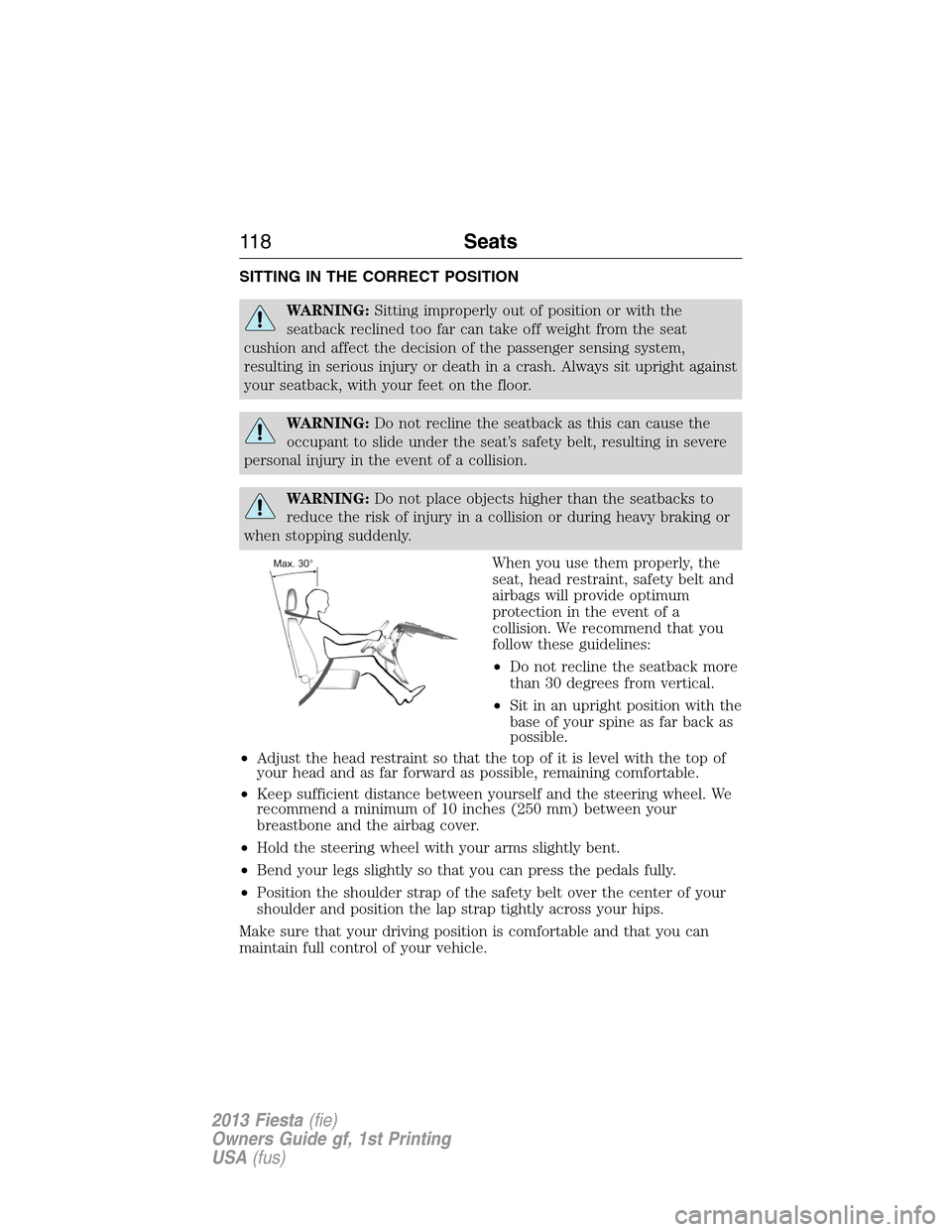
SITTING IN THE CORRECT POSITION
WARNING:Sitting improperly out of position or with the
seatback reclined too far can take off weight from the seat
cushion and affect the decision of the passenger sensing system,
resulting in serious injury or death in a crash. Always sit upright against
your seatback, with your feet on the floor.
WARNING:Do not recline the seatback as this can cause the
occupant to slide under the seat’s safety belt, resulting in severe
personal injury in the event of a collision.
WARNING:Do not place objects higher than the seatbacks to
reduce the risk of injury in a collision or during heavy braking or
when stopping suddenly.
When you use them properly, the
seat, head restraint, safety belt and
airbags will provide optimum
protection in the event of a
collision. We recommend that you
follow these guidelines:
•Do not recline the seatback more
than 30 degrees from vertical.
•Sit in an upright position with the
base of your spine as far back as
possible.
•Adjust the head restraint so that the top of it is level with the top of
your head and as far forward as possible, remaining comfortable.
•Keep sufficient distance between yourself and the steering wheel. We
recommend a minimum of 10 inches (250 mm) between your
breastbone and the airbag cover.
•Hold the steering wheel with your arms slightly bent.
•Bend your legs slightly so that you can press the pedals fully.
•Position the shoulder strap of the safety belt over the center of your
shoulder and position the lap strap tightly across your hips.
Make sure that your driving position is comfortable and that you can
maintain full control of your vehicle.
11 8Seats
2013 Fiesta(fie)
Owners Guide gf, 1st Printing
USA(fus)
Page 119 of 341
HEAD RESTRAINTS
WARNING:To minimize the risk of neck injury in the event of a
crash, the driver and passenger occupants should not sit in
and/or operate the vehicle, until the head restraint is placed in its
proper position. The driver should never adjust the head restraint while
the vehicle is in motion.
WARNING:The adjustable head restraint is a safety device.
Whenever possible, it should be installed and properly adjusted
when the seat is occupied.
WARNING:Install the head restraint properly to minimize the
risk of neck injury in the event of a crash.
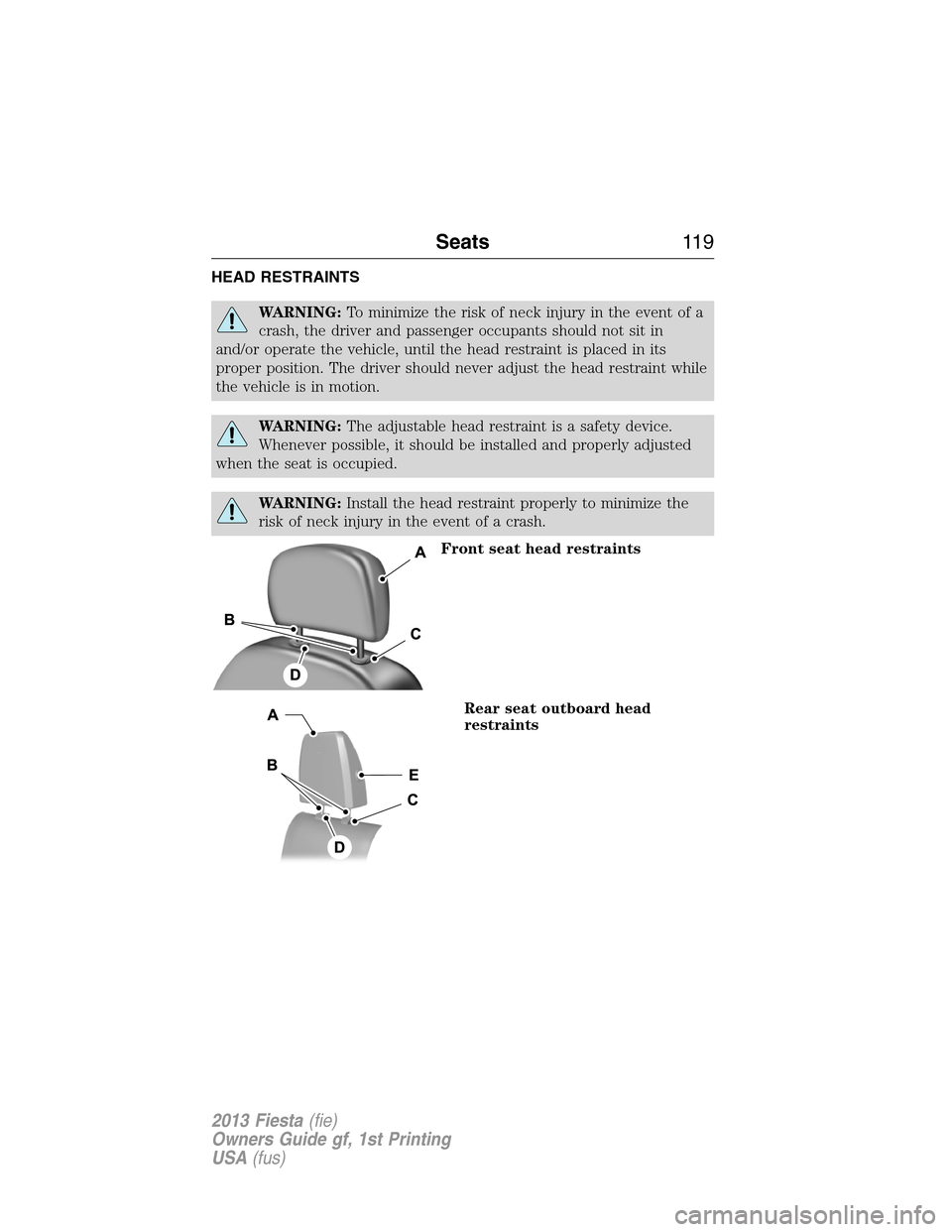
Front seat head restraints
Rear seat outboard head
restraints
Seats11 9
2013 Fiesta(fie)
Owners Guide gf, 1st Printing
USA(fus)
Page 120 of 341
Rear seat center head restraints
The head restraints consist of:
A. An energy absorbing head restraint
B. Two steel stems
C. Guide sleeve adjust and release button
D. Guide sleeve unlock and remove button
E. Fold button
Note:Adjust the seatback to an upright driving position before adjusting
any head restraint. Adjust the head restraint so that the top of it is level
with the top of your head and as far forward as possible, remaining
comfortable. For occupants of extremely tall stature, adjust the head
restraint to its highest position.
Adjusting the Head Restraint
Raising the head restraint
Pull up the head restraint.
Lowering the head restraint
1. Press and hold button C.
2. Push the head restraint down.
Removing the head restraint
1. Pull up the head restraint until it reaches the highest adjustment
position.
2. Press and hold buttons C and D.
3. Pull the head restraint up.
D
B
A
B
C
120Seats
2013 Fiesta(fie)
Owners Guide gf, 1st Printing
USA(fus)
Page 121 of 341
Installing the head restraint
Align the steel stems into the guide sleeves and push the head restraint
down until it locks.
Folding the rear head restraint (if equipped)
1. To fold, press and hold button E.
2. To unfold, rotate the head restraint rearward.
Tilting Head Restraints (If Equipped)
The front head restraints may have a tilting feature for extra comfort. To
tilt the head restraint, do the following:
1. Adjust the seatback to an upright driving/riding
position.
2. Tilt the head restraint forward by gently pulling
the top of the head restraint.
Once it is in its forward-most position, tilting it forward once more will
release it to the upright position.
Note:Do not attempt to force the head restraint backward after it is
tilted. Instead, continue tilting it forward until the head restraint releases
to the upright position.
Seats121
2013 Fiesta(fie)
Owners Guide gf, 1st Printing
USA(fus)
Page 122 of 341
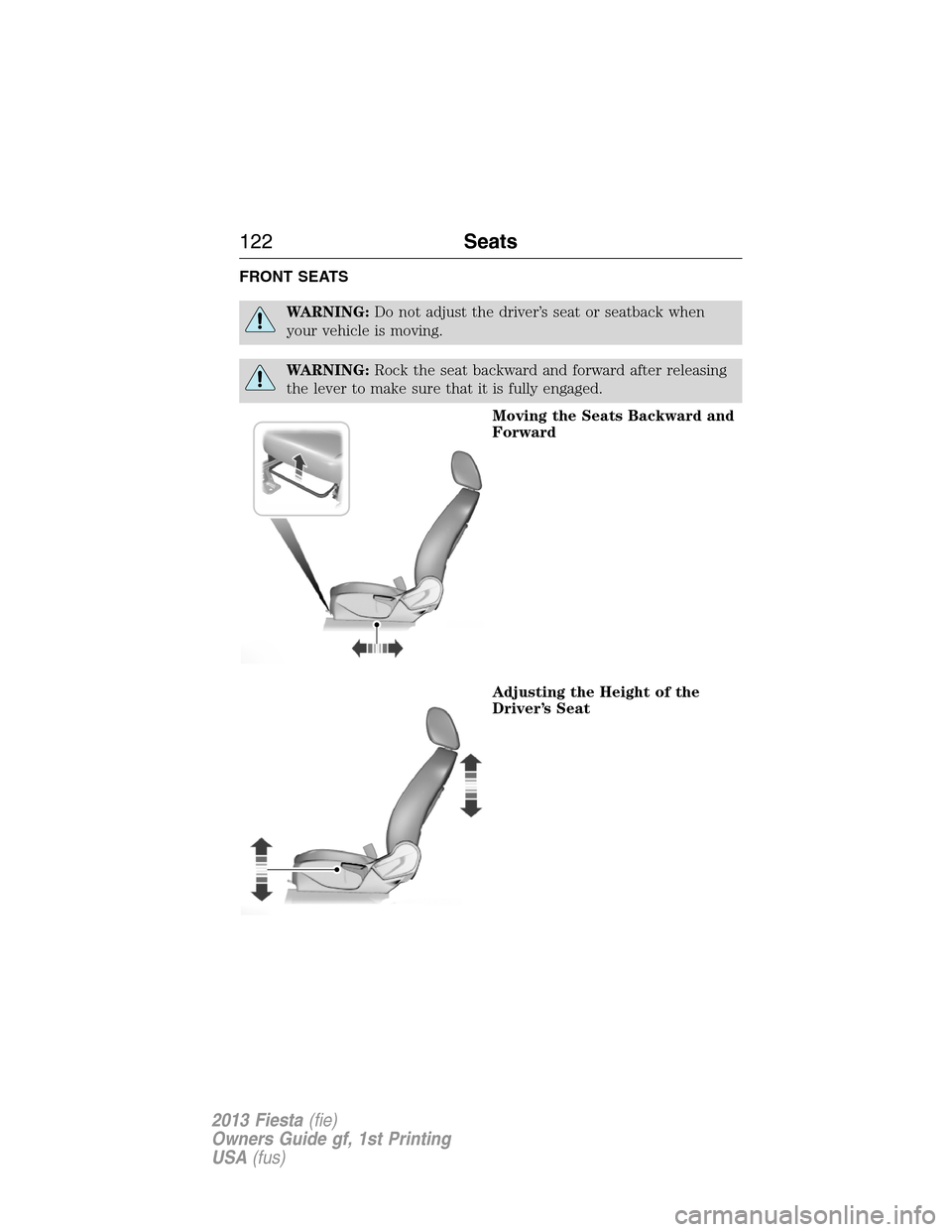
FRONT SEATS
WARNING:Do not adjust the driver’s seat or seatback when
your vehicle is moving.
WARNING:Rock the seat backward and forward after releasing
the lever to make sure that it is fully engaged.
Moving the Seats Backward and
Forward
Adjusting the Height of the
Driver’s Seat
122Seats
2013 Fiesta(fie)
Owners Guide gf, 1st Printing
USA(fus)