2013 FORD F SERIES MOTORHOME AND COMMERCIAL CHASSIS stop start
[x] Cancel search: stop startPage 2 of 157
Introduction 4
Steering Wheel 11
Adjusting the steering wheel..............................11
Wipers and Washers 12
Windshield wipers.....................................12
Windshield washers....................................12
Lighting 13
Lighting control.......................................13
Instrument lighting dimmer...............................14
Daytime running lamps..................................14
Directionindicators ....................................15
Instrument Cluster 16
Gauges.............................................16
Warning lamps and indicators.............................18
Audible warnings and indicators...........................21
Information Displays 22
Controls.............................................22
Starting and Stopping the Engine 27
Ignition switch........................................28
Starting the engine.....................................28
Fuel and Refueling 30
Fuel quality..........................................32
Refueling............................................33
Fuel consumption......................................34
Transmission 39
Transmission operation..................................39
Brakes 44
Brakes..............................................44
Hints on driving with anti-lock brakes.......................45
Table of Contents1
2013 Motorhome(mot)
Owners Guide gf, 1st Printing
USA(fus)
Page 18 of 157
Transmission Fluid Temperature Gauge
Normal area:The transmission fluid is within the normal operating
temperature (between H and C).
Yellow area:The transmission fluid is higher than normal operating
temperature. This can be caused by special operation conditions (i.e.
snowplowing, towing or off-road use). Operating the transmission for
extended periods of time with the gauge in the yellow area may cause
internal transmission damage. Altering the severity of the driving
conditions is recommended to lower the transmission temperature into
the normal range.
Red area:The transmission fluid is overheating. Stop the vehicle to
allow the temperature to return to normal range.
If the gauge is operating in the yellow or red area, stop the vehicle and
verify the airflow is not restricted such as snow or debris blocking airflow
through the grill. If the gauge continues to show high temperatures, see
your authorized dealer.
Engine Coolant Temperature Gauge
At normal operating temperature, the needle will remain in the center
section. If the needle enters the red section, the engine is overheating.
Stop the engine, switch the ignition off and determine the cause once
the engine has cooled down. SeeEngine Coolant Check.
Note:Do not restart the engine until the cause of overheating has been
resolved.
WARNING:Never remove the coolant reservoir cap while the
engine is running or hot.
Fuel Gauge
Switch the ignition on. The fuel gauge will indicate approximately how
much fuel is left in the fuel tank. The fuel gauge may vary slightly when
the vehicle is moving or on a gradient. The arrow adjacent to the fuel
pump symbol indicates on which side of your vehicle the fuel filler door
is located.
Instrument Cluster17
2013 Motorhome(mot)
Owners Guide gf, 1st Printing
USA(fus)
Page 19 of 157
WARNING LAMPS AND INDICATORS
The following warning lamps and indicators will alert you to a vehicle
condition that may become serious. Some lamps will illuminate when you
start your vehicle to make sure they work. If any lamps remain on after
starting your vehicle, refer to the respective system warning lamp for
further information.
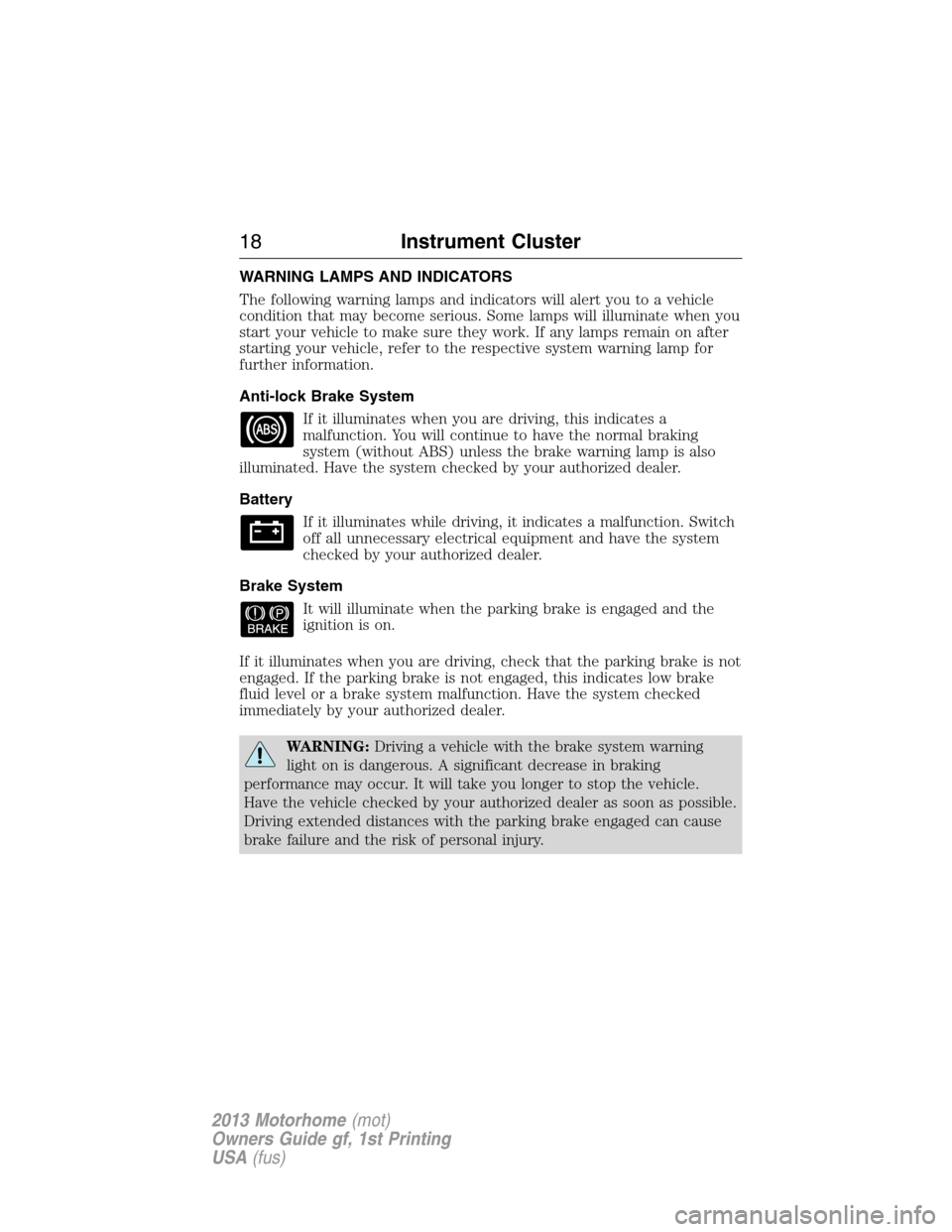
Anti-lock Brake System
If it illuminates when you are driving, this indicates a
malfunction. You will continue to have the normal braking
system (without ABS) unless the brake warning lamp is also
illuminated. Have the system checked by your authorized dealer.
Battery
If it illuminates while driving, it indicates a malfunction. Switch
off all unnecessary electrical equipment and have the system
checked by your authorized dealer.
Brake System
It will illuminate when the parking brake is engaged and the
ignition is on.
If it illuminates when you are driving, check that the parking brake is not
engaged. If the parking brake is not engaged, this indicates low brake
fluid level or a brake system malfunction. Have the system checked
immediately by your authorized dealer.
WARNING:Driving a vehicle with the brake system warning
light on is dangerous. A significant decrease in braking
performance may occur. It will take you longer to stop the vehicle.
Have the vehicle checked by your authorized dealer as soon as possible.
Driving extended distances with the parking brake engaged can cause
brake failure and the risk of personal injury.
18Instrument Cluster
2013 Motorhome(mot)
Owners Guide gf, 1st Printing
USA(fus)
Page 28 of 157
GENERAL INFORMATION
WARNING:Extended idling at high engine speeds can produce
very high temperatures in the engine and exhaust system,
creating the risk of fire or other damage.
WARNING:Do not park, idle, or drive your vehicle on dry grass
or other dry ground cover. The emission system heats up the
engine compartment and exhaust system, which can start a fire.
WARNING:Do not start your vehicle in a closed garage or in
other enclosed areas. Exhaust fumes can be toxic. Always open
the garage door before you start the engine.
WARNING:If you smell exhaust fumes inside your vehicle, have
your vehicle checked by an authorized dealer immediately. Do
not drive if you smell exhaust fumes.
If you disconnect the battery, your vehicle may exhibit some unusual
driving characteristics for approximately 5 miles (8 kilometers) after you
connect it. This is because the engine management system must realign
itself with the engine. You may disregard any unusual driving
characteristics during this period.
This system meets all Canadian interference-causing equipment standard
requirements regulating the impulse electrical field strength of radio
noise.
When starting your vehicle, avoid pressing the accelerator pedal before
and during operation. Only use the accelerator pedal when you have
difficulty starting the engine.
Starting and Stopping the Engine27
2013 Motorhome(mot)
Owners Guide gf, 1st Printing
USA(fus)
Page 29 of 157
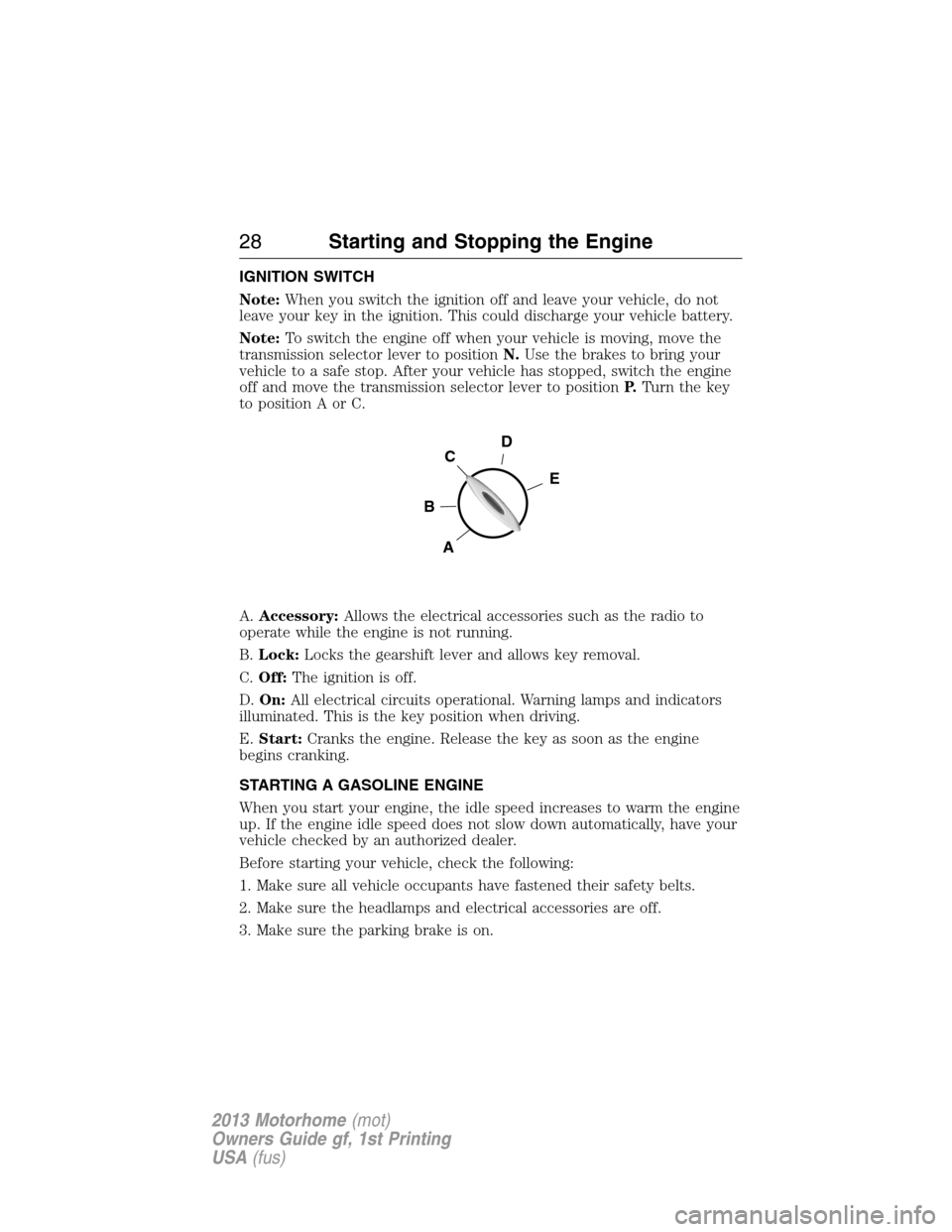
IGNITION SWITCH
Note:When you switch the ignition off and leave your vehicle, do not
leave your key in the ignition. This could discharge your vehicle battery.
Note:To switch the engine off when your vehicle is moving, move the
transmission selector lever to positionN.Use the brakes to bring your
vehicle to a safe stop. After your vehicle has stopped, switch the engine
off and move the transmission selector lever to positionP.Turn the key
to position A or C.
A.Accessory:Allows the electrical accessories such as the radio to
operate while the engine is not running.
B.Lock:Locks the gearshift lever and allows key removal.
C.Off:The ignition is off.
D.On:All electrical circuits operational. Warning lamps and indicators
illuminated. This is the key position when driving.
E.Start:Cranks the engine. Release the key as soon as the engine
begins cranking.
STARTING A GASOLINE ENGINE
When you start your engine, the idle speed increases to warm the engine
up. If the engine idle speed does not slow down automatically, have your
vehicle checked by an authorized dealer.
Before starting your vehicle, check the following:
1. Make sure all vehicle occupants have fastened their safety belts.
2. Make sure the headlamps and electrical accessories are off.
3. Make sure the parking brake is on.
D
E
C
B
A
28Starting and Stopping the Engine
2013 Motorhome(mot)
Owners Guide gf, 1st Printing
USA(fus)
Page 30 of 157
4. Move the transmission selector lever to positionP.
5. Turn the ignition key to position D.
Note:Vehicle speed is limited to either 65 mph (105 km/h) or 75 mph
(120 km/h).
Note:Do not touch the accelerator pedal.
1. Move the transmission selector lever to positionPorN.
2. Fully press the brake pedal.
3. Start the engine, then release the key as soon as the engine begins
cranking. The engine may continue cranking for up to 10 seconds or
until it starts.
Note:If you cannot start your engine, wait for a short period of time
and try again.
If you cannot start your engine after three attempts, press the
accelerator to the floor until the engine begins to accelerate.
Guarding against Exhaust Fumes
WARNING:If you smell exhaust fumes inside your vehicle, have
your dealer inspect your vehicle immediately. Do not drive if you
smell exhaust fumes. Carbon monoxide is present in exhaust fumes.
Take precautions to avoid its dangerous effects.
Important Ventilating Information
If you stop your vehicle and leave the engine idling for long periods of
time, we recommend that you do one of the following:
•Open the windows at least one inch (2.5 centimeters)
•Set your climate control to outside air.
Starting and Stopping the Engine29
2013 Motorhome(mot)
Owners Guide gf, 1st Printing
USA(fus)
Page 39 of 157
Readiness for Inspection/Maintenance (I/M) Testing
Some state/provincial and local governments may have
Inspection/Maintenance (I/M) programs to inspect the emission control
equipment on your vehicle. Failure to pass this inspection could prevent
you from getting a vehicle registration.
If the service engine soon indicator is on or the bulb does not
work, the vehicle may need to be serviced. Refer toOn-board
diagnostics (OBD-II)in this chapter.
Your vehicle may not pass the I/M test if the service engine soon
indicator is on or not working properly (bulb is burned out), or if the
OBD-II system has determined that some of the emission control systems
have not been properly checked. In this case, the vehicle is considered
not ready for I/M testing.
If the vehicle’s engine or transmission has just been serviced, or the
battery has recently run down or been replaced, the OBD-II system may
indicate that the vehicle is not ready for I/M testing. To determine if the
vehicle is ready for I/M testing, turn the ignition key to the on position
for 15 seconds without cranking the engine. If the service engine soon
indicator blinks eight times, it means that the vehicle is not ready for I/M
testing; if the service engine soon indicator stays on solid, it means that
the vehicle is ready for I/M testing.
The OBD-II system is designed to check the emission control system
during normal driving. A complete check may take several days. If the
vehicle is not ready for I/M testing, the following driving cycle consisting
of mixed city and highway driving may be performed:
15 minutes of steady driving on an expressway/highway followed by
20 minutes of stop-and-go driving with at least four 30-second idle
periods.
Allow the vehicle to sit for at least eight hours without starting the
engine. Then, start the engine and complete the above driving cycle. The
engine must warm up to its normal operating temperature. Once started,
do not turn off the engine until the above driving cycle is complete. If
the vehicle is still not ready for I/M testing, the above driving cycle will
have to be repeated.
38Fuel and Refueling
2013 Motorhome(mot)
Owners Guide gf, 1st Printing
USA(fus)
Page 40 of 157
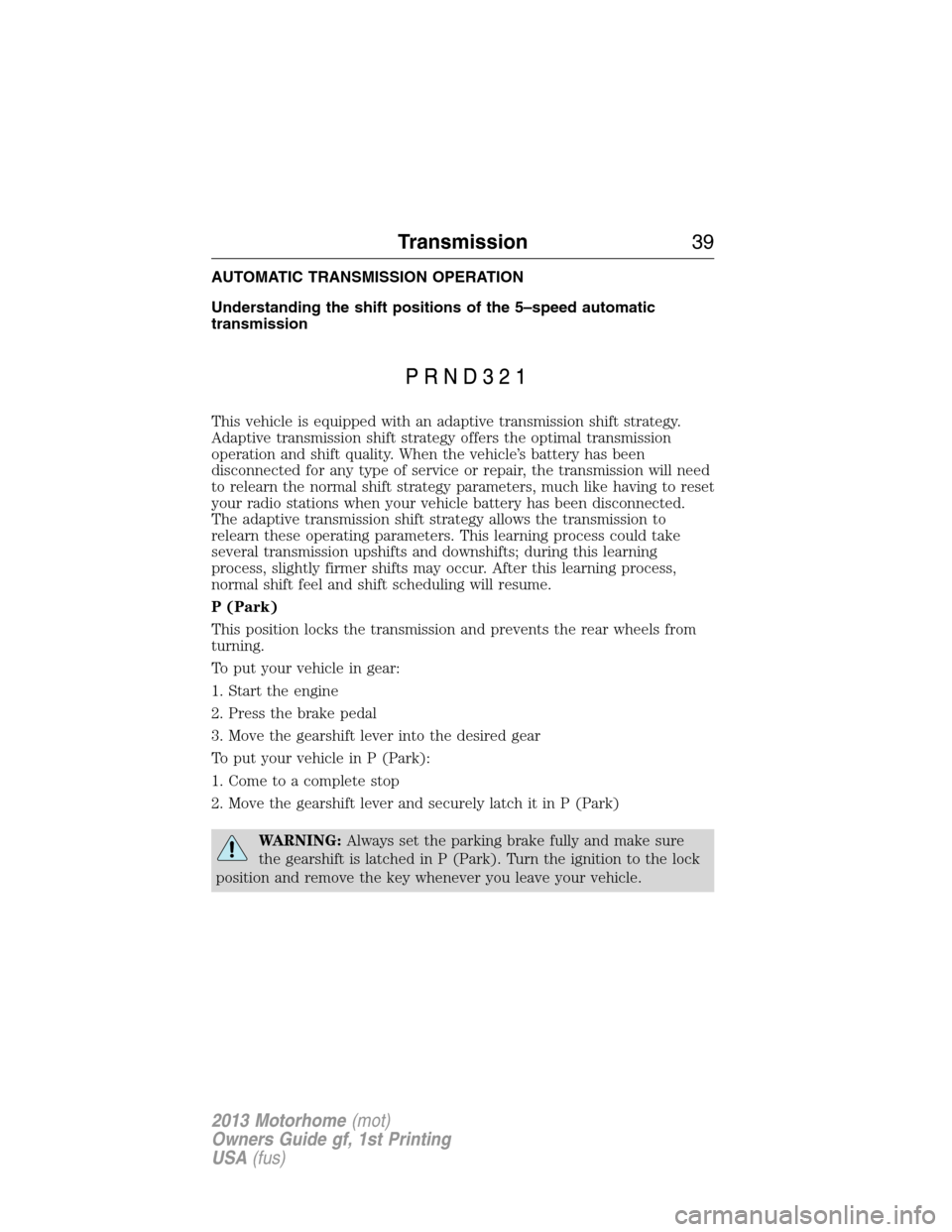
AUTOMATIC TRANSMISSION OPERATION
Understanding the shift positions of the 5–speed automatic
transmission
This vehicle is equipped with an adaptive transmission shift strategy.
Adaptive transmission shift strategy offers the optimal transmission
operation and shift quality. When the vehicle’s battery has been
disconnected for any type of service or repair, the transmission will need
to relearn the normal shift strategy parameters, much like having to reset
your radio stations when your vehicle battery has been disconnected.
The adaptive transmission shift strategy allows the transmission to
relearn these operating parameters. This learning process could take
several transmission upshifts and downshifts; during this learning
process, slightly firmer shifts may occur. After this learning process,
normal shift feel and shift scheduling will resume.
P (Park)
This position locks the transmission and prevents the rear wheels from
turning.
To put your vehicle in gear:
1. Start the engine
2. Press the brake pedal
3. Move the gearshift lever into the desired gear
To put your vehicle in P (Park):
1. Come to a complete stop
2. Move the gearshift lever and securely latch it in P (Park)
WARNING:Always set the parking brake fully and make sure
the gearshift is latched in P (Park). Turn the ignition to the lock
position and remove the key whenever you leave your vehicle.
Transmission39
2013 Motorhome(mot)
Owners Guide gf, 1st Printing
USA(fus)