Page 141 of 576
MyKey�Messages Action / Description
Buckle Up to Unmute
AudioDisplayed when a MyKey�is in use and
Belt-Minder�is activated.
Could Not Program
KeyDisplayed when an attempt is made to
program a spare key using two existing
MyKeys.
Park Aid / Active
Park MessagesAction / Description
Check Park Aid Displayed when the transmission is in R
(Reverse) and the park aid is disabled.
Check Rear Park Aid Displayed when the transmission is in R
(Reverse) and the park aid is disabled.
Rear Park Aid On Off Displays the rear park aid status.
Active Park Fault Displayed when a fault has occurred with the
active park assist system.
Terrain Management/
Off Road / Hill
Descent MessagesAction / Description
For Hill Descent
Reduce Speed XX
MPH/km/h or LessDisplayed when hill descent speed exceeds
20 MPH (32 KM/H).
For Hill Descent Shift
into GearDisplayed when hill descent control mode
requires driver shift transmission into gear.
Driver Resume Control Displayed when the hill control mode requires
the driver to resume control.
Hill Descent Control
ActiveDisplayed when hill descent control mode is
activated.
Hill Descent Control
FAULTDisplayed when a hill descent system fault is
present.
Hill Descent Control Off Displayed when hill descent control mode is
deactivated.
Hill Descent Control
OFF System CoolingDisplayed when hill descent control mode is
disabled to cool the brake system.
Information Displays141
2013 Explorer(exp)
Owners Guide gf, 1st Printing
USA(fus)
Page 168 of 576
SITTING IN THE CORRECT POSITION
WARNING:Sitting improperly out of position or with the
seatback reclined too far can take off weight from the seat
cushion and affect the decision of the passenger sensing system,
resulting in serious injury or death in a crash. Always sit upright against
your seatback, with your feet on the floor.
WARNING:Do not recline the seatback as this can cause the
occupant to slide under the seat’s safety belt, resulting in severe
personal injury in the event of a collision.
WARNING:Do not place objects higher than the seatbacks to
reduce the risk of injury in a collision or during heavy braking or
when stopping suddenly.
When you use them properly, the
seat, head restraint, safety belt and
airbags will provide optimum
protection in the event of a collision.
We recommend that you follow
these guidelines:
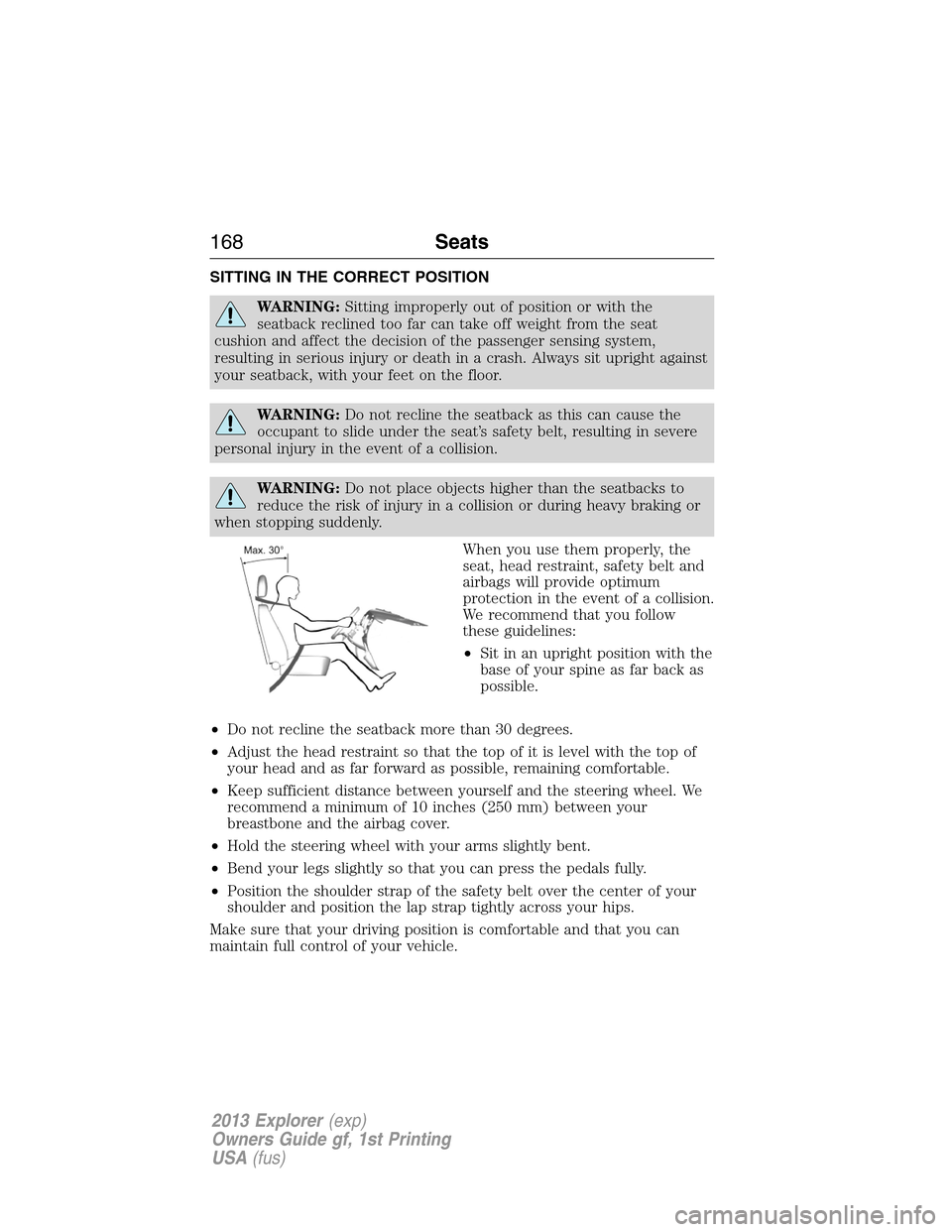
•Sit in an upright position with the
base of your spine as far back as
possible.
•Do not recline the seatback more than 30 degrees.
•Adjust the head restraint so that the top of it is level with the top of
your head and as far forward as possible, remaining comfortable.
•Keep sufficient distance between yourself and the steering wheel. We
recommend a minimum of 10 inches (250 mm) between your
breastbone and the airbag cover.
•Hold the steering wheel with your arms slightly bent.
•Bend your legs slightly so that you can press the pedals fully.
•Position the shoulder strap of the safety belt over the center of your
shoulder and position the lap strap tightly across your hips.
Make sure that your driving position is comfortable and that you can
maintain full control of your vehicle.
168Seats
2013 Explorer(exp)
Owners Guide gf, 1st Printing
USA(fus)
Page 172 of 576
FRONT MANUAL SEATS
WARNING:Always drive and ride with your seatback upright
and the lap belt snug and low across the hips.
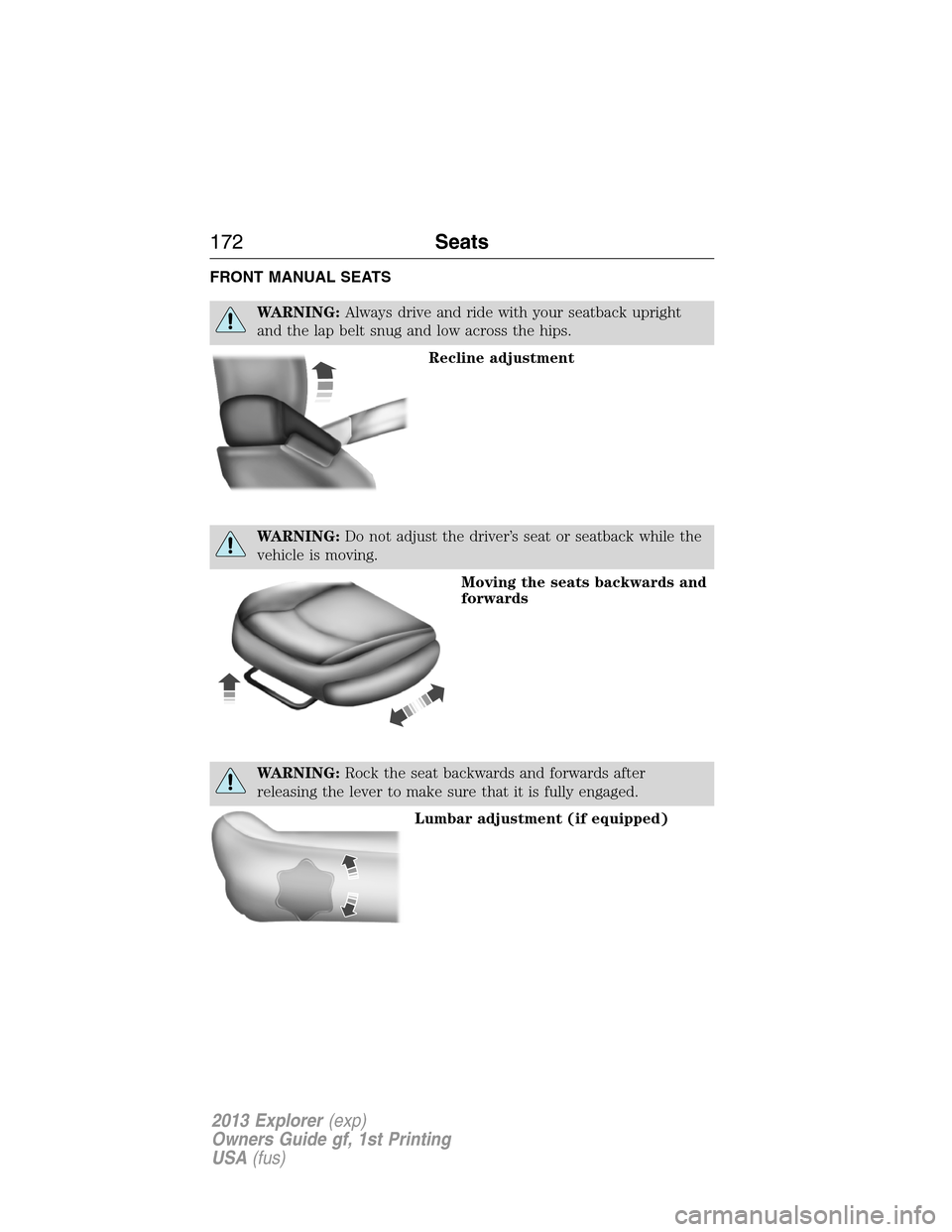
Recline adjustment
WARNING:Do not adjust the driver’s seat or seatback while the
vehicle is moving.
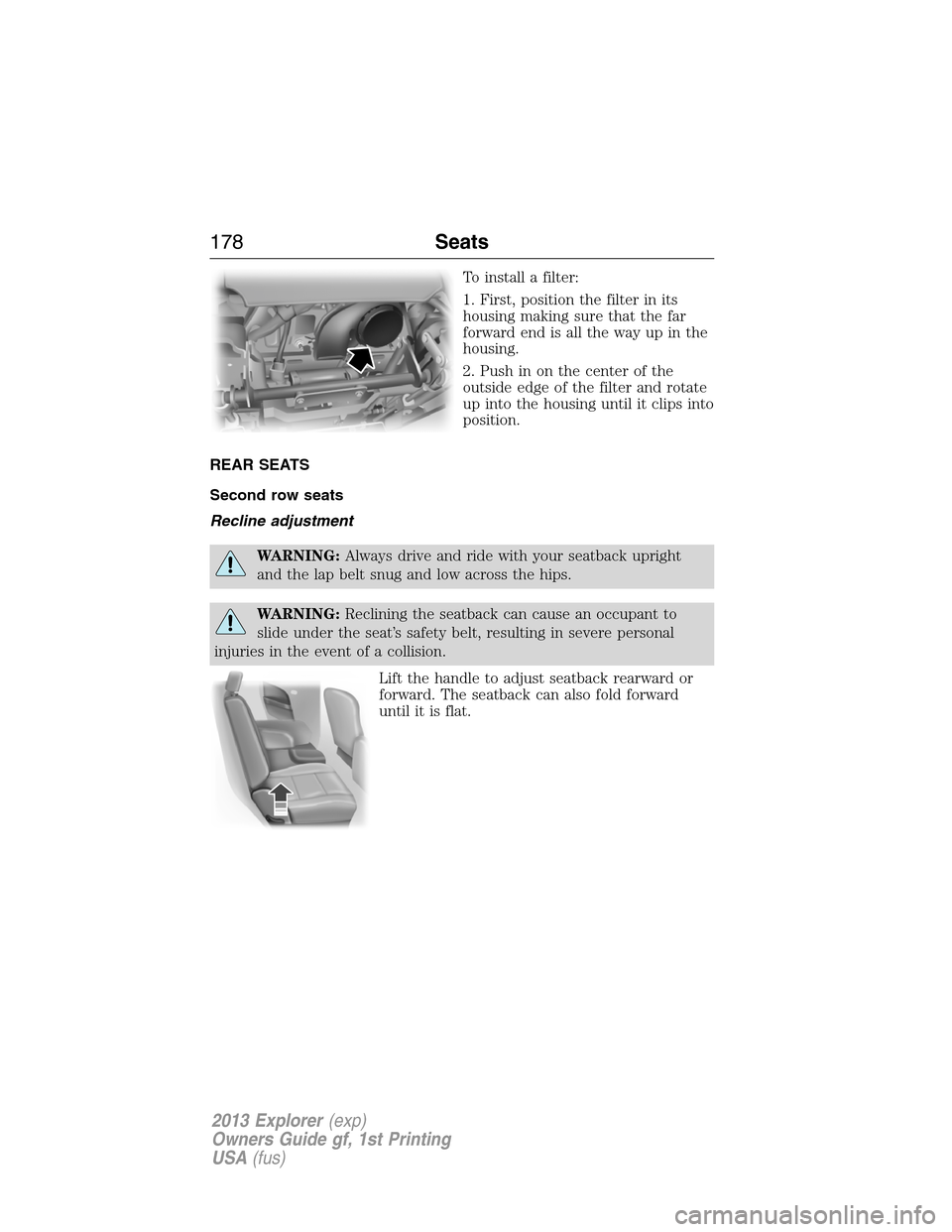
Moving the seats backwards and
forwards
WARNING:Rock the seat backwards and forwards after
releasing the lever to make sure that it is fully engaged.
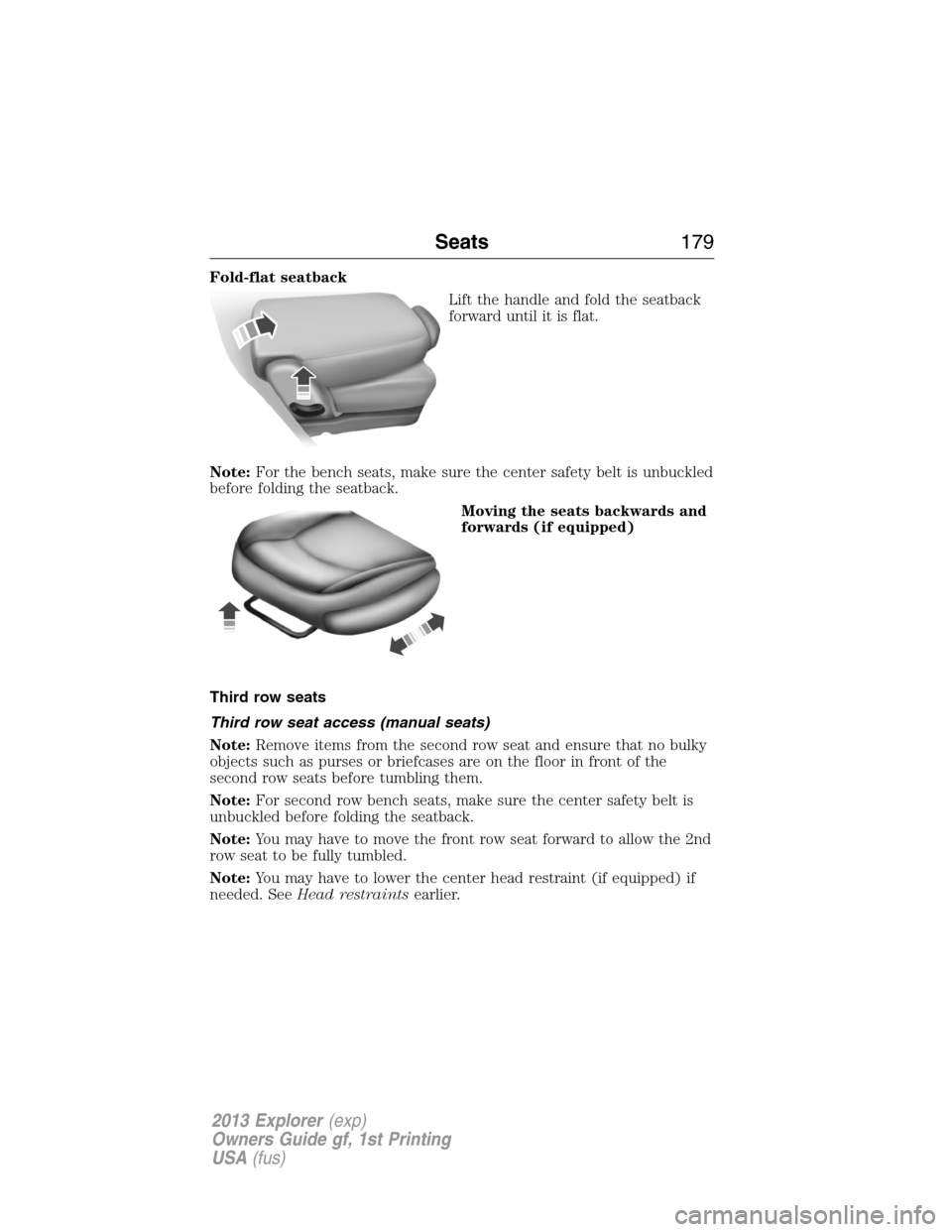
Lumbar adjustment (if equipped)
172Seats
2013 Explorer(exp)
Owners Guide gf, 1st Printing
USA(fus)
Page 178 of 576
To install a filter:
1. First, position the filter in its
housing making sure that the far
forward end is all the way up in the
housing.
2. Push in on the center of the
outside edge of the filter and rotate
up into the housing until it clips into
position.
REAR SEATS
Second row seats
Recline adjustment
WARNING:Always drive and ride with your seatback upright
and the lap belt snug and low across the hips.
WARNING:Reclining the seatback can cause an occupant to
slide under the seat’s safety belt, resulting in severe personal
injuries in the event of a collision.
Lift the handle to adjust seatback rearward or
forward. The seatback can also fold forward
until it is flat.
178Seats
2013 Explorer(exp)
Owners Guide gf, 1st Printing
USA(fus)
Page 179 of 576
Fold-flat seatback
Lift the handle and fold the seatback
forward until it is flat.
Note:For the bench seats, make sure the center safety belt is unbuckled
before folding the seatback.
Moving the seats backwards and
forwards (if equipped)
Third row seats
Third row seat access (manual seats)
Note:Remove items from the second row seat and ensure that no bulky
objects such as purses or briefcases are on the floor in front of the
second row seats before tumbling them.
Note:For second row bench seats, make sure the center safety belt is
unbuckled before folding the seatback.
Note:You may have to move the front row seat forward to allow the 2nd
row seat to be fully tumbled.
Note:You may have to lower the center head restraint (if equipped) if
needed. SeeHead restraintsearlier.
Seats179
2013 Explorer(exp)
Owners Guide gf, 1st Printing
USA(fus)
Page 187 of 576
WARNING:Ensure seat is latched to vehicle floor by
pushing/pulling on seat. If not latched, the seat may cause injury
during a sudden stop.
WARNING:Before returning the seatback to its original position,
make sure that cargo or any objects are not trapped behind the
seatback. After returning the seatback to its original position, pull on
the seatback to ensure that it has fully latched. An unlatched seat may
become dangerous in the event of a sudden stop or collision.
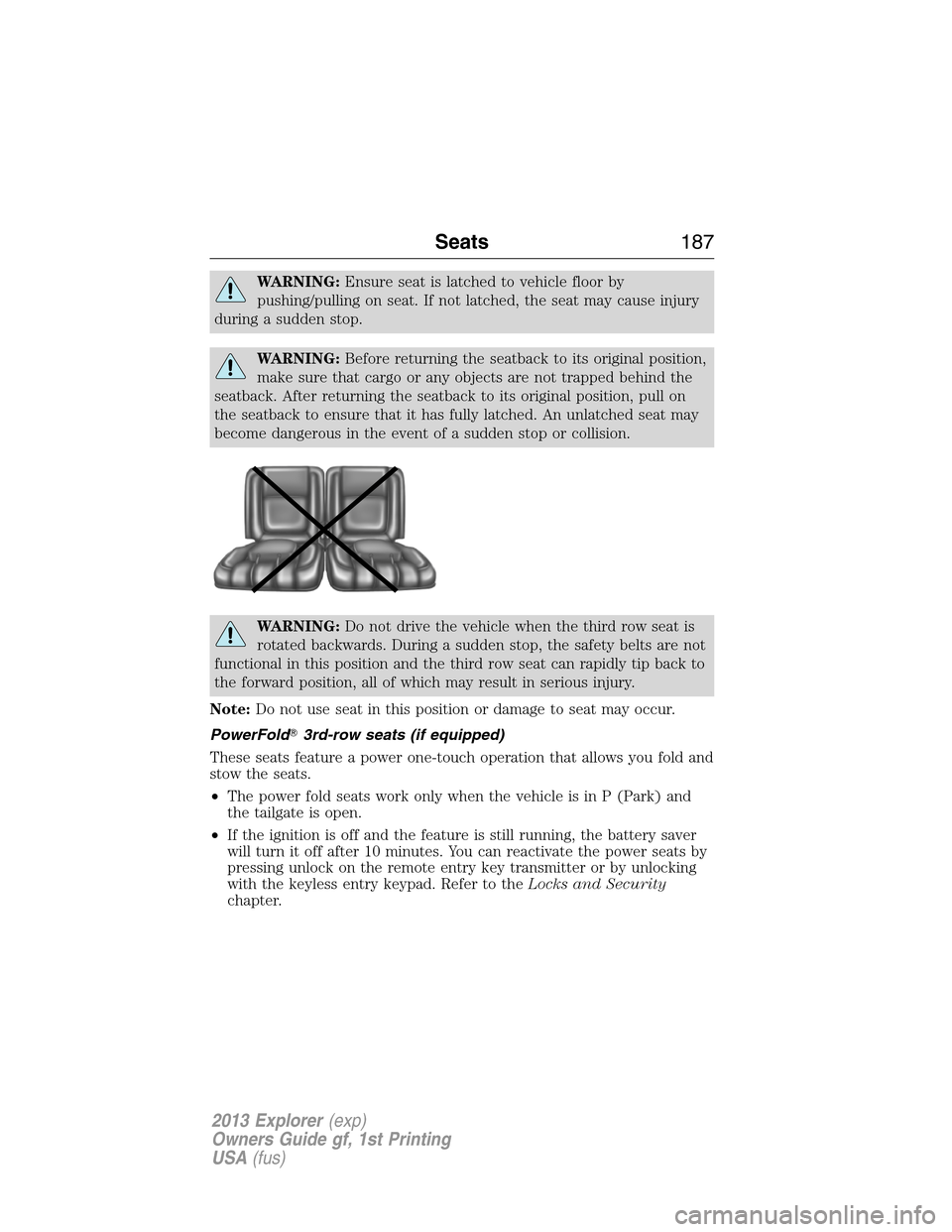
WARNING:Do not drive the vehicle when the third row seat is
rotated backwards. During a sudden stop, the safety belts are not
functional in this position and the third row seat can rapidly tip back to
the forward position, all of which may result in serious injury.
Note:Do not use seat in this position or damage to seat may occur.
PowerFold�3rd-row seats (if equipped)
These seats feature a power one-touch operation that allows you fold and
stow the seats.
•The power fold seats work only when the vehicle is in P (Park) and
the tailgate is open.
•If the ignition is off and the feature is still running, the battery saver
will turn it off after 10 minutes. You can reactivate the power seats by
pressing unlock on the remote entry key transmitter or by unlocking
with the keyless entry keypad. Refer to theLocks and Security
chapter.
Seats187
2013 Explorer(exp)
Owners Guide gf, 1st Printing
USA(fus)
Page 207 of 576

The fast restart feature allows you to restart your vehicle within
20 seconds of switching the vehicle off, if a valid passive key is not
present. Apply the brake pedal and press the start button for up to
20 seconds. After 20 seconds have expired, you can no longer start your
vehicle without the passive key present inside the vehicle.
Once the vehicle has started, the vehicle will remain running until being
turned off by the start button, even if the passive key is no longer found
in the vehicle. Whenever a door is opened and then closed while the
vehicle is running, the system will search for a passive key inside the
vehicle. If the passive key is no longer present in the vehicle, you will not
be able to restart your vehicle outside of the fast restart time.
Your vehicle may have remote start capability. Refer toRemote startin
theKeys and Remote Controlchapter.
STARTING A GASOLINE ENGINE
When the engine starts, the idle RPM runs faster to warm the engine. If
the engine idle speed does not slow down automatically, have the vehicle
checked.
Before starting the vehicle:
•Make sure all occupants buckle their safety belts.
•Make sure the headlamps and electrical accessories are off.
•Make sure the parking brake is set.
•Make sure the gearshift is in P (Park).
•Turn the key to on without turning the key to start.
Some warning lights will briefly illuminate.
Note:Do not touch the accelerator pedal.
1. Select park or neutral.
2. Fully press the brake pedal.
3. Turn the key to start the engine. The engine may continue cranking
for up to 15 seconds or until the vehicle starts.
Note:If the engine does not start on the first try, wait for a short period
of time and try again.
If you have difficulty starting the engine when the temperature is below
-13°F (-25°C), press the accelerator pedal slightly and try again.
Starting and Stopping the Engine207
2013 Explorer(exp)
Owners Guide gf, 1st Printing
USA(fus)
Page 293 of 576
•Use the grade assist or tow/haul feature when towing. These provide
engine braking and help eliminate excessive transmission shifting for
optimum fuel economy and transmission cooling.
•Allow more distance for stopping with a trailer attached; anticipate
stops and brake gradually.
•Avoid parking on a grade. However, if you must park on a grade, place
wheel chocks under the trailer’s wheels.
WRECKER TOWING
If you need to have your vehicle towed, contact a professional towing
service or, if you are a member of a roadside assistance program, your
roadside assistance service provider.
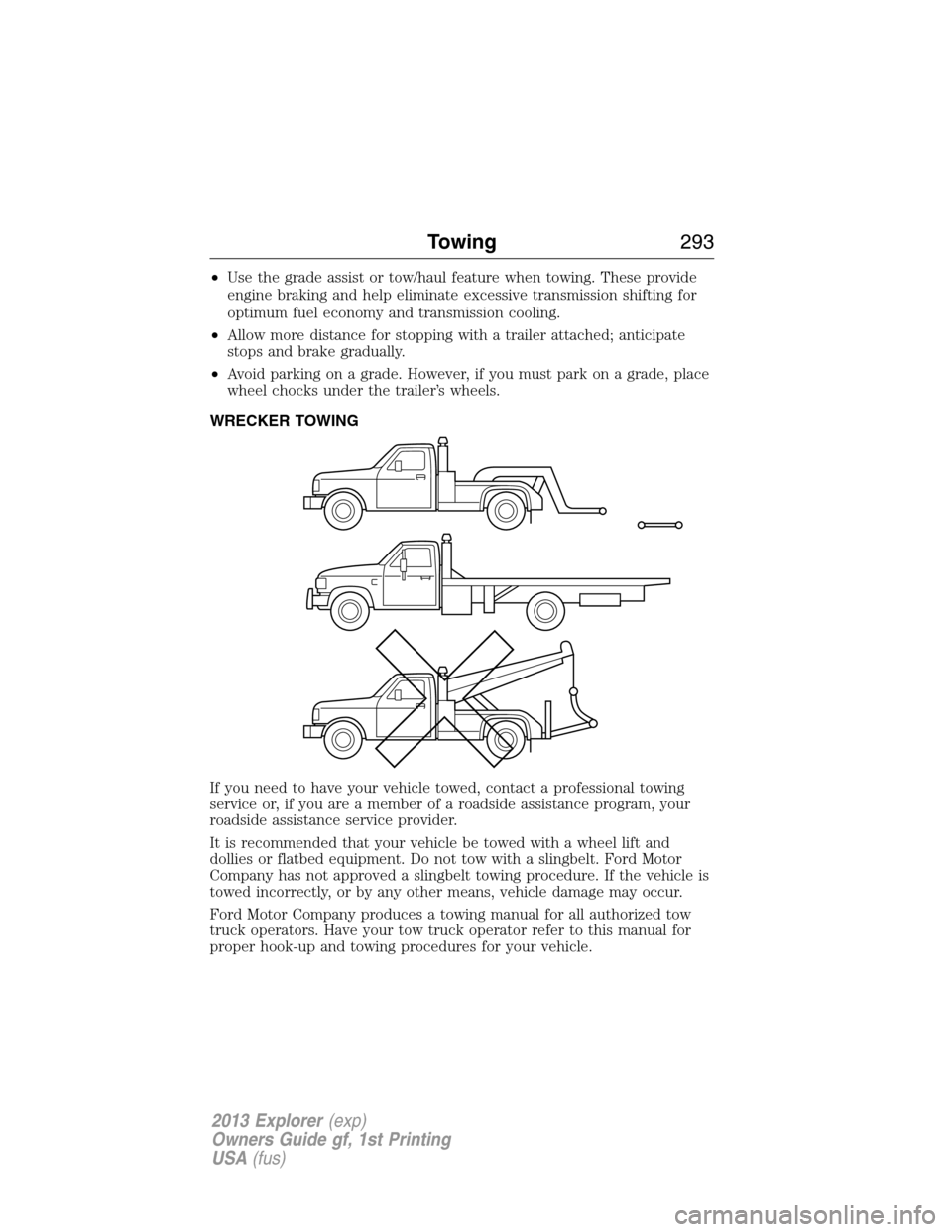
It is recommended that your vehicle be towed with a wheel lift and
dollies or flatbed equipment. Do not tow with a slingbelt. Ford Motor
Company has not approved a slingbelt towing procedure. If the vehicle is
towed incorrectly, or by any other means, vehicle damage may occur.
Ford Motor Company produces a towing manual for all authorized tow
truck operators. Have your tow truck operator refer to this manual for
proper hook-up and towing procedures for your vehicle.
Towing293
2013 Explorer(exp)
Owners Guide gf, 1st Printing
USA(fus)