Page 464 of 630

Tire Pressure Monitoring Low Pressure Warnings
The “Tire Pressure Monitoring Telltale Light” will
illuminate in the instrument cluster, a “LOW
TIRE” message will be displayed and a chime will
sound when tire pressure is low in one or more of the
four active road tires. An�Inflate to XX�message will also
be displayed. Should this occur, you should stop as soon
as possible, check the inflation pressure of each tire on
your vehicle, and inflate each tire to the vehicle’s recom-
mended cold placard pressure value, as shown in the
�Inflate to XX�message. Once the system receives the
updated tire pressures, the system will automatically
update and the “Tire Pressure Monitoring Telltale Light”
and “LOW TIRE” message will turn off. The vehicle may
need to be driven for up to 20 minutes above 15 mph
(24 km/h) in order for the TPMS to receive this
information.
Service TPMS Warning
When a system fault is detected, the “Tire Pressure
Monitoring Telltale Light” will flash on and off for
75 seconds and then remain on solid. The system fault
will also sound a chime. If the ignition switch is cycled,
this sequence will repeat, providing the system fault still
exists. The “Tire Pressure Monitoring Telltale Light” will
turn off when the fault condition no longer exists. A
system fault can occur due to any of the following:
1. Jamming due to electronic devices or driving next to
facilities emitting the same Radio Frequencies as the
TPMS sensors.
2. Installing some form of aftermarket window tinting
that affects radio wave signals.
3. Lots of snow or ice around the wheels or wheel
housings.
462 STARTING AND OPERATING
Page 465 of 630

4. Using tire chains on the vehicle.
5. Using wheels/tires not equipped with TPMS sensors.
NOTE:
1. The compact spare tire does not have a tire pressure
monitoring sensor. Therefore, the TPMS will not moni-
tor the pressure in the compact spare tire.
2. If you install the compact spare tire in place of a road
tire that has a pressure below the low-pressure warn-
ing limit, a chime will sound and the “Tire Pressure
Monitoring Telltale Light” will turn on and a “LOW
TIRE” message will be displayed for a minimum of
five seconds upon the next ignition switch cycle. An
�Inflate to XX�message will also be displayed.3. After driving the vehicle for up to 20 minutes above
15 mph (24 km/h), the “Tire Pressure Monitoring
Telltale Light” will flash on and off for 75 seconds and
then remain on solid.
4. For each subsequent ignition switch cycle, a chime will
sound and the “Tire Pressure Monitoring Telltale
Light” will flash on and off for 75 seconds and then
remain on solid.
5. Once you repair or replace the original road tire and
reinstall it on the vehicle in place of the compact spare,
the TPMS will update automatically and the “Tire
Pressure Monitoring Telltale Light” will turn off, as
long as no tire pressure is below the low-pressure
warning limit in any of the four active road tires. The
vehicle may need to be driven for up to 20 minutes
above 15 mph (24 km/h) in order for the TPMS to
receive this information.
5
STARTING AND OPERATING 463
Page 466 of 630

Premium System – If Equipped
The Tire Pressure Monitor System (TPMS) uses wireless
technology with wheel rim mounted electronic sensors to
monitor tire pressure levels. Sensors, mounted to each
wheel as part of the valve stem, transmit tire pressure
readings to the receiver module.
NOTE:It is particularly important for you to check the
tire pressure in all of the tires on your vehicle monthly
and to maintain the proper pressure.
The TPMS consists of the following components:
•Receiver module
•Four Tire Pressure Monitoring Sensors•Various Tire Pressure Monitoring System messages,
which display in the Electronic Vehicle Information
Center (EVIC)
•Tire Pressure Monitoring Telltale Light
Tire Pressure Monitoring Low Pressure Warnings
The “Tire Pressure Monitoring Telltale Light” will
illuminate in the instrument cluster and a chime
will sound when tire pressure is low in one or
more of the four active road tires. In addition, the
Electronic Vehicle Information Center (EVIC) will display
a graphic showing the pressure values of each tire with
the low tire pressure values flashing or changing colors.
An�Inflate to XX�message will also be displayed.
464 STARTING AND OPERATING
Page 468 of 630
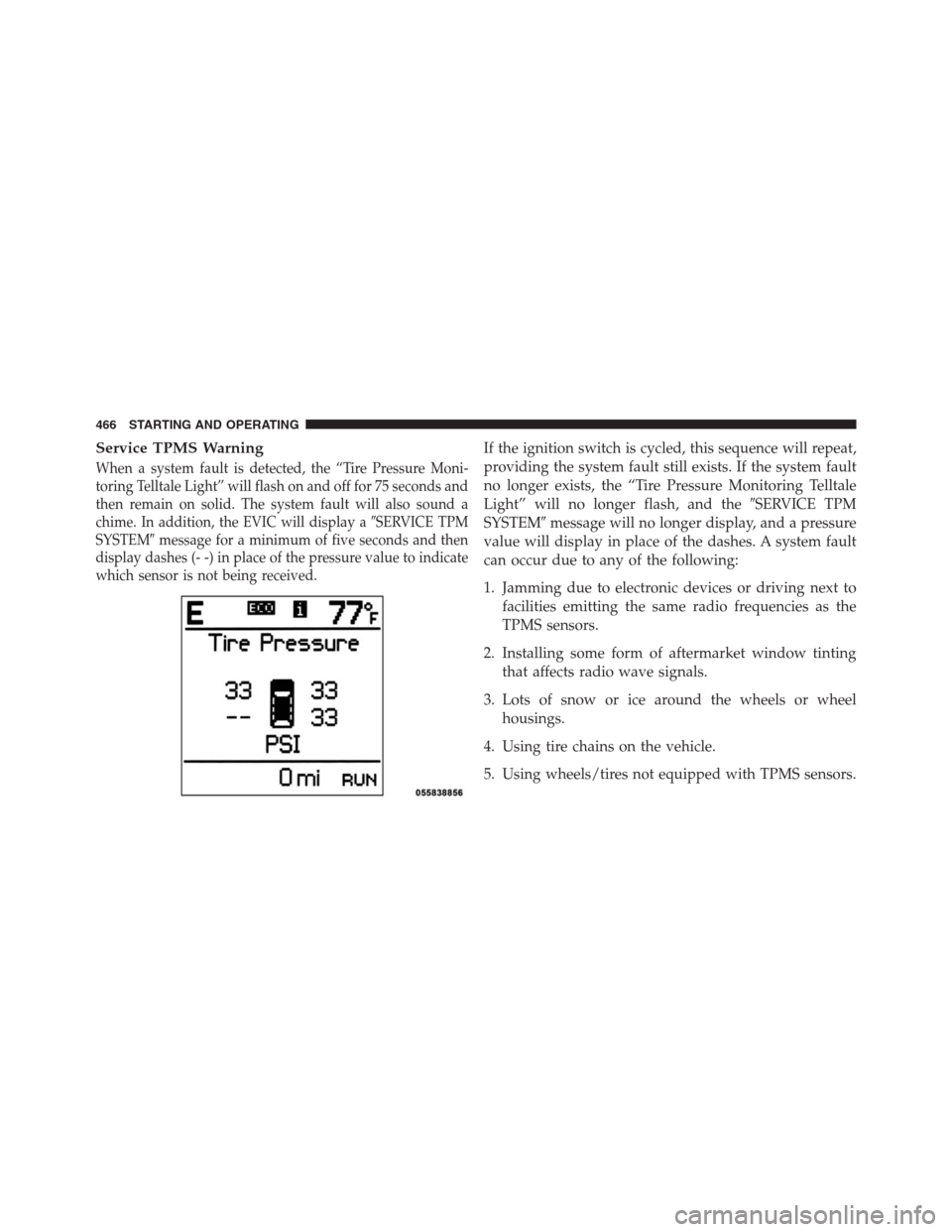
Service TPMS Warning
When a system fault is detected, the “Tire Pressure Moni-
toring Telltale Light” will flash on and off for 75 seconds and
then remain on solid. The system fault will also sound a
chime. In addition, the EVIC will display a�SERVICE TPM
SYSTEM�message for a minimum of five seconds and then
display dashes (- -) in place of the pressure value to indicate
which sensor is not being received.
If the ignition switch is cycled, this sequence will repeat,
providing the system fault still exists. If the system fault
no longer exists, the “Tire Pressure Monitoring Telltale
Light” will no longer flash, and the�SERVICE TPM
SYSTEM�message will no longer display, and a pressure
value will display in place of the dashes. A system fault
can occur due to any of the following:
1. Jamming due to electronic devices or driving next to
facilities emitting the same radio frequencies as the
TPMS sensors.
2. Installing some form of aftermarket window tinting
that affects radio wave signals.
3. Lots of snow or ice around the wheels or wheel
housings.
4. Using tire chains on the vehicle.
5. Using wheels/tires not equipped with TPMS sensors.
466 STARTING AND OPERATING
Page 482 of 630

WARNING!
Because the front wheels steer the vehicle, it is
important that you do not exceed the maximum front
or rear GAWR. A dangerous driving condition can
result if either rating is exceeded. You could lose
control of the vehicle and have a collision.
Overloading
The load carrying components (axle, springs, tires,
wheels, etc.) of your vehicle will provide satisfactory
service as long as you do not exceed the GVWR and the
front and rear GAWR.
The best way to figure out the total weight of your
vehicle is to weigh it when it is fully loaded and ready for
operation. Weigh it on a commercial scale to ensure that
it is not over the GVWR.Figure out the weight on the front and rear of the vehicle
separately. It is important that you distribute the load
evenly over the front and rear axles.
Overloading can cause potential safety hazards and
shorten useful service life. Heavier axles or suspension
components do not necessarily increase the vehicle’s
GVWR.
Loading
To load your vehicle properly, first figure out its empty
weight, axle-by-axle and side-by-side. Store heavier items
down low and be sure you distribute their weight as
evenly as possible. Stow all loose items securely before
driving. If weighing the loaded vehicle shows that you
have exceeded either GAWR, but the total load is within
the specified GVWR, you must redistribute the weight.
Improper weight distribution can have an adverse effect
on the way your vehicle steers and handles and the way
the brakes operate.
480 STARTING AND OPERATING
Page 490 of 630

NOTE:
•
The trailer tongue weight must be considered as part of the
combined weight of occupants and cargo, and should
never exceed the weight referenced on the Tire and Load-
ing Information placard. Refer to “Tire Safety Information”
in “Starting and Operating” for further information.
•*For All Wheel Drive (AWD) models carrying 5 to 7 persons
and luggage will exceed the rear Gross Axle Weight Rating
(GAWR) and therefore should not be attempted
Trailer And Tongue Weight
Always load a trailer with 60% to 65% of the weight in the
front of the trailer. This places 10% to 15% of the Gross
Trailer Weight (GTW) on the tow hitch of your vehicle.
Loads balanced over the wheels or heavier in the rear can
cause the trailer to swayseverely
side to side which will cause
loss of control of the vehicle and trailer. Failure to load trailers
heavier in front is the cause of many trailer collisions.
Never exceed the maximum tongue weight stamped on
your bumper or trailer hitch.Consider the following items when computing the
weight on the rear axle of the vehicle:
•The tongue weight of the trailer.
•The weight of any other type of cargo or equipment
put in or on your vehicle.
•The weight of the driver and all passengers.
488 STARTING AND OPERATING
Page 492 of 630

WARNING!
Improper towing can lead to a collision. Follow these
guidelines to make your trailer towing as safe as
possible:
•Make certain that the load is secured in the trailer
and that it will not shift during travel. When
trailering cargo that is not fully secured, dynamic
load shifts can occur that may be difficult for the
driver to control. You could lose control of your
vehicle and have a collision.
•When hauling cargo or towing a trailer, do not
overload your vehicle or trailer. Overloading can
cause a loss of control, poor performance, or dam-
age to brakes, axle, engine, transmission, steering,
suspension, chassis structure, or tires.
(Continued)
WARNING!(Continued)
•Safety chains must always be used between your
vehicle and trailer. Always connect the chains to
the frame or hook retainers of the vehicle hitch.
Cross the chains under the trailer tongue and allow
enough slack for turning corners.
•Vehicles with trailers should not be parked on a
grade. When parking, apply the parking brake on
the tow vehicle. Put the tow vehicle automatic
transmission in PARK. Always, block or�chock�
the trailer wheels.
•GCWR must not be exceeded.
(Continued)
490 STARTING AND OPERATING
Page 498 of 630
Cooling System
To reduce potential for engine and transmission over-
heating, take the following actions:
City Driving
When stopped for short periods, shift the transmission
into NEUTRAL and increase engine idle speed.
Highway Driving
Reduce speed.
Air Conditioning
Turn off temporarily.
RECREATIONAL TOWING
(BEHIND MOTORHOME, ETC.)
Recreational towing is not allowed. DO NOT flat tow
this vehicle. Damage to the drivetrain will result.
NOTE:This vehicle may be towed on a flatbed or
vehicle trailer provided all four wheels areOFFthe
ground.
CAUTION!
Towing this vehicle in violation of the above require-
ments can cause severe transmission and/or transfer
case damage. Damage from improper towing is not
covered under the New Vehicle Limited Warranty.
496 STARTING AND OPERATING
