Page 477 of 631
2. If you install the compact spare tire in place of a roadtire that has a pressure below the low-pressure warn-
ing limit, upon the next ignition switch cycle, the TPM
Telltale Light will remain ON and a chime will sound.
In addition, the graphic in the EVIC will still display a
flashing pressure value or a pressure value in a
different color. An �Inflate to XX�message will also be
displayed.
3. After driving the vehicle for up to 20 minutes above 15 mph (24 km/h), the TPM Telltale Light will flash on
and off for 75 seconds and then remain on solid. In
addition, the EVIC will display a �SERVICE TPM
SYSTEM� message for a minimum of five seconds and
then display dashes (- -) in place of the pressure value. 4. For each subsequent ignition switch cycle, a chime will
sound, the TPM Telltale Light will flash on and off for
75 seconds and then remain on solid, and the EVIC
will display a �SERVICE TPM SYSTEM� message for a
minimum of five seconds and then display dashes (- -)
in place of the pressure value.
5. Once you repair or replace the original road tire and reinstall it on the vehicle in place of the compact spare,
the TPMS will update automatically. In addition, the
TPM Telltale Light will turn OFF and the graphic in
the EVIC will display a new pressure value instead of
dashes (- -), as long as no tire pressure is below the
low-pressure warning limit in any of the four active
road tires. The vehicle may need to be driven for up to
20 minutes above 15 mph (24 km/h) in order for the
TPMS to receive this information.
5
STARTING AND OPERATING 475
Page 493 of 631
Figure out the weight on the front and rear of the vehicle
separately. It is important that you distribute the load
evenly over the front and rear axles.
Overloading can cause potential safety hazards and
shorten useful service life. Heavier axles or suspension
components do not necessarily increase the vehicle’s
GVWR.
Loading
To load your vehicle properly, first figure out its empty
weight, axle-by-axle and side-by-side. Store heavier items
down low and be sure you distribute their weight as
evenly as possible. Stow all loose items securely before
driving. If weighing the loaded vehicle shows that you
have exceeded either GAWR, but the total load is within
the specified GVWR, you must redistribute the weight.
Improper weight distribution can have an adverse effect
on the way your vehicle steers and handles and the way
the brakes operate.NOTE:
•
Refer to the “Vehicle Certification Label” affixed to the
rear of the driver’s door for your vehicle’s GVWR and
GAWRs.
• Refer to the “Tire Placard” for your vehicle’s proper
tire pressure.
TRAILER TOWING
In this section you will find safety tips and information
on limits to the type of towing you can reasonably do
with your vehicle. Before towing a trailer, carefully
review this information to tow your load as efficiently
and safely as possible.
To maintain warranty coverage, follow the requirements
and recommendations in this manual concerning ve-
hicles used for trailer towing.5
STARTING AND OPERATING 491
Page 502 of 631
Towing Requirements – Tires
– Do not attempt to tow a trailer while using a compactspare tire.
– Proper tire inflation pressures are essential to the safe and satisfactory operation of your vehicle. Refer to
“Tires – General Information” in “Starting and Oper-
ating” for information on tire pressures and for proper
tire inflation procedures.
– Check the trailer tires for proper tire inflation pressures before trailer usage.
– Check for signs of tire wear or visible tire damage before towing a trailer. Refer to “Tires – General
Information” in “Starting and Operating” for informa-
tion on tread wear indicators and for the proper
inspection procedure. – When replacing tires, refer to “Tires – General Infor-
mation” in “Starting and Operating” for information
on replacement tires and for the proper tire replace-
ment procedures. Replacing tires with a higher load
carrying capacity will not increase the vehicle’s GVWR
and GAWR limits.
Towing Requirements – Trailer Brakes
• Do not interconnect the hydraulic brake system or
vacuum system of your vehicle with that of the trailer.
This could cause inadequate braking and possible
personal injury.
• An electronically actuated trailer brake controller is
required when towing a trailer with electronically
actuated brakes. When towing a trailer equipped with
a hydraulic surge actuated brake system, an electronic
brake controller is not required.
500 STARTING AND OPERATING
Page 511 of 631

CAUTION!
Driving with a hot cooling system could damage
your vehicle. If the temperature gauge reads “H,”
pull over and stop the vehicle. Idle the vehicle with
the air conditioner turned off until the pointer drops
back into the normal range. If the pointer remains on
the “H,” turn the engine off immediately and call for
service.
WARNING!
You or others can be badly burned by hot engine
coolant (antifreeze) or steam from your radiator. If
you see or hear steam coming from under the hood,
do not open the hood until the radiator has had time
to cool. Never try to open a cooling system pressure
cap when the radiator or coolant bottle is hot.
JACKING AND TIRE CHANGING
WARNING!
•Do not attempt to change a tire on the side of the
vehicle close to moving traffic. Pull far enough off
the road to avoid the danger of being hit when
operating the jack or changing the wheel.
• Being under a jacked-up vehicle is dangerous. The
vehicle could slip off the jack and fall on you. You
could be crushed. Never put any part of your body
under a vehicle that is on a jack. If you need to get
under a raised vehicle, take it to a service center
where it can be raised on a lift.
• Never start or run the engine while the vehicle is
on a jack.
(Continued)
6
WHAT TO DO IN EMERGENCIES 509
Page 555 of 631

Cooling System
WARNING!
•When working near the radiator cooling fan, dis-
connect the fan motor lead or turn the ignition
switch to the LOCK position. The fan is tempera-
ture controlled and can start at any time the igni-
tion switch is in the ON position.
• You or others can be badly burned by hot engine
coolant (antifreeze) or steam from your radiator. If
you see or hear steam coming from under the hood,
do not open the hood until the radiator has had
time to cool. Never try to open a cooling system
pressure cap when the radiator is hot.
Coolant Checks
Check engine coolant (antifreeze) protection every
12 months (before the onset of freezing weather, where
applicable). If the engine coolant (antifreeze) is dirty or
rusty in appearance, the system should be drained,
flushed, and refilled with fresh coolant. Check the front
of the radiator for any accumulation of bugs, leaves, etc.
If dirty, clean by gently spraying water from a garden
hose vertically down the face of the condenser.
Check the coolant recovery bottle tubing for brittle rubber,
cracking, tears, cuts, and tightness of the connection at the
bottle and radiator. Inspect the entire system for leaks.
With the engine at normal operating temperature (but
not running), check the cooling system pressure cap for
proper vacuum sealing by draining a small amount of
engine coolant (antifreeze) from the radiator drain cock.7
MAINTAINING YOUR VEHICLE 553
Page 578 of 631
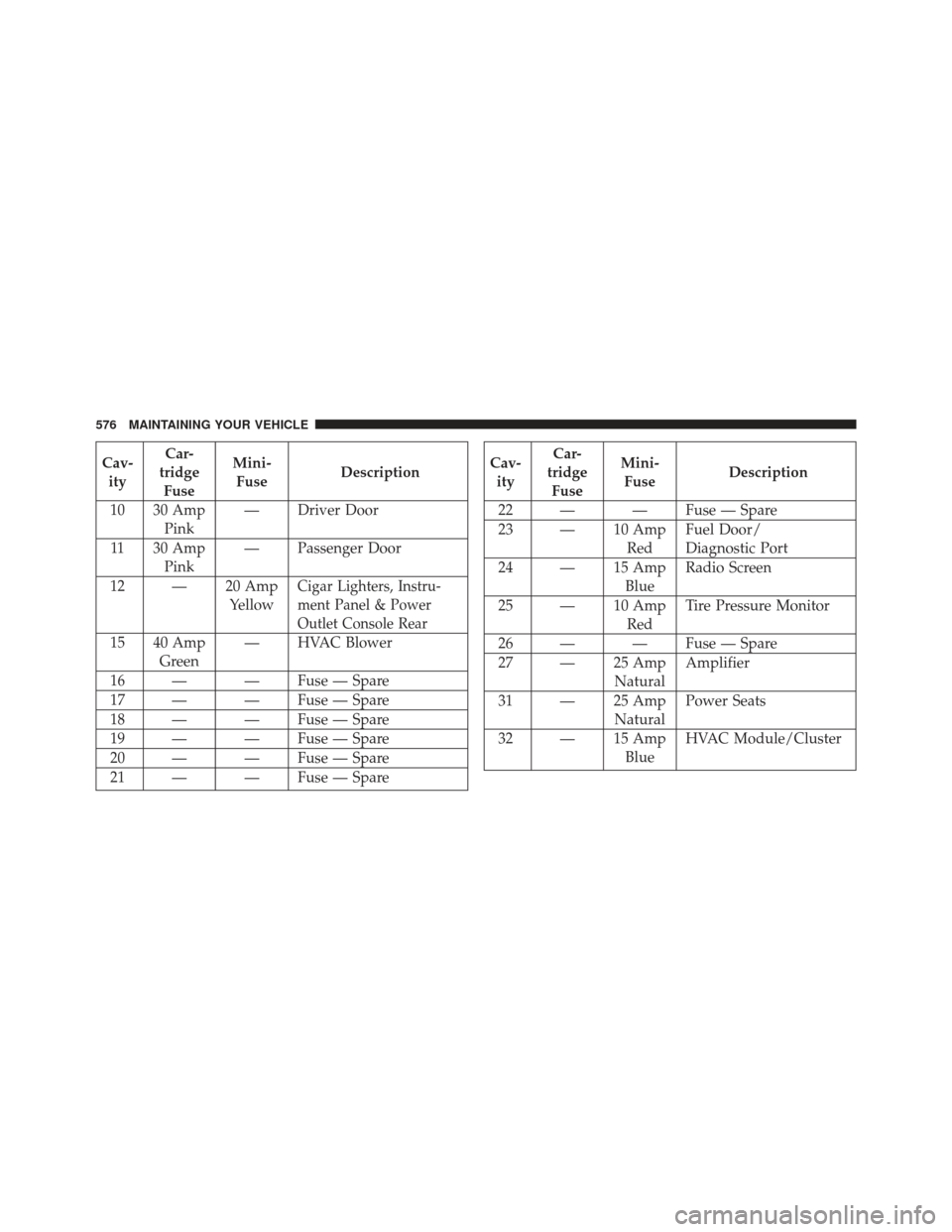
Cav-ity Car-
tridge Fuse Mini-
Fuse Description
10 30 Amp Pink — Driver Door
11 30 Amp Pink — Passenger Door
12 — 20 Amp Yellow
Cigar Lighters, Instru-
ment Panel & Power
Outlet Console Rear
15 40 AmpGreen — HVAC Blower
16 — — Fuse — Spare
17 — — Fuse — Spare
18 — — Fuse — Spare
19 — — Fuse — Spare
20 — — Fuse — Spare
21 — — Fuse — Spare
Cav- ity Car-
tridge Fuse Mini-
Fuse Description
22 — — Fuse — Spare
23 — 10 Amp RedFuel Door/
Diagnostic Port
24 — 15 Amp BlueRadio Screen
25 — 10 Amp RedTire Pressure Monitor
26 — — Fuse — Spare
27 — 25 Amp NaturalAmplifier
31 — 25 Amp NaturalPower Seats
32 — 15 Amp BlueHVAC Module/Cluster
576 MAINTAINING YOUR VEHICLE
Page 591 of 631
NOTE:Under no circumstances should oil change inter-
vals exceed 10,000 miles (16,000 km) or twelve months,
whichever comes first.
Once A Month Or Before A Long Trip:
• Check engine oil level
• Check windshield washer fluid level
• Check the tire inflation pressures and look for unusual
wear or damage
• Check the fluid levels of the coolant reservoir, brake
master cylinder, power steering and transmission as
needed
• Check function of all interior and exterior lights
Required Maintenance Intervals.
Refer to the maintenance schedules on the following
page for the required maintenance intervals.At Every Oil Change Interval As Indicated By Oil Change Indicator System:
•Change oil and filter
• Rotate the tires. Rotate at the first sign of
irregular wear, even if it occurs before the
oil indicator system turns on.
• Inspect battery and clean and tighten terminals as
required
• Inspect automatic transmission fluid if equipped
with dipstick
• Inspect brake pads, shoes, rotors, drums, hoses
and park brake
• Inspect engine cooling system protection and
hoses
• Inspect exhaust system
• Inspect engine air cleaner if using in dusty or
off-road conditions
8
M
A I
N T
E
N
A
N
C E
S
C
H E
D
U L
E
SMAINTENANCE SCHEDULES 589
Page 610 of 631
About Your Brakes....................... .429
ABS (Anti-Lock Brake System) ................431
Adaptive Cruise Control (ACC) (Cruise Control) . . .244
Adding Engine Coolant (Antifreeze) ............555
Adding Fuel ............................ .486
Adding Washer Fluid ..................... .550
Additives, Fuel .......................... .479
Adjustable Pedals ........................ .238
Airbag ..................................60
Airbag Deployment ........................71
Airbag Light .............................68
Airbag Maintenance ........................73
Airbag, Side ..............................63
Airbag, Window (Side Curtain) ................64
Air Cleaner, Engine (Engine Air Cleaner Filter) . . . .543
Air Conditioner Maintenance .................546
Air Conditioning Filter .....................387
Air Conditioning, Operating Tips ..............388
Air Conditioning Refrigerant .................546Air Conditioning System
....................384
Air Pressure, Tires ........................ .453
Alarm Light ............................ .322
Alarm, Panic .............................24
Alarm (Security Alarm) ......................18
Alarm System (Security Alarm) ................18
All Wheel Drive (AWD) .....................423
Alterations/Modifications, Vehicle ...............7
Antifreeze (Engine Coolant) ..................554
Disposal ............................. .557
Anti-Lock Brake System (ABS) ................431
Anti-Lock Warning Light ....................321
Anti-Theft Security Alarm (Theft Alarm) ..........18
Appearance Care ........................ .564
Arming Theft System (Security Alarm) ...........18
Assist, Hill Start ......................... .437
Auto Down Power Windows ..................41
Automatic Dimming Mirror ..................110
Automatic Door Locks ......................33
608 INDEX