2013 DACIA SANDERO tyre pressure
[x] Cancel search: tyre pressurePage 4 of 146

tyre pressures .......................................(up to the end of the DU)tyres ......................................................(up to the end of the DU)tyre pressure.........................................(up to the end of the DU)
0.4
ENG_UD5539_1Pressions de gonflage des pneumatiques à froid (en bar) (B90 - Dac\
ia)ENG_NU_817-2_NU_Dacia_0
Tyre dimensions165/80 R 14185/65 R 15
Wheel sizes5,5 J 146 J 15
– Front
2.02.0
– Rear
2.02.2
Tyre safety and use of chains
Refer to the information on “Tyres” in Section 5 for the maintenance conditions and, depending on the version, the conditions under which snow chains may be fitted to the vehicle.
TYrE PrESSurE WHEN COlD (in bar)
Special note concerning vehicles used fully laden (Maximum Permissible All-Up Weight) and towing a trailer:The maximum speed must be limited to 60 mph (100 km/h) and the tyre pr\
essure increased by 0.2 bar.Refer to the paragraph on “Weights” in Section 6.
Page 66 of 146
ENG_NU_817-2_NU_Dacia_2
ADVICE ON ANTIPOLLUTION, FUEL ECONOMY AND DRIVING (continued)
– In vehicles fitted")
2.8
ENG_UD5485_1Conseils antipollution, économies de carburant, conduite (U90 - Daci\
a)ENG_NU_817-2_NU_Dacia_2
ADVICE ON ANTIPOLLUTION, FUEL ECONOMY AND DRIVING (continued)
– In vehicles fitted with air condi- tioning, it is normal to observe an increase in fuel consumption (es- pecially in city conditions) when it is used. For vehicles fitted with manual air conditioning, switch off the system when it is not required.
Some advice for reducing fuel consumption and therefore help- ing to protect the environment:
– It is advisable to drive with the air
vents open and the windows closed.
– If the vehicle has been parked in the
sun, open the doors for a few mo- ments to let the hot air escape before starting the engine.
– Never fill the fuel tank to the brim to
avoid overflow.
– Do not leave an empty roof rack
fitted to the vehicle.
– It is better to fit a trailer for bulky ob
- jects.
– When towing a caravan, fit a wind
deflector and adjust it carefully.
Advice on use
– Electricity is fuel; switch off all the electrical components which are not really needed.
However (safety first), keep your lights on when the visibility is bad (“see and be seen”).
– Use the air vents. Driving with the
windows open will increase fuel consumption by 4% at a speed of 60 mph (100 km/h). –
Avoid using the vehicle for door-to
- door journeys (short journeys, with long stops in-between) because in these conditions, the engine never reaches its ideal temperature.
Tyres
Increased fuel consumption could be the result of:
– insufficient pressure,
– using non-recommended tyres.
Page 70 of 146
driving ...................................................(up to the end of the DU)ABS ......................................................(up to the end of the DU)anti-lock braking system: ABS ..............(up to the end of the DU)
2.12
ENG_UD5488_1Système antiblocage des routes : ABS (U90 - Dacia)ENG_NU_817-2_NU_Dacia_2
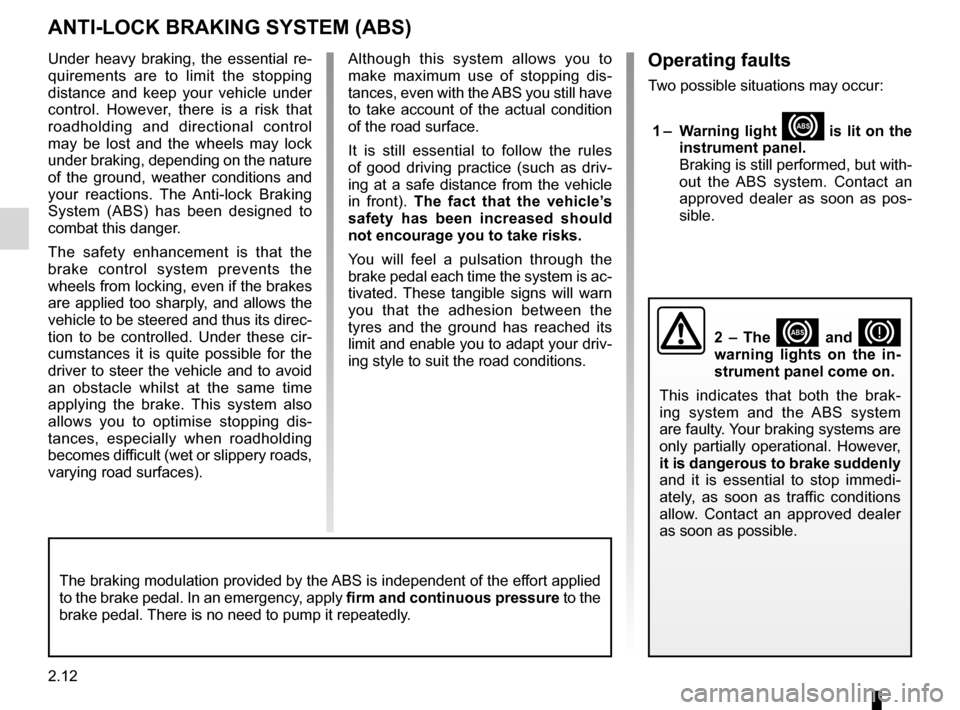
Operating faults
Two possible situations may occur:
1 – Warning light x is lit on the instrument panel.Braking is still performed, but with- out the ABS system. Contact an approved dealer as soon as pos- sible.
Although this system allows you to make maximum use of stopping dis- tances, even with the ABS you still have to take account of the actual condition of the road surface.
It is still essential to follow the rules of good driving practice (such as driv- ing at a safe distance from the vehicle in front). The fact that the vehicle’s safety has been increased should not encourage you to take risks.
You will feel a pulsation through the brake pedal each time the system is ac- tivated. These tangible signs will warn you that the adhesion between the tyres and the ground has reached its limit and enable you to adapt your driv- ing style to suit the road conditions.
2 – The x and D warning lights on the in- strument panel come on.
This indicates that both the brak- ing system and the ABS system are faulty. Your braking systems are only partially operational. However, it is dangerous to brake suddenly and it is essential to stop immedi- ately, as soon as traffic conditions allow. Contact an approved dealer as soon as possible.
Système antiblocage des roues (ABS)
ANTI-LOCK BRAKING SYSTEM (ABS)
Under heavy braking, the essential re- quirements are to limit the stopping distance and keep your vehicle under control. However, there is a risk that roadholding and directional control may be lost and the wheels may lock under braking, depending on the nature of the ground, weather conditions and your reactions. The Anti-lock Braking System (ABS) has been designed to combat this danger.
The safety enhancement is that the brake control system prevents the wheels from locking, even if the brakes are applied too sharply, and allows the vehicle to be steered and thus its direc- tion to be controlled. Under these cir- cumstances it is quite possible for the driver to steer the vehicle and to avoid an obstacle whilst at the same time applying the brake. This system also allows you to optimise stopping dis- tances, especially when roadholding becomes difficult (wet or slippery roads, varying road surfaces).
The braking modulation provided by the ABS is independent of the effort applied to the brake pedal. In an emergency, apply firm and continuous pressure to the brake pedal. There is no need to pump it repeatedly.
Page 108 of 146
tyre pressure..........................................................(current page)
5.8
ENG_UD5513_1Pneumatiques (U90 - Dacia)ENG_NU_817-2_NU_Dacia_5
JauneNoirNoir texte
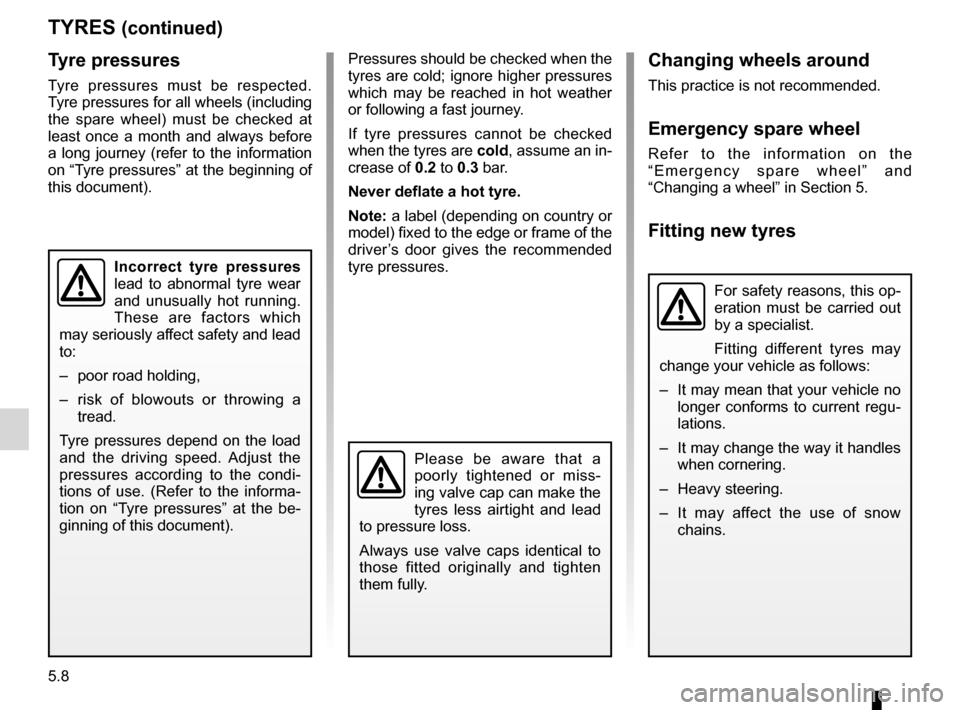
Changing wheels around
This practice is not recommended.
Emergency spare wheel
Refer to the information on the “ E m e r g e n c y s p a r e w h e e l ” a n d “Changing a wheel” in Section 5.
Fitting new tyres
TYRES (continued)
Tyre pressures
Tyre pressures must be respected. Tyre pressures for all wheels (including the spare wheel) must be checked at least once a month and always before a long journey (refer to the information on “Tyre pressures” at the beginning of this document).
Incorrect tyre pressures lead to abnormal tyre wear and unusually hot running. These are factors which may seriously affect safety and lead to:
– poor road holding,
– risk of blowouts or throwing a
tread.
Tyre pressures depend on the load and the driving speed. Adjust the pressures according to the condi- tions of use. (Refer to the informa- tion on “Tyre pressures” at the be- ginning of this document).
Pressures should be checked when the tyres are cold; ignore higher pressures which may be reached in hot weather or following a fast journey.
If tyre pressures cannot be checked when the tyres are cold, assume an in- crease of 0.2 to 0.3 bar.
Never deflate a hot tyre.
Note: a label (depending on country or model) fixed to the edge or frame of the driver’s door gives the recommended tyre pressures.
For safety reasons, this op- eration must be carried out by a specialist.
Fitting different tyres may change your vehicle as follows:
– It may mean that your vehicle no
longer conforms to current regu- lations.
– It may change the way it handles
when cornering.
– Heavy steering.
– It may affect the use of snow
chains.
Please be aware that a poorly tightened or miss- ing valve cap can make the tyres less airtight and lead to pressure loss.
Always use valve caps identical to those fitted originally and tighten them fully.
Page 131 of 146

JauneNoirNoir texte
5.31
ENG_UD5616_1Anomalies de fonctionnement (B90 - Dacia)ENG_NU_817-2_NU_Dacia_5
OPERATING FAULTS (continued)
On the roadPOSSIBLE CAUSESWHAT TO DO
Vibrations.Tyres not inflated to correct pres- sures, incorrectly balanced or dam- aged.
Check the tyre pressures; if this is not the cause, have their condition checked by an approved dealer.
Abnormal white smoke from the exhaust or coolant boiling in the reservoir.Mechanical fault: cylinder head gasket blown, faulty coolant pump.Stop the engine.Contact an approved dealer.
Smoke under the bonnet.Short circuit or cooling system leak.Stop, switch off the ignition, stand away from the vehicle and contact an approved Dealer.
The oil pressure warning light comes on:
on a bend or under brakingThe level is too low.Top up the engine oil (refer to the informa- tion on “Engine oil level, topping up/refill- ing” in Section 4).
at idle speedLow oil pressure.Go to your nearest approved dealer.
is slow to go out or remains lit up under accelerationLoss of oil pressure.Stop the vehicle: contact a an approved dealer.
Page 146 of 146
ENG_NU_817-2_NU_Dacia_7
trims ........................................................................\
.... 5.4 – 5.5trip computer and warning system............")
7.4
FRA_UD8707_2Index (B90 - Dacia)ENG_NU_817-2_NU_Dacia_7
trims ........................................................................\
.... 5.4 – 5.5trip computer and warning system.........................1.41 → 1.44tyre pressure.................................................................0.4, 5.8tyre pressures ......................................................................0.4tyres .................................................................... 0.4, 5.7 → 5.9
Vvehicle identification ................................................... 6.2 – 6.3vehicle identification plates ......................................... 6.2 – 6.3ventilationheating and air conditioning system ....................3.4 → 3.8
Wwarning buzzer ..................................................................1.47warning lights.........................................................1.36 → 1.44washing .................................................................. 4.10 – 4.11weight ........................................................................\
..........6.6weights ........................................................................\
........6.6wheelbrace ........................................................................\
..5.3windscreen washer .....................................................1.50, 4.8wiper blades ......................................................................5.10wipers ........................................................................\
........1.50blades ........................................................................\
..5.10
AlphABEtiCAl inDEx (continued)