2013 DACIA SANDERO roof
[x] Cancel search: roofPage 9 of 146

children .................................................(up to the end of the DU)doors.....................................................(up to the end of the DU)electric door locking ..............................(up to the end of the DU)central door locking ..............................(up to the end of the DU)
1.5
ENG_UD5543_1Verrouillage des portes (B90 - Dacia)ENG_NU_817-2_NU_Dacia_1
LOCKING THE DOORS
Manual locking
Front: use the key if outside or, if inside,
press down knob 1 when the door is closed.
Rear: press down button 1 in each door.
Electric central locking
Depending on the vehicle, this is used to simultaneously lock the four doors and luggage compartment.
Press the bottom of switch
2 to lock.
The front door mechanism cannot be locked if the door is open.
Childproof locks
To make it impossible for the rear doors to be opened from the inside, move
lever 3 on each door and check from the inside that the doors are securely locked.
If you decide to keep the doors locked when you are driving, remember that it may be more difficult for those assisting you to gain access to the passenger compartment in the event of an emergency.
3
21
Page 66 of 146
ENG_NU_817-2_NU_Dacia_2
ADVICE ON ANTIPOLLUTION, FUEL ECONOMY AND DRIVING (continued)
– In vehicles fitted")
2.8
ENG_UD5485_1Conseils antipollution, économies de carburant, conduite (U90 - Daci\
a)ENG_NU_817-2_NU_Dacia_2
ADVICE ON ANTIPOLLUTION, FUEL ECONOMY AND DRIVING (continued)
– In vehicles fitted with air condi- tioning, it is normal to observe an increase in fuel consumption (es- pecially in city conditions) when it is used. For vehicles fitted with manual air conditioning, switch off the system when it is not required.
Some advice for reducing fuel consumption and therefore help- ing to protect the environment:
– It is advisable to drive with the air
vents open and the windows closed.
– If the vehicle has been parked in the
sun, open the doors for a few mo- ments to let the hot air escape before starting the engine.
– Never fill the fuel tank to the brim to
avoid overflow.
– Do not leave an empty roof rack
fitted to the vehicle.
– It is better to fit a trailer for bulky ob
- jects.
– When towing a caravan, fit a wind
deflector and adjust it carefully.
Advice on use
– Electricity is fuel; switch off all the electrical components which are not really needed.
However (safety first), keep your lights on when the visibility is bad (“see and be seen”).
– Use the air vents. Driving with the
windows open will increase fuel consumption by 4% at a speed of 60 mph (100 km/h). –
Avoid using the vehicle for door-to
- door journeys (short journeys, with long stops in-between) because in these conditions, the engine never reaches its ideal temperature.
Tyres
Increased fuel consumption could be the result of:
– insufficient pressure,
– using non-recommended tyres.
Page 98 of 146
bodywork (maintenance) ......................(up to the end of the DU)maintenance:bodywork ........................................(up to the end of the DU)washing ................................................(up to the end of the DU)paintworkmaintenance ....................................................(current page)
4.10
ENG_UD5594_1Entretien de la carrosserie (B90 - Dacia)ENG_NU_817-2_NU_Dacia_4
JauneNoirNoir texte
Entretien de la carrosserie
BODYWORK MAINTENANCE
Protection against the effects
of corrosive agents
Although your vehicle has been treated with very effective anti-corrosion prod- ucts, it nevertheless remains subject to the effects of:
– corrosives in the atmosphere
– atmospheric pollution (urban and
industrial areas),
– saline atmospheres (near the sea, particularly in hot weather),
– seasonal and damp climatic con- ditions, (e.g.: road salt in winter, water from road cleaners, etc.).
– abrasives
wind-borne dust and sand, mud, road grit thrown up by other vehicles, etc
– minor impacts
You should take a minimum number of precautions in order to safeguard your vehicle against such risks and not to lose the benefit of your vehicle’s anti- corrosion protection.
You should not:
– Wash the vehicle in bright sunlight or freezing temperatures.
– Scrape off mud or dirt without pre
- wetting.
– Allow dirt to accumulate.
– Allow rust to form following minor im
- pacts.
– Use solvents not approved by the
Technical Department to remove stains as this could damage the paintwork.
– Drive frequently in snow or muddy
conditions without washing the vehicle, particularly under the wheel arches and body. –
Degrease or clean mechanical com
- ponents (e.g. engine compartment), underneath the body, parts with hinges (e.g. fuel filler cap, inside of filler flap, sunroof, etc.) and painted external plastic fittings (e.g. bump- ers) using high-pressure cleaning equipment or using spray products not approved by the Technical Department. If adequate precautions are not taken, this could give rise to corrosion or operational faults.
Page 132 of 146

5.32
ENG_UD5616_1Anomalies de fonctionnement (B90 - Dacia)ENG_NU_817-2_NU_Dacia_5
JauneNoirNoir texte
OPERATING FAULTS (continued)
On the roadPOSSIBLE CAUSESWHAT TO DO
The power-assisted steering be- comes heavy.Belt brokenInsufficient oil in pump.Have the belt replaced.
Top up the power-assisted steering fluid (refer to the information on the “Power-as- sisted steering pump” in Section 4).
If the fault is still present, consult your approved dealer.
The engine overheats. The coolant temperature indicator light comes on.Engine cooling fan not working.Stop the vehicle, switch off the engine and contact an approved dealer.
Coolant leaks.Check the coolant reservoir: it should con- tain coolant. If there is none, consult your approved dealer as soon as possible.
WhistlingRoof aerial incorrectly positionedFold down the aerial until the end is approx- imately 44 cm from the roof of the vehicle.
Radiator: If there is a significant lack of coolant, remember that it must never be topped up using cold coolant while the engine is very warm. After any procedure on the vehicle which has involved even partial draining of the cooling system, it must be refilled with a new mixture prepared in the correct proportions. Reminder: only products approved by the Technical Department may be used for this purpose.
Page 140 of 146
technical specifications .........................(up to the end of the DU)weight ...................................................(up to the end of the DU)towing ...................................................(up to the end of the DU)towing a caravan ...................................................(current page)towing weights .......................................................(current page)weights ..................................................................(current page)
6.6
ENG_UD5621_1Masses (en kg) (B90 - Dacia)ENG_NU_817-2_NU_Dacia_6
Masses/Charges remorquables
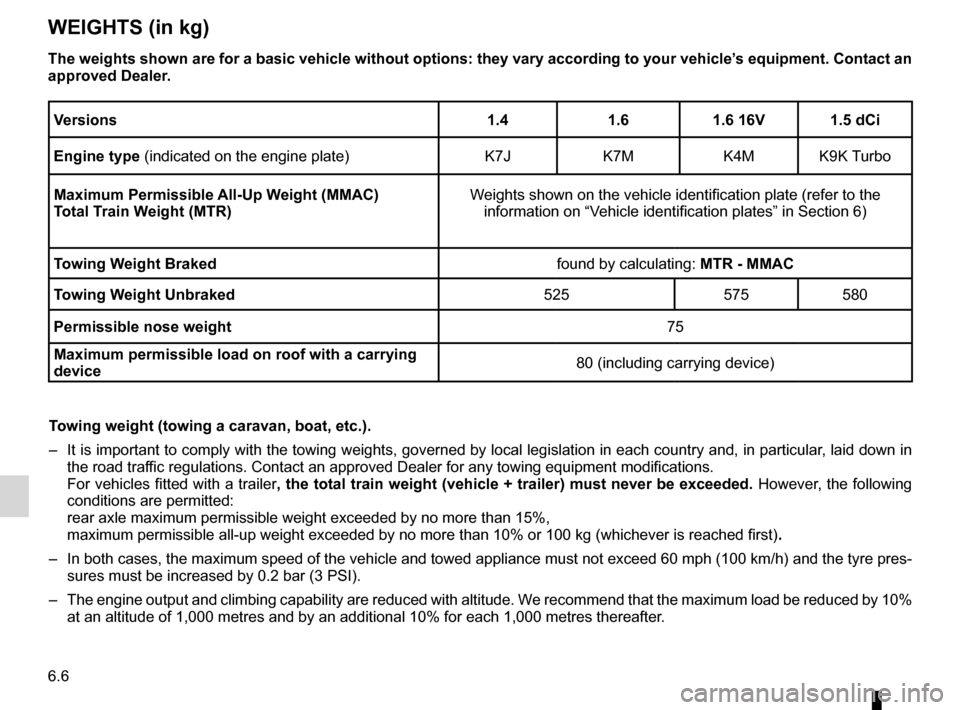
WEIGHTS (in kg)
Versions1.41.61.6 16V1.5 dCi
Engine type (indicated on the engine plate)K7JK7MK4MK9K Turbo
Maximum Permissible All-Up Weight (MMAC)Total Train Weight (MTR)Weights shown on the vehicle identification plate (refer to the information on “Vehicle identification plates” in Section 6)
Towing Weight Brakedfound by calculating: MTR - MMAC
Towing Weight Unbraked525575580
Permissible nose weight75
Maximum permissible load on roof with a carrying device80 (including carrying device)
Towing weight (towing a caravan, boat, etc.).
– It is important to comply with the towing weights, governed by local legislation in each country and, in particular, laid down in
the road traffic regulations. Contact an approved Dealer for any towing equipment mod\
ifications. For vehicles fitted with a trailer, the total train weight (vehicle + trailer) must never be exceeded. However, the following conditions are permitted:rear axle maximum permissible weight exceeded by no more than 15%,maximum permissible all-up weight exceeded by no more than 10% or 100 kg\
(whichever is reached first).
– In both cases, the maximum speed of the vehicle and towed appliance must not exceed 60 mph (100 km/h) and the tyre pres
- sures must be increased by 0.2 bar (3 PSI).
– The engine output and climbing capability are reduced with altitude. We recommend that the maximum load be reduced by 10%
at an altitude of 1,000 metres and by an additional 10% for each 1,000 m\
etres thereafter.
The weights shown are for a basic vehicle without options: they vary according to your vehicle’s equipment. Contact an approved Dealer.