2013 DACIA SANDERO Check light
[x] Cancel search: Check lightPage 90 of 146
bonnet...................................................(up to the end of the DU)
4.2
ENG_UD5590_1Capot moteur (B90 - Dacia)ENG_NU_817-2_NU_Dacia_4
Capot moteur
BONNET
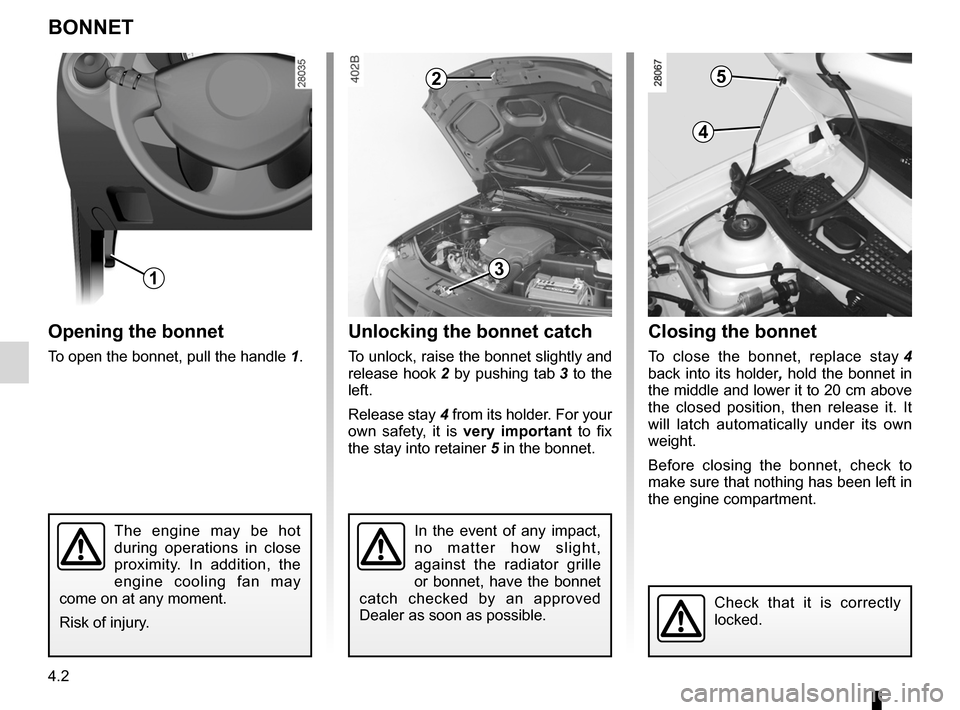
Opening the bonnet
To open the bonnet, pull the handle 1.
Unlocking the bonnet catch
To unlock, raise the bonnet slightly and
release hook 2 by pushing tab 3 to the left.
Release stay
4 from its holder. For your own safety, it is very important to fix
the stay into retainer 5 in the bonnet.
Closing the bonnet
To close the bonnet, replace stay 4 back into its holder, hold the bonnet in the middle and lower it to 20 cm above the closed position, then release it. It will latch automatically under its own weight.
Before closing the bonnet, check to make sure that nothing has been left in
the engine compartment.
The engine may be hot during operations in close proximity. In addition, the engine cooling fan may come on at any moment.
Risk of injury.
In the event of any impact, n o m a t t e r h o w s l i g h t , against the radiator grille or bonnet, have the bonnet catch checked by an approved Dealer as soon as possible.Check that it is correctly locked.
1
2
3
4
5
Page 94 of 146
maintenance:mechanical ......................................(up to the end of the DU)brake fluid ..............................................................(current page)levels ....................................................(up to the end of the DU)tanks and reservoirsbrake fluid ........................................................(current page)
4.6
ENG_UD5592_1Niveaux / Filtres (B90 - Dacia)ENG_NU_817-2_NU_Dacia_4
JauneNoirNoir texte
Niveaux : Liquide de freins
LEVELS
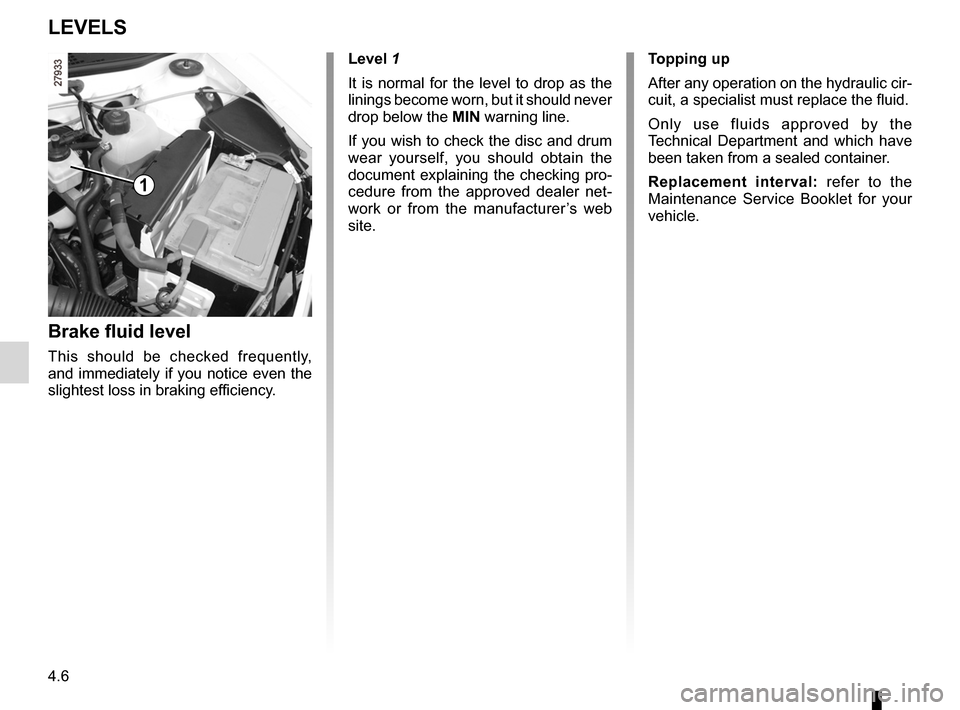
Brake fluid level
This should be checked frequently, and immediately if you notice even the slightest loss in braking efficiency. Level
1
It is normal for the level to drop as the linings become worn, but it should never drop below the MIN warning line.
If you wish to check the disc and drum wear yourself, you should obtain the document explaining the checking pro- cedure from the approved dealer net-work or from the manufacturer’s web site.
Topping up
After any operation on the hydraulic cir- cuit, a specialist must replace the fluid.
Only use fluids approved by the Technical Department and which have been taken from a sealed container.
Replacement interval: refer to the Maintenance Service Booklet for your vehicle.
1
Page 99 of 146
JauneNoirNoir texte
4.11
ENG_UD5594_1Entretien de la carrosserie (B90 - Dacia)ENG_NU_817-2_NU_Dacia_4
BODYWORK MAINTENANCE (continued)
You should
– Wash your car frequently, with the engine off, with cleaning products recommended by the manufacturer (never use abrasive products) and be sure to jet-rinse off:
– spots of tree resin and industrial grime;
– bird droppings, which contain chemicals that rapidly discolour paintwork and may cause the paint to peel off;
Wash the vehicle immediately to
remove these marks since it is im- possible to remove them by pol- ishing;
– salt deposited in the wheel arches and underneath the body after driving in areas where the roads are chemically treated;
– mud in the wheel arches and un- derneath the body which form damp patches. –
Keep well away from the vehicle in
front when driving on gravelled sur- faces to prevent paint damage.
– Repair or have repaired quickly
patches where the paint has been damaged to prevent corrosion spreading.
– Remember to visit the body shop pe
- riodically in order to maintain your anti-corrosion warranty. Refer to the Maintenance Service Booklet.
– Respect local regulations about
washing vehicles (e.g. do not wash your vehicle on a public highway). –
Before using a roller type car wash,
put the windscreen wiper stalk in Park position (refer information on the “Windscreen wash/wipe” in Section 1), check that the external accessories, additional lights, and mirrors are securely fitted and that the wiper blades and radio aerial are taped down.
If your vehicle has a car phone and radio, remove the aerials.
– Spray mechanical components,
hinges, etc. with products approved by the Technical Department to protect them after they have been cleaned.
We have selected special products to care for your vehicle and you can obtain these from approved dealer accessory outlets.
Page 106 of 146
changing a wheel..................................(up to the end of the DU)practical advice .....................................(up to the end of the DU)jack .......................................................(up to the end of the DU)puncture................................................(up to the end of the DU)lifting the vehiclechanging a wheel ............................(up to the end of the DU)
5.6
ENG_UD5600_1Changement de roue (B90 - Dacia)ENG_NU_817-2_NU_Dacia_5
Changement de roue
CHANGING A WHEEL
Park the vehicle away from traffic and on level ground which is not slippery (place a plank under the jack if necessary). Switch on the hazard warning lights.
Apply the hand brake and engage a gear (first or reverse).
Ask all the passengers to leave the vehicle and keep them away from traffic.
If you have a puncture, re-
place the wheel as soon as possible.
A tyre which has been punc- tured should always be inspected (and repaired, where possible) by a specialist.
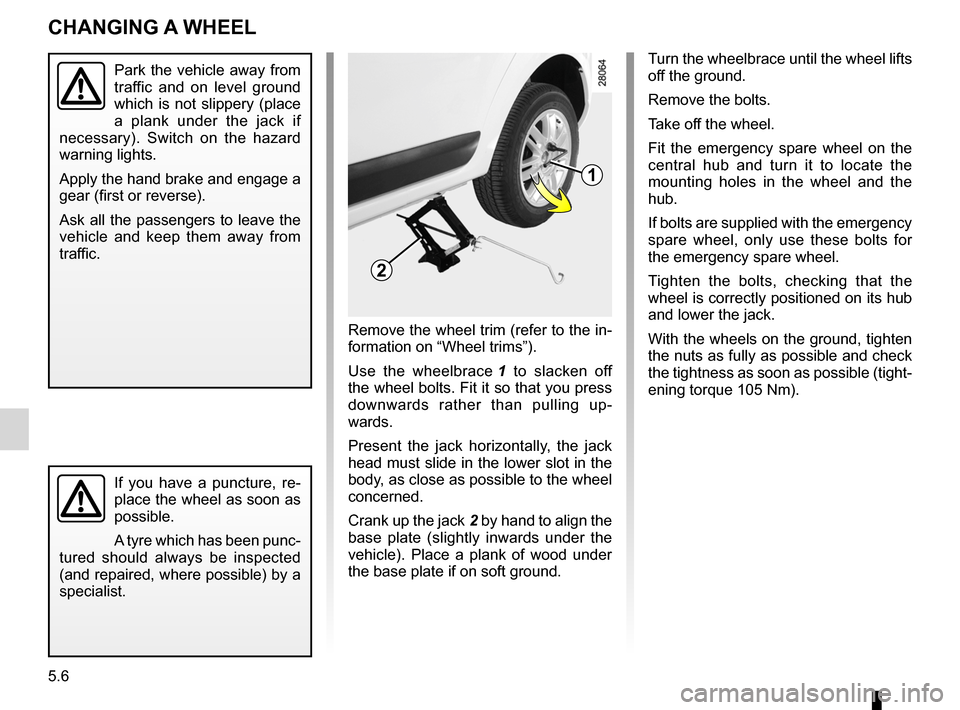
Remove the wheel trim (refer to the in- formation on “Wheel trims”).
Use the wheelbrace
1 to slacken off the wheel bolts. Fit it so that you press downwards rather than pulling up- wards.
Present the jack horizontally, the jack head must slide in the lower slot in the body, as close as possible to the wheel concerned.
Crank up the jack
2 by hand to align the base plate (slightly inwards under the vehicle). Place a plank of wood under the base plate if on soft ground.
Turn the wheelbrace until the wheel lifts off the ground.
Remove the bolts.
Take off the wheel.
Fit the emergency spare wheel on the central hub and turn it to locate the mounting holes in the wheel and the hub.
If bolts are supplied with the emergency spare wheel, only use these bolts for the emergency spare wheel.
Tighten the bolts, checking that the wheel is correctly positioned on its hub and lower the jack.
With the wheels on the ground, tighten the nuts as fully as possible and check the tightness as soon as possible (tight- ening torque 105 Nm).
1
2
Page 131 of 146

JauneNoirNoir texte
5.31
ENG_UD5616_1Anomalies de fonctionnement (B90 - Dacia)ENG_NU_817-2_NU_Dacia_5
OPERATING FAULTS (continued)
On the roadPOSSIBLE CAUSESWHAT TO DO
Vibrations.Tyres not inflated to correct pres- sures, incorrectly balanced or dam- aged.
Check the tyre pressures; if this is not the cause, have their condition checked by an approved dealer.
Abnormal white smoke from the exhaust or coolant boiling in the reservoir.Mechanical fault: cylinder head gasket blown, faulty coolant pump.Stop the engine.Contact an approved dealer.
Smoke under the bonnet.Short circuit or cooling system leak.Stop, switch off the ignition, stand away from the vehicle and contact an approved Dealer.
The oil pressure warning light comes on:
on a bend or under brakingThe level is too low.Top up the engine oil (refer to the informa- tion on “Engine oil level, topping up/refill- ing” in Section 4).
at idle speedLow oil pressure.Go to your nearest approved dealer.
is slow to go out or remains lit up under accelerationLoss of oil pressure.Stop the vehicle: contact a an approved dealer.
Page 132 of 146

5.32
ENG_UD5616_1Anomalies de fonctionnement (B90 - Dacia)ENG_NU_817-2_NU_Dacia_5
JauneNoirNoir texte
OPERATING FAULTS (continued)
On the roadPOSSIBLE CAUSESWHAT TO DO
The power-assisted steering be- comes heavy.Belt brokenInsufficient oil in pump.Have the belt replaced.
Top up the power-assisted steering fluid (refer to the information on the “Power-as- sisted steering pump” in Section 4).
If the fault is still present, consult your approved dealer.
The engine overheats. The coolant temperature indicator light comes on.Engine cooling fan not working.Stop the vehicle, switch off the engine and contact an approved dealer.
Coolant leaks.Check the coolant reservoir: it should con- tain coolant. If there is none, consult your approved dealer as soon as possible.
WhistlingRoof aerial incorrectly positionedFold down the aerial until the end is approx- imately 44 cm from the roof of the vehicle.
Radiator: If there is a significant lack of coolant, remember that it must never be topped up using cold coolant while the engine is very warm. After any procedure on the vehicle which has involved even partial draining of the cooling system, it must be refilled with a new mixture prepared in the correct proportions. Reminder: only products approved by the Technical Department may be used for this purpose.