2013 CHEVROLET CAPTIVA SPORT engine
[x] Cancel search: enginePage 232 of 374
Black plate (44,1)Chevrolet Captiva Sport Owner Manual - 2013 - crc - 11/12/12
9-44 Driving and Operating After loading the trailer, weigh the
trailer and then the tongue,
separately, to see if the weights are
proper. If they are not, adjustments
might be made by moving some
items around in the trailer.
Trailering may be limited by the
vehicle's ability to carry tongue
weight. Tongue weight cannot cause
the vehicle to exceed the GVWR
(Gross Vehicle Weight Rating) or
the RGAWR (Rear Gross Axle
Weight Rating). The effect of
additional weight may reduce the
trailering capacity more than the
total of the additional weight.
It is important that the vehicle does
not exceed any of its ratings —
GCWR, GVWR, RGAWR, Maximum
Trailer Rating or Tongue Weight.
The only way to be sure it is not
exceeding any of these ratings is to
weigh the vehicle and trailer. Total Weight on the Vehicle's
Tires Inflate the vehicle's tires to the
upper limit for cold tires. These
numbers can be found on the
Certification label or see Vehicle
Load Limits on page 9 ‑ 10 for more
information. Do not go over the
GVW limit for the vehicle, or the
GAWR, including the weight of the
trailer tongue. If using a weight
distributing hitch, do not go over the
rear axle limit before applying the
weight distribution spring bars.
Towing Equipment Hitches It is important to have the correct
hitch equipment. Crosswinds, large
trucks going by, and rough roads
are a few reasons why the right
hitch is needed. .
The rear bumper on the vehicle
is not intended for hitches. Do
not attach rental hitches or other bumper-type hitches to it. Use
only a frame-mounted hitch that
does not attach to the bumper. .
Will any holes be made in the
body of the vehicle when the
trailer hitch is installed? If there
are, then be sure to seal the
holes when the hitch is removed.
If the holes are not sealed, dirt,
water, and deadly carbon
monoxide (CO) from the exhaust
may get into the vehicle. See
Engine Exhaust on page 9 ‑ 19 .
Safety Chains Always attach chains between the
vehicle and the trailer. Cross the
safety chains under the tongue of
the trailer to help prevent the tongue
from contacting the road if it
becomes separated from the hitch.
Always leave just enough slack so
the rig can turn. Never allow safety
chains to drag on the ground.
Page 235 of 374

Black plate (1,1)Chevrolet Captiva Sport Owner Manual - 2013 - crc - 11/12/12
Vehicle Care 10-1
Vehicle Care General Information General Information . . . . . . . . . . 10-2
Accessories and
Modifications . . . . . . . . . . . . . . . 10-2
Vehicle Checks Doing Your Own
Service Work . . . . . . . . . . . . . . . 10-3
Hood . . . . . . . . . . . . . . . . . . . . . . . . 10-3
Engine Compartment
Overview . . . . . . . . . . . . . . . . . . . 10-4
Engine Cover . . . . . . . . . . . . . . . . 10-7
Engine Oil . . . . . . . . . . . . . . . . . . . 10-8
Engine Oil Life System . . . . . 10-10
Automatic Transmission
Fluid . . . . . . . . . . . . . . . . . . . . . . 10-11
Engine Air Cleaner/Filter . . . . 10-11
Cooling System . . . . . . . . . . . . 10-13
Engine Coolant . . . . . . . . . . . . . 10-14
Engine Overheating . . . . . . . . 10-18
Power Steering Fluid . . . . . . . 10-19
Washer Fluid . . . . . . . . . . . . . . . 10-20
Brakes . . . . . . . . . . . . . . . . . . . . . 10-20
Brake Fluid . . . . . . . . . . . . . . . . . 10-21
Battery . . . . . . . . . . . . . . . . . . . . . 10-23
All-Wheel Drive . . . . . . . . . . . . . 10-23 Starter Switch Check . . . . . . . 10-23
Automatic Transmission Shift
Lock Control Function
Check . . . . . . . . . . . . . . . . . . . . . 10-24
Ignition Transmission Lock
Check . . . . . . . . . . . . . . . . . . . . . 10-24
Park Brake and P (Park)
Mechanism Check . . . . . . . . 10-24
Wiper Blade
Replacement . . . . . . . . . . . . . . 10-25
Headlamp Aiming Headlamp Aiming . . . . . . . . . . 10-26
Bulb Replacement Bulb Replacement . . . . . . . . . . 10-26
Halogen Bulbs . . . . . . . . . . . . . . 10-26
Headlamps . . . . . . . . . . . . . . . . . 10-26
Fog Lamps . . . . . . . . . . . . . . . . . 10-27
Front Turn Signal and
Parking Lamps . . . . . . . . . . . . 10-27
Taillamps, Turn Signal,
Stoplamps, and Back-Up
Lamps . . . . . . . . . . . . . . . . . . . . 10-28
License Plate Lamp . . . . . . . . 10-29
Replacement Bulbs . . . . . . . . . 10-29 Electrical System Electrical System
Overload . . . . . . . . . . . . . . . . . . 10-30
Fuses and Circuit
Breakers . . . . . . . . . . . . . . . . . . 10-30
Engine Compartment Fuse
Block . . . . . . . . . . . . . . . . . . . . . 10-30
Instrument Panel Fuse
Block . . . . . . . . . . . . . . . . . . . . . 10-33
Wheels and Tires Tires . . . . . . . . . . . . . . . . . . . . . . . . 10-36
All-Season Tires . . . . . . . . . . . . 10-37
Winter Tires . . . . . . . . . . . . . . . . 10-37
Summer Tires . . . . . . . . . . . . . . 10-37
Tire Sidewall Labeling . . . . . . 10-38
Tire Designations . . . . . . . . . . . 10-40
Tire Terminology and
Definitions . . . . . . . . . . . . . . . . 10-40
Tire Pressure . . . . . . . . . . . . . . . 10-43
Tire Pressure for High-Speed
Operation . . . . . . . . . . . . . . . . . 10-44
Tire Pressure Monitor
System . . . . . . . . . . . . . . . . . . . 10-45
Tire Pressure Monitor
Operation . . . . . . . . . . . . . . . . . 10-46
Tire Inspection . . . . . . . . . . . . . . 10-49
Tire Rotation . . . . . . . . . . . . . . . 10-49
Page 238 of 374
Black plate (4,1)Chevrolet Captiva Sport Owner Manual - 2013 - crc - 11/12/12
10-4 Vehicle Care
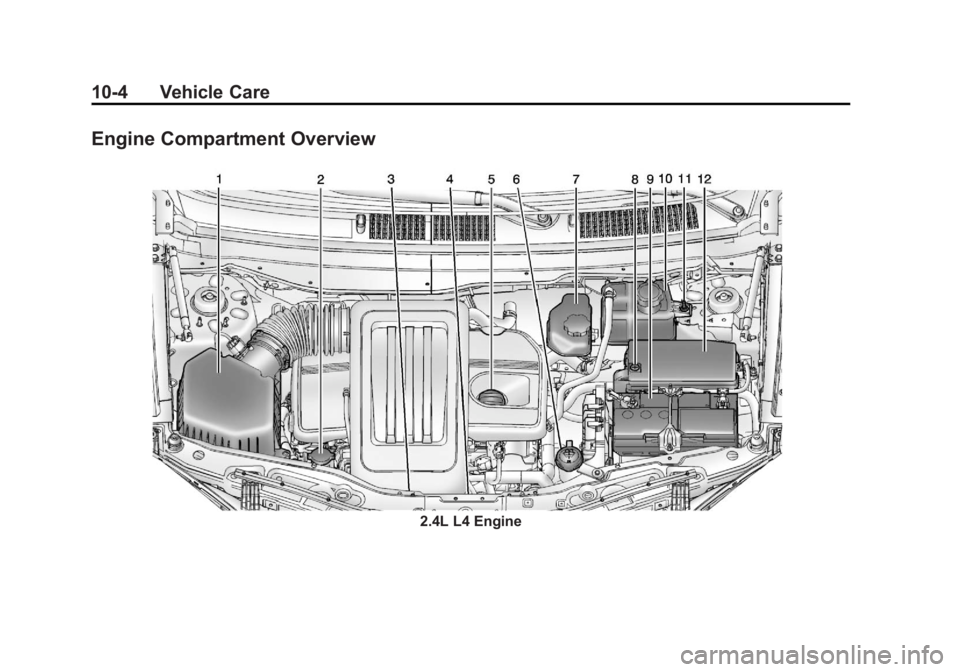
Engine Compartment Overview
2.4L L4 Engine
Page 239 of 374
Black plate (5,1)Chevrolet Captiva Sport Owner Manual - 2013 - crc - 11/12/12
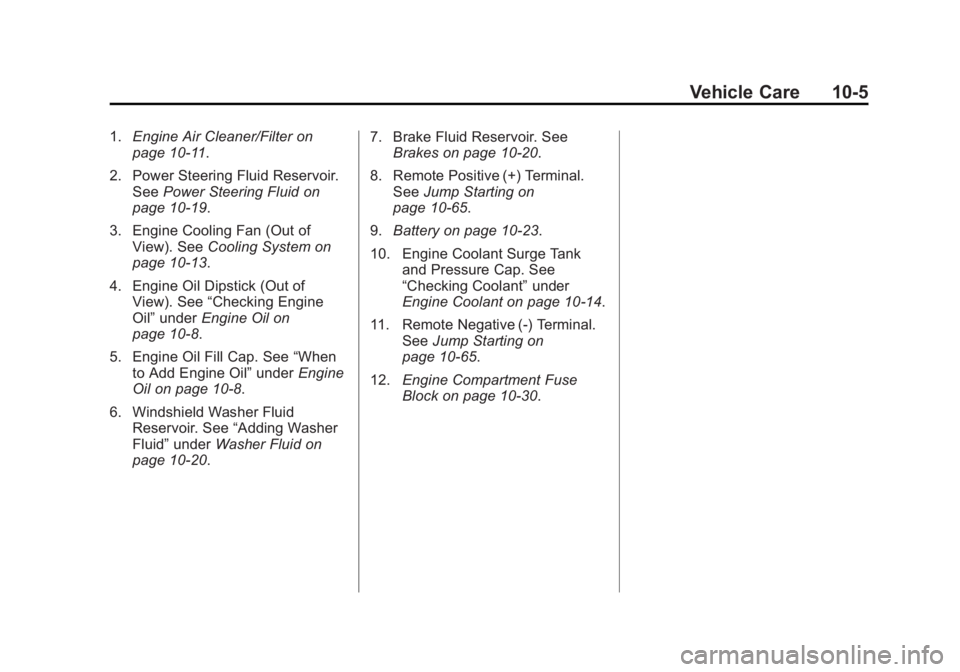
Vehicle Care 10-51. Engine Air Cleaner/Filter on
page 10 ‑ 11 .
2. Power Steering Fluid Reservoir.
See Power Steering Fluid on
page 10 ‑ 19 .
3. Engine Cooling Fan (Out of
View). See Cooling System on
page 10 ‑ 13 .
4. Engine Oil Dipstick (Out of
View). See “ Checking Engine
Oil ” under Engine Oil on
page 10 ‑ 8 .
5. Engine Oil Fill Cap. See “ When
to Add Engine Oil ” under Engine
Oil on page 10 ‑ 8 .
6. Windshield Washer Fluid
Reservoir. See “ Adding Washer
Fluid ” under Washer Fluid on
page 10 ‑ 20 . 7. Brake Fluid Reservoir. See
Brakes on page 10 ‑ 20 .
8. Remote Positive (+) Terminal.
See Jump Starting on
page 10 ‑ 65 .
9. Battery on page 10 ‑ 23 .
10. Engine Coolant Surge Tank
and Pressure Cap. See
“ Checking Coolant ” under
Engine Coolant on page 10 ‑ 14 .
11. Remote Negative (-) Terminal.
See Jump Starting on
page 10 ‑ 65 .
12. Engine Compartment Fuse
Block on page 10 ‑ 30 .
Page 240 of 374
Black plate (6,1)Chevrolet Captiva Sport Owner Manual - 2013 - crc - 11/12/12
10-6 Vehicle Care
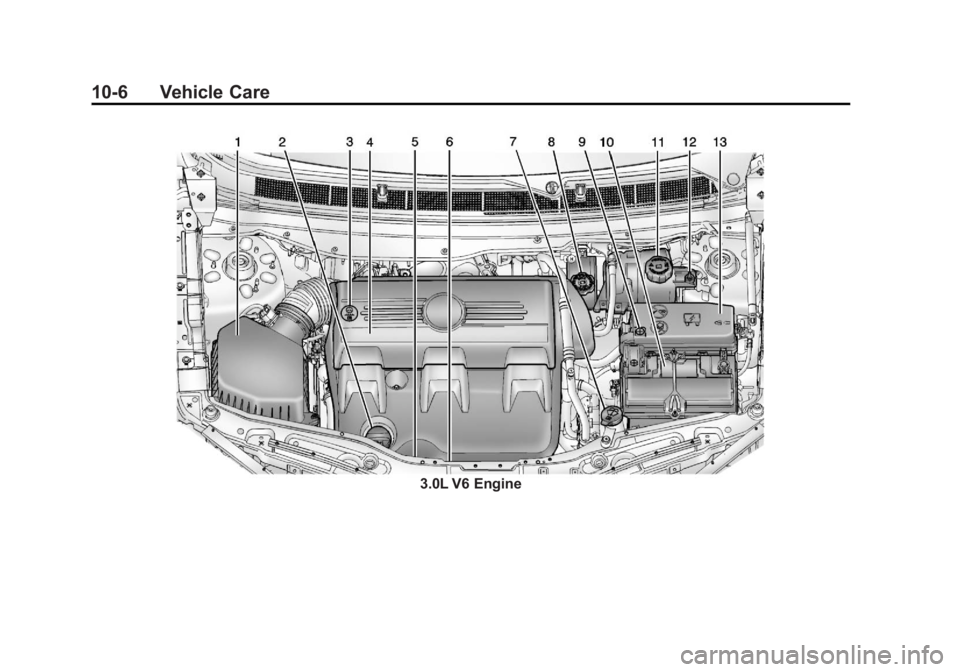
3.0L V6 Engine
Page 241 of 374
Black plate (7,1)Chevrolet Captiva Sport Owner Manual - 2013 - crc - 11/12/12
Vehicle Care 10-71. Engine Air Cleaner/Filter on
page 10 ‑ 11 .
2. Engine Oil Fill Cap (Out of
View). See “ When to Add Engine
Oil ” under Engine Oil on
page 10 ‑ 8 .
3. Power Steering Fluid Reservoir
(Out of View). See Power
Steering Fluid on page 10 ‑ 19 .
4. Engine Cover. See Engine
Cover on page 10 ‑ 7 .
5. Engine Oil Dipstick (Out of
View). See “ Checking Engine
Oil ” under Engine Oil on
page 10 ‑ 8 .
6. Engine Cooling Fans (Out of
View). See Cooling System on
page 10 ‑ 13 . 7. Windshield Washer Fluid
Reservoir. See “ Adding Washer
Fluid ” under Washer Fluid on
page 10 ‑ 20 .
8. Brake Fluid Reservoir. See
Brakes on page 10 ‑ 20 .
9. Remote Positive (+) Terminal.
See Jump Starting on
page 10 ‑ 65 .
10. Battery on page 10 ‑ 23 .
11. Engine Coolant Surge Tank.
See “ Checking Coolant ” under
Engine Coolant on page 10 ‑ 14 .
12. Remote Negative (-) Terminal.
See Jump Starting on
page 10 ‑ 65 .
13. Engine Compartment Fuse
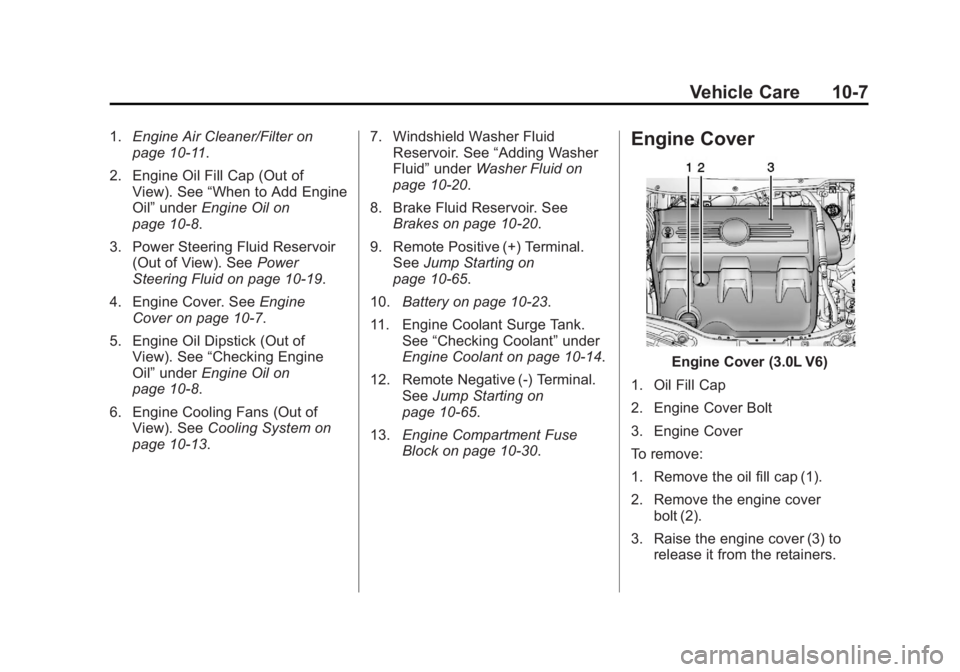
Block on page 10 ‑ 30 .Engine Cover
Engine Cover (3.0L V6)
1. Oil Fill Cap
2. Engine Cover Bolt
3. Engine Cover
To remove:
1. Remove the oil fill cap (1).
2. Remove the engine cover
bolt (2).
3. Raise the engine cover (3) to
release it from the retainers.
Page 242 of 374
Black plate (8,1)Chevrolet Captiva Sport Owner Manual - 2013 - crc - 11/12/12
10-8 Vehicle Care 4. Lift and remove the engine
cover.
5. Reverse Steps 1 – 4 to reinstall
the engine cover.
Engine Oil To ensure proper engine
performance and long life, careful
attention must be paid to engine oil.
Following these simple, but
important steps will help protect
your investment: .
Always use engine oil approved
to the proper specification and of
the proper viscosity grade. See
“ Selecting the Right Engine Oil ”
in this section. .
Check the engine oil level
regularly and maintain the
proper oil level. See “ Checking
Engine Oil ” and “ When to Add
Engine Oil ” in this section..
Change the engine oil at the
appropriate time. See Engine Oil
Life System on page 10 ‑ 10 . .
Always dispose of engine oil
properly. See “ What to Do with
Used Oil ” in this section.
Checking Engine Oil It is a good idea to check the engine
oil level at each fuel fill. In order to
get an accurate reading, the vehicle
must be on level ground. The
engine oil dipstick handle is a loop.
See Engine Compartment Overview
on page 10 ‑ 4 for the location of the
engine oil dipstick.
Obtaining an accurate oil level
reading is essential:
1. If the engine has been running
recently, turn off the engine and
allow several minutesfor the oil
to drain back into the oil pan.
Checking the oil level too soon
after engine shutoff will not
provide an accurate oil level
reading. { WARNINGThe engine oil dipstick handle
may be hot; it could burn you.
Use a towel or glove to touch the
dipstick handle.
2. Pull out the dipstick and clean it
with a paper towel or cloth, then
push it back in all the way.
Remove it again, keeping the tip
down, and check the level.
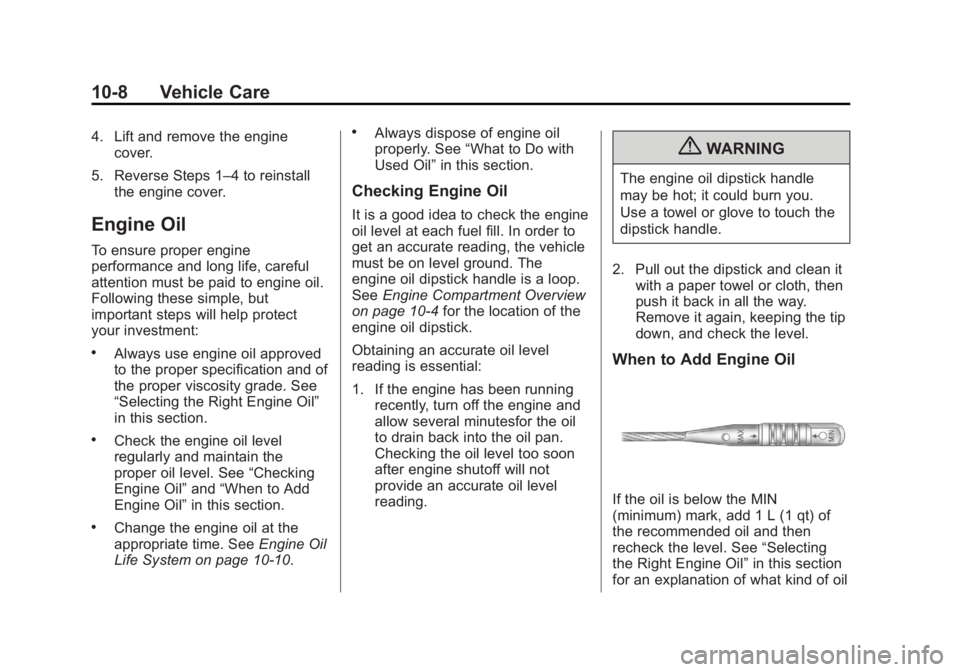
When to Add Engine Oil
If the oil is below the MIN
(minimum) mark, add 1 L (1 qt) of
the recommended oil and then
recheck the level. See “ Selecting
the Right Engine Oil ” in this section
for an explanation of what kind of oil
Page 243 of 374

Black plate (9,1)Chevrolet Captiva Sport Owner Manual - 2013 - crc - 11/12/12
Vehicle Care 10-9to use. For engine oil crankcase
capacity, see Capacities and
Specifications on page 12 ‑ 2 .
Notice: Do not add too much oil.
Oil levels above or below the
acceptable operating range
shown on the dipstick are harmful
to the engine. If you find that you
have an oil level above the
operating range, i.e., the engine
has so much oil that the oil level
gets above the upper mark that
shows the proper operating
range, the engine could be
damaged. You should drain out
the excess oil or limit driving of
the vehicle and seek a service
professional to remove the
excess amount of oil.
See Engine Compartment Overview
on page 10 ‑ 4 for the location of the
engine oil fill cap.
Add enough oil to put the level
somewhere in the proper operating
range. Push the dipstick all the way
back in when through. Selecting the Right Engine Oil Selecting the right engine oil
depends on both the proper oil
specification and viscosity grade.
See Recommended Fluids and
Lubricants on page 11 ‑ 12 .
Specification
Use and ask for licensed engine oils
with the dexos1 ®
approved
certification mark. Engine oils
meeting the requirements for the
vehicle should have the dexos1
approved certification mark. This
certification mark indicates that the
oil has been approved to the dexos1
specification. Notice: Failure to use the
recommended engine oil or
equivalent can result in engine
damage not covered by the
vehicle warranty. Check with your
dealer or service provider on
whether the oil is approved to the
dexos1 specification.
Viscosity Grade
SAE 5W-30 is the best viscosity
grade for the vehicle. Do not use
other viscosity grade oils such as
SAE 10W-30, 10W-40, or 20W-50.
Cold Temperature Operation: In an
area of extreme cold, where the
temperature falls below − 29°C
( − 20°F), an SAE 0W-30 oil may be
used. An oil of this viscosity grade
will provide easier cold starting for
the engine at extremely low
temperatures. When selecting an oil
of the appropriate viscosity grade,
always select an oil of the correct
specification. See “ Specification ”
earlier in this section for more
information.