2013 CHEVROLET CAPTIVA SPORT sport mode
[x] Cancel search: sport modePage 211 of 374
Black plate (23,1)Chevrolet Captiva Sport Owner Manual - 2013 - crc - 11/12/12
Driving and Operating 9-23the DIC is the highest gear that the
transmission will be allowed to
operate in. This means that all
gears below that number are
available. For example, when
4 (Fourth) is shown, 1 (First) through
4 (Fourth) gears are automatically
shifted by the vehicle. The
transmission will not shift into
5 (Fifth) until the + (Plus) button is
used or you shift back into D (Drive).
While in M (Manual), the
transmission will prevent shifting to
a lower gear range if the engine
speed is too high. You have a brief
period of time to slow the vehicle.
If vehicle speed is not reduced
within the time allowed, the lower
gear range shift will not be
completed. You must further slow
the vehicle, then press the − (Minus)
button to the desired lower gear
range.
Automatic Engine Grade Braking is
not available when the ERS is
active. It is available in D (Drive).
While using the ERS, cruise control
can be used. Fuel Economy Mode The vehicle may have a fuel
economy mode. When engaged,
fuel economy mode can improve the
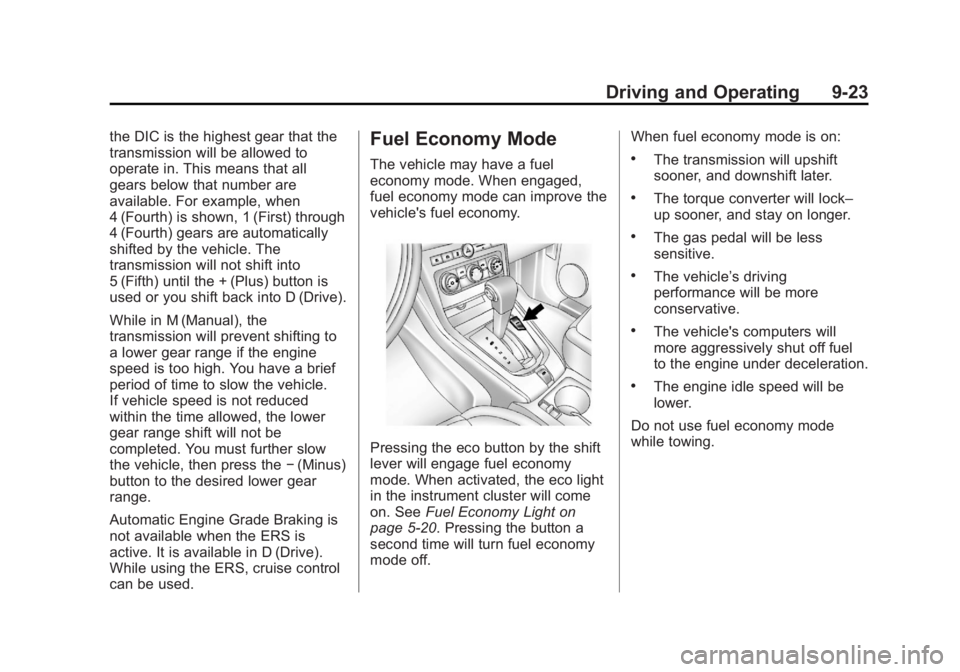
vehicle's fuel economy.
Pressing the eco button by the shift
lever will engage fuel economy
mode. When activated, the eco light
in the instrument cluster will come
on. See Fuel Economy Light on
page 5 ‑ 20 . Pressing the button a
second time will turn fuel economy
mode off. When fuel economy mode is on: .
The transmission will upshift
sooner, and downshift later. .
The torque converter will lock –
up sooner, and stay on longer. .
The gas pedal will be less
sensitive. .
The vehicle ’ s driving
performance will be more
conservative. .
The vehicle's computers will
more aggressively shut off fuel
to the engine under deceleration. .
The engine idle speed will be
lower.
Do not use fuel economy mode
while towing.
Page 227 of 374
Black plate (39,1)Chevrolet Captiva Sport Owner Manual - 2013 - crc - 11/12/12
Driving and Operating 9-39WARNING (Continued) .
Place the nozzle inside the fill
opening of the container
before dispensing fuel, and
keep it in contact with the fill
opening until filling is
complete. .
Fill the container no more
than 95% full to allow for
expansion. .
Do not smoke, light matches,
or use lighters while
pumping fuel. .
Avoid using cell phones or
other electronic devices. Towing General Towing
Information Only use towing equipment that has
been designed for the vehicle.
Contact your dealer or trailering
dealer for assistance with preparing
the vehicle for towing a trailer. Read
the entire section before towing a
trailer.
For towing a disabled vehicle, see
Towing the Vehicle on page 10 ‑ 69 .
For towing the vehicle behind
another vehicle such as a motor
home, see Recreational Vehicle
Towing on page 10 ‑ 69 .
Driving Characteristics
and Towing Tips Driving with a Trailer
When towing a trailer: .
Become familiar with the state
and local laws that apply
specifically to trailer towing. .
Do not tow a trailer during the
first 800 km (500 mi), to prevent
damage to the engine, axle or
other parts. .
Then, during the first 800 km
(500 mi) trailer towing, do not
drive over 80 km/h (50 mph) and
do not make starts at full throttle. .
The vehicle can tow in D (Drive)
but M (Manual Mode) is
recommended. See Manual
Mode on page 9 ‑ 22 . Use a lower
gear if the transmission shifts
too often.
{ WARNING
When towing a trailer, exhaust
gases may collect at the rear of
the vehicle and enter if the
liftgate, trunk/hatch, or rear-most
window is open.
When towing a trailer:
(Continued)
Page 230 of 374
Black plate (42,1)Chevrolet Captiva Sport Owner Manual - 2013 - crc - 11/12/12
9-42 Driving and Operating 4. Reapply the brake pedal. Then
apply the parking brake and shift
into P (Park).
5. Release the brake pedal.
Leaving After Parking on a Hill 1. Apply and hold the brake pedal
while you: .
Start the engine. .
Shift into a gear. .
Release the parking brake.
2. Let up on the brake pedal.
3. Drive slowly until the trailer is
clear of the chocks.
4. Stop and have someone pick up
and store the chocks.
Maintenance When Trailer
Towing
The vehicle needs service more
often when pulling a trailer. See the
Maintenance Schedule on
page 11 ‑ 3 . Things that are especially important in trailer
operation are automatic
transmission fluid, engine oil, axle
lubricant, belts, cooling system and
brake system. Inspect these before
and during the trip.
Check periodically to see that all
hitch nuts and bolts are tight.
Engine Cooling When Trailer
Towing The cooling system may temporarily
overheat during severe operating
conditions. See Engine Overheating
on page 10 ‑ 18 .
Trailer Towing Three important considerations
have to do with weight: .
The weight of the trailer .
The weight of the trailer tongue .
The total weight on the vehicle's
tires Weight of the Trailer How heavy can a trailer safely be?
Speed, altitude, road grades,
outside temperature, special
equipment, and the amount of
tongue weight the vehicle can carry
must be considered. See “ Weight of
the Trailer Tongue ” later in this
section for more information.
Maximum trailer weight is calculated
assuming only the driver is in the
tow vehicle and it has all the
required trailering equipment. The
weight of additional optional
equipment, passengers and cargo in
the tow vehicle must be subtracted
from the maximum trailer weight.
Use the following chart to determine
how much the vehicle can weigh,
based upon the vehicle model and
options.
Page 269 of 374
Black plate (35,1)Chevrolet Captiva Sport Owner Manual - 2013 - crc - 11/12/12
Vehicle Care 10-35Fuses Usage
KEY
CAPTURE Key Capture
L/GATE Liftgate
LOGISTIC
MODE Logistic Mode
OSRVM Outside Rearview
Mirror
PASS
PWR WNDW Passenger Power
Window
PWR DIODE Power Diode
PWR/
MODING Power Moding
RADIO Radio
RR FOG Rear Defogger
RUN 2 Power Battery Key
On Run
RUN/CRNK Run Crank
SDM (BATT) Safety Diagnosis
Module (Battery) Fuses Usage
SDM (IGN 1) Safety Diagnosis
Module (Ignition 1)
SPARE Spare
S/ROOF Sunroof
S/ROOF
BATT Sunroof Battery
SSPS Speed Sensitive
Power Steering
STR/
WHL SW Steering Wheel
Switch
TRLR Trailer
TRLR BATT Trailer Battery
XBCM Export Body
Control Module
XM/
HVAC/DLC SiriusXM Satellite
Radio (If
Equipped)/Heating,
Ventilation, and Air
Conditioning/Data
Link Connection Relays Usage
ACC/
RAP RLY Accessory/Run
Accessory Power
CIGAR
APO
JACK RLY Cigarette and
Auxiliary Power
Outlet
RUN/
CRNK RLY Run/Crank
RUN RLY Run
Page 276 of 374
Black plate (42,1)Chevrolet Captiva Sport Owner Manual - 2013 - crc - 11/12/12
10-42 Vehicle Care Maximum Inflation Pressure :
The maximum air pressure to
which a cold tire can be inflated.
The maximum air pressure is
molded onto the sidewall.
Maximum Load Rating :
The
load rating for a tire at the
maximum permissible inflation
pressure for that tire.
Maximum Loaded Vehicle
Weight :
The sum of curb
weight, accessory weight,
vehicle capacity weight, and
production options weight.
Normal Occupant Weight :
The
number of occupants a vehicle
is designed to seat multiplied by
68 kg (150 lb). See Vehicle Load
Limits on page 9 ‑ 10 .
Occupant Distribution :
Designated seating positions. Outward Facing Sidewall :
The
side of an asymmetrical tire that
has a particular side that faces
outward when mounted on a
vehicle. The side of the tire that
contains a whitewall, bears
white lettering, or bears
manufacturer, brand, and/or
model name molding that is
higher or deeper than the same
moldings on the other sidewall
of the tire.
Passenger (P-Metric) Tire :
A
tire used on passenger cars and
some light duty trucks and
multipurpose vehicles.
Recommended Inflation
Pressure :
Vehicle
manufacturer's recommended
tire inflation pressure as shown
on the tire placard. See Tire
Pressure on page 10 ‑ 43 and
Vehicle Load Limits on
page 9 ‑ 10 . Radial Ply Tire :
A pneumatic
tire in which the ply cords that
extend to the beads are laid at
90 degrees to the centerline of
the tread.
Rim :
A metal support for a tire
and upon which the tire beads
are seated.
Sidewall :
The portion of a tire
between the tread and the bead.
Speed Rating :
An
alphanumeric code assigned to
a tire indicating the maximum
speed at which a tire can
operate.
Traction :
The friction between
the tire and the road surface.
The amount of grip provided.
Tread :
The portion of a tire that
comes into contact with
the road.
Treadwear Indicators :
Narrow
bands, sometimes called wear
bars, that show across the tread
Page 331 of 374
Black plate (1,1)Chevrolet Captiva Sport Owner Manual - 2013 - crc - 11/12/12
Technical Data 12-1
Technical Data Vehicle Identification Vehicle Identification
Number (VIN) . . . . . . . . . . . . . . 12-1
Service Parts Identification
Label . . . . . . . . . . . . . . . . . . . . . . . 12-1
Vehicle Data Capacities and
Specifications . . . . . . . . . . . . . . 12-2
Engine Drive Belt Routing . . . 12-4 Vehicle Identification Vehicle Identification
Number (VIN)
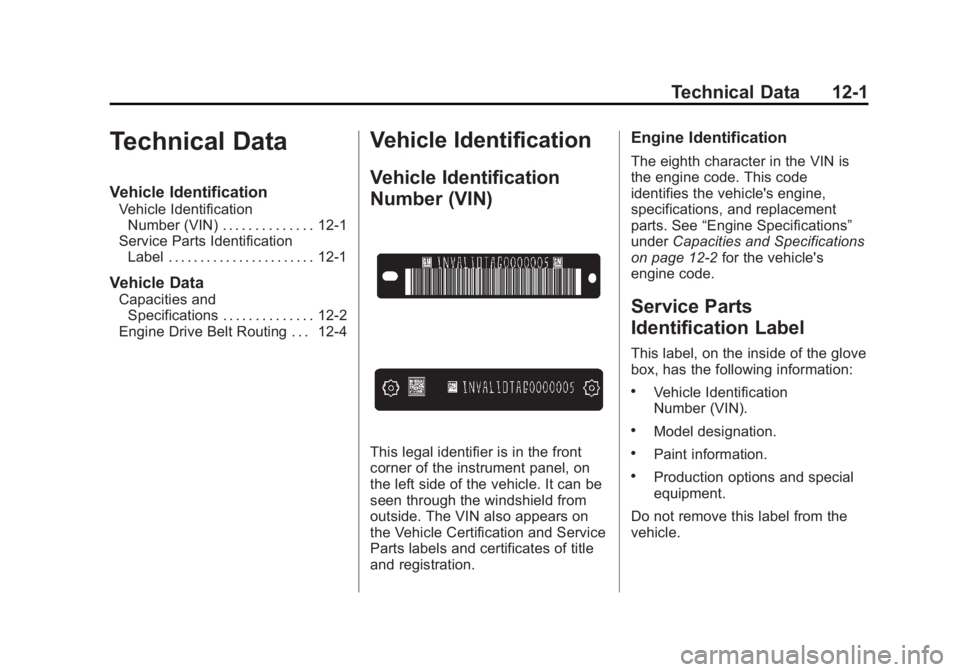
This legal identifier is in the front
corner of the instrument panel, on
the left side of the vehicle. It can be
seen through the windshield from
outside. The VIN also appears on
the Vehicle Certification and Service
Parts labels and certificates of title
and registration. Engine Identification The eighth character in the VIN is
the engine code. This code
identifies the vehicle's engine,
specifications, and replacement
parts. See “ Engine Specifications ”
under Capacities and Specifications
on page 12 ‑ 2 for the vehicle's
engine code.
Service Parts
Identification Label This label, on the inside of the glove
box, has the following information: .
Vehicle Identification
Number (VIN). .
Model designation. .
Paint information. .
Production options and special
equipment.
Do not remove this label from the
vehicle.
Page 338 of 374
Black plate (4,1)Chevrolet Captiva Sport Owner Manual - 2013 - crc - 11/12/12
13-4 Customer Information
Customer Satisfaction
Procedure (Mexico)
Did you get the Warranty Extension
Plan? This plan is recommended by
General Motors to supplement the
warranty included with the new
vehicle purchase.
See your dealer for details.
Customer Assistance
Procedure Owner satisfaction and goodwill are
very important to your dealer and
General Motors.
Normally, any problem with the
transaction, sale, or usage of the
vehicle must be handled by your
dealer sales or service departments. However, we recognize that despite
the good intentions of all parties
involved, sometimes a
misunderstanding may occur.
If you have a problem that has not
been satisfactorily handled through
the normal means, we suggest the
following steps:
STEP ONE
Explain your case to your dealer
service agent, service manager,
dealer sales agent, or sales
manager, depending on your case.
Make sure that they have all
necessary information. They are
interested in your continual
satisfaction.
STEP TWO
If you are not satisfied, please
contact the general manager or your
dealership owner to ask for their
help. If they are not able to resolve
your case, ask them to contact the
right people at General Motors for
support, if needed. STEP THREE
If your case is not resolved in a
reasonable amount of time by your
dealer, please call the General
Motors Customer Assistance
Center (CAC) and provide the
following information: .
Name .
Address .
Phone number .
Model year .
Brand .
Vehicle Identification
Number (VIN) .
Mileage .
Delivery date .
Description of the problem .
Dealership name .
Dealership address
See Customer Assistance Offices
(U.S. and Canada) on page 13 ‑ 5 or
Customer Assistance Offices
(Mexico) on page 13 ‑ 5 .
Page 345 of 374
Black plate (11,1)Chevrolet Captiva Sport Owner Manual - 2013 - crc - 11/12/12
Customer Information 13-11
Roadside Assistance
Program (U.S. and
Canada) For U.S.-purchased vehicles, call
1-800-243-8872; (Text Telephone
(TTY): 1-888-889-2438).
For Canadian-purchased vehicles,
call 1-800-268-6800.
Service is available 24 hours a day,
365 days a year.
Calling for Assistance When calling Roadside Assistance,
have the following information
ready: .
Your name, home address, and
home telephone number. .
Telephone number of your
location. .
Location of the vehicle. .
Model, year, color, and license
plate number of the vehicle. .
Odometer reading, Vehicle
Identification Number (VIN), and
delivery date of the vehicle. .
Description of the problem.
Coverage Services are provided up to 5 years/
160 000 km (100,000 mi), whichever
comes first.
In the U.S., anyone driving the
vehicle is covered. In Canada, a
person driving the vehicle without
permission from the owner is not
covered.
Roadside Assistance is not a part of
the New Vehicle Limited Warranty.
Chevrolet and General Motors of
Canada Limited reserve the right to
make any changes or discontinue
the Roadside Assistance program at
any time without notification.
Chevrolet and General Motors of
Canada Limited reserve the right to
limit services or payment to an
owner or driver if they decide the claims are made too often, or the
same type of claim is made many
times.
Services Provided .
Emergency Fuel Delivery:
Delivery of enough fuel for the
vehicle to get to the nearest
service station. .
Lock-Out Service: Service to
unlock the vehicle if you are
locked out. A remote unlock may
be available if you have OnStar.
For security reasons, the driver
must present identification
before this service is given. .
Emergency Tow from a Public
Road or Highway: Tow to the
nearest Chevrolet dealer for
warranty service, or if the vehicle
was in a crash and cannot be
driven. Assistance is also given
when the vehicle is stuck in the
sand, mud, or snow. .
Flat Tire Change: Service to
change a flat tire with the spare
tire. The spare tire, if equipped,