2013 AUDI TT child lock
[x] Cancel search: child lockPage 138 of 262
136 Child Safet y
from moving ¢ page 140 or install the seat
using the LATCH attachments .
• Push the child safety seat down with your
full weight to get the safety belt really t ight
so that the seat cannot move forward or
sideways more than one inch (2 .5 cm) .
• Secure unused safety be lts on the rear seat
¢ page 135.
Infants up to about one year (20 lbs . or 9 kg)
a re best protected in special infant carriers
a nd chi ld safety seats designed for their age
group. Many experts believe that i nfants a nd
small children should ride only in spec ial re
strai nts in which the ch ild faces the back of
the vehicle . These infant seats support the ba
by's back, neck and head in a cras h¢
fig . 113 .
The airbag on the passenger side makes the
front seat a po tentially dangerous place for a
chi ld to r ide. The front seat is not the safest
p lace for a child in a forward-facing child seat.
It is a very dangerous p lace for an infant or a
larger child in a rearward-facing seat .
A WARNING
Not using a child safety seat, using the
wrong ch ild safety seat or improperly in
stall ing a child restraint inc reases the risk
of serious persona l injury and d eath in a
c rash .
- Never install rear-fac ing ch ild safety
seats or infant carriers on the front pas senger seat -even wi th an Advanced Air
bag System. A child w ill be seri ously in
jured an d can be k illed when the inflat
ing airbag hits the child safety seat o r in
fant ca rr ier with great force and smashes
the ch ild safety seat and ch ild aga inst
the backrest, doo r or roof ¢
page 110,
Child restraints on the front seat -some
important things to know.
- Always install rear-facing child safety
seats or infant car riers on the rear seat.
- Never install a rear-facing child restraint
in t he forward-facing direction. Such re
straints are des igned for the spec ial
needs of infants and very small childre n and cannot protect them properly if the
seat is forward-facing.
-
If you must install a rearwa rd facing
child safety seat on the front passenger
seat because of exceptional c ircumstan
ces and the
PASSENGER AIR BAG OFF
light does not come o n and stay on, im
mediately insta ll the rear-fac ing ch ild
safety seat in a rear seating position and
have the airbag system inspe cted by your
Aud i dea le r.
- Always read a nd heed a ll WAR NINGS
whenever us ing a chi ld re strained in ave
hicle is be ing used
¢ page 100, Safety
belts, ¢page 108, Airbag system
and
¢ page 130, Important things to know .
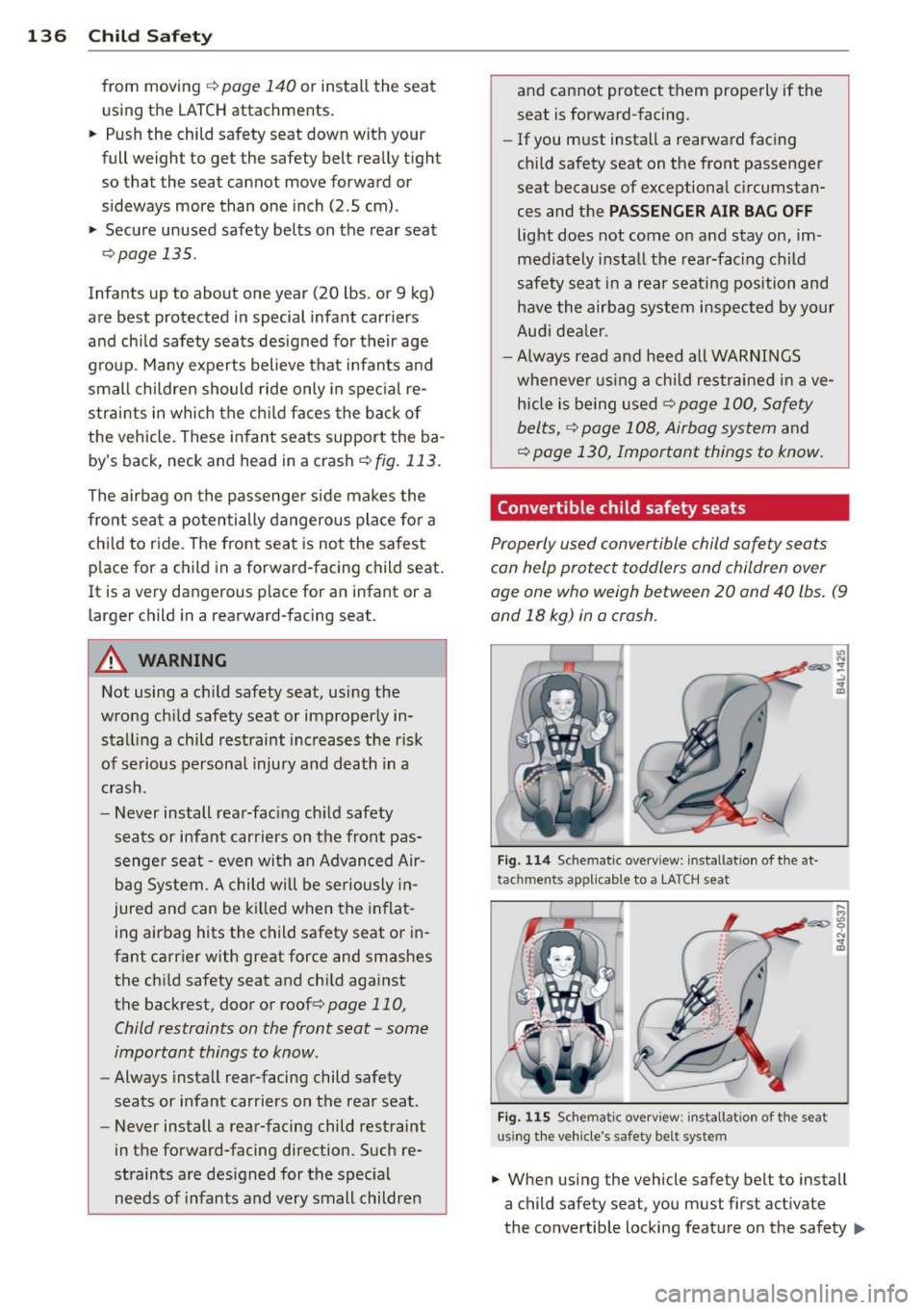
Convertible child safety seats
Properly used convertible child safety sea ts
can help protect toddlers and childr en ov er
age one who weigh between 20 and 40 lbs . (9
and 18 kg) in a crash.
Fig . 1 14 Sc hema tic overview: instal lat ion of the at·
t ac hme nts applicab le to a LA TCH sea t
Fig. 115 Sc hemat ic overview: installa tion of t he sea t
us ing t he ve hicle 's safety be lt sys te m
• When using the vehicle safety belt to install
a child safety seat, you must first activate
the convertible locking feature on the safety ..,_
Page 140 of 262

138 Child Safet y
time whenever the ignition is switched
on.
- If the light does not stay on, perform the
checks
i=> page 119, Monitoring the Ad
vanced Airbag System.
- Take the child restraint off the front pas
senger seat and install it properly at one
of the rear seat positions if the
P A SSEN
G ER A IR BAG OFF
light does not stay on
whenever the ignition is sw itched on.
Booster seats and safety belts
Properly used booster seats con help protect
children weighing between about 40 lbs. and
80 lbs . (18 kg and 36 kg) who ore less than 4
ft. 9 in. (57 inchesll .45 meters) toll.
Fi g. 11 6 Rear seat: child properly restra ined in a boos
te r seat
Booster seats raise these children up so that
the safety belt will pass properly over the
stronger parts of their bodies and the safety belt can help protect them in a crash .
> Do not use the convertible locking retractor
when using the vehicle's safety belt to re
stra in a child on a booster seat .
> The shoulder belt must lie as close to the
center of the child's collar bone as poss ible
and must lie and snug on the upper body. It
must never lie across the th roat or neck . The
l ap belt must lie across the pe lvis and never
across the stomac h or abdomen. Make sure
the belt lies f lat and snug . Pull on the be lt
to t ighten if necessary.
> Secure unused safety belts on the rear seat
c:> poge 135.
Children up to at least 8 years old (over 40
lbs. or 18 kg) are best protected in child safe
ty seats des igned for their age and weight. Ex
perts say that the skeletal structure, particu
larly the pelvis, of these children is not fully
developed, and they must not use the vehicle
safety belts without a suitable c hild restraint.
It is usually best to put these chi ldren in ap
propr iate booster seats. Be sure the booster
seat meets all applicable safety standards.
Booster seats ra ise the seating posit ion of the
child and reposition both the lap and shoulder
parts of the safety belt so that they pass
across the ch ild's body in the r ight p laces . The
routing of the belt over the ch ild 's body is very
important for the child's protect ion, whether
o r not a booster seat is used. Chi ldren age 12
and under must always r ide in the rea r seat.
Children who are at least 4
ft. 9 in. (57 in
ches/1.45 mete rs) tall can gene ra lly us e the
vehicle's three point lap and shoulder belts.
Never use the lap belt port io n of the vehicle 's
safety belt alone to restrain any chi ld, regard
less of how big the chi ld is . Always remember
that children do not have the pronounced pel
vic structure required for the proper funct ion
of lap belt portion of the vehicle's three point
lap and shou lder belts. T he child's safety ab
solutely requires that a lap belt portion of the
safety belt be fastened snugly and as low as
poss ible a round the pe lvis. Neve r let the lap
belt port ion of the safety belt pass over the
c hi ld 's stomach or abdomen.
In a crash, a irbags must inflate within a blink
of an eye and with considerable force. In o rder
to do its job, the a irbag needs room to inflate
so that it will be the re to p rotect the occ upan t
as the occupant moves forward into the air
bag.
A vehicle oc cupant who is out of posit ion and
too close to the a irbag gets in the way of an
inflating airbag. When an occ upant is too
close, he or s he will be struck violently and
will receive serious or possibly even fatal in-
jury. .,.
Page 142 of 262

140 Child Saf ety
must never -under any circumstances -
be less than 1 inch (2.5 cm.) when the
passengers sits fully upright .
- Always make sure that the rear seat pas
sengers cannot be struck when the rear
lid is closed.
Booster seats on the front seat
Children aged about 7 years and older and
weigh ing more than 55 lbs (25 kg) who are
between 4'3" (1.3 m) and 4 '11 " (1.5 m) tall
may in exceptiona l circumstances ride on the
front passenger 's seat. Children less than 4'
9" (1.4 m) tall must sit on a certified booster
seat and properly wear the vehicle's three point lap and shou lder safety belt.
A lways securely latch the passenger seat at
the very rear of its fore and aft adjustment range . The backrest must be adjusted to an
upright position .
.&_ WARNING
If you must install a booster seat child re
straint on the front passenger seat :
- Make sure the booster seat has been de
signed and certified by its manufacturer
for use on a front seat with a passenger
front and s ide a irbag.
- Always follow the manufacturer's in
struct ions provided with the booster
seat .
- Always move the passenger seat to the
very rear of its fore and aft adjustment
range, as far away from the airbag as
poss ible .
- Always make sure that the passenger
seat is securely latched in place before
install ing the booster seat . The backrest
must be adjusted to an upright position.
-If the passenge r seat cannot be securely
latched in the very rear of its fore and aft
adjustment range, then the passenger
front a irbag must be turned off with the
ON / OFF switch.
Installing a child safety
seat
Securing a child safety seat using a
safety belt
Safety belts for the rear seats and the front
passenger can be locked with the convertible
locking retractor to properly secure child
safe ty sea ts.
The safety belts emergency locking retractors
for the rear s eats safety belts and for the
front passenger's seat safety belt have a con
ver tible locking retractor for child restraints.
The safety belt must be locked so that belt
webbing cannot unreel. The retractor can be
activated to lock the safety belt and prevent
the safety be lt webbing from loosening up
during norma l dr iving . A chi ld safety seat can
only be prope rly installed when the safety be lt
is locked so that the chi ld and child safety
seat wi ll stay in place .
Always remember: Even though your vehicle is
equipped with an Advanced Airbag system, all
children, especially those 12 years and young
er, shou ld always ride in the back seat proper
l y restrained for their age and size.
.&_ WARNING
Improperly installed chi ld safety seats in
crease the risk of serious personal injury
and death in a collision .
- Always make sure that the safety belt re
tractor is locked when installing a child
safety seat. An unlocked safety belt re
tractor cannot hold the child safety seat
in place dur ing normal driving o r in a
crash.
- Always buckle the child safety seat firmly
in place even if a ch ild is not sitting in it.
A loose child safety seat can fly around
during a sudden stop or in a collision
- If the backrest is not securely latched,
the child and the child restraint will be
thrown forward together with the back-
rest and will strike parts of the vehicle ..,_
Page 144 of 262

142 Child Safety
-The inflating airbag will hit the child
safety seat or infant carrier with great
force and will smash the child safety seat and child against the backrest, door or
roof.
- Always be especially careful if you must
install a rearward facing child safety seat
on the front passenger seat in exception
al circumstances.
-A tight tether strap on a rearward-facing child restraint attached to the front pas
senger seat can put too much pressure
on the weight-mat in the seat and regis
ter a heavier weight in the Advanced Air
bag System. The heavier weight regis
tered can make the system work as
though an adult were on the seat and de
ploy the Advanced Airbag when it must
be suppressed causing serious or even
fatal injury to the child .
- Make sure that the
PASSENGER AIR BAG
OFF
light comes on and stays on all the
time whenever the ignition is switched on .
- If the
PASSENGER AIR BAG OFF light
does not come on and stay on, immedi
ately install the rear-facing child safety
seat in a rear seating position and have
the airbag system inspected by your Audi
dealer.
Activating the convertible locking retractor
Use the convertible locking retractor to se
cure a child restraint.
Always heed the child safety seat manufactur
er's instructions when installing a child re
straint in your vehicle. To activate the conver
tible lock ing retractor :
"' Place the child restraint on a seat, prefera
bly on the rear seat .
... Slowly pull the belt
all the way out.
... Route it around or through the child re
straint belt path
c:> ,& .
... Push the child safety seat down with your
full weigh t to get the safety belt really tight. "'
Insert the belt tongue into the buckle for
that seating position .
"' Guide the safety belt back into the retractor
until the belt lies flat and snug on the child
safety seat.
... You should hear a "clicking" noise as the
belt winds back into the inertia reel. Test the
convertible locking retractor by pulling on
the belt. You should no longer be able to
pull the belt out of the retractor. The con
vertible locking retractor is now activated.
... Make sure that the red release button is fac
ing away from the child restraint so that it
can be unbuckled quickly.
"' Pull on the belt to make sure the safety belt
is properly tigh t and fas tened so tha t the
seat cannot move forward or sideways more
than one inch (2.5 cm) .
A WARNING
Using the wrong child restraint or an im
properly installed child restraint can cause
serious personal injury or death in a crash.
-Always make sure that the safety belt re-
tractor is locked when installing a child
safety seat. An unlocked safety belt re
tractor cannot hold the child safety seat
in place during normal driving or in a
crash.
- Always buckle the child safety seat firmly
in place even if a child is not sitting in it.
A loose child safety seat can fly around
during a sudden stop or in a crash.
- Always make sure the seat backrest to
which the child restraint is installed is in
an upright position and securely latched
into place and cannot fold forward . Oth
erwise, the seatback with the child safety
seat attached to it could fly forward in
the event of an accident or other emer
gency situation.
- Always read and heed all WARNINGS
whenever using a child restrained in ave
hicle is being used
c:> page 130. Special
precautions apply when installing a child
safety seat on the front passenger seat
c:> page 110, Child restraints on the front
seat -some important things to know.
-
Page 145 of 262

Deactivating the convertible locking
retractor
The convertible locking retractor for child re
straints will be deactivated automatically when the belt is wound all the way back into the retractor.
" Press the red button on the safety be lt
buck le. The belt tongue will pop out of the
buck le .
" Guide the safety belt all the way back into
its stowed pos ition .
A lways let the safety belt retract complete ly
into its stowed pos ition . The sa fety belt can
now be used as an ordinary safety belt with
out the convertib le locking retractor for child
rest raints .
If the convertible locking retractor shou ld be
activated inadvertently , the safety belt must
be unfastened and guided completely back in
to its stowed position to deactivate this fea
t ure. If the conver tible locking retractor is not
deactivated, the safety belt will gradually be
come tighter and uncomfortable to wear .
A WARNING
Improperly insta lled child safety seats in
crease the risk of ser ious personal injury
and death in a collision.
- Never unfasten the safety belt to deacti
vate the convert ible lock ing ret ractor for
child restraints while the vehicle is mov
ing. You would not be rest rained and
cou ld be seriously injured in an accident.
- Always read and heed all WARN INGS
whenever using a child restrained in ave
hicle is being used
¢page 130. Special
precautions apply when installing a chi ld
safety seat on the front passenger seat
¢ page 110, Child restraints on the front
seat -some important things to know .
Child Safet y 143
LATCH Lower
anchorages and tethers
for children
Child Restraint System anchors and how
are they related to child safety
To prov ide a simpler and more practicable way
to attach the child restraint on the vehicle
seat, Federal regulat ions requ ire spec ial lower
anchorages in vehicles and devices on new
child restraints to attach to the vehicle ancho
rages.
T he combination of the tether anchorages and
the lower anchorages is now generally ca lled
the
LATCH system for " Lower Anchorages and
T ethers for Chil dren." In Canada, the terms
"top tether" with "lower universal anchorag
es" (or "lower universal anchorage bars") are
used to describe the system.
Forward-facing chi ld restraints manufactured
after September 1, 1999, are required by U.S.
federal regulations to comply with new child
head movement performance requirements .
These new performance requirements make a
tether necessary on most new child seats.
Installing a child restraint that requires a top
tether wi thout one can seriously impair the
performance of the child restraint and its abil
ity to protect the child in a coll is ion. Installing
a child restraint that requires a top tether
without the top tether may be a violat ion of
state law.
Child restraint manufacturers offer LATCH
lower anchorages on their child seats w ith
hook-on or push-on connectors attached to
adjustable straps.
In add ition to the LATCH lower anchorages,
these child restraint systems usua lly require
the use of tether straps to help keep the chi ld
restraint firmly in place.
A WARNING
Improper installation of child restraints
will increase the risk of injury and death in
a crash.
-
•
•
Page 148 of 262

146 Child Safet y
& WARNING
Improper use of tether anchorages or low
er anchorages can cause serious personal
injury in a crash.
- Always carefully follow the ch ild re
straint manufacturer 's instructions for
proper installation and use of child re
st raint systems .
- Never use the
LATCH or tethe r anchorag
es to attach safety belts or other kinds of
occupant restraints.
- Child restraint tether attachments and
lower attachments are only des igned to
se cu re a child res traint that has been
equipped to use these anchorages.
- T ether anchorages and lower anchorages
are designed to withstand only those loads imposed by correct ly fitted ch ild
restraints . Under no circumstances can
they be used safe ly for adu lt or chi ld
safety belts or harnesses.
- Never mount more than one chi ld re
straint to a sing le tether or to a lower an
chorage point. Attaching two chi ld re
straints to a single anchorage point can cause the anchorage to fail and cause se
rious personal injury in a crash.
(D Note
- Remove the guidance f ixtures before
fold ing the rear seatback to prevent
damaging the seat cushion.
- If you leave the guidance fixtures instal
led for several days, they could leave a
mark on the upholstery on the seat cush
ion and backrest in the area that the
guidance fixtures were insta lled. The up
ho lstery would also be permanently
stretched around the guid ance fixtu res.
This applies especially to leather seats.
Installing a child restraint with LATCH
lower anchorages
Whenever you install a child restraint always
follow the child restraint manufacturer's in
structions.
Fig . 122 Lower ancho rages: proper mount ing
Mo unting
.,. Make s ure the seatback of the rear seat
bench is in the upright position and securely
latched in place.
.,. Attach both hook-on connectors with the
spring catch release on the child safety seat
onto the LATCH lower anchorage so that the
connectors lock into place
~ fig. 122.
.,. Pull on the connector attachments to make
sure they are properly attached to the LATC H
lower ancho rage .
.,. Pull straps tight fo llow ing the child re
straint manufacturer's instructions .
Releasing
.,. Loosen the tension on the straps following
t he child restra int manufac turer's inst ruc
tions.
.. Depress the spring catches to release the
anchorage hooks from the lower anchorag
es.
Remember: Use tether straps to help keep the
child restraint firmly in place.
A WARNING
'-
Improper use of the LATCH system can in-
crease the risk of serious personal injury
and death in an accident.
Page 192 of 262

190 Checking and filling
If the brake fluid level falls considerably b e
l ow the "MIN" mark, the brake warning/ indi
cator light (U .S . mode ls:
1111 , Canad ian
model s:. ) will come on
c> page 14 . Do not
continue to ope ra te the vehicle. The comple te
brake system shou ld be thoroughly checked
by an author ized Audi dealer or ot her quali
fied fac ility and the cause corrected . If the
b rake fluid level is too low, the b rake war ning/
i ndicator ligh t w ill illuminate. Contact an a u
thor ized A udi dealer
immediatel y.
Changing brake fluid
Hove the broke fluid changed by on experi
enced technician.
Brake fl uid abso rbs moist ure from the a ir. If
the wate r content in the b ra ke fluid is too
h igh, cor ros ion in the br ake sys tem may result
after a per iod of t ime . The bo iling point of the
brake fluid wi ll also decrease considerab ly and
decrease braking performanc e.
Therefore, the brake fl uid mus t be changed
every tw o year s. Always use new b rake fluid
which conforms to Federal Motor Veh icle
Standard "FMVSS 1 16 DOT 4".
The brake flu id rese rvoi r can be difficul t to
r each, therefo re , we recommend that yo u
have the brake f luid changed by yo ur autho r
ized
Audi dealer. Your dea ler has the correct
too ls , the right brake f luid and the know-how
to do this for you.
A WARNING
- Brake fluid is poiso nous . It must be stor
ed only i n the closed orig inal container
o ut o f the reac h of children!
- Brake fa ilure can result from old o r inap
propriate b rake fluid . Observe these pre
caut ions :
- Use only bra ke fluid that meets SAE
specif ication
J 1 703 and co nforms to
Federal Motor Vehicle Standard 116 .
Always check with your a uthori zed Audi
dealer to ma ke sure you are using the
correct brake flu id. The correct type of brake flu
id is also ind icate d on the
brake f lu id rese rvoir.
- The brake fluid must be new. Heavy use
of the brakes can cause a vapo r lock if
the brake fluid is left in the system too
long. This can seriously affect the effi
c iency of t he brakes as well as your
safety . T his co uld resu lt in a n accide nt.
([) Note
Brake fluid will damage the paint of your
vehicle.
@ For the sake of the environment
Because o f the prob lem of proper disposal
of brake fluid as well as the spec ial too ls
required and the necessary expertise, we
recomme nd that you have the brake flu id
changed by yo ur autho rize d Aud i deale r.
Battery
General information
Your vehicle is equipped with a specia l bat
tery, an
ACM battery. This battery is located
in the luggage compartment and must be re
placed with an origina l equipment battery .
U nder normal opera ting condit ions, the bat
te ry is
maintenance-fr ee .
Have the battery checked when you take your
vehicle in for serv ice . You a re well advised to
replace a battery that is o lde r th an 5 years .
Disconnecting the battery terminals
Some vehicle functions (power window reg u
lators, for example) are lost if the battery te r
mina ls are disconnected . T hese functions have
to be relearned after the battery termina ls are
connected again . T o p revent t his, t he battery
shou ld only be disconne cted from the veh icle
elect ric a l sys tem when abso lutely ne cessary
f or rep air s.
Vehicles not driven for long periods
If you do not drive your vehicle ove r a period
of seve ral days o r weeks , e lectr ica l compo-
nents a re g radually cut back or switched off.
Ill-
Page 249 of 262

A
A/C operation . . . . . . . . . . . . . . . . . . . . . . . 69
Accessories . . . . . . . . . . . . . . . . . . . . . . . . 245
Acoust ic park assist . . . . . . . . . . . . . . . . . . 78
Adapt ive light .. ........... .. .. .. .... 43
defect ive . . . . . . . . . . . . . . . . . . . . . . . . . . 20
Adding Eng ine coolant .............. .... . .
E ng ine oi l .. ............. .... .. .. .
W indshield washer fl uid ... .. .. .. .. .
Addit ional accessories .... .. .. .. .. .. .
Additives Engine oil .. .... .. .... ... .. .. .. .. . 188
185
194
245
185
Ad justab le steer ing colum n .. .. .. .. .. .. 7 1
Adjusting front seats ....... .. .. .. .. .. 54
Ad justing steering co lumn ... .. .. .. .. .. 71
Ad just ing the seats ............. ... ... 55
Advanced Airbag System Chi ldren . .. ............. .... .. .. .
Components ............. .... .. .. .
Front airbags ............... ... .. .
H ow the components work together ..
Mo nitor ing . .. ........... .. .. .. .. . 131
115
113
116
1 19
Weight-sens ing mat ...... .. .. .. .. . 13 1
Airbag War ning/ indicator lights . ...... ... ... 15
Ai rbag system . . . . . . . . . . . . . . . . . 108, 127
Care . .. .. .. .. .. ........... .. .. ... 122
C hi ld restra ints ........... .... .. .. . 132
Components (front airbags) . . . . . . . . . 115
Danger of fitting a child safety seat on
the front passenger seat . . . . . . . . . . . . 110
D isposal . . . . . . . . . . . . . . . . . . . . . . . . . 122
Fr ont airbag s ............ .... .. .. .
H ow do the front a irbags wo rk? . .. .. .
H ow many airbags does my vehi cle
have? ... .. .. .. ... . .... ... .. .. .. .
Important safety instructions on the knee airbag system ....... .. .. .. .. .
Important things to know .. .. .. .. .. .
Indicator light .. ...... ... .... .. .. . 1
12
1 17
115 125
108 119
Knee airbags . . . . . . . . . . . . . . . . . . . . . . 123
Mo nitor ing .... ........... ... ... .. 119
P ASSENG ER AIR BAG OFF light .. .. .. . 119
Repa irs .. .. ............. .... .. .. .
Side airbags .. ........... .. .. .. .. .
When must the system be inspected? . 12
2
126 1 19
Inde x 247
All- wheel drive . ..... . .. .. ..... ... . .
Winter tires ... .... . ... ...... ... . .
Alloy w heels .. .. .. ................ .
Alternator lSS
211 169
refer to Generator .. . ... .... ... .. .. . 16
Anti-freeze
refer to Engine cooling system ... .. .. 187
A nti- lock b rake system
W arning/ind icator lights ........ .. .. . 18
Anti -lock braking system ............. 150
Anti-slip reg ulation
150
Ant i-theft systems
An ti- theft a la rm system ........ .. .. . 38
El ectronic immob ilizer .......... .... . 33
Ashtray .......... .. ..... ........... 62
Aste risk
What does it mean when something is marked w it h an aster isk? . . . . . . . . . . . . . . 6
A udi magnet ic r ide . . . . . . . . . . . . . . . 2 1, 78
Desc ription . . . . . . . . . . . . . . . . . . . . . . . . 78
Indicator light ..... . ... ...... ... .. . 21
Audi Se rv ice Repair Manuals and Litera-
tu re ..... .. .. .. .. .... . · · · · · · · · · · · ·
Automat ic be lt retractor .. ...... .... .
Automatic car wash
refer to Washing ... . ... .... ... .. . . 243
104
165
Automa tic transm iss ion . ......... .... . 80
D rivi ng No tes .. .. ............... .. . 82
Emergency prog ram . .. ..... ... .. .. . 85
Emergency re lease . .. .. ..... ... .. .. . 86
Ignit ion key safety lock . ..... ... .. .. . 72
K ick-down . . . . . . . . . . . . . . . . . . . . . . . . . 85
Launch Control Program .......... .. .
8S
Se lector lever lock ... ... .... ... .. .. . 81
Se lector lever positions
80
Tiptronic .. .. .. .... ... ....... ...... 84
T iptronic controls on the stee ring wheel 84
Auto Safety Hotline ................. . 98
Ave rage fuel mileage . . . . . . . . . . . . . . . . . 23
Average speed . . . . . . . . . . . . . . . . . . . . . . . 23
Avoid damaging the vehicle .... ... .. .. 160
B
Battery . . . . . . . . . . . . . . . . . . . . . . 190, 193
Charg ing . ... .... .. . .. .. ..... ... .. 193
Checking battery acid level ........ .. 193
•
•