2013 AUDI A6 tire pressure
[x] Cancel search: tire pressurePage 251 of 306

The tire pressure label on your Audi also lists
the maximum combined weight of all of the
occupants and luggage or other cargo that
the vehicle can carry. For the location of the
label
c:::>fig. 191.
A WARNING
Overloading a vehicle can cause loss of ve
hicle control, a crash or other accident, se
rious personal injury, and even death.
- Carrying more weight than your vehicle
was designed to carry will prevent the
vehicle from handling properly and in
crease the risk of the loss of vehicle con
trol.
- The brakes on a vehicle that has been
overloaded may not be able to stop the
vehicle within a safe distance.
- Tires on a vehicle that has been overload
ed can fail suddenly, including a blowout
and sudden deflation, causing loss of
control and a crash.
- Always make sure that the total load be
ing transported -including the weight of
a trailer hitch and the tongue weight of a
loaded trailer -does not make the vehi
cle heavier than the vehicle's Gross Vehi
cle Weight Rating.
Determining correct load limit
Use the example below to cal
culate the total weight of the
passengers and luggage or oth
er things that you plan to trans
port so that you can make sure
that your vehicle will not be
overloaded.
Steps for Determining
Correct Load Limit
1. Locate the statement "THE COMBINED WEIGHT OF QC-
Tires and wheels 249
CUPANTS AND CARGO
SHOULD NEVER EXCEED XXX KG OR XXX LBS" on your ve
hicle's placard (tire inflation
pressure label)
¢ fig. 191.
2. Determine the combined weight of the driver and passengers that will be riding in
your vehicle.
3. Subtract the combined weight of the driver and passengers from
"XXX" kilo
grams or
"XXX" pounds
shown on the sticker
¢ fig. 191.
4. The resulting figure equals
the available amount of car
go and luggage load capaci
ty. For example, if the
"XXX"
amount equals 1400 lbs.
and there will be five 150 lbs. passengers in your vehi
cle, the amount of available
cargo and luggage load ca pacity is 650 lbs. (1400-7 50
(5
X 150) = 650 lbs.)
5. Determine the combined weight of luggage and cargo being loaded on the vehicle.
That weight may not safely exceed the available cargo
and luggage load capacity
calculated in Step 4.
•
•
Page 252 of 306

250 Tires and wheels
6. If your vehicle will be towing
a trailer, load from your trail
er will be transferred to your
vehi cle. Consult thi s manual
to determine how this re
duces the available car go
and luggage lo ad capacity of
y o ur vehicle .
.,. Check the tire sidewall
(9 fig . 195) to de termine the
de signated load rating for a
s pe cifi c tir e.
Tire service life
The s ervi ce life of tires dep ends on a lot of
different things including proper installation
and balancing, correc t tire pressu re and driv
ing style.
Fig. 193 T ire tread: tread wea r ind icators ( TWI)
( ,------- ')
l"-------
Fi g. 1 94 Rotat ing t ires fo r m ore eve n wear
Tread W ear Indicator (TWI)
The o rigi na l t ires o n your ve hicle have
1/16 inch (1.6 mm) high "wear indicators" ¢
fig. 193 r
u nning across the tread. Depend
ing on the make, t here will be six to e ight of
them even ly placed aro und the tire. Marks on
the tire sidewall (for examp le "TWI" or other
symbols) ind icate the positions of the tread
wear indicato rs . Wor n tires must be rep laced.
D iffere nt f igures may apply in othe r countr ies
Q ,&. .
Tire pressure
Incorrect t ire pressure ca uses premature wear
and can cause sudde n tire blow-out. For this
reason, tire pressure must be checked at least
o nce a month ¢
page 246.
Driving style
Driving fast around c urves, heavy acce lerat ion
and hard braking increase tire wear .
Rotating tires for more even wear
Fo r all four tires on your ve hicl e to have the
same service life, we recommend that the
front and rear t ires a re rotated according to
the tire manu fact urer's suggested tire rota
tion intervals. Please remember the follow
ing :
- Tire rotation intervals may differ from t he
veh icle service interva ls outlined in your
Warranty
& M aintenance booklet.
- The longer one tire is used in one location
o n t he vehicle, the more it wears at certain
points; theref ore, we recommend t hat y ou
follow the tire manufacturer's suggested
tire rotation int ervals .
- Veh icles w ith front-wheel dr ive experience
more tread wear on the fro nt wheels com
pa red to a ll-wheel d rive ( quattro ®).
- Please rotate tires as shown¢
fig. 194.
- Extra care must be taken when rotating di-
rection-specific tires ¢
page 268.
Wheel balancing
The wheels on new ve hicles are balance d.
Howeve r, various s ituations during everyday
dr iv ing can cause them to become unba l
anced, resulti ng in vibrations you can usually
feel th rough the steer ing wheel.
liJJ,-
Page 254 of 306

252 Tire s and wheel s
contribution to good road ho lding and safe
handling when in good condition and properly
inflated
¢ ,& .
We recommend that all work on tires and
wheels be perfo rmed by an authorized Audi
dea ler. They are familiar with recommended
proced ures and have the necessary spec ial
too ls and spare parts as well as the proper fa
cilities for disposing of the old tires.
Authorized Audi dealers have the necessary information about techn ica l requ irements for
installing or changing tires and r ims.
Re placing t ires and whe els
Tires sho uld be rep laced at least in pairs and
not individua lly (for examp le both front tires
or both rear tires together).
Be sure to read and heed the information to
the tire pressure monitoring system*
¢page 258.
Always buy rep lacement radial tires that have
the same specifications as the tires approved
for your vehicle by Audi. Replacement t ires
must always have the same load rating speci
fication as the original equipment or approved
optional tires listed in the table
c:> page 244.
Aud i-approved specification ti res are specially
matched to your vehicle and its load limits,
and can contribute to the important road ho ld
ing, driving characteristics, and safety of the
vehicle. The table
(c:> page 244) lists spec ifica
tions of the tires approved for the Audi mod
els covered by your Owner's Literature .
The tire pressure labe l located on driver's side
B-pillar
(c:> fig. 192) lists the specifications of
the orig inal equipment tires installed on your
vehicle at the time it was manufactured.
Federal law requires tire manufacturers to
place standard ized information on the s ide
wall of all tires
c:> fig. 195. This information
ident ifies and describes the fundamental
characterist ics, the quality grade of the tire
and a lso provides a tire ident ificat ion number
fo r safety standa rd cert ificat ion and in case of
a recall.
Tir e spe cification s
Knowledge o f ti re specifications ma kes it eas
ier to choose the correct tires. Radial ti res
have the tire specifications marked on the
sidewa ll, for examp le:
255 /40 R 19 100 H XL
Th is conta ins the following information:
P Indicates the tire is for passenger cars
(where app licab le)
2 55 Nominal tire w idth in mm of the tire
from sidewall edge to sidewall edge. In general, the larger the number, the wider
the tire
40 Height/w idth ratio in percent (aspect ra-
t io)
R Tire construct ion: Radial
19 Rim diameter code (in inches)
100 Load rating code
H Speed ra ting letter code
XL (or "xl", "E XTRA LOAD" or "RF") Indica tes
that the t ire is a "Reinfo rced" or an "Ext ra
Load" t ire
M+S (or "M/5") Indicates that the ti re has
some mud and snow capabi lity
The tires could also have the information of
direction of rotat io n
¢ page 240.
Tire manufacturing d ate
The manufacturing date is also indicated on
the tire sidewall (possibly on ly on the
inner
s ide of the wheel):
"DOT ... 2212 ... " means, for example, the tire
was produced in the 22nd week of 2012.
Spe ed rating (le tte r cod e)
The speed rating letter code on the whee ls in
dicates the maximum permissible road speeds
c:> & in Winter tires on page 256.
p up to 93 mph (150 km/h)
Q u p to 99 mp h (158 km/h)
R up to 106 mph ( 170 km/h)
s up to 110 mph (180 km/h)
T up to 118 mph (190 km/h)
u up to 124 mph (200 km/h)
H up to 130 mph (210 km/h)
Page 255 of 306

V up to 149 mph (240 km/h)1
)
Z over 149 mph (240 km/h)1)
W up to 168 mph (270 km/h)1l
Y up to 186 mph (298 km/h)
1 )
Your veh icle is norma lly factory equipped with
t ires, which posses s excellen t driving charac
ter istics and give your Audi opt imum driving
comfort . An electronic speed limiter
~ page 30 w ill normally prevent your vehicle
from go ing faste r th an the tire speed rating
~ &. -
U.S. DOT T ire Identification Number (TIN )
and tire manufactur e date
This is the t ire's "serial numbe r" . It begins
with the le tters "DOT" and indicates that the
tire meets all federal standards . The next two
numbers or letters indicate the p lant where it
was manufactured, and the last four numbers represent the week and year of manufactu re.
Fo r example, the numbers 2212 mean the tire
was produced in the 22nd week of 2012. The
other numbers are market ing codes that may
or may not be used by the t ire manufacturer.
This informat ion is used to contact consumers
if a t ire defect requires a reca ll.
Audi Original tire
Tires with the iden tifica tion "AO" or "RO" have
been spec ially matched with your Aud i. We
recommend using only these tires because
they meet the highest standards regard ing
safety and d riving charac ter istics when used
correctly . Yo ur au thori zed Audi dealer w ill
g lad ly provide you with more information.
Tire ply composition and materials used
The numbe r of p lies ind icates the n umber of
l ayers of rubber-coated fabric i n the t ire. In
gener al, the grea ter the numbe r of p lies, the
more weig ht a tire can s upport. Tire man ufac
turers a lso must indicate the materials in the
tire, wh ich include ste el, nylon, polyest er, and
others.
ll Fo r tires wit h a m ax im um s pee d ca pabil ity over
1 4 9 m ph (24 0 k m/h) , tire m an ufa ctur ers somet ime s
use the let ters "ZR."
Tire s an d wheel s 253
Maximum Load Rating
This number indicates the max imum load in
k ilograms and po unds t hat can be ca rr ied by
the tire.
Tire quality grading for treadwear ,
traction, and temp eratu re resistance
T read wear, t raction and tempe ra tu re grades
¢ page
254 .
Maximum Permissible Inflation Pressure
This number is the greatest amount of a ir
pressure that should ever be put in the tire
u nder norma l dr iv ing cond itions .
_& WARNING ~
- Using incorrect o r unmatched tires and I
or wheels or improper tire and wheel
comb inat ions can lead to loss of control,
coll is ion and serious personal in jury.
- Always use t ires , rims and whee l bolts
that meet the specif ications of original
factory- installed tires or other combina
tions that have been sp ecifically ap
proved by the vehicle manufacture r.
- Tires age even if they are not being used
and can fai l sudden ly, especially at high
speeds . Tires that are more than 6 yea rs
old can only be used in an emergency
and then w ith special care and at lower
speeds.
- Never mo unt used tires on your veh icle if
you are not sure of the ir "previous histo
ry ." O ld used tires may have been dam
aged even though the damage cannot be
seen that can lead to sudden tire fai lure
and loss of vehicle control.
-All four whee ls must be fitted with radial
tires of the same type, size (rolling cir cumference) and the same tread pattern .
Driving with different tires reduces vehi
cle handling and can lead to a loss of
control.
•
•
Page 259 of 306

@ Tips
Where snow chains are mandatory oncer
tain roads, this normally also applies to
veh icles with all-wheel dr ive.
Wheel bolts
Wheel bolts must always be tightened to the
correct torque .
The design of whee l bolts is matched to the
factory insta lled rims . If different rims are fit
ted, the correct wheel bolts with the right
length and correctly shaped bolt heads must
be used. This ensures that wheels are f itted
securely and that the brake system functions
correctly .
In certain circumstances, you may not use
wheel bolts from a different vehicle -even if it
is the same model
<=> page 287.
.&_ WARNING
Improperly tightened or maintained wheel
bolts can becom e loose caus ing loss of
cont ro l, a co llision and serious persona l in
Jury .
- Always keep the wheel bolts and the
threads in the wheel hubs clea n so the
w heel bolts can t urn easily and be prop
erly t ightened .
- Never grease or oil the wheel bolts and
the threads in the wheel hubs. They can
become loose while d riving if greased or
oi led, even if tightened to the specif ied
torque.
- Only use whee l bolts that belong to the
rim being installed .
- Never use different whee ls bolts on your
vehicle.
- Always maintain the co rrect tighten ing
torq ue for the wheel bo lts to reduce the
risk of a wheel loss . If the tightening tor
que of the wheel bolts is too low, they
can loosen and come out when the vehi
cle is moving. If the tightening torque is
too high, the whee l bolts and threads
Tire s an d wheel s 257
can be damaged and the whee l can be
come loose.
(D Note
The specified torque for the whee l bolts is
90 ft lb (120 Nm) with a tolerance of± 7,4
ft lb(± 10 Nm) . Torq ue whee l bolts diago
nally. After changing a whee l, the torq ue
must be checked as soon as possible with a
torque wrench -preferably by an author
i zed Audi dealer or qualified workshop.
Low aspect ratio tires
You r Aud i is facto ry-equ ipped w it h low aspect
ra tio tires. These tires have been tho ro ughly
tested and been se lec ted spe cifically for you r
model for their superb perfo rmance, road fee l
and handling under a variety of driving condi
tions. Ask your authorized Audi dealer for
more details .
T he low aspect ratio of these t ires is ind icated
by a numera l of
55 or le ss in the tire's s ize
designation. The numera l represents the ratio
of the t ire's sidewa ll height in relation to its
tread width expressed in percentage. Conven
tiona l tires have a he ight/w idth rat io of 60 or
more .
The performance of low-aspect -ra tio tire s is
particularly sens it iv e to improper inflation
pressure. It is therefore important that low
aspect ratio t ires are inflated to the specified
pre ssure and that the inflation pressur e is
regularly che cked and maintain ed. Tire pre s
s ures should be checked at least on ce a
m onth and alwa ys before a long trip
¢ page 246, Checking tire pressure .
What you can do to avoid tire and rim
damage
Low aspect ratio tires can be damage d mo re
easily by impact w ith potholes, curbs, g ull ies
or ridges on t he road, partic ularly if the tire is
u nderinflated.
Ill>-
•
•
Page 260 of 306

258 Tires and wheels
In order to minimize the occurrence of impact
damage to the tires of your vehicle, we recom
mend that you observe the following precau
tions :
- Always maintain recommended inflation
pressures. Check your tire pressure every
2,000 miles (3,000 km) and add a ir if neces
sary.
- Drive carefu lly on roads with potholes, deep
gullies or ridges. The impact from driving
through or over such obstacles can damage
your tires. Impact with a curb may also cause damage to your tires.
- After any impact, immediately inspect your
tires or have them inspected by the nearest
authorized Aud i dealer . Replace a damaged
t ir e as soon as possible .
- Inspect your t ires every 2,000 miles (3,000
km) for damage and wear . Damage is not al
ways easy to see. Damage can lead to loss of
air and underinflation, wh ich could event u
ally cause t ire failure.
If you believe that a
ti re may have been damaged, replace the
tire as soon as possible.
-These tires may wea r more quickly than oth
ers.
- Please also remember that, while these tires
deliver responsive handling, they may ride
less comfortably and make more noise than
other choices.
Reduced performance in winter/cold
season conditions
All tires are designed for certain purposes .
The low aspect ratio, ultra high performance
tires originally installed on your vehicle are in
tended for max imum dry and wet road per
f ormance and handling . They are not suitable
for cold, snowy or icy weather cond it ions.
If
you dr ive under those circumstances, you
should equip your vehicle with all-season or
winter tires, which offer better traction under
those conditions . We suggest you use the rec
ommended snow or all-season tires specified
for your vehicle, or their equiva lent .
Refer to~
page 255 for mo re detailed infor
mation regarding w inter tires.
Tire pressure
monitoring system
ill General notes
Applies to veh icles: w ith tire pressure monito ring system
Each tire, including the spare (if provided),
shou ld be checked monthly when co ld and in
flated to the inf lation pressure recommended
by the vehicle manufacturer on the vehicle
placard or tire inflation pressure label. (If your
vehicle has tires of a different size than the
s iz e indicated on the vehicle placard or tire in
flat io n pressu re label, you shou ld dete rmin e
the proper tire inflation pressure for those
tires) .
As an added safety feature, your veh icle has
been equipped with a tire pressure monitoring
system ( TPMS) that illuminates a low tire
pressure telltale when one or more of your
tires is significant ly under -inflated . Acco rding
ly, when the low tire pressure te lltale illumi
nates, you shou ld stop and check your tires as
soon as possib le, and inflate them to the
proper pressure. Driving on a sign ificantly un
der-inflated tire causes the tire to overheat
and can lead to tire fa ilure . Under -inflation al
so reduces fuel effic iency and tire tread life,
and may affect the vehicle 's hand ling and
stopp ing ability.
Please note that the TPMS is not a substitute
for proper tire ma intenance, and it is the driv
er's respons ibility to maintain correct tire
pressure, even if under -inflation has not
reached the level to trigger illumination of the
T PMS low tire p ressu re tellta le .
Your vehicle has also been equipped with a
TPMS malfunction indicator to ind icate when
the system is not operating properly . Th e
T PMS ma lfunction indicator is combined with
the low tire pressure telltale. When the sys
tem detects a malfunction, the telltale will
flash for approximately one minute and then
rema in con tinuously illuminated . Th is se
quence will continue upon subsequent vehicle
start-ups as long as the malfunct ion exists . .,.
Page 261 of 306
When the malfunction indicator is illuminat
ed, the system may not be able to detect or
signal low tire pressure as intended. TPMS
malfunctions may occur for a variety of rea
sons, including the installation of replace ment or alternate tires or wheels on the vehi
cle that prevent the TPMS from function ing
properly . Always check the TPMS malfunction
tellta le after replacing one or more tires or
wheels on your vehicle to ensure that the re
placement or alternate tires and wheels allow
the TPMS to continue to function properly.
Tire pressure indicator appears
Applies to vehicles: with tire pressure monitoring system
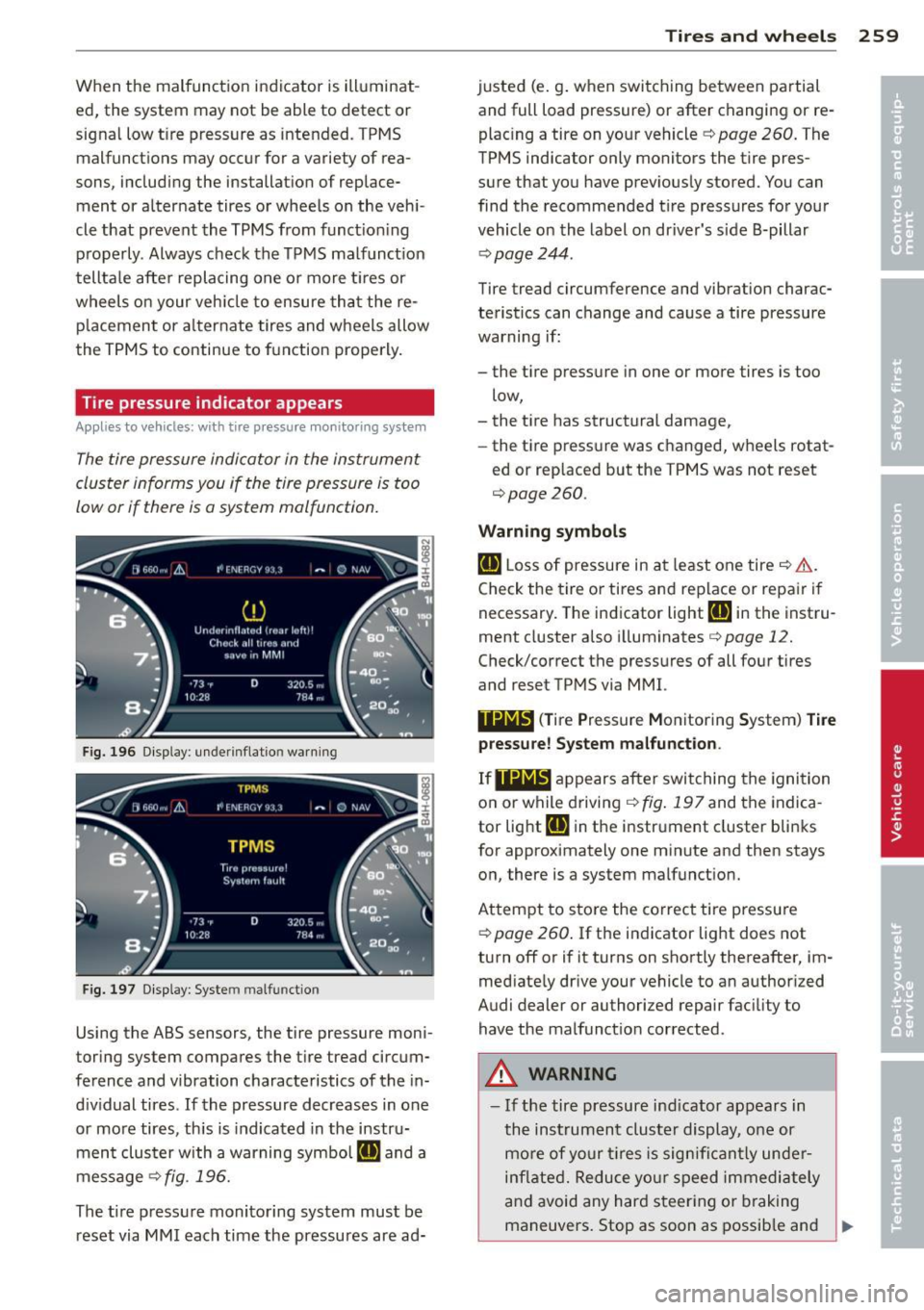
The tire pressure indicator in the instrument
cluster informs you if the tire pressure is too
low or if there is a system malfunction.
Fig. 196 Display : underinflatio n warning
Fig. 197 Display : Syste m malfun ctio n
Using the ABS sensors, the tire pressure moni
toring system compares the tire tread circum
ference and vibration characteristics of the in
dividual tires . If the pressure decreases in one
or more tires , th is is indicated in the instru
ment cluster with a warning symbol
RE and a
message
¢fig . 196.
The tire pressure monitoring system must be
reset via MMI each time the pressures are ad-
Tires and wheels 259
justed (e.g. when switching between partial
and full load pressure) or after changing or re
plac ing a tire on your vehicle¢
page 260. The
TPMS indicator only monitors the tire pres
sure that you have previously stored. You can
find the recommended tire pressures for your
vehicle on the label on dr iver's side B-pillar
~page 244.
Tire tread circumference and vibration charac
teristics can change and cause a tire pressure
warning if :
- the tire pressure in one or more tires is too
low,
- the tire has structural damage,
- the tire pressure was changed, wheels rotat-
ed or replaced but the TPMS was not reset
¢page 260.
Warning symbols
RE Loss of pressure in at least one tire¢.&. .
Check the tire or tires and replace or repair if
necessary. The indicator light
RE in the instru
ment cluster also illuminates
¢ page 12.
Check/correct the pressures of all four tires
and reset TPMS via MMI.
11;;~, ( T ire Pressure Monitoring System) Tire
pressure! System malfunction.
If11NIS, appears after switching the ignition
on or while driving¢
fig. 197 and the indica
tor light
RE in the instrument cluster blinks
for approximately one minute and then stays
on, there is a system malfunction.
Attempt to store the correct tire pressure
¢
page 260 . If the indicator light does not
turn off or if it turns on shortly thereafter, im
mediately drive your vehicle to an authorized
Audi dealer or authorized repair facility to have the malfunction corrected .
A WARNING
-If the tire pressure ind icator appears in
the instrument cluster display, one or
more of your tires is significantly under
inflated. Reduce your speed immediately
and avoid any hard steering or braking
maneuvers. Stop as soon as possib le and .,.
Page 262 of 306

260 Tire s and wheel s
check the tires and their pressures. In
flate the tire pressure to the proper pres
sure as indicated on the vehicle's tire pressure label
c> page 244. Driving on a
significantly under-inflated tire causes
the tire to overheat and can lead to tire
failure. Under-inflation also is likely to impair the vehicle's handling and stop
ping ability.
- T he driver is responsible for ma inta ining
the correct tire pressures. You must check the t ire pressures regular ly .
- Under certain cond itions (such as a spor
ty driving s tyle, win ter condit ions or un
paved roads), the pressure monitor indi
cator may be de layed .
- Ask your author ized Audi dealer if r un
flat tires may be used on your vehicle .
You r vehicle regist ration becomes invalid
if yo u use these tires when not permit
ted. Damage to your veh icle or accidents
cou ld also resu lt.
- The tire pressure monitoring system
stops wor king when there is an ESC/ABS
malfunction .
- Using snow chains may result in a system
malfunction.
- The tire pressure monitoring system on
your A udi was developed using tires with
the "AO" or "RO" identif ication on the
tire sidewall <:>page 251. We recom
mend using these t ires.
Reset tire pressure monitoring system
App lies to vehicles: with tire pressure monito ring system
If the tire pressure is adjusted, wheels are ro
tated or changed, the TPMS must be reset via
MMI.
., Switch on the ignition .
., Se lect in the MMI: !CAR !function button>
(Car )* syst ems contro l butto n > Serv icing &
checks > Tire pres sure mon itoring > Store
tire pre ssure s> Yes, store n ow .
(D Tips
Do not store the tire pressure if there are
snow cha ins on the tire .