2013 AUDI A5 CABRIOLET child lock
[x] Cancel search: child lockPage 171 of 290

belts,<:!) page 140, Airbag system and
i=> page 161, Important things to know.
A WARNING
If exceptional circumstances require the
use of a forward-facing child restraint on
the front passenger's seat, the child's safe
ty and well-being require that the follow ing special precautions be taken:
- Make sure the forward-facing seat has
been designed and certified by its manu
facturer for use on a front seat with a
passenger front and side airbag.
-Always follow the manufacturer's in
structions provided with the child safety
seat or infant carrier.
- Always move the front passenger seat in
to the rearmost position of the passen
ger seat's fore and aft adjustment range,
and as far away from the airbag as possi
ble before installing the child restraint.
- Always make sure that nothing prevents
the front passenger's seat from being
moved to the rearmost position in its
fore and aft adjustment range.
- Always make sure the backrest is in an
upright position.
- Make sure that the
PASSENGER AIR BAG
OFF
light comes on and stays on all the
time whenever the ignition is switched
on.
- If the light does not stay on, perform the
checks
q page 151, Monitoring the Ad
vanced Airbag System.
- Take the child restraint off the front pas
senger seat and install it properly at one
of the rear seat positions if the
PASSEN
GER AIR BAG OFF
light does not stay on
whenever the ignition is switched on.
-
Child Safety 169
Booster seats and safety belts
Properly used booster seats can help protect
children weighing between about 40 lbs . and
80 lbs . (18 kg and 36 kg) who are less than 4
ft. 9 in. (57 inches/1.45 meters) tall.
Fig. 162 Rear seat: c hild p roperly restrained in a boos
ter seat
The vehicle's safety belts alone will not fit
most children until they are at least 4 ft. 9 in .
(57 inches/1.45 meters) tall and weigh about
80 lbs.
(36 kg). Booster seats raise these chil
dren up so that the safety belt will pass prop
erly over the stronger parts of their bodies and the safety belt can help protect them in a
crash.
.,. Do not use the convertible locking retractor
when using the vehicle's safety belt to re
strain a child on a booster seat.
.. The shoulder belt must lie as close to the
center of the child's collar bone as possible
and must lie flat and snug on the upper
body .
It must never lie across the throat or
neck . The lap belt must lie across the pelvis
and never across the stomach or abdomen .
Make sure the belt lies flat and snug. Pull on
the belt to tighten if necessary .
.,. Secure unused safety belts on the rear seat
r:1;>page 166 .
Children up to about 40 lbs. (18 kg) are best
protected in child safety seats designed for
their age and weight. Experts say that the
skeletal structure, particularly the pelvis, of
these children is not fully developed, and they
must not use the vehicle safety belts without
a suitable child restraint.
Page 173 of 290

-If the PA SS ENGER AIR BAG O FF light
does not come o n an d stay on, perform
the checks described
c:> page 151, Moni
toring the Advanced Airbag System .
-Take the child restraint off the front pas
senger seat and install it properly at one
of the rear seat positions if the
PAS SEN
GER AIR BAG OFF
light does not stay on
whenever the ignition is switched on.
- Always read and heed all WARNINGS
whenever using a child rest rained in ave
hicle is being used
c:> page 132, Safety
belts,
c:> page 140, Airbag system and
c:> page 161, Important things to know.
Installing a child safety
seat
Securing a child safety seat using a
safety belt
Safety belts for the rear seats and the front
pas senger's seat can be locked with the con
vertible locking retractor to properly secure
child saf ety seat s.
The safety belts eme rgency lock ing re tracto rs
for the re ar seats safety belts and for the
front passenger 's seat sa fety belt have a con
ve rtible locking retractor for child restraints.
The safety belt must be locked so that belt
webbing cannot unreel. The retractor can be
activated to lock the safety belt and prevent
t he safety belt webbing from loosening up
during normal driving . A child safety seat can
only be properly installed when the safety belt
i s locked so tha t the child and ch ild safety
seat will stay in place.
Always remember: Even though your veh icle is
equ ipped w it h an Advanced A irbag system, all
chi ld ren , espec ia lly those 12 yea rs and yo ung
e r, should always ride in the back seat proper
l y rest rained for thei r age and weig ht.
~ WARNING
Improperly insta lled child sa fety seats in
crease the risk of ser ious personal inju ry
and death in a collision.
Child Sa fet y 1 71
-Always ma ke sure that the safety be lt re
tractor is locked when insta lling a child
safety seat. An unlocked safety belt re
tracto r cannot hold the child safety seat
in place dur ing no rma l dr iving o r in a
crash .
- Always buckle the child safety seat firmly
in place even if a ch ild is not sitt ing in it .
A loose child safety seat can fly around
du ring a s udden stop or in a collision.
- If t he backrest is not securely latched,
the child and the child res traint will be
thrown fo rward togethe r with the bac k
rest and wi ll stri ke par ts of the ve hicle
interior. The child can be seriously i n
jured or killed .
- Never install rearwa rd -fac in g ch ild safety
seats or infant ca rrie rs on the front pas
senger seat . A child will be serio usly in
jured and can be killed when the passen
ger airbag inflates .
- The inflating airbag will h it the ch ild
safety seat or infant carrier with great
force and will smas h the child safety seat
and child against the backrest, center
armrest, doo r or roof .
- Always install rearward-facing chi ld safe
ty seats or infant carriers on the rea r
seat.
- Forward-facing child safety seats or in
fant carriers installed on the front pas
senger's seat may interfer e with the de
ployment of t he a irbag and cause serious
in jur y to the child.
- I t is safer to install a forwa rd-facing
child safety seat on t he rear seat.
- Always read a nd heed a ll WAR NIN GS
wheneve r us ing a chi ld restrained in ave
hicle is being used
c:> p age 161. Special
prec autions apply when instal ling a child
safety seat on the fron t passenger seat
c:> page 141, Child restraints on the front
seat -some important things to know.
A WARNING
A lways take specia l precautions if you
must install a forward or rearward-facing •
•
Page 175 of 290

Activating the convertible locking retractor
Use the convertible locking retractor to se
cure a child restraint .
Always heed the child safety seat manufactur
er's instructions when installing a child re
straint in your vehicle. To activate the conver
tible locking retractor :
"" Place the child restraint on a seat, prefera
bly on the rear seat.
.. Slowly pull the belt
all the way out.
.. Route it around or through the child re
straint belt path¢.&_ .
.. Push the child safety seat down with your
full weight to get the safety belt really tight.
.. Insert the belt tongue into the buckle for
that seating position .
.. Guide the sa fety belt back into the retractor
until the belt lies flat and snug on the child
safety seat .
.. You should hear a "clicking " noise as the
belt winds back into the inertia reel. Test the
convertible locking retractor by pulling on
the belt. You should no longer be able to
pull the belt out of the retractor. The con
v ertible locking retractor is now activated.
.. Make sure that the red release button is fac
ing away from the child restraint so that it
can be unbuckled quickly .
"" Pull on the belt to make sure the safety belt
is properly tight and fastened so that the
seat cannot move forward or sideways more
than one inch (2.5 cm).
A WARNING
Using the wrong child restraint or an im
properly installed child restraint can cause
serious personal injury or death in a crash.
- Always make sure that the safety belt re-
tractor is locked when installing a child safety seat. An unlocked safety belt re
tractor cannot hold the child safety seat in place during normal driving or in a
crash .
- Always buckle the child safety seat firmly
in place even if a child is not sitting in it.
-
Child Safety 173
A loose child safety seat can fly around
during a sudden stop or in a crash.
- Always make sure the seat backrest to
which the child restraint is installed is in
an upright position and securely latched
into place and cannot fold forward . Oth
erwise, the seatback with the child safety
seat attached to it could fly forward in
the event of an accident or other emer
gency situation.
- Always read and heed all WARNINGS
whenever using a child restrained in ave
hicle is being used¢
page 161. Special
precautions apply when installing a child
safety seat on the front passenger seat
¢ page 141, Child restraints on the front
seat -some important things to know .
Deactivating the convertible locking
retractor
T he convertible locking retractor for child re
straints will be deactivated automatically
when the bel t is wound oil the way bock in to
the retractor .
.. Press the red button on the safety belt
buckle. The belt tongue will pop out of the
buckle .
.,. Guide the safety belt all the way back into
its stowed position .
Always let the sa fety belt retract completely
into its stowed position . The safety belt can
now be used as an ordinary safety belt with
out the convertible locking retractor for child
restraints.
If the convertible locking retractor should be
activated inadvertently, the safety belt must be unfastened and guided completely back in
to its stowed position to deactivate this fea
ture.
If the convertible locking retractor is not
deactivated , the safety belt will gradually be-
come tighter and uncomfortable to wear.
11>
•
•
Page 176 of 290

174 Child Saf ety
A WARNING
Improperly installed child safety seats in
crease the risk of ser ious personal injury
and death in a collision .
- Never unfasten the safety belt to deacti
vate the convert ible lock ing retractor for
child rest raints while the veh icle is mov
ing. You would not be rest rained and
c ou ld be ser iously injured in an ac cident.
- Always read and heed all WARNI NGS
whenever using a child rest rained in ave
hicle is being use d
¢page 161. Spe cial
precautions apply when installing a ch ild
sa fety seat on the front passenger seat
¢ page 141, Child restraints on the front
seat -some important things to know.
Page 179 of 290
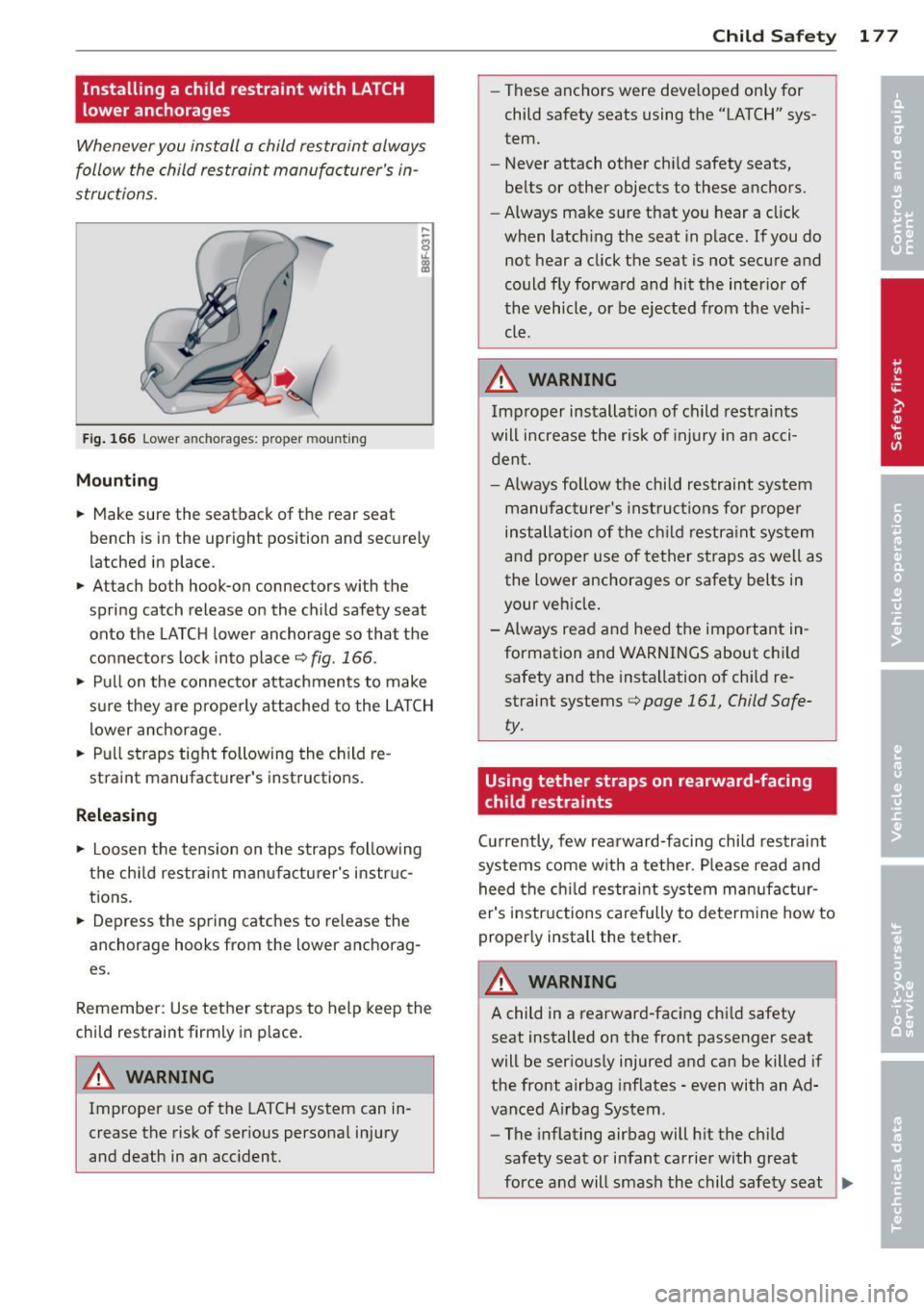
Installing a child restraint with LATCH
lower anchorages
Whenever you install a child restraint always
follow the child restraint manufacturer's in
structions.
F ig . 166 Lower anchorages: proper mounting
Mou nting
~ Make sure the seatback of the rear seat
bench is in the upright position and securely
latched in place.
~ Attach both hook-on connectors with the
spring catch release on the child safety seat
onto the LATC H lower anchorage so that the
connectors lock into p lace
c::> fig. 166 .
~ Pull on the connector attachments to make
s u re they are properly attached to the LATCH
lower anchorage.
~ Pull st raps tight following the child re
straint manufacturer's instructions.
Re leasing
~ Loosen the tension on the straps follow ing
the chi ld restraint manufacturer's instr uc
tions.
~ Depress the spring catches to re lease the
anchorage hooks from the lower anchorag
es.
Remember: Use tether straps to help keep the
child restraint firmly in p lace.
A WARNING
Improper use of the LATCH system can in
crease the risk of ser ious personal injury
and death in an acc ident.
Child S afety 177
- These anchors were deve loped only for
child safety seats using the "LATCH" sys
tem.
- Never attach other chi ld safety seats,
belts or other objects to these anchors.
- Always make sure that you hear a click
when latch ing the seat in p lace. If you do
not hear a click the seat is not secure and
could fly forward and hit the interior of
the vehicle, or be ejected from the veh i
cle .
A WARNING
Improper installat ion of ch ild rest ra ints
will increase the risk of injury in an acci
dent.
- Always follow the child restraint system
manufacturer's inst ruct ions for prope r
installation of the ch ild restra int system
and proper use of tether s traps as well as
the lower anchorages or safety belts in
your vehicle.
- Always read and heed the important in
formation and WARNINGS about chi ld
safety and the insta llation of chi ld re
straint systems
c::> page 161, Child Safe
ty.
Using tether straps on rearward-facing
child restraints
-
Currently, few rearward-facing chi ld restraint
systems come w ith a tether . Please read and
heed the ch ild restraint system manufactur
er's instructions carefully to determine how to
properly install the tether.
A WARNING
-
A child in a rearward-fac ing chi ld safety
seat installed on the front passenger seat
will be ser iously injured and can be killed if
the front airbag inflates - even with an Ad
vanced Airbag System .
- The inflating airbag will h it the ch ild
safety seat or i nfant carrier with great
force and will smash the child safety seat
11>-
Page 223 of 290

scalding from hot coo lant by following
these steps.
- Turn
off the engi ne and a llow it to cool
down.
- Protect your face, hands and arms from
escapi ng fl uid and steam by cover ing
the cap with a large, thick rag .
- Turn the cap slowly and very ca refully
i n a cou nte r-clockw ise dir ect ion while
a pply ing lig ht, downwa rd p ress ure on
the top of the cap.
- T o avo id being burned, do no t sp ill an
tifree ze o r coolan t on t he exh aust sys
tem or ho t engine parts . Un der certain
conditions, the ethylene glyco l in en
gine coolant can catch fire .
- Antifree ze is poisono us. Always store an
tifreeze in its or iginal co ntainer and we ll
o ut o f the reac h of children.
- If you drain the coolant , it must be
caught and safely stored in a p roper con
tainer clear ly marked "poison".
(D Note
- Coolant po llutes the env ironment and
could ca use a n engine fire . Excess coo l
ant wi ll be forced out through the pres
sure re lief va lve in the cap when the en
gine becomes hot.
- If, in an emergency, only water can be
added , the correct ratio between water
and antifreeze¢
page 219 must be re
stored as soon as possib le .
@ For the sake of the environment
Drained coolant should not be re used . Al
ways dispose of used c oolant while observ
ing all envir onmental regulations .
Radiator fan
The radiator fan switches on automa tically by
itself
T he radiator fan is driven by the engine via the
V-be lt. The viscous clutch regulates the speed
of the fan according to the temperature of the
coolant .
Checkin g and fillin g 221
An auxiliary electric radiato r fan* sw itches on
and
off depending on coolant temperature
and othe r vehicle ope rat ing con ditions.
After yo u switc h the engi ne off, the aux iliary
f an can con tinue r unning for up to 10 minutes
- even with the ignition off. It can even switch
on again later by itself¢ & , if
- t he temperatu re of the engine coo lant rises
due to the heat b uild -up from the en gine in
the engi ne compartment, or
- the engine compartment heats up be cause
the vehicle is parked in intense sunlight.
A WARNING
- To reduce the risk of personal in jury nev
er touch the radiator fan.
- The a uxiliary electric fan is temperat ure
contro lled and can switch on sud denly
even when the engine is not running.
- The a uxiliary radiator fa n switches on a u
tomatically when the engine coo lant
reaches a certain temperature and will
continue to run until the coo lant temper
ature drops .
Brake fluid
Checking brake fluid level
The brake fluid level can be checked with a
qui ck glance.
Fig. 17 9 En gin e compar tment: Cover o n the brak e flu
i d reservoi r
Before you check anyth ing in the eng ine com
partment ,
always re ad and heed all WARN
INGS c::> ,& in Working in the engine compar t-
ment on page 212 . .,..
Page 224 of 290

222 Check ing and filling
• Read the brake fluid leve l from the brake
fluid reservoir ¢
fig. 179, ¢ fig. 175. The
brake f lu id leve l must be between the "MIN"
and "MAX" markings.
The brake fluid reservoir is located at the rear partition of the engine compartment on the
left side ¢
page 214 .
The fluid level may drop slightly after some
time due to the automatic adjustment of the brake pads . This is not cause for alarm .
I f the brake fluid level falls
considerably be
l ow the "MIN" mark, the brake wa rning/indi
cator light (U .S . mode ls:
1111 , Canadian
models :. ) will come on
¢ page 15. Do not
continue to operate the vehicle. The complete brake system should be thoroughly checked
by an authorized Audi dealer or qualified
workshop and the cause corrected . If the
brake fluid level is too low, the b rake war ning/
i ndicato r light w ill illuminate . Contact an au
thor ized Audi dealer
imm ediately .
@ Tips
The brake f lu id reservoir is located unde r
neath the cove r.
Changing brake fluid
Have the brake fluid changed by an experi
enced technician .
Brake fluid absorbs moisture from the a ir . If
the water content in the brake fluid is too
h igh, corrosion in the brake system may result
after a per iod of t ime . The bo iling po int of the
b rake fluid w ill also decrease considerably and
dec rease braking per formance.
Therefore, the brake flu id must be changed
e ver y two ye ars. A lways use new b rake fluid
which confo rms to Fede ral Motor Vehicle
S tanda rd "FMVSS 116 DO T 4".
The brake flu id reservoir can be difficult to
r each, therefo re , we recommend that yo u
have the brake fl uid changed by yo ur au tho r
i z ed
Audi dealer . Your dealer has the co rrec t tools, the
right brake flu id and t he know -how
to do this for you.
A WARNING
'-
- Brake flu id is poisonous. It must be stor-
ed only in the closed or igina l container
out of the reach of children!
- Brake failure can res ult from o ld or inap
propriate brake f lu id. Observe these pre
cautions:
- Use only brake f luid that meets SA E
spe cifi cat ion
J 17 03 and conforms to
Federa l Motor Vehi cle Standard 1 16.
Always chec k with yo ur authorized A udi
dealer to make sure yo u are using the
correct brake fluid. The cor rect type of
brake flu id is also ind icated on the
brake f lu id reservoir.
- The brake fluid must be new. Heavy use
of the brakes can cause a vapor lock if
the brake fluid is left i n the system too
long . This can se riously affect the effi
c iency of the brakes as well as your
safety . T his could result in an accident.
W Note
Brake fluid will damage the pai nt of you r
vehicle .
@ For the sake of the environment
Because of the prob lem of proper disposal
of brake fluid as well as the spec ial too ls
r equired and the necessary expertise, we
r ecommend that yo u have the brake flu id
changed by yo ur autho rized Aud i dea le r.
Battery
General information
U nder normal operat ing cond itions, the bat
te ry in your Audi does not need any ma inte
nance. With
high outside temperatu res or
long da ily drives we recommend that you have
the e lectrolyte leve l che cked by an autho riz ed
A udi dealer or qu alified workshop. The elec
tro ly t e level should also be checked e ach time
the battery is charged
¢ page 225. ...
Page 276 of 290

274 Index
A
Accessories . . . . . . . . . . . . . . . . . . . . . . . . 2 71
Active rollover p rotection system ... .. . 130
Retract ing ro llover protection . . . . . . . . 13 1
AC (automatic climate control) ... .. .. .. 71
Adapt ive cruise control . . . . . . . . . . . . . . . . 94
C leaning sensors/camera . ... .. .... . 198
Messag es . .... .. ..... ... .. .. .... . 101
Request for dr iver intervention . . . . . . . . 99
Setting the driving program .. .. .. .. . . 99
Adapt ive dampers .......... .... .... . 107
Adapt ive light ................ ... .... 52
Adaptive Lig ht (defective) ... .. .. .... .. 22
Adding Eng ine coolant ................... .
E ng ine oil . .... .. ..... ... .. .. .... .
Windshield washer fluid ... .. .. .... .
Addit ional accessories
Addit ives 220
21
7
226
271
Eng ine oil .. ............. .. .. .. .. . 217
Ad justab le steering column . ... .. .... .. 75
Adjusting Air dist ribution (automatic climate con -
trol) . .. .. .. ............. .. .. .... .. 72
I ns trument illum inat ion . .. .. .. .. .. .. S5
Steering column .. ..... ... .. .. .... .. 75
Temperature (automatic climate control) 72
A irbag
War ning/ indicato r ligh ts ... .... .... .. 20
A irbag system . . . . . . . . . . . . . . . . . 140, 159
Advanced Airbag System ........ ... . 144
Advanced Airbag System components . 147
Care . .. .. ... ....... ........ ..... . 153
C hil dren . ............... .. .. .. .. . 162
Ch ild restr aints ........... .. .. .. .. . 163
Components (front airbags) .. .... .. . 1 47
Danger of fitting a child safety seat on
the front passenger seat . . . . . . . . . . . . 141
Disposal . .... ........... .. .. .... . 153
Front airbags . . . . . . . . . . . . . . . . 144, 145
H ow do the front airbags work? . . . . . . 149
H ow many airbags does my vehicle
have? .... ................... ... . 147
H ow the Advanced Airbag System com-
po nents work together ............. 148
I mpor tan t safety instructions on the
knee airbag system .. ... .. .. .. .... . 15 7 Important things to know ....
.... . .. 140
Indicator light ... .. ... ..... ... .. .. 151
Knee airbags ... .. ... .. ..... ... .. .. 155
Monitoring .... .. ............. .... 151
PASSENGER AIR BAG OFF light ....... 151
Repairs ......... .. .............. . 153
Safety instructions ..... ....... ... .. 153
S ide a irbags . .. .. .......... ....... 158
We ight-sensing mat ........... .. .. 162
When m ust t he system be inspected? . 151
all-wheel drive .. .. .......... ....... 184
Alloy wheels . ..... .. .... .... ... .. .. 200
All wheel d rive
Winter tires . .. .. .. ........... .. .. 242
Alternator
refer to Generator . . . . . . . . . . . . . . . . . . 17
Anti-freeze
refer to Engine coolant system ....... 219
An ti-lock brak ing system ............. 179
Warning/ind icator lights ..... ... .. .. . 19
An ti-slip regulation ................ . 179
Anti -theft alarm warning system ... .. .. . 31
Anti-theft systems El ectronic immob il iz er .......... .. .. . 37
Armrest .......... .. .............. .. 64
Ashtray . ... .... .. ... .. .. ..... .. . .. . 66
Aste risk
What does it mean when something is ma rked wit h an aster is k? . . . . . . . . . . . . . . 6
Audi braking guard
refer to b rak ing guard ............... 94
Audi drive select .. .. ................ 107
Adaptive dampers ............. .... 107
Description .. ... . ... ... .... ... .. .. 107
Dynam ic steering . ................ . 107
Setting the dr iv ing mode ........... . 108
Spo rt diffe rential .............. .... 10 7
Audi Serv ice Repair Manuals and Litera-
ture .............................. 269
AUTO Automatic climate control . . . . . . . . . . . . 72
Automat ic head lights . . . . . . . . . . . . . . . 52
A ut o Lock . . . . . . . . . . . . . . . . . . . . . . . . . . 31
Automat ic be lt retractor . ....... ... .. 136
Automatic car wash
refer to Washing ... ... ..... ... .. .. 195