2013 AUDI A4 SEDAN tow
[x] Cancel search: towPage 199 of 294

Tire pressure
When towing a trai le r, inflate the t ires of your
vehicle to the co ld tire pressure listed under
"Full load" on the label located on the driver's
side B-pillar (vis ible when the door is open).
Inflate trailer tires to trailer and tire manufac
turers' specifications.
Light s
The headlight settings should be checked with
the trailer attached before driving off. Check
to make sure both vehicle and trai ler lights
are working properly.
Safety chains
Be su re tra iler sa fety chains are properly con
nected from the trailer to the hitch on the ve
hicle. Leave enough slack in the chains to per
mit turning corners . When you install safety
chains, make sure they w ill not drag on the
road when you are driving.
The chains shou ld cross under the trai ler
tongue to prevent it from dropping in case of
separatio n from the hitch .
Driving instructions
Driving with a trailer always requires extra
core and consideration.
To obtain the best possible handling o f vehicle
and trai ler, p lease note the following:
.,. Do not tow a loaded trailer whe n your car it
self is not loaded .
.,. Be especia lly careful when passing other
vehicles .
.,. Observe speed limits .
.,. Do not drive at the maximum permissible
speed .
.,. Always apply brakes ea rly .
.,. Monitor the temperature gauge.
Weight di stribution
Towing a loaded trai ler with an empty car re
sults in a highly unstable distribution of
weight . If this cannot be avo ided, drive at very
low speeds only to avoid the risk of losing
steer ing control.
Trailer towing 197
A "balanced" rig is easier to operate and con
trol. This means that the tow vehicle should be loaded to the extent possible and permissi
ble, while keep ing the trailer as light as possi
ble under the c ircumstances. Whenever poss i
ble, transfer some cargo to the luggage com
partment of the tow vehicle while observing
tongue load requirements and vehicle loading
considerations.
Speed
The higher the speed, the more d iff icult it be
comes for the driver to control the rig . Do not
drive at the maximum permissible speed. Re
duce your speed even more if load, weather or
wind conditions are unfavorable -pa rticularly
when going downhill.
Reduce veh icle speed
immediately if the trail
er shows the slightest s ign of sway ing .
Do not
try to stop the swaying by accelerating.
Observe speed limits . In some areas, speeds
for vehicles tow ing tra ilers are lower than for
regular vehicles .
Always apply brakes early. When driving downh ill, shift into a lower gear to use the en
gine braking effect to slow the vehicle . Use of
the brakes alone can cause them to overheat
and fail.
Coolant temperature
The coolant temperature gauge ¢ page 10
must be observed carefully . If the need le
moves close to the upper end of the scale, re
duce speed immediately and/or turn off the
air conditioner.
If the coolant temperature warning light •
in the instrument cluster starts flashing, pull
off the road, stop and let the engine
idle for
about two minutes to prevent heat build -up .
A WARNING
Anyone not properly restrained in a mov
ing vehicle is at a much greater risk in an
accident . Never let anyone ride in yo ur car
who is not properly wearing the restraints
prov ided by Audi.
-
•
•
Page 200 of 294

198 Trailer towing
Trailer towing tips
Important to know
Your vehicle hand les different ly when tow ing
a trailer because of the addit ional weight and
different weight distribution . Safety, perform
ance and economy wi ll greatly depend on how
carefully you load your trailer and operate
your rig.
Before you actually tow your trailer, practice
turning, stopp ing and backing up in an area
away from traffic. Keep practicing until you have become completely familiar with the way
your veh icle-trailer combination behaves and
responds.
Backing up is difficult and requires practice.
Backing up with a trai ler generally requires
steering action opposite to that when backing
up your vehicle without a trailer.
Maintain a greater distance between your ve
hicle and the one in front of you. You will need
more room to stop. To compensate for the
trailer, you will need a larger than normal
turning radius .
When passing, remember that you cannot ac
celerate as fast as you normally would be
cause of the added load. Make sure you have
enough room to pass . After passing, allow
plenty of room for your tra iler before chang
in g lanes again.
Avoid jerky starts, sharp turns or rapid lane
changes.
(D Tips
- Do not tow a tra iler dur ing the break-in
period of your vehicle.
- If you tow a trailer, your Audi may re
quire more frequent maintenance due to
the extra load
q page 2 72.
Parking on a slope
Do not park on a slope with a trailer . If it can
not be avoided, do so only after doing the fol lowing :
When parking:
.. App ly the foot brake.
.. Have someone place chocks under both the
vehicle and the trailer wheels .
.,. With chocks in place, slowly release the
brakes until the wheel chocks absorb the
load.
.. Tur n the wheels towards the curb.
.. App ly the parking b rake.
.. Place an automatic transmission* in P, re
spectively a manual transmission in first or reverse gear.
When restarting after parking:
.. App ly the foot brake .
.. Start the engine.
.. Move the se lector lever to D/S, respectively
a manual transmission in first gear.
.. Release the parking brake and slow ly pu ll
out and away from the wheel chocks.
.. Stop and have someone retr ieve the wheel
chocks .
(D Tips
If you move the selector lever of the auto
matic transmission* to P before applying
the parking brake and before blocking the
whee ls, you may have to use more force
lat er to move the lever out of the P posi
tion.
Page 205 of 294
If a spot starts to rust, however , a simple
touch-up job will not be enoug h. The affected
surface must be sanded smooth and coated
with an anti -rust pr imer before the painted
finish can be restored.
The number for the origina l vehicle paint can
be found on the vehicle ident ification labe l
<=:>page 268.
A WARNING
Always read and heed all WARNINGS and
other information
c::> page 199 .
Windows
Clear vision to all sides.
Clean all windows regularly to remove road
fi lm and car wash wax b uildup .
.,. Remove snow from windows using a brush .
.,. Use a plast ic ice scraper to remove ice from
windows and mirrors .
.,. Remove other residue on the windows with
a spray •on glass cleaner .
.,. Wipe the windows dry with a clean piece of
cloth or kitchen paper towel.
The best way to remove snow from windows
and mirrors is to use a brush. Use a non-abra
sive
pl astic ice sc ra p er -better still, a spray
de icer -to remove
ic e from windows and mir
rors .
The windows must not be cleaned with insect
remover or wax since these can interfere with
the function of the windshield wiper blades
(chatter) .
Oi l, grease, o r silicone residue can be removed
with
glass cleaner or silicone remo ver . How
ever, wax residue requires the use of a special
ly formulated solvent . Please contact your au
thor ized Audi dealer for adv ice on safe prod
ucts for wax removal.
W indows should also be cleaned on the inside
at regular intervals.
Never dry w indows with the same chamois
that you use to dry painted surfaces. Wax resi-
Cleaning and protec tion 203
due on the chamois can impair vis ion through
the windows .
A WARNING
-Always read and heed all WARNINGS and
other information
c::> page 199.
-The windshield must not be treated with
water-repellent materials. They can in
crease glare under poor v is ibility condi
tions such as wetness, darkness, or when
the sun is low on the hor izon. In addi
tion, they can cause the w indshield w ip
ers to chatter.
(D Note
- Never use warm o r hot water to remove
snow and ice from w indows and mirrors.
Th is could cause the glass to crack.
- To prevent damage to the wires of the
rear defogger, do not place any adhesive
st ickers on t he ins ide of the rear w indow
over the wires .
- T o help prevent dirt from scratch ing the
w indow, always sc rape in a forward di
rec tion -pushing the sc raper away from
yo u -never bac k and forth.
- Wate r lea king from the i nside of the rear
w indows may damage sens itive e lec trica l
c omponents located ei ther under the
rear parcel shelf or in the rear trunk area .
Always ensure that water never leaks
through the body section of the vehicle.
Yo u can do th is by using waterproof pro
tection over the vehicle's electrical com
ponents (e .g. when instal ling window
tint ing) .
- Damage or malfunction of electrical
compone nts due to water damage or any
other outside influence is not covered by
the Audi New Ve hicle Limited War ranty.
See you r Wa rranty
& M ain tenance boo k
let for addit ional detai ls about your war
ranty.
•
•
Page 209 of 294
(D Note
-To keep your leathe r from bleaching out,
do not a llow it to be exposed to bright
sunlight for long periods of time. If you have to leave the vehicle parked outside
for long periods, cover the leather to protect it from d irect exposure to sun
l ight .
- Sharp objects on clothing, such as zip pers, rivets or sha rp pieces on belts can
l eave pe rmanent scratches o r scrape
mar ks on the surface of the leather.
@ Tips
- After each time you clean the leathe r and
at reg ular i nte rva ls, use a leather prese r
vat ive cream th at co ntains UV-blo ckers
and th at wor ks into the leather. This
cream will no urish and moistur ize the
l eather, helping it to breathe and stay
supple . It also helps to b uild up a protec
tive coat ing on the surface.
- Clean the leather every 2 - 3 months,
and clean any areas that get soiled.
- Remove fresh marks made by ba llpoint
pens, in k, lipst ick, shoe polish, etc . as
soon as possib le.
- Preserve the color of the leather as need
ed by using a special colored leather care
cream to touch up areas of uneven color.
Cleaning and caring for leather
upholstery and trim
Applies to vehicles: with natural leather
Natural leather requires special care and at
tention .
Normal cleaning
.,. Clean soiled areas w it h a slightly mo istened
cotton or woolen cloth.
More stubborn dirt
.,. More stubbo rn dirt can be removed using a
cl oth saturated with a m ild soap so lution ( 2
tablespoons mi ld liquid soap) .
Cleaning and protec tion 207
.,. Never allow the soap sol ution to sa turate
the leather, and make certain that no water
soaks into the seams .
.,. Wipe
off the soap so lution with a soft, dry
cloth.
Clean ing spots
.,. Remove fresh wate r-ba sed spots (such as
coffee, tea, juices, blood) with an absorbent
cloth or paper towel.
.,. Remove fresh
grease or oil -based spots
(such as butter, mayonnaise, chocolate) with
an absorbent clot h or pape r towel, or use
the cleaner from the leather care k it if the
spot has not yet penetrated into the surface
of t he leathe r.
.,. Use an oil/grease dissolving spray, if
oil /
grease spot s have dried on.
.,. Remove s pecific kinds of spots (ballpoint
pen, fe lt mar ker, fingernai l polish, water
based pa int, shoe po lish, etc.) with a spot
remover specifically formulated for leather.
Leather care
.,. Every ha lf year use an approved leather care
product (available from your authorized
Audi dea ler) to care for the leather .
.,. App ly the product very spar ingly.
.,. Wipe it
off with a damp cloth.
If you have any q uestions about cleaning and
caring for the leather in your vehicle, it is best
to contact your a uth orized Audi dea ler, who
will be g lad to help you and tell you about our
full range of leather care products, such as:
- Leather cleaning and care kit
- Creams to ca re fo r colored leather
- Spot removers for ballpoint pens, shoe pol-
ish, etc .
- Oil/grease d issolving spray
- New and upcom ing products .
_&. WARNING
Always read and heed all WAR NINGS and
other information
q page 199.
•
•
Page 240 of 294
238 Tires and wheels
-If the tire pressure is too low or too high,
the tires will wear prematurely and the
vehicle will not handle well.
- If the tire is not flat and you do not have
to change a wheel immediately, drive at
reduced speed to the nearest service sta
t ion to check the tire pressure and add
air as required.
(D Note
Driving without valve stem caps can cause
damage to the tire va lves. To prevent this,
always make sure that facto ry installed
valve stem caps on all wheels are securely mounted on the valve.
@ For the sake of the environment
Underinflated tires will also increase the
fuel consumption .
Tires and vehicle load limits
There are limits to the amount of load or
weight that any vehicle and any tire can carry.
A vehicle that is overloaded w ill not handle
well and is more difficult to stop. Overloading
can not only lead to loss of vehicle control,
but can a lso damage important parts of the
vehicle and can lead to sudden tire failure, in
cluding a blowout and sudden deflation that
can cause the vehicle to crash .
Your safety and that of your passengers a lso
depends on making sure that load limits are
not exceeded. Vehicle load includes everybody
and everything in and on the vehicle . These
load limits are techn ically referred to as the
vehicle's
Gross Vehicle Weight Rating
("GVWR").
The "GVWR" includes the weight of the basic
vehicle, all factory installed accessories , a full
tank of fuel , oi l, coolant and other fluids plus
maximum load. The maximum load includes
the number of passengers that the vehicle is
intended to carry ("seating capacity") with an
assumed weight of 150 lbs . (68 kg) for each
passenger at a designated seating position
and the tota l weight of any luggage in the ve- hide.
If you tow a trai ler, the weight of the
trailer hitch and the tongue weight of the loaded trailer must be included as part of the
vehicle load.
T he
Gross Axle Weight Rating ("GAWR") is
the maximum load that can be applied at each
of the vehicle's two axles .
T he Gross Vehicle Weight Rating and the
Gross Axle Weight Rating are listed on the
safety compliance sticker label located on the
driver's side B-pillar.Your Audi has 5 seating
positions, 2 in the front and 3 in the rear for
total seating capacity of 5. Each seating posi
tion has a seat belt <=>
page 136, Safety belts .
The fact that there is an upper limit to yo ur
vehicle's Gross Vehicle Weight Rating means
that the to tal weight of wha tever is being car
ried in the vehicle ( including the weight of a
tra iler hitch and the tongue weight of the
loaded trailer) is lim ited. The more passen
gers in the vehicle or passengers who are
heavier than the standard we ights assumed
mean that less we ight can be carried as lug
gage.
T he tire pressure label on your Audi also lists
the maximum combined weight of all of the
occupants and luggage or other cargo that
the vehicle can carry. For the location of the
label <=>page234 , fig.174.
A WARNING
-Overloading a vehicle can cause loss of ve-
hicle control, a crash or other accident, se
rious personal injury, and even death.
- Carrying more we ight than your vehicle
was des igned to carry will prevent the
veh icle from handling properly and in
crease the risk of the loss of vehicle con
trol.
- The brakes on a vehicle that has been
overloaded may not be able to stop the
veh icle with in a safe distance .
- Tires on a vehicle that has been overload
ed can fail suddenly, incl uding a blowout
and sudden deflation, causing loss of
con trol and a crash .
Page 241 of 294
-Always make sure that the total load be
ing transported - including the weight of
a trailer hitch and the tongue weight of a
loaded trailer -does not make the vehi
cle heav ier than the vehicle's Gross Vehi
cle Weight Rating.
Determining correct load limit
Use the example below to cal
culate the total weight of the
passengers and luggage or oth
er things that you plan to trans
port so that you can make sure
that your vehicle will not be
overloaded.
Steps for Determining Correct Load Limit
1. Locate the statement "THE
COMBINED WEIGHT OF OC
CUPANTS AND CARGO
SHOULD NEVER EXCEED XXX KG OR XXX LBS"on your vehi
cle's placard (tire inflation pressure label)
¢ page 234,
fig. 174.
2. Determine the combined
weight of the driver and pas sengers that will be riding in
your vehicle.
3. Subtract the combined
weight of the driver and pas sengers from
"XXX" kilo
grams or
"XXX" pounds
Tires and wheels 239
shown on the sticker
¢ page 234, fig. 174.
4. The resulting figure equals
the available amount of car
go and luggage load capaci
ty. For example, if the
"XXX"
amount equals 1400 lbs.
and there will be five
150
lbs. passengers in your vehi
cle, the amount of available
cargo and luggage load ca
pacity is
650 lbs. (1400-7 50
(5
X 150) = 650 lbs.)
5. Determine the combined
weight of luggage and cargo being loaded on the vehicle.
That weight may not safely
exceed the available cargo
and luggage load capacity
calculated in Step
4.
6. If your vehicle will be towing
a trailer, load from your trail
er will be transferred to your
vehicle. Consult this manual
to determine how this re duces the available cargo
and luggage load capacity of
your vehicle.
.,. Check the tire sidewall
(¢ page 241, fig. 178) to de
termine the designated load rating for a specific tire.
•
•
'
Page 253 of 294
What do I do now?
Vehicle tool kit
The tools ore stored underneath the floor
panel in the luggage comportment.
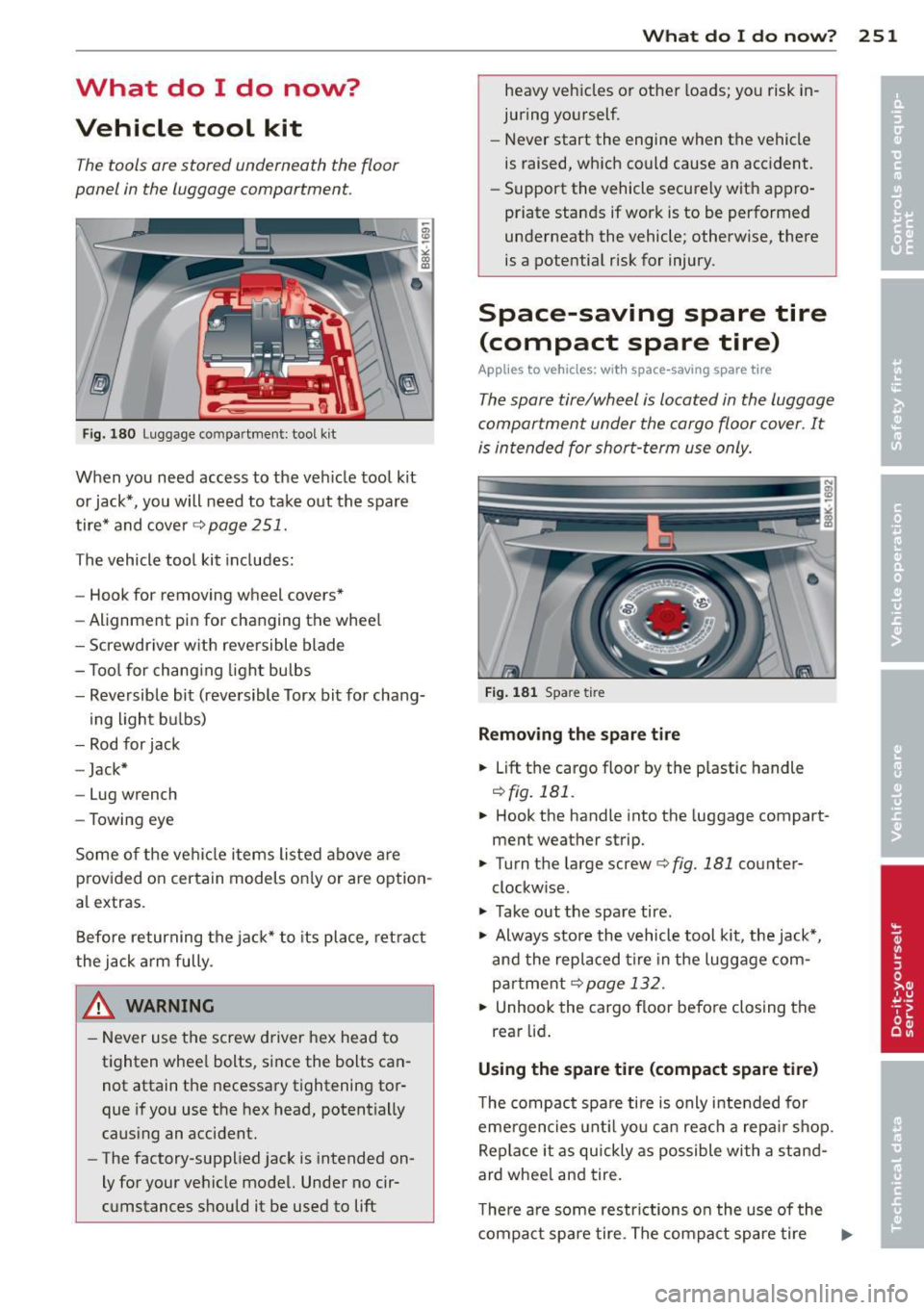
F ig . 180 Luggage compartment: tool kit
When you need access to the veh icle tool kit
or jack*, you will need to take o ut the spare
tire* and cover¢
page 251.
The vehicle tool kit includes:
- Hook for removing wheel covers*
- Alignment pin for changing the whee l
- Screwdriver w ith reversible blade
- T ool for chang ing light bulbs
- Reversible bit (reve rsible Torx bit for chang-
ing light b ulbs)
- Rod for jack
- Jack*
- Lug wrench
- Towing eye
Some o f the ve hicle items listed above are
p rov ided o n certain models on ly or are opt ion
a l extras.
Before returning the ja ck* to its place, ret ra ct
the jack a rm fully.
& WARNING
- Never use t he screw driver hex head to
tighten whee l bolts, since the bolts can
not attain the necessary tightening tor
que if yo u use the hex head, potentially
caus ing an accident.
- The factory-supplied jack is intended on
ly for your ve hicle model. Unde r no cir
c u mstances should it be used to
lift
What do I d o now ? 251
heavy ve hicles o r other loads; yo u risk in
juring yo urself.
- Never start the engi ne when the vehicle
is raised, which could cause an acc ident.
- Support the vehicle secu re ly wit h app ro
priate stands if wor k is to be performed
underneath the vehicle; otherwise, there
is a pote ntia l risk for injury.
Space-saving spare tire
(compact spare tire)
App lies to vehicles: wi th space -saving spare tir e
The spore tire/wheel is located in the luggage
comportment under the cargo floor cover. It
is in tended for shor t-term use only.
Fig. 181 Spare tire
Removing the spare ti re
.. Lift
th e ca rgo floo r by the p lastic handle
r:!) fig. 1 Bl.
.. Hook the handle into the luggage compart
ment weather strip.
.. Turn t he large screw ¢
fig. 181 counter
clockw ise.
.. Take out the spa re tire .
.. Always store the vehicle tool kit, the jack*,
an d the replaced tir e in the luggage com
par tme nt
¢page 132.
.. Unhook the cargo floor befo re closing the
rear lid .
Using the spare tire (compact spare tire)
The compact spa re ti re is only intended for
eme rgencies unt il yo u ca n reac h a repa ir sh op.
Rep lace i t as quickly as possible with a stan d
ard whee l and tire.
T he re a re some restr ictions o n the use of the
compact sp are tire. The compa ct spare tire
IJ>
Page 254 of 294

252 What do I do now?
has been designed specifically fo r you r type of
vehicle . It must not be swapped with a com
pact spare t ire from another type of veh icle.
Snow cha ins
F or technical rea son s, the use of snow chains
on the compact spare tire is
not p ermitt ed .
If you do have to dr ive with snow cha ins and a
front tire fails, mount the spare whee l w ith
tire instead of a rear t ire. Install the snow
cha ins on the rear tire and use it to rep lace
the defective front tire .
A WARNING
-Never use the spare tire if it is damaged
or if it is worn down to the tread wear in
dicators.
- If the spare tire is more than 6 years o ld,
use it only in an emergency and w ith ex
treme caution and careful driving.
- The spare tire is intended only for tem
porary and short-term use. It should be
replaced as soon as possib le w ith the
normal wheel and tire.
- After mounting the compact spare tire,
the tire pressure must be checked as
soon as poss ible. The tire pressure of the
compact spa re tire must be 4.2 bar; oth
erw ise, you risk hav ing an accident.
- Do not drive faster than SO mph (80 km/
h). You risk having an acc id ent.
-Avoid full-throttle acce le rat ion, heavy
braking, and fast corner ing . You risk hav
ing an acc ident.
- Never drive us ing more than one spare
wheel and tire. You risk having an acci
dent .
- Normal summer or winte r tires must not
be mounted on the compact spare whee l
rim.
- For technical reasons, the use of ti re
c hains on the spare tire is not permitted.
If it is necessa ry to dr ive wi th tire ch ains,
the spare whee l must be mounted on the
front axle in the event o f a f lat in a rear
t ir e. The newly ava ilable front wheel
must then be installed in place of the rear whee
l with the flat tire. Installing
the t ire cha in before mounting the whee l
and tire is recommended.
- Loose items in the passenger compart
ment can cause serious personal injury
during hard brak ing or in an accident.
Never store the inflatable spare tire or
jack and tools in the passenge r compart
ment.
Changing a wheel
Before changing a wheel
Observe the following precautions for your
own and your passenger's safety when chang
ing a wheel .
.,. After you experience a t ire failure, p ull the
car we ll away from moving traffic and try to
reach
level ground before you stop ¢ A .
.,. All passengers should lea ve the car and
move to a safe location (for instance, behind
the guardrail)¢
A.
.,. Engage the park ing brake to prevent your
ve hicle from rolling unintentionally ¢
A.
.,. Shift into 1st ge ar on veh icles with manual
transmiss ion, or move th e
selector lever to
the P positi on
on vehicles w it h automatic
transmiss io n.
.,. If you are towing a trai ler : u nhitch the trail
er from your vehicle .
.,. Take the
jack ¢ page 251 and the spare tire
¢ page 251 out of the luggage compart
ment.
A WARNING
You or your passengers could be injured
while changi ng a wheel if you do not fo l-
l ow these safety precaut ions:
- If you have a flat tire, move a safe d is
tance off the road. Turn off the engine,
tur n the eme rgency flashers on and use
o ther warni ng device s to a le rt othe r mo
torists.
- Make sure that passengers wait in a safe
place aw ay from the vehicle a nd well
-
away from the road and traffic . ~