2013 AUDI A4 SEDAN center
[x] Cancel search: centerPage 143 of 294

_& WARNING
Improperly positioned safety belts can
cause serious personal injury in an acci
dent.
- The shoulder belt shou ld lie as close to
the center of the collar bone as poss ible
and should fit we ll on the body. Ho ld the
belt above the latch tongue and pull it
evenly across the chest so that it sits as
low as possible on the pe lvis and there is
no press ure on the abdomen. The be lt
should a lways f it snugly¢
fig. 136 . Pull
on the be lt to tighten if necessary.
- The lap belt portion of the safety be lt
must be positioned as low as possible
across pelvis and never over the abdo
me n. Make sure the be lt lies flat and
snug
¢ fig . 136. Pull on the belt to tight
en if necessary .
- A loose-fitt ing safety belt can cause seri
ous in juries by sh ifting its position on
your body from the strong bones to more
vulnerab le, soft tissue and cause se rious
injury.
- Always read and heed all WARNINGS and
other important information
¢ page 139.
Pregnant women must also be correctly
restrained
The best way to protect the fetus is to make
sure tha t expectant mothers always wear
safety belts correctly -throughout the preg
nancy.
F ig. 137 Safety belt positio n du ring pregnancy
Safety belts 141
To p rovide maximum protect ion, safety belts
must a lways be positioned correctly on the
wearer's body ¢
page 140.
.. Adjust the front seat and head rest rain t cor
rectly¢
page 54, Seats and storage.
.. Make s ure the seatback of the rear seat
bench is in an upright position and securely
latched in place before using the belt.
.. Hold the belt by the tongue and pull it
even ly across the chest and pelvis
¢fig. 137, ¢ 11..
.. Insert the tongue into the correct buckle of
your seat unt il you hear it latch secu re ly
¢page 139, fig. 135 .
.. Pull on the belt to make s ure that it is se
curely latched in the buck le .
A WARNING
-Improperly posit ioned safety be lts can
cause serious persona l injury in an acci
dent.
-
- Expectant mothers must always wear the
lap portion of the safety belt as low as
possible across the pelvis and below the
round ing of the abdomen.
- Always read and heed all WARNINGS and
other important information
¢.&. in Fas
tening safety belts on page 140.
Unfastening safety belts
Unbuckle the safety belt with the red release
button only after the vehicle has stopped.
Fig. 138 Re leasin g the tongue from the buck le
.. Push the red release button on the buckle
¢
fig. 138 . The belt tongue w ill spr ing out
of the buckle ¢
.&_. ..,..
Page 144 of 294
142 Safet y belt s
• Let the belt wind up on the retractor as you
gu ide the belt tongue to its stowed pos ition .
A WARNING
Never unfasten safety belt while the veh i
cle is moving. Doing so will increase your
r isk of being injured or killed .
Adjusting safety belt height
-
With the aid of the safety belt height adjust
men t, the three point safety belt strap rout
ing can be fitted to the shoulder area, accord
ing to body size .
~ 0 0 6
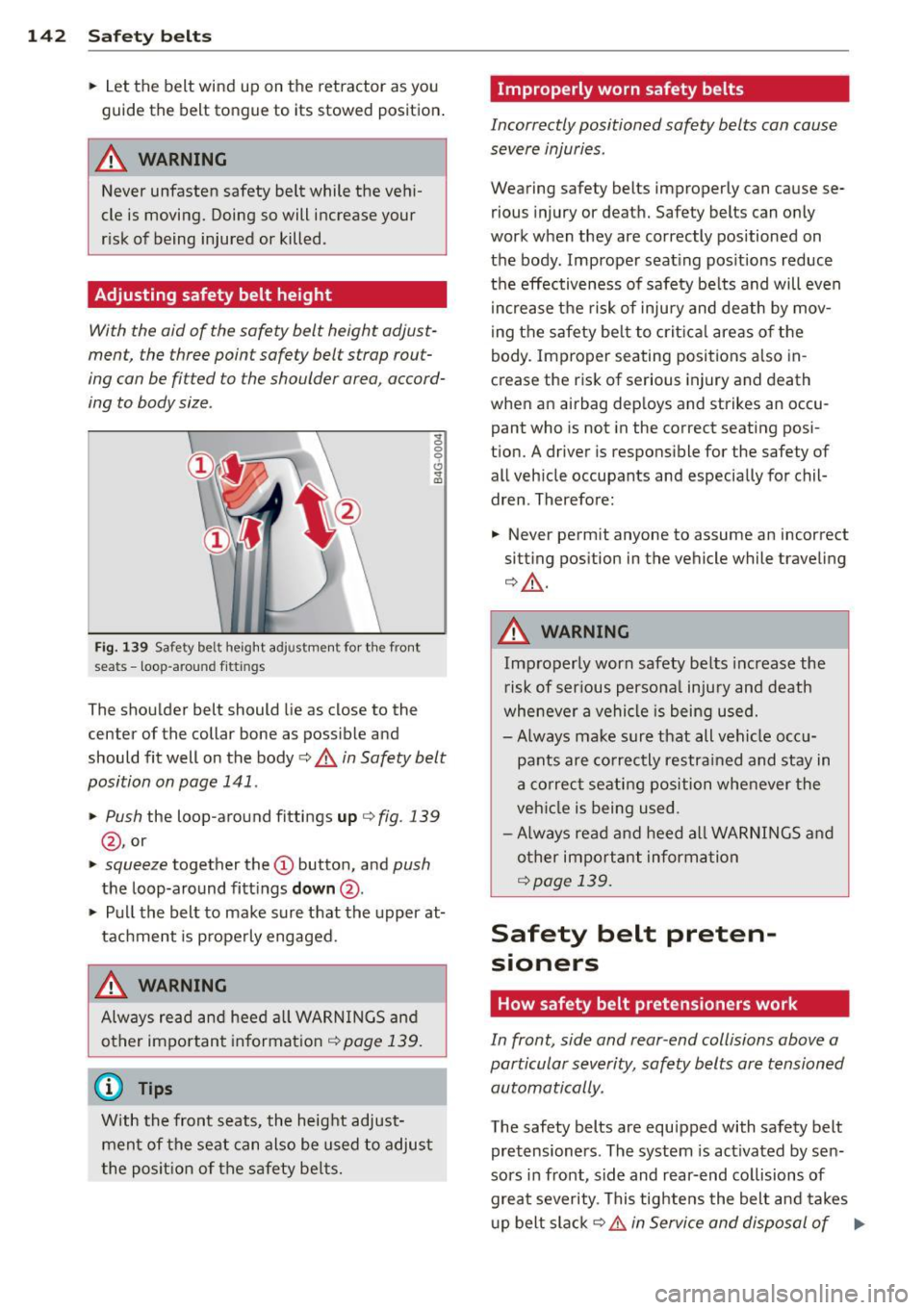
Fig. 139 Safety be lt he ig ht a dju stme nt for t he front
sea ts - loop -a rou nd fit tings
.. (0
The shoulder belt should lie as close to the
center of the collar bone as possib le and
should fit well on the body
c:> .&. in Safety belt
position on page 141 .
• Push
the loop-around fittings up c:> fig . 139
@ , or
• squeeze together the (D button, and push
the loop-around fitt ings down @.
• Pull the belt to make sure that the upper at
tachment is properly engaged.
.&, WARNING
Alw ays read and heed all WARNINGS and
other impo rtant informat ion
¢ page 139.
(D Tips
With the front seats, the height adjust
ment of the seat can also be used to adjus t
the posit ion of the safety be lts.
Improperly worn safety belts
Incorrectly positioned safety belts can cause
severe injuries .
Wearing safety belts improperly can cause se
rious injury or death. Safety belts can only
work when they are correctly positioned on
the body . Improper seat ing pos itions reduce
the effectiveness of safety be lts and will even
i ncrease the risk of inju ry and death by mov
ing the safety be lt to crit ical areas o f the
body. Improper seating positions also in
crease the risk of serious injury and death
when an airbag deploys and strikes an occu pant who is not in the cor rect seating posi
tion. A driver is responsible for the safety of
all veh icle occupants and especially for chil
dren . Therefore:
• Never permit anyone to assume an incorrect
sitting position in the vehicle while traveling
c:> ,&. .
.&, WARNING
Improperly worn safety belts increase the
r isk of ser ious persona l injury and death
whenever a vehicle is being used.
- Always make sure that all vehicle occ u
pants are correctly restrained and stay in
a correc t seating position whe never the
veh icle is being used .
- Always read and heed all WARNINGS and
other important information
¢ page 139.
Safety belt preten
sioners
How safety belt pretensioners work
In front, side and rear -end collisions above a
particular severity, safety belts are tensioned automatically .
The safety belts are equipped with safety belt
pretensioners . The system is act ivated by sen
sors in front, side and rear-end collisions of
great severity. This tightens the belt and takes
u p belt slack
c:> .&. in Service and disposal of .,._
Page 152 of 294
150 Airbag sys te m
For exa mpl e, the air b ag ma y depl oy if:
- a small child that is heavier than a typical 1
year-o ld child is on the front passenger seat
(regardless of whe ther the child is in one of
the chi ld safety seats listed
¢ page 167),
-a ch ild who has outgrown child rest raints is
on the front passenger seat.
If the front passenger airbag is turned off, the
PA SSENGER AIR BAG OFF light in the cente r
of the instrument panel w ill come on and stay
on.
The front a irbag on the passenger side may
not deploy (the PAS SENGER AIR BAG OFF
light does not illuminate and stay lit) if:
- a small adult or teenager is on the front pas
senger seat
- a passenger who is not sitt ing upright wit h
their back against a non-reclined backrest
with their feet on the veh icle floo r in front
of the seat is on the front passenger seat.
If the front passenger airbag deploys, the Federal Standard requires the airbag to meet
the "low risk" deployment criteria to help re
d uce the risk of inju ry through interaction
with the airbag. " Low risk" deployment occurs
in those crashes that take place at lower de
celerations as defined in the e lectronic control
un it.
¢ page 155
Alw ays remember : Even though you r vehicle
is equipped with Advanced Airbags, the safest
p lace for children is properly restrained on the
back seat . Please be sure to read the impor
tant information in the sect ions that follow
and be sure to heed all of the WARNINGS.
A WARNING
To reduce the risk of injury when an airbag
inf lates, always wear safety belts properly.
- If you are unrestrained, lean ing forward,
sitting sideways or out of position in any
way, your risk of in jury is much higher.
- You w ill also receive serious injuries and
cou ld even be killed if you are up against
the a irbag or too close to it when it in- f
lates - even with an Advanced A irbag
¢page 144.
A WARNING
-A child in a rearward-fac ing ch ild safety
seat installed on the front passenger seat
will be serious ly injured and can be killed if
the front airbag inflates - even with an Ad
vanced A irbag System.
- Although the Advanced Airbag System in your veh icle is designed to turn off the
front airbag when a rearward-facing child restraint has been instal led on the
front passenger seat, nobody can abso
lutely g uarantee that dep loyment is im
possible in all conceivable situations that
may happen during the usefu l life of your
veh icle.
- The inflating airbag will hit the child
safety seat or infant carrier with great
force and will smash the child safety seat
and child aga inst the backrest, center
armrest, door, or roof.
-Always install rearward -facing ch ild re
straints in the back seat.
- If you must install a rearward fac ing
child safety seat on the front passenger
seat because of exceptiona l circumstan
ces and the
PASSENGER AIR BAG OFF
light does not come on and stay on, im
mediately insta ll th e rear-fac ing ch ild
safety seat in a rear seating position and
have the airbag system inspected by your
authorized Audi dealer .
A WARNING
If, in exceptional circumstances, you m ust
insta ll a forward -facing child restraint on
the front passenger's seat:
- Always make sure the forward-facing
seat has been designed and certified by
its manufacturer for use on a front seat
with a passenger front and s ide a irbag.
- Never p ut the forward-facing child re
straint up against or very near the instru- ment panel.
~
Page 156 of 294
154 Airbag system
must always sit in an upright position,
must not lean against or place any part
of their body too close to the area where
the airbags are located .
- Occupants who are unbelted, out of posi
tion or too close to the airbag can be se riously injured by an airbag as it unfolds
with great force in the blink of an eye
~page 145.
A WARNING
A child in a rearward-facing child safety
seat installed on the front passenger seat
will be seriously injured and can be killed if
the front airbag inflates -even with an Ad
vanced Airbag System.
- The inflating airbag will hit the child
safety seat or infant carrier with great
force and will smash the child safety seat
and child against the backrest, center
armrest, door or roof.
- Always install rear-facing child safety
seats on the rear seat.
- If you must install a rearward facing
child safety seat on the front passenger
seat because of exceptional circumstan
ces and the
PASSENGER AIR BAG OFF
light does not come on and stay on, im
mediately install the rear-facing child
safety seat in a rear seating position and
have the airbag system inspected by your
authorized Audi dealer.
A WARNING
Objects between you and the airbag will
increase the risk of injury in a crash by in
terfering with the way the airbag unfolds
or by being pushed into you as the airbag
inflates.
- Never hold things in your hands or on
your lap when the vehicle is in use.
- Never transport items on or in the area of the front passenger seat. Objects
could move into the area of the front air
bags during braking or other sudden ma
neuver and become dangerous projec- tiles that can cause serious personal in
jury if the airbags inflate.
- Never place or attach accessories or oth
er objects (such as cupholders, tele phone brackets, large, heavy or bulky ob
jects) on the doors, over or near the area marked "AIRBAG" on the steering wheel,
instrument panel, seat backrests or be
tween those areas and yourself. These
objects could cause injury in a crash, es
pecially when the airbags inflate.
- Never recline the front passenger's seat
to transport objects. Items can also
move into the area of the side airbag or
the front airbag during braking or in a
sudden maneuver. Objects near the air
bags can become projectiles and cause
injury, particularly when the seat is re
clined.
A WARNING
'-
The fine dust created when airbags deploy
can cause breathing problems for people
with a history of asthma or other breath
ing conditions.
- To reduce the risk of breathing problems, those with asthma or other respiratory
conditions should get fresh air right
away by getting out of the vehicle or
opening windows or doors.
- If you are in a collision in which airbags
deploy, wash your hands and face with
mild soap and water before eating.
- Be careful not to get the dust into your
eyes, or into any cuts or scratches.
- If the residue should get into your eyes,
flush them with water.
Page 157 of 294

Monitoring the
Advanced Airbag
System
Airbag monitoring indicator light
Two separate indicators monitor the function
of the Advanced Airbag System: the airbag
monitoring indicator light and the
PAS SEN
G ER AIR B AG
OFF light.
The Advanced Airbag System (including the
e lectronic control unit, sensor circuits and sys
tem wiring) is monitored continuously to
make sure that it is functioning properly
whenever the ignit ion is on . Each t ime you
turn on the ignition, the
I airbag monitoring
i ndicator light w ill come on for a few seconds
(self diagnostics) .
The system mu st be in spected when the
I indicator l ight:
- does not come on when the ignit ion is
switched on,
- does not go out a few seconds after yo u
have switched on the ignition, o r
- comes on while driving .
If an airbag system malfunction is detected,
the indicator light will first start flashing to
catch the driver's attention and then stay on
continuously to serve as a constant reminder
to have the system inspected immediately.
If a malfunction occurs that turns the front
airbag on the passenger side off, the
PASSEN
GER AIR BAG
OFF li ght will come on and stay
on whenever the ignition is on.
_& WARNING
An airbag system that is not funct ioning
properly cannot provide supp lemen tal p ro
tection in a frontal crash.
- If the airbag indicator l ight c::> page 20
comes when the vehicle is be ing used,
have the system inspected immediately
by your authorized Audi dea ler .
It is pos
sible that the airbag will inflate when it is not supposed to, or w ill not inflate
when it should.
-
A irba g sy stem 155
PASSENGER AIR BAG OFF light
Fig. 143 Sect io n fro m the instrument panel: PASSEN
GER AIR BAG OFF light
The PAS SENG ER AIR BAG OFF light is located
in the center of the instrument pa ne l
¢ fig. 143 .
The PAS SENG ER AIR BA G OFF light will come
on and stay on to tell you when the front Ad
vanced Airbag on the passenger s ide has been
tu rned off by the electronic cont rol unit. Each
time you turn on the ignition, the
PASSEN
GE R AIR BA G OFF
light will flash for a few
seconds and:
- wi ll stay on if the front passenger seat is not
occupied,
-w il l stay on if there is a small ch ild or child
restraint on the front passenger seat,
- w ill go out if the front passenger seat is oc
cupied by an adult as registered by the
weight-sensing mat .
The
PAS SEN GER AIR BAG OFF li ght mu st
co m e on and st ay o n if the ignition is on and
- a car bed has been installed on the front
seat, or
- a rearward -facing child restraint has been
installed o n the front passenger seat, or
- a forward-fac ing child restraint has been in
stalled on the front passenger seat , or
- the weight registered on the front passen
ger seat is equal to or less than the com
bined weight of a typical 1 year-old restra in
ed in one of the rear-facing or forward-fac
ing infan t restra ints listed in Federal Motor
Veh icle Safety Standard 208 wi th which the
Advanced A irbag System in your vehicle was
certified.
111-
Page 158 of 294

156 Airbag sys te m
If the front passenger seat is not occupied,
the front airbag will not deploy, and the
PAS
SENGER AIR BAG OF F
light wi ll stay on. Nev
er install a rearward-fac ing ch ild restra int on
the front passenger seat, the safest place fo r
a child in any kind of child restraint is at one
of the seat ing positions on the rear seat
¢ page 145, Child restraints on the front seat
- some important things to know
and
¢ page 165, Child Safety.
If th e PA SSEN GER AI R BAG OFF light c ome s
on
when one of the conditions listed above is
met, be sure to check the light regular ly to
make certa in that the
PAS SENGER AIR BA G
O FF
light stays on cont inuous ly whenever the
ignition is on. If the
PASSENGER AIR BAG
OFF
li ght does not appear and not stay on all
the time, stop as soon as it is safe to do so
and
- reactivate the system by turning the ignition off and then turning it on again;
- remove and re install the child restraint.
Make sure that the child restraint is properly
installed and that the safety belt for the
front passenger seat has been correctly routed around the child restraint as descr i
bed in the child restraint manufacturer's i n
structions;
- make sure that the convertible locking fea
ture on the safety belt for the front passen
ger seat has been activated and that the
safety belt has been pulled tight. The belt
must not be loose o r have loops of slack so
that the senso r below the safety be lt latch
on the seat can do its job
¢ page 175 .
-make su re that th ings that may increase the
weight of the ch ild and child safety seat are
not being transpo rted on the front passen
ger seat;
- make su re that the safety belt tension sen
sor is not b locked. Shake the safety be lt
l atch on the front passenger seat back and
forth;
- If a strap or tether is being used to tie the
child safety seat to the front passenger
seat, make sure that it is not so tight that it causes the weight
-sensing mat to measure
more weight than is act ually on the seat.
If th e PASSENGER AIR BAG OFF lig ht still
does not come on
and does not s tay on con
t in uous ly (when the ignition is switched on) ,
- take the child restraint off the front passen-
ge r seat and install it properly at one of the
rea r seat posi tions. Have the airbag system
inspected by your authorized Audi dealer
immediate ly .
- move the child to a rear seat position and
make sure t hat the c hild is properly restrain
ed in a c hild restraint that is appropriate for
its size and age.
T he
PAS SENGER AIR BAG OFF light should
NOT come on when t he ignition is on and an
adult is sitting in a proper seating position on
the front passenger seat. If the
PA SSENGER
AIR BAG OFF
light comes on and stays on or
flashes for about 5 seconds wh ile driving, un
der these c ircumstances, make sure that:
- the adult on the front passenger seat is properly seated on the center of the seat
cushion with his or her back up aga inst the
backrest and the backrest is not recl ined
¢ page 12 7, Proper occupant seating posi
tions,
- the adult is not tak ing weight off the seat by
holding on to the passenger assist handle
above the front passenger door or support
ing their weight on the armrest,
- the safety belt is being properly wo rn and
t ha t the re is no t a lot of s lack in the safety
be lt webb ing ,
- accesso ry seat covers or cushions or other
t hings tha t may cause an incorrect reading
or impression on the weight-sensing mat
under the upho lstery of the seat have been
removed from the front passenger seat,
- a safety belt extender has not been left in
the safety belt latch for the front passenger
seat.
In add ition to the
PASSENGER AIR BAG OFF
light in the center o f the instrument panel,
t h e message
PASSENGER AIR BAG OFF or
PASSENGER AIR BAG ON wi ll briefly appear ..,.
Page 161 of 294

dealer is familiar with these requi rements
and we recommend that you have your
dea ler perform this serv ice for you.
Other things that can affect Advanced
Airbag performance
Changing the vehicle's suspension system can
change the way that the Advanced A irbag Sys
tem performs in a crash. For example, us ing
tire-r im combinations not app roved by Aud i,
l owering the vehicle, changing the stiffness o f
the suspension, incl uding the sp rings, s uspen
sion struts, shock absorbers etc. can change
the forces that are measured by the airbag sensors and sent to the electronic control
un it. Some suspension changes can, for exam
ple, increase the force levels measured by the
sensors and make the airbag system deploy in
crashes in wh ic h it would not dep loy if the
changes had not been made. Other k inds of
changes may reduce the force levels meas
u red by the sensors and prevent the a irbag
from deploying when it shou ld .
The senso rs in the safety belt buckle fo r the
d river and front passenger sea t tell the elec
tronic control module if the safety belt is
l atched or not . If the safety belt is being used,
the front airbag will dep loy at a slightly high
er rate of vehicle deceleration than if the safe
ty belt is not being used. Therefore, in a par
ticular co llision, it is poss ible that an airbag
will not deploy at a seating position where the
safety belt is being use d but will inflate at the
position whe re the safety belt is not being
used. It is important tha t nothing i nterfe re
w it h the safety belt buckles so t hat the sen
sors can send t he correct information abo ut
safety belt use to the electronic contro l unit.
.&_ WARNING
Changing the vehicle 's s uspension includ
ing use of unapproved tire-rim c ombina
tions can change Advanced Airbag pe r
formance and increase the risk of ser ious
personal i njury in a crash.
- Never install suspens ion components
that do not have the same performance
A irba g sy stem 159
characteristics as the components o rigi
na lly installed on your vehicle.
- Never use tire-rim com binations that
have not been approved by Audi.
.&_ WARNING
= -
Items stored between the safety be lt
b uckle and the center console can cause
the sens ors in t he buckle to send the
wrong information to the e lectronic con
trol module and prevent the Advanced Air bag Syst em from wo rking properly.
- Always make s ure that nothing can in ter-
fe re with the safety b elt buckles and that
they are no t obstructed.
Side airbags
Description of side airbags
The airbag system can provide supplemental
protection to properly restrained occupants.
Fi g. 144 Side airbag location in t he drive r's seat
The side airbags are located in the sides of the
front seat backrests¢
fig. 144 and the rea r
backrest faci ng the doors. They are ident ified
by the word "AIRBAG".
The side airbag system basically consists of :
-the electronic control modu le and external
side impact sensors
- the two a irbags located in the sides of the
front backrests and the two a irbags* located
in the rear backrest
- the airbag warn ing light in the instrument
cl uster .
T he airbag system is mo nitored e lec tronically
t o make ce rtain tha t it is f unction ing p ro perly
Ill-
Page 164 of 294

162 Airbag system
-Objects between you and the airbag can
increase the risk of injury in an accident
by interfering with the way the airbag
unfolds or by being pushed into you as
the airbag inflates .
- Never place or attach accessories or other objects (such as cupholders, tele
phone brackets, or even large, bulky
objects) on the doors, over or near the
area marked "AIRBAG" on the seat
backrests.
- Such objects and accessories can be
come dangerous projectiles and cause
injury when the supplemental side air
bag deploys.
- Never carry any objects or pets in the
deployment space between them and
the airbags or allow children or other
passengers to travel in this position .
- Always use the built-in coat hooks only
for lightweight clothing . Never leave any
heavy or sharp-edged objects in the
pockets that may interfere with side air
bag dep loyment and can cause personal
injury in an accident.
- Always prevent the side airbags from be
ing damaged by heavy objects knocking
against or hitting the sides of the seat
backs.
- The airbag system can only be triggered
once. If the airbag has been triggered,
the system must be replaced by an au
thorized Audi dealership.
- Damage (cracks, deep scratches etc.) to
the original seat covers or to the seam in
the area of the side airbag module must always be repaired immedia tely by an au
thorized Audi dealer .
- If children are seated improperly, their
risk of injury increases in the case of an
accident
q page 165, Child Safety .
- Never attempt to modify any compo
nents of the airbag system in any way .
- In a side collision, side airbags will not
function properly if sensors cannot cor
rectly measure increasing air pressure in
side the doors when air escapes through larger, unclosed openings in the door
panel.
- Never drive with interior door trim pan
els removed.
- Never drive when parts have been re
moved from the inside door panel and
the openings they leave have not been properly closed.
- Never drive when loudspeakers in the
doors have been removed unless the
speaker holes have been properly
closed.
- Always make certain that openings are
covered or filled if additional speakers
or other equipment is installed in the
inside door panels.
- Always have work on the doors done by
an authorized Audi dealer or qualified
workshop.
Side curtain airbags
Description of side curtain airbags
The side cur tain airbag system can provide
supplemental protection to properly restrain
ed occupants.
Fig. 146 S ide curta in sy stem , driver's s ide: sid e cur tain
airb ag loc ation
The side cur tain airbags are located on both
sides of the interior above the front and rear
side windows
q fig . 146 . They are identified
by the word "AIRBAG " on the windshield
frame and the center roof pillar .
T he side curtain airbag system supplements
the safety belts and can help to reduce the
risk of injury for occupants' heads and upper
torso on the side of the vehicle that is struck ..,.