2013 AUDI A4 SEDAN towing
[x] Cancel search: towingPage 254 of 294

252 What do I do now?
has been designed specifically fo r you r type of
vehicle . It must not be swapped with a com
pact spare t ire from another type of veh icle.
Snow cha ins
F or technical rea son s, the use of snow chains
on the compact spare tire is
not p ermitt ed .
If you do have to dr ive with snow cha ins and a
front tire fails, mount the spare whee l w ith
tire instead of a rear t ire. Install the snow
cha ins on the rear tire and use it to rep lace
the defective front tire .
A WARNING
-Never use the spare tire if it is damaged
or if it is worn down to the tread wear in
dicators.
- If the spare tire is more than 6 years o ld,
use it only in an emergency and w ith ex
treme caution and careful driving.
- The spare tire is intended only for tem
porary and short-term use. It should be
replaced as soon as possib le w ith the
normal wheel and tire.
- After mounting the compact spare tire,
the tire pressure must be checked as
soon as poss ible. The tire pressure of the
compact spa re tire must be 4.2 bar; oth
erw ise, you risk hav ing an accident.
- Do not drive faster than SO mph (80 km/
h). You risk having an acc id ent.
-Avoid full-throttle acce le rat ion, heavy
braking, and fast corner ing . You risk hav
ing an acc ident.
- Never drive us ing more than one spare
wheel and tire. You risk having an acci
dent .
- Normal summer or winte r tires must not
be mounted on the compact spare whee l
rim.
- For technical reasons, the use of ti re
c hains on the spare tire is not permitted.
If it is necessa ry to dr ive wi th tire ch ains,
the spare whee l must be mounted on the
front axle in the event o f a f lat in a rear
t ir e. The newly ava ilable front wheel
must then be installed in place of the rear whee
l with the flat tire. Installing
the t ire cha in before mounting the whee l
and tire is recommended.
- Loose items in the passenger compart
ment can cause serious personal injury
during hard brak ing or in an accident.
Never store the inflatable spare tire or
jack and tools in the passenge r compart
ment.
Changing a wheel
Before changing a wheel
Observe the following precautions for your
own and your passenger's safety when chang
ing a wheel .
.,. After you experience a t ire failure, p ull the
car we ll away from moving traffic and try to
reach
level ground before you stop ¢ A .
.,. All passengers should lea ve the car and
move to a safe location (for instance, behind
the guardrail)¢
A.
.,. Engage the park ing brake to prevent your
ve hicle from rolling unintentionally ¢
A.
.,. Shift into 1st ge ar on veh icles with manual
transmiss ion, or move th e
selector lever to
the P positi on
on vehicles w it h automatic
transmiss io n.
.,. If you are towing a trai ler : u nhitch the trail
er from your vehicle .
.,. Take the
jack ¢ page 251 and the spare tire
¢ page 251 out of the luggage compart
ment.
A WARNING
You or your passengers could be injured
while changi ng a wheel if you do not fo l-
l ow these safety precaut ions:
- If you have a flat tire, move a safe d is
tance off the road. Turn off the engine,
tur n the eme rgency flashers on and use
o ther warni ng device s to a le rt othe r mo
torists.
- Make sure that passengers wait in a safe
place aw ay from the vehicle a nd well
-
away from the road and traffic . ~
Page 264 of 294

262 Emergency situations
Emergency situations
General
This chapter is intended for trained emer
gency crews and working personnel who
have the necessary tools and equipment to perform these operations.
Starting by pushing or
towing
Q;) Note
Vehicles with an automatic transmission
cannot be started by pushing or towing.
Starting with jumper
cables
If necessary , the engine can be started by
connecting it to the battery of another vehi
cle.
If the engine should fail to start because of a
discharged or weak battery, the battery can be
connected to the battery of
another vehicle,
using a
pair of jumper cables to start the en
gine .
Jumper cables
Use only jumper cables of sufficiently
large cross section to carry the starter current
safely. Refer to the manufacturer's specifica
ti ons.
Use only jumper cables with
insulated termi
nal clamps which are distinctly marked :
plus(+) cable in most cases colored red
minus (-) cable
in most cases colored black .
A WARNING
Batteries contain electricity, acid, and gas.
Any of these can cause very serious or fatal
injury. Follow the instructions below for
safe handling of your vehicle's battery.
- Always shield your eyes and avoid lean
ing over the battery whenever possible. -
A discharged battery can freeze at tem
peratures just below 32 °F (0 °C). Before
connecting a jumper cable, you must
thaw the frozen battery completely, oth
erwise it could explode.
- Do not allow battery acid to contact eyes
or skin . Flush any contacted area with
water immediately .
- Improper use of a booster battery to
start a vehicle may cause an explosion.
- Vehicle batteries generate explosive gas
es . Keep sparks, flame and lighted ciga
rettes away from batteries .
- Do not try to jump start any vehicle with
a low acid level in the battery .
- The voltage of the booster battery must
also have a 12-Volt rating. The capacity
(Ah) of the booster battery should not be
lower than that of the discharged bat
tery . Use of batteries of different voltage
or substantially different "Ah" rating
may cause an explosion and personal in
jury.
- Never charge a frozen battery. Gas trap
ped in the ice may cause an explosion.
- Never charge or use a battery that has
been frozen. The battery case may have
be weakened.
- Use of batteries of different voltage or
substantially different capacity (Ah) rat
ing may cause an explosion and injury.
The capacity (Ah) of the booster battery
should not be lower than that of the dis
charged battery.
- Before you check anything in the engine
compartment, always read and heed all
WARNINGS¢
page 208, Engine com
partment.
@ Note
- Applying a higher voltage booster bat
tery will cause expensive damage to sen
sitive electronic components, such as
control units, relays, radio, etc.
- There must be no electrical contact be
tween the vehicles as otherwise current
could already start to flow as soon as the
positive(+) terminals are connected. ..,.
Page 266 of 294

264 Emergency sit uat ions
-Jumper cables mus t be long enough so
that the vehicles do not touch.
- W hen connecting jumper ca bles, make
sure that they cannot get caught in any moving parts in the eng ine compart
ment.
- Do not bend over the batteries -danger
of chemical burns!
- The battery ce ll locking screws must be
tightened securely .
- Before you check anything in the engine
compartment, always read and heed all
WARNINGS
9 page 208, Engine com
partment.
(D Note
Improper hook-up of jumper cables can r u
in the generator.
- Always connect POSITIVE( +) to POSI
TIVE(+), and NEGATIVE( -) to NEGATIVE
( - ) ground post of the battery manager
control unit.
- Check that a ll screw plugs on the battery
cells are sc rewed in firmly. If not, tighten
plugs prior to connecting clamp on nega
tive battery term inal.
- Please note that the procedure for con
nect ing a jumper cable as described
above applies spec ifically to the case of
your vehicle being jump started . When
you are giv ing a jump start to a nothe r ve
hicle, do
not connect the negat ive (-) ca
ble to the negat ive (-) term inal on the
discharged battery @
9 fig. 194. In
stead, securely connect the negative(- )
cab le to e ither a solid metal component
that is firmly bolted to the engine bloc k
or to the engine block itse lf. If the bat
tery that is being charged does not vent
to the outside, escaping batte ry gas
could ignite and explode!
Emergency towing
with commercial tow
truck
General hints
Your Audi requires special handling for tow
ing.
T he following information is to be used by
commercial tow truck operators who know
how to operate their equipment safely.
- Ne ver tow your Audi , towing will cau se
damage to the engine and transmi ssion .
- Ne ver wrap th e safet y chains or winch ca
ble s around the brak e lines.
- To prevent unne cessar y damage, your Audi
must be tr an sp o rted with a flat bed tru ck.
- To load th e vehi cle on to the fl at bed, use
the towing l oop found in the ve hicle to ols
and atta ch to th e front or rea r anchorage
c:> page 265 and c:> page 265 .
& WARNING
= -
A vehicle being towed is not safe for pas
sengers. Never allow anyone to ride in a
vehicle being towed, for any reason.
Page 267 of 294
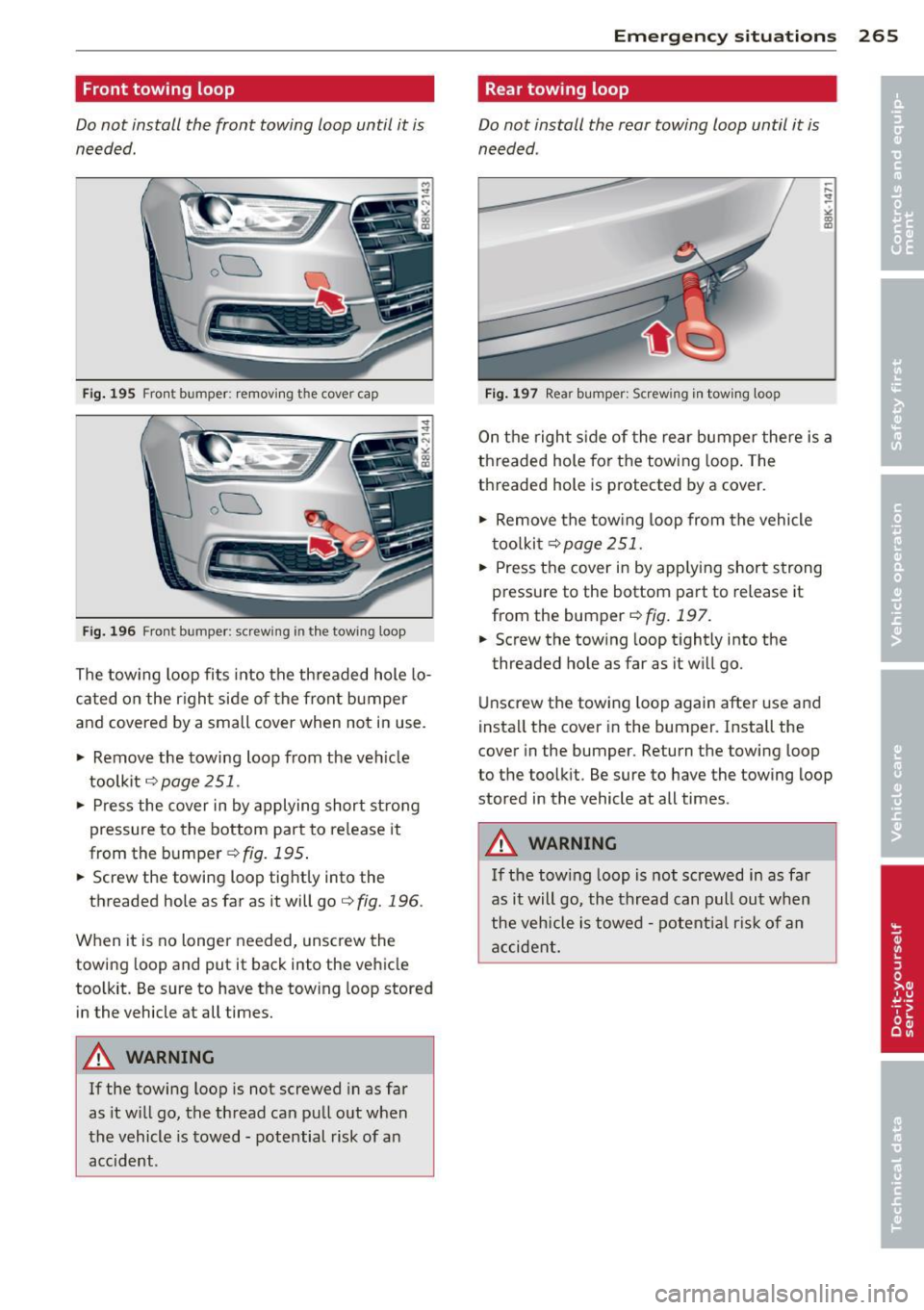
Front towing loop
Do not install the front towing loop until it is
needed.
ou
Fig . 195 Fro nt bumper : removing t he cover cap
ou
Fi g. 196 Front bumper: screw ing in t he tow ing loop
The tow ing loop fits into the th readed hole lo
cated on the r igh t side of the fron t bumper
and covered by a small cover when not in use .
"' Remove the towing loop from the veh icle
toolkit
c:::> page 251 .
"' Press the cover in by applying short st rong
pressure to the bottom part to re lease it
from the bumper
c:::> fig. 195 .
"' Screw the towing loop tight ly into the
threaded hole as far as it will go
c:::> fig. 196 .
When it is no longer needed, unscrew the
towing loop and put it back into the vehicle
too lkit. Be sure to have the tow ing loop stored
in the vehicle at all times.
A WARNING
If the towing loop is not screwed in as far
as it w ill go, the thread can pull out when
the vehicle is towed - potential risk of an
acc ident.
Emergenc y situ ation s 265
Rear towing loop
Do not install the rear towing loop until it is
needed .
Fig . 1 97 Rea r bumper: Screw ing in tow ing loop
On the right s ide of the rear bumper there is a
th readed hole for the towing loop . The
threaded hole is protected by a cover .
"' Remove the tow ing loop from the vehicle
t oo lkit
c:::> page 251.
"' Press the cover in by app lying short strong
pressure to the bottom part to release it
from the bumper
c:::> fig. 197.
"' Screw the tow ing loop tightly into the
threaded hole as far as it w ill go.
Unscrew the towing loop again after use and
insta ll the cover in the bumper. Install the
cover in the bumper. Return the towing loop
to the toolkit. Be sure to have the towing loop
stored in the vehicle at all times .
A WARNING
If the towing loop is not screwed in as far
as it will go, the thread can pull out when
the veh icle is towed -potent ia l risk o f an
accident.
Page 274 of 294

272 Consumer Information
Consumer Information
Warranty coverages
You r Audi is covered by the following war
ranties:
- New Vehicle Limited Warranty
- Limited Warranty Against Corrosion Perfo-
ration
- Emissions Control System Warranty
- Emissions Performance Warranty
- California Emissions Control Warranty (USA
vehicles only)
- California Emissions Performance Warranty
(USA vehicles only)
Detailed information regarding your warran
ties can be found in your
Warranty & Mainte
nance booklet .
Operating your vehicle
outside the U.S.A. or
Canada
Government regu lations in the United States
and Canada require that automobiles meet
specific emission regulations and safety
standards. Therefore, veh icles built for the
U.S.A . and Canada differ from vehicles sold in
other countries .
If you p lan to take your vehicle outside the
continental limits of the United States or Can
ada, there is the possibility that:
- unleaded fuels for vehicles with cata lytic
converter may not be available;
- fuel may have a considerably lowe r octane
rating. Improper fuel may cause engine
damage ;
- service may be inadequate due to lack of
proper service facilities, tools or testing
equipment ;
- replacement pa rts may not be readily availa
ble.
- Navigation systems for vehicles built for the
U.S.A. and Canada will not necessar ily work
in Europe, and may not work in other coun
tries outside of North America.
(D Note
Audi cannot be responsible for mechanical
damage that could result from inadequate
fuel, service or parts availability.
Audi Service Repair Manuals and Literature
Audi Official Factory Service Manuals and Lit
erature are published as soon as possible after
model introduction. Service manuals and lit
erature are available to order from the Audi
T echnical Literature Ordering Center at:
www.audi.techliterature.com
Maintenance
General
Your vehicle has been designed to help keep
maintenance requirements to a minimum.
However, a certain amount of regular mainte
nance is still necessary to assure your vehicle's
s afety, economy and rel iability. For detailed
vehicle maintenance consult your Warranty &
Maintenance booklet.
Under difficult operating conditions, for ex
ample at extremely low outside temperatures,
i n very dusty regions , when towing a trailer
very frequently, etc., some service work
should be performed between the intervals
specified. This applies particularly to:
- oil changes, and
- cleaning or replacing the air filter .
(® For the sake of the environment
By regularly maintaining your vehicle, you
help make sure that emission standards
are maintained, thus minimizing adverse
effects on the environment.
Important considerations for you and
your vehicle
The increasing use of electronics, sophisticat
ed fuel injection and emission contro l sys-
tems, and the genera lly increasing technical
liJJ,
Page 282 of 294

280 Index
Cornering light ................ .... .. 44
Cruise control Changing speed .......... .... .... .. 81
Presetting your speed . . . . . . . . . . . . . . . 82
Sw itching off ............ .. .. .... .. 82
Switching on . .. . ...... ... .. .. .... .. 81
Cruising range . . . . . . . . . . . . . . . . . . . . . . . 25
(upho lder ..... ........... ........ .. 61
D
Data .. .... .. .............. ... .... .
Data recorder
Date display 270
184
12
Daytime ru nning lights . . . . . . . . . . . . 44, 45
Declaration of compl iance
Adaptive cruise control ...... .. .. ... 275
Audi side assist .......... .. .. .. .. . 275
Cell phone package ........... .... . 275
Conven ience key .......... .... .. .. . 275
Electronic immobilize r ............. . 275
Homelink ® universal remote control .. 275
Remote control key ....... .... .... . 275
Tire pressure monitoring system ..... 275
Defective light bulb warning . . . . . . . . . . . 21
Defrosting (w indows) ......... .. .. .... 70
Determining correct load limit .... ... . 239
Digital clock ... ........... .... .... .. 12
Digital compass ............. .. .... .. 52
Dimensions .. ... .... ......... ..... . 269
Dimming the rearview mirror .. .... .. .. 48
Doors Ch ild safety locks ......... .... ...... 40
emergency lock ing ... ... .. .... .. .. . . 37
Driver information system
Enhanced sh ift indicator ....... .... . . 28
Open door or front lid warning . . . . . . . . 24
Outside temperature display .. .. .. .. . . 24
Sound system display . . . . . . . . . . . . . . . 24
Driver seat
refer to Seating position ....... .. .. . 127
D . . f l riving sa e y .. ........... .. .. .. .. . 126
Driving through water ...... .... .... . 192
Driving time ............. .... ..... .. 25
D . t . ynam1c s eermg . . . . . . . . . . . . . . 111, 188
E
E85 (Fuel)
Efficiency program ........ ........ .. . 211
27
Fuel economy messages . . . . . . . . . . . . . 29
Memo ry levels ................ .. .. . 25
Other equipment .... .......... .. ... 28
Shift indicator . . . . . . . . . . . . . . . . . . . . . 28
Electro-mechanical power assist . .. .. .. 188
E lectromechanical parking brake
Emergency braking ............ .... . 79
Indicator light .................... . 77
Parking ....... .. .. ... ....... ... .. . 78
Releas ing and closing . ...... ... .. .. . 77
Starting assist . . . . . . . . . . . . . . . . . . . . . 78
Starting from rest ............. .. .. . 78
Starting off with a tra iler . . . . . . . . . . . . . 79
Warning/indicator lights ............. 16
Electronic differential lock (EDL) . .. .. .. 184
Warning/indicator lights ........ .. .. . 19
E lectronic immobilizer . . . . . . . . . . . . 12, 38
El ectronic power control
(EPC) warning/indicator ligh t . . . . . . . . . 20
Electronic speed limiter .... ........ .. . 31
E lectronic Stabilization Contro l (ESC) ... 184
Warning/ind icator lights ........ .... . 19
Emergency actuation
Doors .. .. .... .. .. .......... ..... . 37
Ignition key ..... ... .......... ..... 35
Rear lid . . . . . . . . . . . . . . . . . . . . . . . . . . . 39
Slid ing/tilting sunroof .......... ..... 42
Emergency braking .............. .... . 79
Emergency flasher .... ........... ... . 46
Warning/indicator lights ..... ..... .. . 23
Emergency key .. .. ............. .... . 33
Starting engine .. ... .......... ..... 74
Emergency operation
Emergency braking function (parking
brake) ........ .. .. ......... .... .. . 79
Emergency re lease
Selector lever .. .. ............. .... . 89
Emergency starting ....... ........ .. 262
Emergency towing .... .......... .. .. 264
En ergy management .............. .. 190
Battery power . . . . . . . . . . . . . . . . . . . . . 17
Driver notification . . . . . . . . . . . . . . . . . . 17
Page 290 of 294

288 Index
Tires and wheels
Checking tire pressure .............. 236
Cold t ire inflation pressure ... .. .... . 234
Dimensions .............. .. .. .... . 241
General notes . ............. .. .... . 230
Glossary of tire and loading terminolo -
gy .. .. .. .. ... .... ...... .. .. .. .. . 231
New tires and wheels .......... .. .. . 241
Replacing . . . . . . . . . . . . . . . . . . . . . . . . 242
Snow chains .. ........... .. .. .... . 246
Tires and vehicle load limits . ... .. .. . 238
Wheel bolts .............. ... .... . 247
Winter tires .............. ... .... . 245
Tire service life . ........... .... .... . 240
Tool kit . .. ................. .. .... . 251
Torn or frayed safety belts ............ 139
Touch-up paint . .. ...... .... ... .. .. . 202
Towing Front eyelet ............. .. .. ..... 265
Rear eyelet ... ........... .... .... . 265
Tow truck procedures .......... .. ... 264
TPM5 Tire pressure monitoring system .. ... 249
Trailer towing ... .......... .. .. .. .. . 196
Operating instructions ......... .. .. . 196
Technical requirements . . . . . . . . 196, 197
Tips ..... .. ................ ..... . 198
Transmission ............ .. .. .. .. .. .. 83
6-speed manual transmission . . . . . . . . . 83
multitronic . . . . . . . . . . . . . . . . . . . . . . . . 83
S tronic .... ................ ..... .. 89
tiptronic . . . . . . . . . . . . . . . . . . . . . . . . . . 83
Transmission malfunction (ind icator lamp) 95
Transmission malfunction (indicator light) 88
Transport Canada ................... 134
Travel mode ... .. ...... .... ... .. .. .. 46
Tread Wear Indicator (TWI) ... ... .. .. . 240
Trip computer
Fu el consumption . . . . . . . . . . . . . . . . . . 25
Mileage .................... ..... .. 25
Sing le-trip memory ........ ..... .. .. 25
Total-trip memory . . . . . . . . . . . . . . . . . . 25
Trip odometer ............. .... .... .. 12
Trunk
refer to Luggage compartment . . . 64, 132
Trunk escape handle ................ .. 40 Trunk
lid
refer to Rear lid . ................. .. 39
Turn signals . .... .. ............. ..... 45
Warning/indicator lights .......... .. . 23
u
Undercoating ..... ................ . 204
Unfastening safety belts ......... .. ..
141
Unidirectional tires .............. .... 230
Uniform tire quality grading .......... 244
Unlocking Rear lid ... .... .. ................. . 39
Unlocking/locking at the lock cylinder . . . . . . . . . . . . . . . . . . 3 7
by remote control ................ .. 35
with the centra l locking switch ..... .. . 36
with the convenience key ...... .. .. .. . 36
Use of jumper cables ............ .... 263
V
Valet parking ...... ................ .. 43
Vanity mirrors ..... ............. ..... 49
Vehicle-care products . . . . . . . . . . . . . . . . 199
Vehicle electrical system . . . . . . . . . . . . . . 17
Vehicle Identification Number (VIN) .. .. 268
Vehicle jack . .. .. .. ... .......... .... 255
Vehicle key . . . . . . . . . . . . . . . . . . . . . . . . . 33
Vehicle literature .. ............. ...... 5
Vehicle tool kit . ... ....... ...... .. .. 251
Ventilation . .. .. .. ............. .. .. . 68
w
Warning/indicator lights . . . . . . . . . . 10 , 13
Airbag system ... ................ .. 20
Anti-lock braking system (ABS) . .. .. .. . 19
Brake system .. .. ... .......... .. .. . 15
Electromechanical parking brake . .. .. . 16
Electronic power control . . . . . . . . . . . . . 20
Electronic Stabilization Control (ESC) .. . 19
Generator . . . . . . . . . . . . . . . . . . . . . . . . . 17
Malfunction Ind icator Lamp (MIL) .... . 20
Safety belt . . . . . . . . . . . . . . . . . . . . . . . . 17
Safety systems . . . . . . . . . . . . . . . . . . . . . 20
Turn signals ..... ................ .. 23
Warranty coverages ................. 272