2012 VOLVO V60 lock
[x] Cancel search: lockPage 288 of 400

06 During your journey
Driving with a trailer
06
286
Attaching the towbar
G018928
Remove the protective cover by first press-
ing in the catch
and then pulling the
cover straight back
.
G021487
Ensure that the mechanism is in the
unlocked position by turning the key clock-
wise.
G021488
The indicator window must show red.
G021489
Insert the towbar until you hear a click.
G021490
The indicator window must show green.
G000000
Turn the key anticlockwise to locked posi-
tion. Remove the key from the lock.
ProCarManuals.com
Page 289 of 400

06 During your journey
Driving with a trailer
06
287
G021494
Check that the towbar is secure by pulling
it up, down and back.
WARNING
If the towbar is not fitted correctly then it
must be detached and reattached in
accordance with the previous instructions.
IMPORTANT
Only grease in the ball for the towing hitch,
the remainder of the towbar should be clean
and dry.
G021495
Safety cable.
WARNING
Be sure to attach the trailer's safety cable to
the correct place.
Removing the towbar
Insert the key and turn it clockwise to the
unlocked position.
Push in the locking wheel and turn it
anticlockwise
until you hear a click.
Turn the locking wheel down fully, until it
comes to a stop. Hold it in this position
while pulling the towbar rearward and
upward.
WARNING
Secure the towbar safely if it is stored in the
car, see page 285.
ProCarManuals.com
Page 291 of 400

06 During your journey
Towing and recovery
06
289 Towing
Find out the statutory maximum speed limit for
towing before towing begins.
1. Unlock the steering lock by inserting the
remote control key in the ignition switch
and giving a long press on the START/
STOP ENGINE button - key position II is
activated, see page 80 for more informa-
tion on key positions.
2. The remote control key must remain in the
ignition switch while the car is being towed.
3. Keep the towline taut when the towing
vehicle reduces speed by holding your foot
gently pressed on the brake pedal -
thereby avoiding unnecessary jerking.
4. Be prepared to brake to stop.
WARNING
•Check that the steering lock is unlocked
before towing.
•The remote control key must be in key
position II - in position I all airbags are
deactivated.
•Never remove the remote control key
from the ignition switch when the car is
being towed.
WARNING
The brake servo and power steering do not
work when the engine is switched off - the
brake pedal needs to be depressed
about 5 times more heavily and the steering
is considerably heavier than normal.
Manual gearboxPrior to towing:
–Move gear lever into neutral and release
the parking brake.
Automatic gearbox Geartronic
IMPORTANT
Note that the car must always be towed with
the wheels rolling forward.
•Cars with automatic gearbox must not
be towed at speeds above 80 km/h or
further than 80 km.
Prior to towing:
–
Move the gear selector to position N and
release the parking brake.
Automatic gearbox PowershiftThe model with Powershift transmission
should not be towed as it is dependent on the
engine running in order to receive sufficientlubrication. If towing still has to take place, the
route must be as short as possible and then
with very low speed.
In the event of uncertainty as to whether or not
the car is equipped with Powershift transmis-
sion, this can be verified by checking the des-
ignation on the decal number (5) under the
bonnet - see page 352. The designa-
tion ”MPS6” means that it is Powershift trans-
mission - otherwise it is Geartronic automatic
transmission.
IMPORTANT
Avoid towing.
•However, the car can be towed for a
short distance at low speed to move it
from a dangerous position - not further
than 10 km and not faster than
10 km/h. Note that the car must always
be towed with the wheels rolling for-
ward.
•In the event of moving a longer distance
than 10 km, the car must be transported
with the drive wheels raised from the
road - professional recovery is recom-
mended.
Prior to towing:
–
Move the gear selector to position N and
release the parking brake.
ProCarManuals.com
Page 297 of 400

07 Wheels and tyres
General
07
* Option/accessory, for more information, see Introduction.295
Wear and maintenanceThe correct tyre pressure results in more even
wear, see page 301. Driving style, tyre pres-
sure, climate and road condition affect how
quickly your tyres age and wear. To avoid dif-
ferences in tread depth and to prevent wear
patterns arising, the front and rear wheels can
be switched with each other. A suitable dis-
tance for the first change is approx. 5000 km
and then at 10 000 km intervals. Volvo recom-
mends that you contact an authorised Volvo
workshop for checking if you are uncertain
about tread depth. If significant differences in
wear (>1 mm difference in tread depth)
between tyres have already occurred, the least
worn tyres must always be placed on the rear.
Understeer is normally easier to correct than
oversteer, and leads to the car continuing for-
wards in a straight line rather than having the
rear end skidding to one side, resulting in pos-
sible complete loss of control over the car. This
is why it is important for the rear wheels never
to lose grip before the front wheels.
Wheels should be stored lying down or hanging
up - and not standing up.
WARNING
A damaged tyre can lead to loss of control
of the car.
Tyres with tread wear indicators
G021829
Tread wear indicators.
Tread wear indicators are narrow treadless
bands across the width of the tread. On the
side of the tyre are the letters TWI (Tread Wear
Indicator). When the tyre's tread depth is down
to 1.6 mm, the tread depth will be level in height
with the tread wear indicators. Change to new
tyres as soon as possible. Remember that
tyres with little tread depth provide very poor
grip in rain and snow.
Rims and wheel bolts
IMPORTANT
The wheel bolts must be tightened to
140 Nm. Overtightening can damage the
nuts and the bolts.
Only use rims that are tested and approved by
Volvo and which are Volvo genuine accesso-
ries. Check the torque with a torque wrench.
Locking wheel bolts*Locking wheel bolts* can be used on both alu-
minium and steel rims. Under the cargo area
floor there is space for the sleeve for the lock-
able wheel bolts.
Tools
Located under the cargo area floor are the
car's towing eye, jack* and wheel wrench*.
There is also space for the sleeve for the lock-
able wheel bolts.
ProCarManuals.com
Page 300 of 400

07 Wheels and tyres
Changing wheels
07
298* Option/accessory, for more information, see Introduction.
Removing
Set up the warning triangle, see page 302 if a
wheel must be replaced at a busy location. The
car and jack* must be on a firm horizontal sur-
face.
1. Apply the parking brake and engage
reverse gear, or position P if the car has an
automatic gearbox.
WARNING
Check that the jack is not damaged, that the
threads are thoroughly lubricated and that it
is free from dirt.
NOTE
Volvo recommends only using the jack* that
belongs to the car model in question, which
is indicated on the jack's label.
The label also indicates the jack's maximum
lift capacity at a specified minimum lifting
height.
2. Take out the jack*, wheel wrench* and
removal tool for wheel covers* located
under the cargo floor in the cargo area. If
another jack is selected, see page 312.
3. Place chocks in front of and behind the
wheels which will remain on the ground.Use heavy wooden blocks or large stones
for example.
4. Cars with steel rims have removable wheel
covers. Use the removal tool to hook in and
pull off any full-wheel wheel covers. Alter-
natively, the wheel covers can be pulled
away by hand.
5. Screw together the towing eye with the
wheel wrench* until the stop position as
illustrated below.
IMPORTANT
The towing eye must be screwed into all
threads in the wheel bolt wrench.
6. Loosen the wheel bolts ½-1 turn anticlock-
wise with the wheel wrench.
WARNING
Never position anything between the
ground and the jack, nor between the jack
and the car's jacking point.
7. There are two jacking points on each side
of the car. There is a recess in the plastic
cover at each point. Crank the foot of the
ProCarManuals.com
Page 302 of 400
07 Wheels and tyres
Changing wheels
07
300
IMPORTANT
Never drive faster than 80 km/h with a spare
wheel on the car.
IMPORTANT
The car must never be driven fitted with
more than one temporary spare wheel.
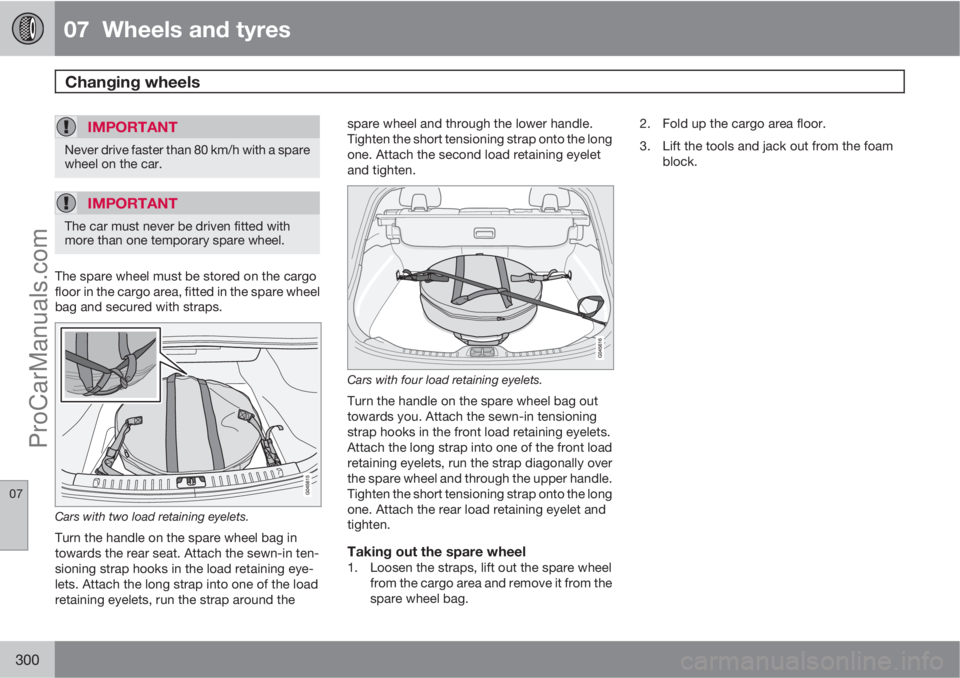
The spare wheel must be stored on the cargo
floor in the cargo area, fitted in the spare wheel
bag and secured with straps.
Cars with two load retaining eyelets.
Turn the handle on the spare wheel bag in
towards the rear seat. Attach the sewn-in ten-
sioning strap hooks in the load retaining eye-
lets. Attach the long strap into one of the load
retaining eyelets, run the strap around thespare wheel and through the lower handle.
Tighten the short tensioning strap onto the long
one. Attach the second load retaining eyelet
and tighten.
Cars with four load retaining eyelets.
Turn the handle on the spare wheel bag out
towards you. Attach the sewn-in tensioning
strap hooks in the front load retaining eyelets.
Attach the long strap into one of the front load
retaining eyelets, run the strap diagonally over
the spare wheel and through the upper handle.
Tighten the short tensioning strap onto the long
one. Attach the rear load retaining eyelet and
tighten.
Taking out the spare wheel1. Loosen the straps, lift out the spare wheel
from the cargo area and remove it from the
spare wheel bag.2. Fold up the cargo area floor.
3. Lift the tools and jack out from the foam
block.
ProCarManuals.com
Page 304 of 400
07 Wheels and tyres
Warning triangle and first-aid kit*
07
302* Option/accessory, for more information, see Introduction.
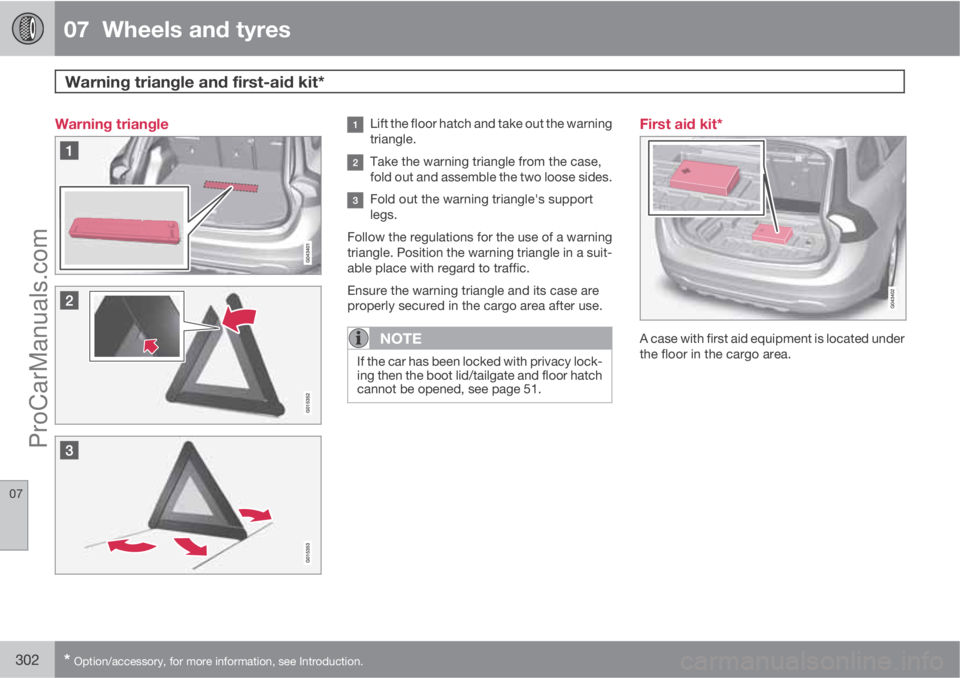
Warning triangleLift the floor hatch and take out the warning
triangle.
Take the warning triangle from the case,
fold out and assemble the two loose sides.
Fold out the warning triangle's support
legs.
Follow the regulations for the use of a warning
triangle. Position the warning triangle in a suit-
able place with regard to traffic.
Ensure the warning triangle and its case are
properly secured in the cargo area after use.
NOTE
If the car has been locked with privacy lock-
ing then the boot lid/tailgate and floor hatch
cannot be opened, see page 51.
First aid kit*
A case with first aid equipment is located under
the floor in the cargo area.
ProCarManuals.com
Page 315 of 400

08 Maintenance and service
Engine compartment
08
313
Turn the handle about 20-25 degrees
clockwise. You will hear when the catch
releases.
Move the catch to the left and open the
bonnet. (The catch hook is located
between the headlamp and grille, see illus-
tration.)
WARNING
Check that the bonnet locks properly when
closed.
Engine compartment, overview
The appearance of the engine compartment may
vary depending on engine variant.
Coolant expansion tank
Power steering fluid reservoir
Engine oil dipstick1
Radiator
Filling engine oil
Reservoir for brake and clutch fluid
(located on the driver's side)
Battery
Relay and fuse box
Filling washer fluid
Air filter
WARNING
The ignition system has very high voltage
and output. The voltage in the ignition sys-
tem is highly dangerous. The remote control
key must always be in 0 position when work
is being done in the engine compartment,
see page 80.
Do not touch the spark plugs or ignition coil
when the remote control key is in II position
or when the engine is hot.
Checking the engine oil
1Engines with electronic oil level sensor have no dipstick (5-cyl. diesel).
ProCarManuals.com