2012 VOLKSWAGEN GOLF starting
[x] Cancel search: startingPage 278 of 516
Braking, stopping, and parking
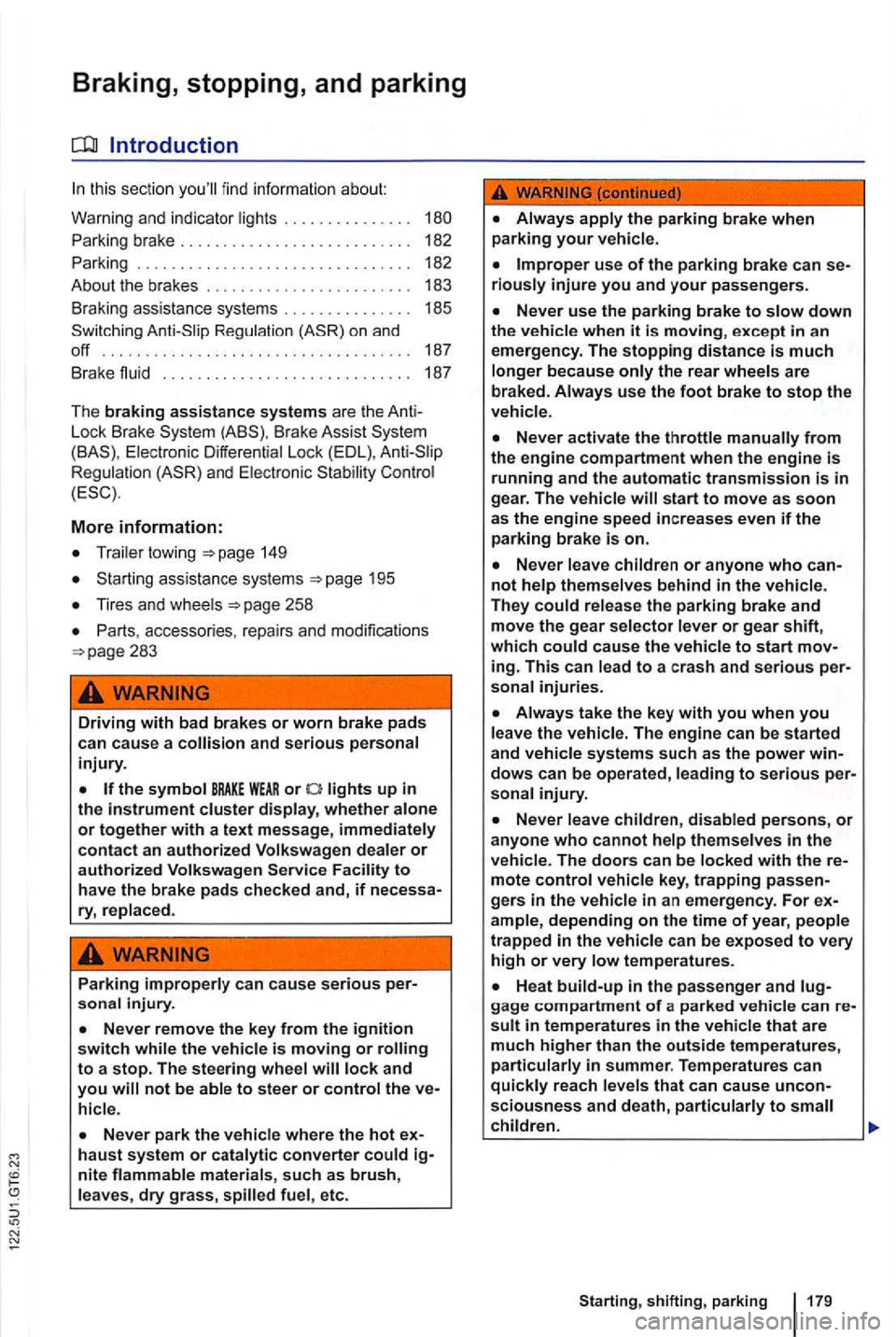
this sectio n
Parking brake . . . . . . . . . . . 182
P arking . . . . . . . . . . . . . .
. . . . . . . . . . . . . . . . . 182
About the brakes . . . . . . . . . . . . . . . . . . . . . . . . 183
Braking assistance systems
Switching
L ock Brake System (ABS) . Br ak e Assist System
(BAS ), Ele ctronic Differential Lock (EDL), R eg ulatio n (ASR) and Electronic C ontrol
(ESC).
More information:
Trai ler towi ng 149
Starting assistance systems 1 95
Tires and whee ls 258
Driving with bad brakes or worn brake pads can cause a and serious personal
injury.
lights up in the instrument cluster display, whether alone or together with a text message, immediately contact an authorized Volkswagen dealer or authorized Facility to have the brake pads checked and, if necessa
ry, replaced .
Parking improperly can cause serious sonal injury.
lock and you
haust system or catalytic converter could
fu el, etc.
riously injure you and your passengers.
sonal injury.
mote control vehicle key, trapping passengers in the vehicle in an emergency. For ample, depending on the time of year, people trapp ed in the vehicle can be exposed to very high or very low temperatures.
children.
Starting, shifting, parking 179
Page 280 of 516
Lights cause or up
I
ES deactivated.
I Together with indicator malfunction .
T ogethe r with warning
or BRAKE:
Brake not dep ressed.
cause
I
The butt on in the is not
engaged .
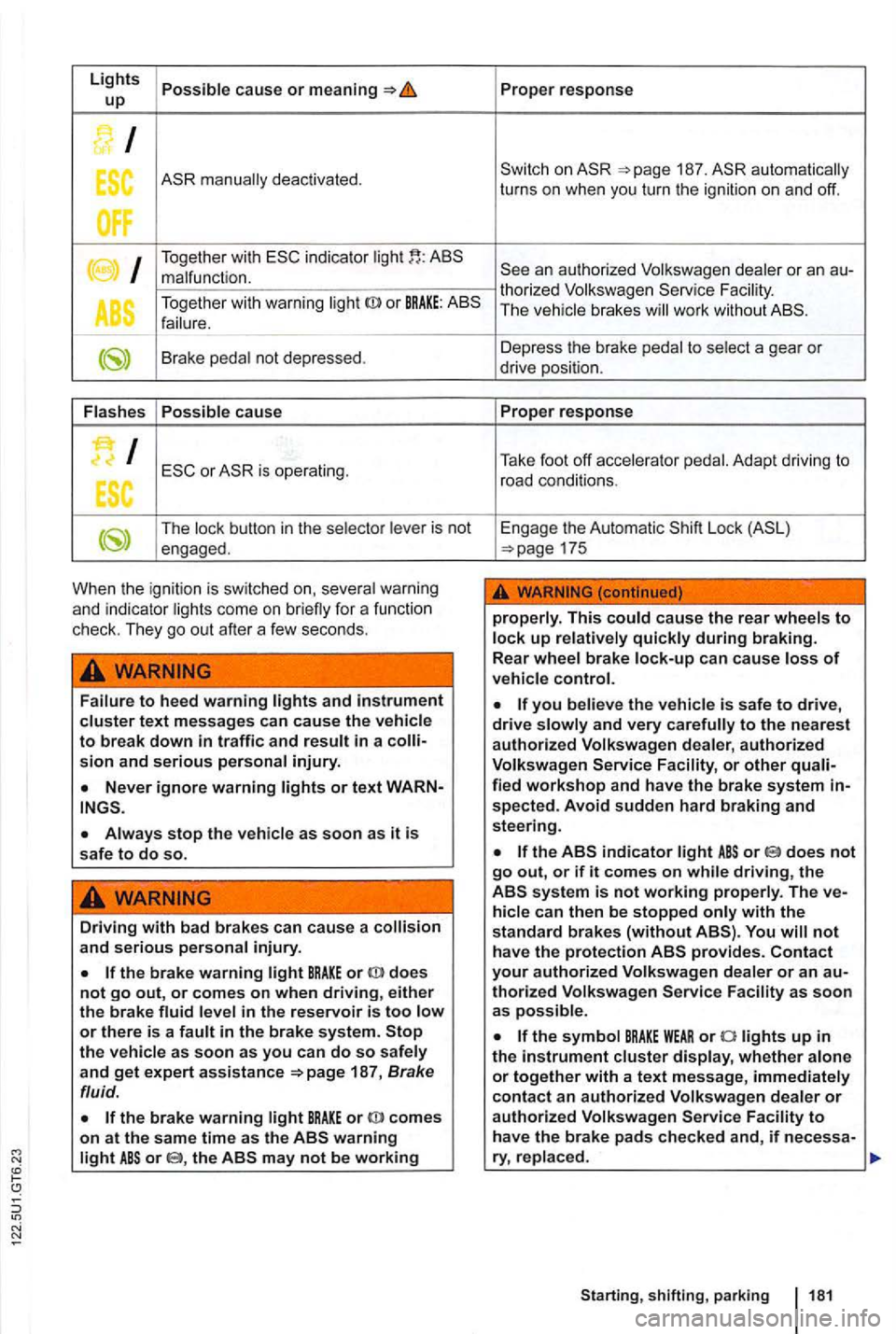
When the ign ition is switch ed on,
text messages can cause the to break down in traffic and
or text WARN
stop the as soon as it is safe to do so.
Driving with bad brakes can cause a and serious
the brake warning BRAKE or does not go out, or comes on when driving, either the brake or there is a the as soon as you can do so and get expert assistance 187, Brake
fluid.
the brake warning comes on at the same time as the or the
187 . automatically
turns on when you turn the ignition on and off.
an authorized Volkswagen or an thorized Volkswage n The brake s work without
to
Adapt driving to
road conditions.
E ngage the Automatic
Lock
This up brake
you is safe to drive, drive and very authorized Volkswagen Service or other
spected. Avoid sudden hard braking and steering.
or does not go out, or if it comes on while driving, the system is not working can then be stopped with the
s tandard brakes (without not have the protection
thorized Volkswagen Service as soon as
Starting, shifting, parki ng 181
Page 288 of 516
this section find info rmat ion about:
Effi cient driving sty le
....... . 189
Fue l-efficient driv in g . . . . . . . . . . . . . . . . . . . . .
Fuel consumpti on, envi ronme ntal impact, and wear
a nd tear on eng ine, brakes and tires depend main
l y on the
pe rsona l d riving style.
External conditions (weather , road condi tions).
Technical requir emen ts.
Efficient driving
on page 189.
Shifting faster
As a rule , th e app lies: The h igh er gear is
a lways the most e ffi cient gear . The rule of thumb
for mos t veh icles is to drive in 3rd gear at
mph
gears when upshifting also saves
Do not run the gea rs up to their lim it. Use 1st gear o nly to s tart movin g and then sm oot hly s hift into
2 n d gear. Avoid kick-do wns in vehicl es with auto
matic tra nsm issions.
Coasting
you take your foot off the accel erator, fuel de livery to the engine is interrupted , which lowers fuel consum ptio n.
Therefo re , whe n nearing a red stop for in
stance , the veh icle to coas t without usin g the
accelerator . Pre ss the peda l a nd release it
o nly if the vehicle mov ing too slowly or the coast
ing distance is too long. The engine
situa tions where the
swi tch off the eng in e.
conditions.
Freq uent braki ng and accelerat ion increase s fuel
cons umption significantly . Just by driving defen
s ive ly and keep ing a sufficiently large
distance
away fro m the
caused by taking your foot off the accelerator . Active braking and acceler
at ing is then not nece ssarily re qu ired .
Calm and smooth driving
Consistency is more important than speed. The
m ore smo oth ly you drive , the less fuel the vehic le
consumes.
Whe n driving
on the highw ay or free way, a co n
stant , m ode rate speed is more efficien t and eco
n omi ca l than constantly accelerating and brak ing.
you can reach your dest ination just as
quick ly by driv ing at a mod erate, but steady sp eed.
Th e crui se control syst
em can assist in mainta ining
a un iform dri vin g style.
Moderate use of extra electrical loads
Comfort in sid e the ve hicle is nic e and important ,
but it is importa nt to use the m in an envi ronm enta l
l y conscious manner.
Some devices can increase fuel consumptio n
whe n activated (exa mples):
Starting, shiftin g, parki ng 189
Page 289 of 516
Climate control system (air cond itioner): th e
trast ing temperatures , it requires a large amount of energy, which is genera ted by the engine. The
tempe ratu re in the shou ld therefore not be
ext remely different from that of the outside ature . may be to venti la te the veh icle fore driving and then to drive a short distance with
the windows open. After that, sw itch on the air
Keep the
windows increase fuel consumption.
off the rear window defroste r as soon as
t he windows are free of fog and ice.
14
miles
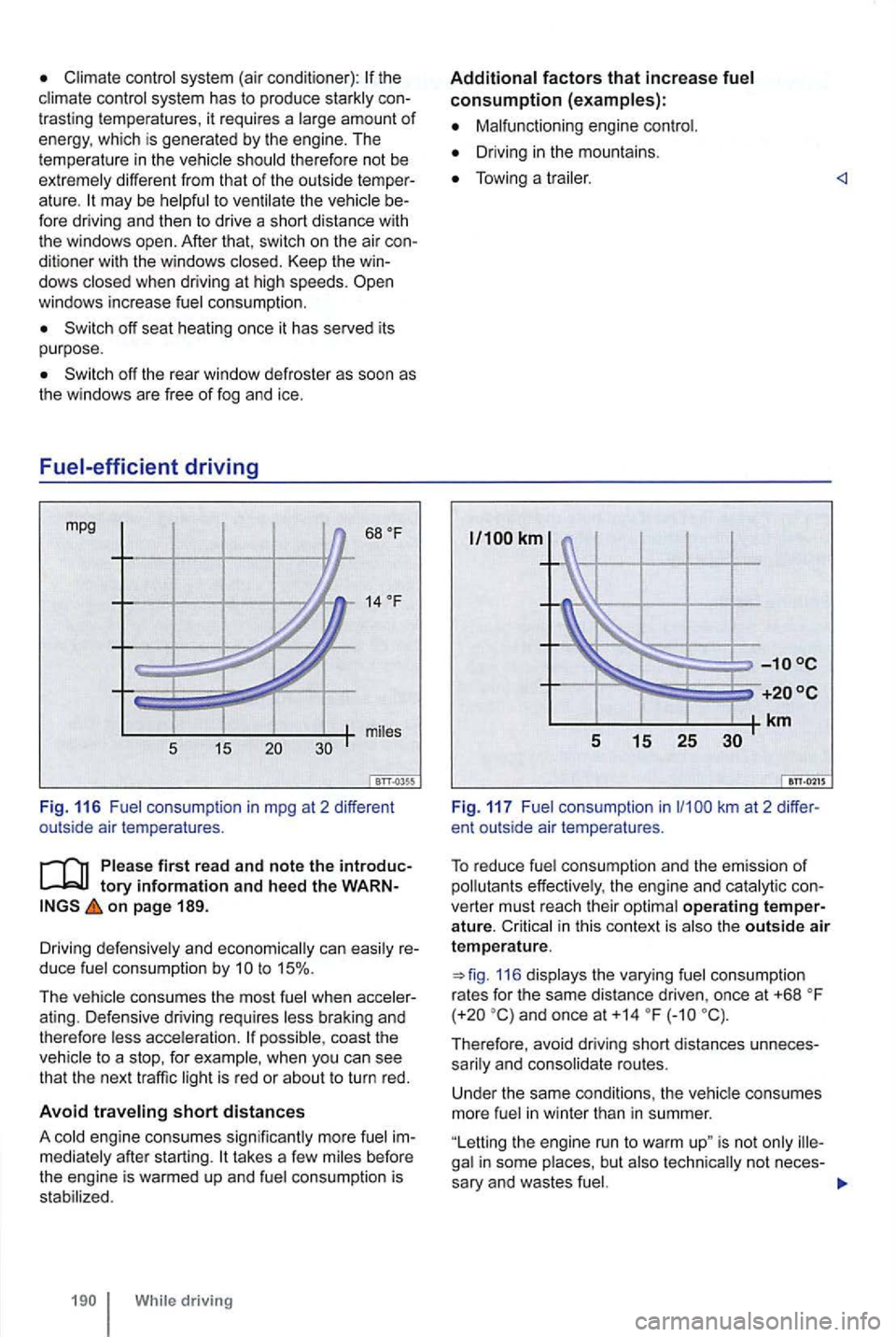
Fi g.
116 F uel consumption in mpg at 2 different
outside air temperatures .
on page 189.
D riving defensive
ly and economica lly can easily duce fuel cons umptio n by to 15%.
The veh icle consumes the most fuel when ating. Defensive driving requires less braking and
ther efore less acceleration. possibl e, coast the
vehicle to a stop , for example, when you can see that the next traffic light is red or about to turn red.
Avoid traveling short distances
A co ld engine consumes sign ificantly more fuel media tely after starting .
consumption (examples):
Malfunction ing eng ine control.
Drivi ng in the mountain s.
T owing a tra iler.
-1
Fig. 117 Fuel consumption in ent outside air temperatures .
To reduce fuel consumption and the emission of
ature. Criti cal in thi s con te xt is also the outside air temperature.
T herefo re , avoid driving short distances sarily and consolidate routes.
Un der the same conditions , the veh icle consumes
more fuel in winte r tha n in summer.
in some places, but also not neces -
Page 291 of 516
Steering
Introduction
this section
is an system. The advantage of this
steering system is that no hoses,
quired. The system is more
pressure in the system; an
steering.
The electro-mechanica l power steering syst
em tomatically adjusts to driving speed, steering of the
turning the
Starting and stopping the engine
battery page 238
Towing
Warning and indicator lights
Turning the stee ring
the
when the
the coast with the engine switched off.
the to a stop. Th e steering and you b e to the
Li g
hts up ca use Proper response
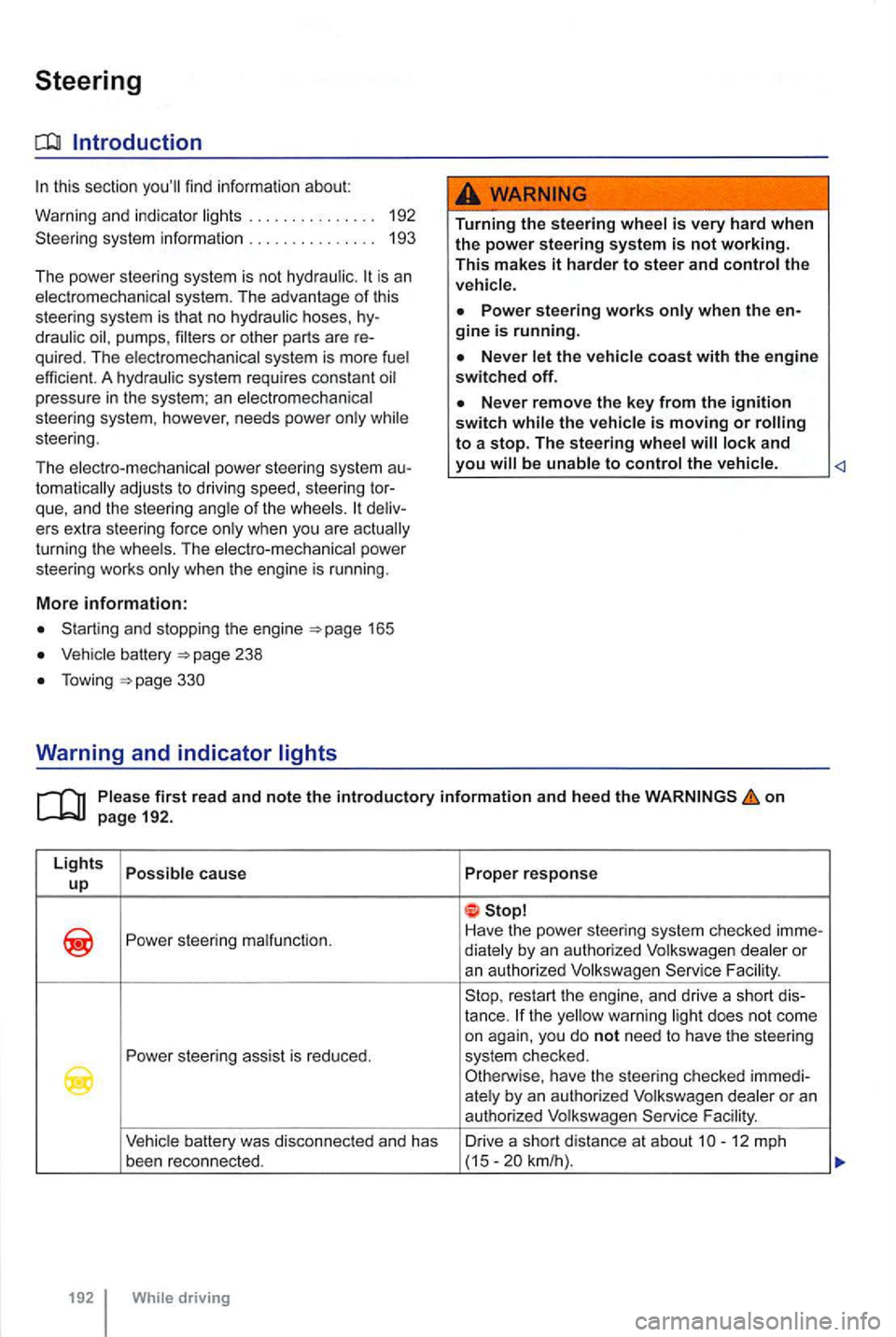
Power steering malfuncti on. Have
the powe r stee ring system checked imme-by an authorized Volkswagen or an authorized Volkswagen Service
Stop, restart the engi ne. and drive a short dis-
lance . the does not come
on again, you do not need to have the steering
P ower steering assist is reduced . system checked .
Otherwise , have the steering checked immedi-by an authorized Volkswagen
12 mph
been reconnected . (1 5 -
Page 294 of 516
Driver assistance systems
Starting assistance systems
Volksw age n Informatio n pag e 24
pa ge 179
Vehicle batt ery
p age 2 58
Jump-s ta rting page 327
The
on p age 195 .
fo r examp le afte r
s topping at a traffic light. don't have to app ly
an d r elease th e park ing brake whil e depress ing the
accele ra tor . For
The dynam ic sta rting assistance feature s
cannot keep the vehicle from moving in all hill-start situations (for example, if the ground is slippery or icy).
Driving with too little fuel in the fuel tank in-
c rea se s th e risk of especially when driving up and down hills.
H old keeps th e bra ke a ppl ied for not quit e
2 seconds with the same force you u sed t o p reve nt the veh ic le f rom mov ing. This gives you time to
t ake your foot off the brake , let the clu tch out on a manual transm issio n veh ic le, a n d gently depress
the accele ra tor to get the veh icle m ovi ng agai n.
F urther more, if any requi remen t for engagi ng
Ho ld disengages and the brakes are automati no longer ho ld th e vehic le.
Driver ass is tance systems 195
Page 322 of 516
Never open or close the engine hood if To reduce th e risk of electrica l shock and steam or coolant is escaping. Hot steam or personal injury
-Never touch ignition cables. Never ant escaping from the engine. touch other components of the high
Always the eng ine down com-age electronic ignition syste m .
opening the hood.
-Never touch the wiring of the Discharge (Xenon) headlights.
system burn skin on contact.
you are read y to open the hood: Moving parts in th e engine compartment can
- Firm ly apply the parking brake a nd shift cause serious personal injury on contact. the transmission into Park (P) (automatic)
vehicles with Keyless Access, make member that the radiator fan is temperature-
s
ure that the remote contro l vehicle key is controlled and can come on sudden ly even
out of range of th e vehicle and that the ve- when the engine
has been switched off for a
hicl e cannot be started by depres sing the 44. ignition.
-
Always keep children and others away you have to perform a check or repair from the engine compartment and never when the engine is runn ing, there are more leave them unsupervised. risks from the rotating parts, such as the
hair do not get caught in
ries. rotating engine
parts. B efore starting an y
- Turn
the cap
fluids onto hot parts of the engine o r exhaust system can
cause a fire. -
Always use
extreme caution if the ac-
ce lerato r pedal has to be depressed to perform a check. The vehicle will start to move even if the parking brake i s on.
Never leave any objects in the engine compartment, for examp le cleaning rags and tools. Objects left b ehind can cause malfunc-lions, engine damage, and even fires.
High voltage sy stems in the engine com part-ment can ca use electrica l shocks or even
electrocution, severe burns, other serious in-juries, and eve n deathl
Neve r short-circuit the electrica l syste m .
B e especially ca reful when using jumper ca-
Operating fluids and some materials in the engi ne compartment can catch fire easily, causing burns an d other serious personal in-juries
Do not smoke .
b les. The
vehicle 's battery could exp lode! Never work next to open flames or sparks .
223
Page 409 of 516
Changing a wheel
Introduction
this sect ion you 'll find informati on about:
for changi ng a wheel . . . . . . . . . 311
Wheel bolts . . . . . . . . . . . . . . . . . . . . . . . . . . . . 311
Lifting the vehi cle with the vehicle jack . . . . . . 313
Changing a whee l ....................... 315
After ch anging a wheel
................... 315
Change a wheel by yourse lf only if the vehicle is
park ed in a safe loca tion , you are fam
ilia r with
safe ty procedures and the technical steps, and you
ha ve proper too ls ava ilable . Otherwise , get expert
ass istan
ce.
More information:
Exterior views 6
Vehicle key set
Tires and whee ls 258
an em ergency
Vehicle tool kit
W heel covers
Changing a wheel ,
proaching traffic.
you are towing a trailer, always unhitch it from your vehicle before starting to change the wheel. Always apply the trailer brakes firmly and make sure the trailer cannot move unintentionally.
ing the transmission in Par k (P) or in gear
proved for use on other Volkswagen models.
es , and serious personal injuries, never en the screws on rims with threaded rim rings.
rate torque wrench.