Page 209 of 516
you to route the belt around the head restraint.
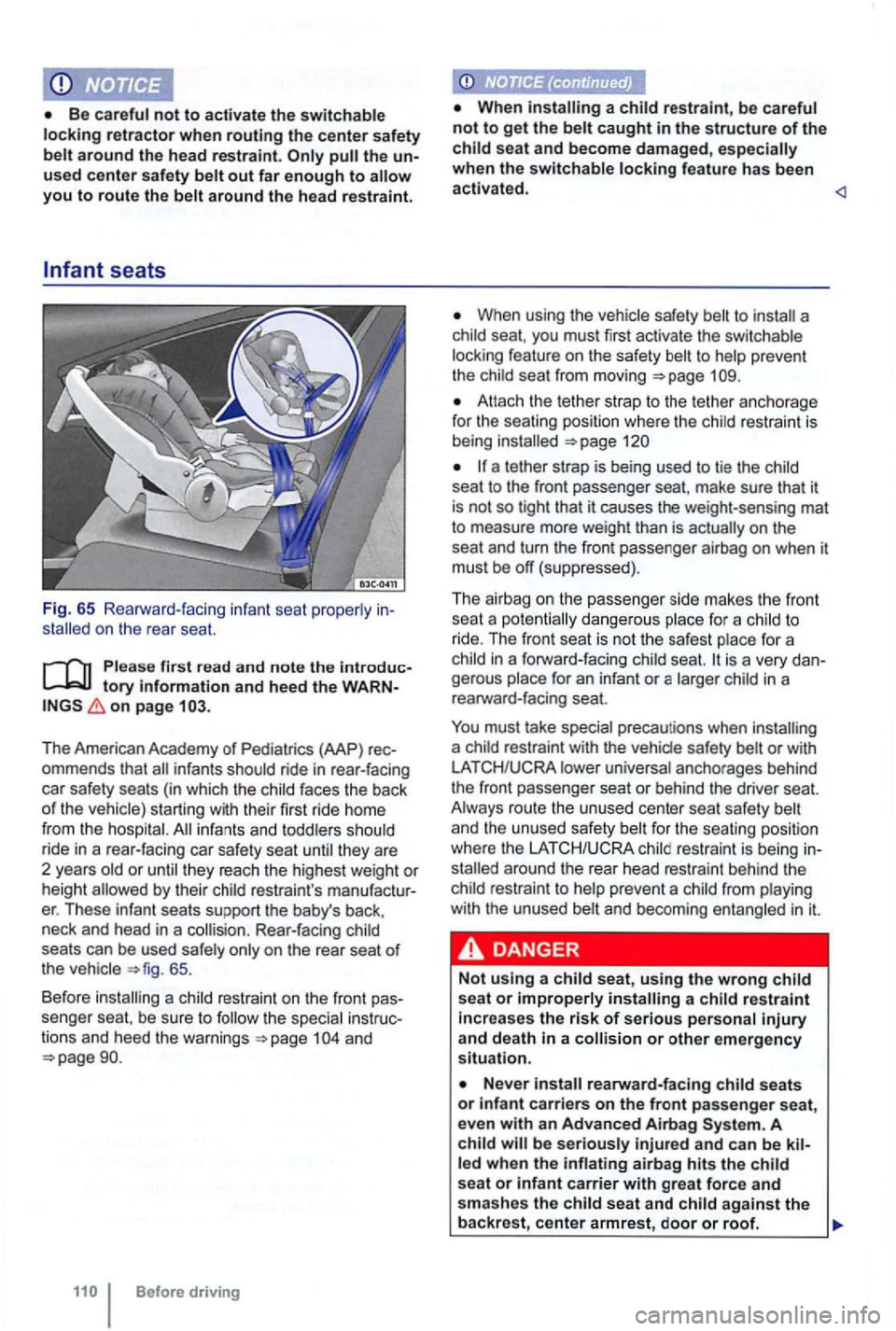
on the rea r seat.
on pag e
The American Academy of Pediatrics (AAP) ommends that infants shou ld ride in rear-facing
ca r safety seats (in whic h the child faces the back
o f the vehicle) starting wi
th their first ride hom e
from the i nfants and todd le rs s hould
r ide in a rea r-facing car safety seat until they are
2 years
Rear- facing child
seats can be used safely only on the rea r sea t of the vehicle 65 .
Before
a ch ild restrain t on the front senge r sea t, b e s ure to the specia l in str u c
t ions and h eed the wa rning s and
Before driving
. ,
When using the vehic le safe ty
to help prevent
the sea t from mov ing
a tether strap is being used to tie the child
seat to the front passenger seat, make sure that it
is not so tight that it causes the weig ht-sensing mat
to measu re more weight than
is actually on the
seat and turn the front passenger airb ag on when it
mus t be off (suppressed).
Th e ai r
bag on the passenger side makes the front seat a pote nti ally dangerous place for a ch ild to
ride. The fron t sea t is no t the safest place fo r a is a very gerous place for an infant or a larger
seat s or infant carriers on the fron t pas senger sea t,
eve n with an Advanced Airbag System. A child
again st the
b ackres t, center armrest, door or roof.
Page 252 of 516
Volkswagen Service Vehicles with Xenon
gas-discharge self-adjust to vehicle load
and do not need manual adjustment.
Special towing considerations
th e t railer has an overrun brake, apply the
br akes
Due to the combined towing weight including
the higher gross vehicle weight, the stopping
tance is longer.
Be fo re drivi ng especially on
The vehicle's center of grav ity and , in turn, the
Weight distribution is especially bad if the is emp ty and the trailer is loaded.
Depending on how steep the is an d the
backwards when you first start moving.
When starting off with a tra iler on a
Depress and hold the brake pedal and depress
and hold the clutch (manu al transmission).
171, Shifting .
Unlock the parking brake a nd gently release it
whi le holding the unlock button. At the same time,
release the brake pedal and
depress the
accelerator and, for manual transmissions , let out
the clutch
you can feel the car moving ward . applicable, follow the instruct ions for the Hold feat ure
Do not release the parking brake lever until the
engine starts to move the vehicle forward. your
vehicle has an automatic tr ansmission , you can
so depress and hold the brake peda l for added
b raking and then Jet up on the brake pedal when
you feel that the to move forward .
Drive ahead slowly.
hicle contro l and serious per sonal injury.
dles and increases the distance it needs to stop safely .
Always adapt your sp ee d and driving to th e heavier loa d and the weight distribution in the vehicle. Tak e road , weather , traffic, and visibility conditions into account as well .
Always avoid sudde n maneuv ers and ha rd braking.
atin g.
som e areas
s p ee d for vehicles towing trailers are
lower than for vehicles without trailers.
T ra n spo rting
Page 262 of 516
N
12 Volt sockets
Introduction
sockets in the . . . . . . . . . . . . . . 163
devices can be connecte d to the 12 socke ts .
Th e co nn ected devices
must be in good worki ng
order .
More information:
Parts . accessories. repairs a nd modifications 283
Consume r informa tion
use of
unattended in the and connected devices can be
used when the ignition is switched on.
switch it off and disconnect the power
12
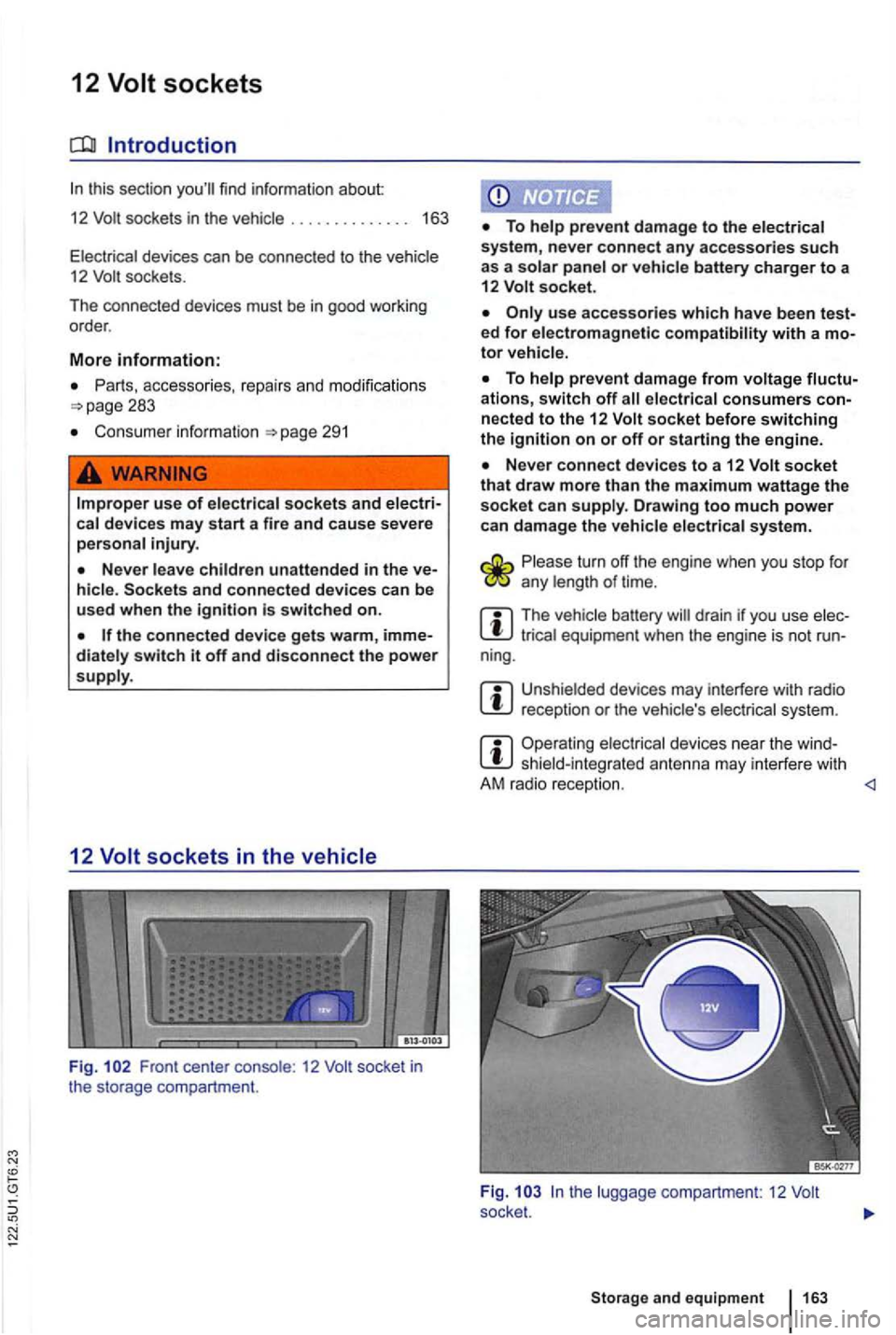
Fig . Front center 12
or battery charger to a
12 socket.
ed for electromagnetic with a
ations, switch off nected to the 12 socket before switching the ignition on or off or starting the engine.
socket that draw more than the maximum wattage the socket can Drawing too much power
can damage the
turn off the engine when you stop for any of time.
m The battery drain if you use equipmen t when the engine is not run-
ning.
m reception or the system.
m Operating shiel d-integrat ed ant enna may interfere with
A M r adio recept ion.
Fig . the luggag e compartment: 12 socket.
and equipment
Page 264 of 516
Explanatory notes in this section regarding tomatic transmissions Direct
an unauthorized vehicle key is used or the sys
tem mal functions , Immobilizer active! may
appear on the instrument
stead wh ile following proper and safe procedures.
More information:
Vehicle key set
Shifting gears
Braking , stopp ing and parking =>page 179
Steering 192
Startin g assistance systems
Refueling =>page 214
Emergen cy clo sing and opening
Jump-starting
Towing
off the engine while the vehicle is moving can make the vehicle harder to stop and result in loss of vehicle control, leading to collisions and severe perso nal injurie s.
To reduce the risk of serious personal injury when starting and running the vehicle's gine:
shifting, parking 165
Page 266 of 516
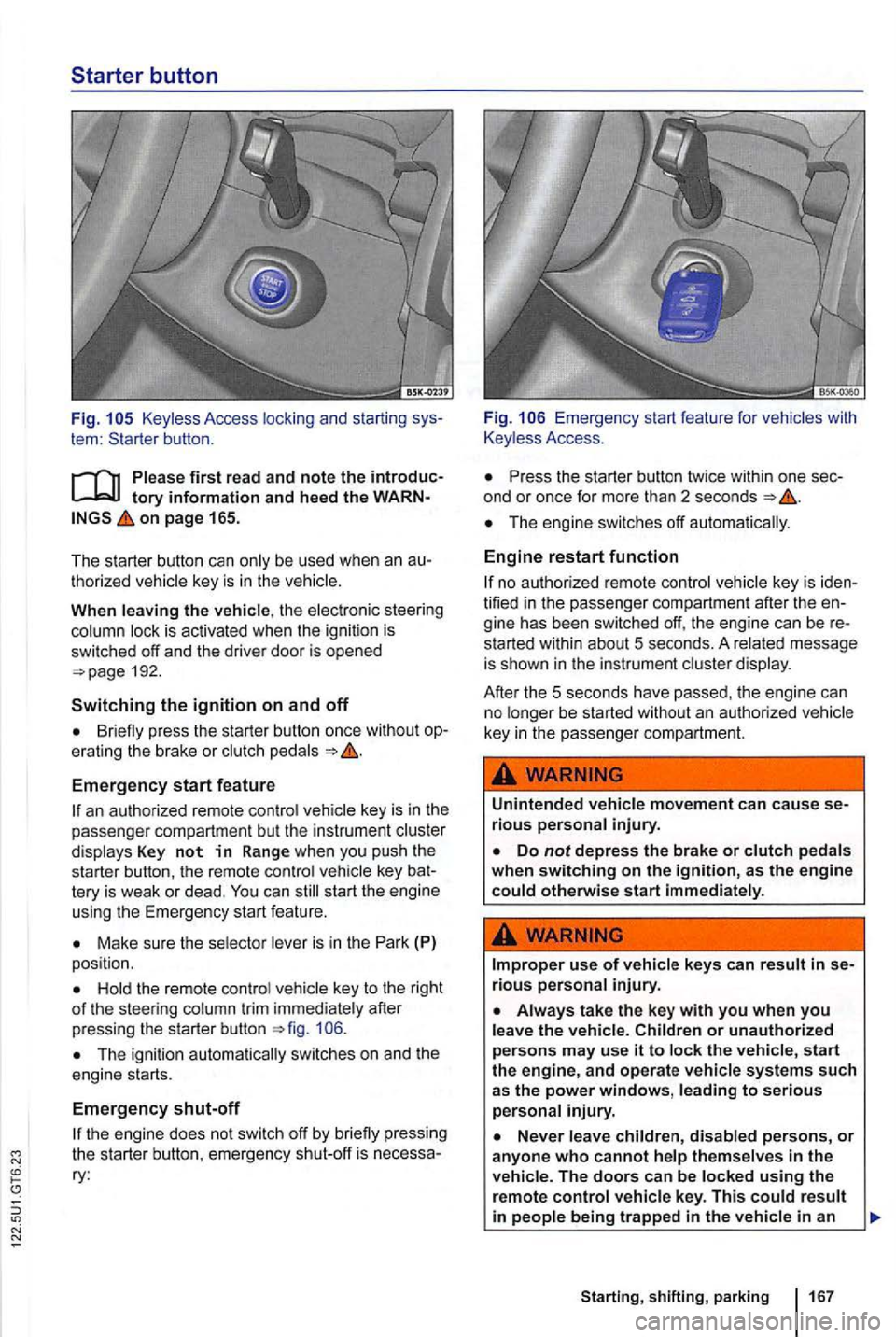
Keyless Access locking and starting sys
tem :
on page 165.
The starter button
be used when an au
t horized
the elec tronic steering is ac tivated when the ignit io n is
swi tched off and the driver door is opened
192.
Switching the ignition on and off
press the starter button once without op
e rating the brake or
Emergency start feature
an authorize d remote veh icle key is in the
passenger compartment but the inst rume nt
can
Make sure the
key to the right of the steering trim immed iate ly after
p ressing the starter button
the
eng ine starts.
Emergency shut-off
the engine does not switch off by
Press the starte r butt on twice within one sec
ond or once for more than 2 secon ds
Engine restart function
no author ize d r emote control veh ic le key is iden
tified in the passenger compartmen t afte r the en
gine has been switched off, the engin e can be re
s tarted wi
thin about 5 seconds . A rela ted message
is sh ow n in the instrument cluster displa y.
Afte r the
5 seconds have passed, the engine can
n o be started without an author ized ve hicle
key in the passenger compartment.
Unintended
in se
rious
start th e engine, and operate vehicle systems such as the power windows,
The doors can be
Starting, shifting, parking 167
Page 267 of 516
emergency. For example , depending on the time of year, people trapped in the vehicle
ca n be exposed to very high or very low tem
peratures .
Heat
quickly reach levels that can cause unconsciousness and death , particularly to
runn in g and the drive r doo r is op ened , a
chime sounds. T he chim e is also a re minde r to swi tch off the engine and turn off the ignition b efore
leavin g and locki ng th e veh icle from the out side .
on page 165.
(auto m atic) , or into Neut ral (manu a l o nly) .
167-
3. Turn the veh icle ke y to posi tion -do no t dep ress the accelerator p ed al. A n au-
do not depr ess the accele ra to r p ed al. t
h oriz ed vehicle key must be insi de t he ve h ic le
i n order to start th e engin e .
4 . Wh en the engi ne s ta rts, release th e v ehic le W
he n the e ng ine starts, release th e sta rte r but-
key . to n .
the engi ne does not start , swi tc h off the igni- tion an d s tart aga in after ab ou t o ne minute .
t io n and sta rt again after about one minut e. Use
the em ergenc y sta rt function if n ecessary 16 7 .
6 .
R elease the pa rking brake when you are ready to s tart dr iving 179 .
Never leave the vehicle unattended while the
engine is running. The vehicle could move suddenly, espec ially when the vehicle is in
gear, resulting in accidents and persona l in-jury.
can explode and can cause a vehicle condition.
Never use starting assist fluids .
moving, or if you try to restart the engine right after switching it off.
Avoid high engine speeds,
Do not le t your ve hicle warm up while stan ding; in stead . start drivi ng right awa y aft er making s ur e that yo u have good visib ilit y t hro ug h w indows. This help the e ngine reac h opera t
ing temp e rature faste r an d ke ep d own emissions.
Page 268 of 516
Major con sumers of are sw itched off when the engine is being started .
Stopping the engine
After start ing a engin e, there may be creased operating noises fo r a few seconds .
This is
first read and note the introductory information and heed the on
perform each step
without Keyless Access Vehicles with Access
1. Bring the to a
2. Dep res s and down the brake s tep 4 is
3 . A ut omatic transmission: th e transmission into Park (P) .
4 .
the parking brake to fr om moving
in Briefly press the starter button 167. 5. the engine 167.
6 . With
a
tran smi ssion , shift into 1st gear or re-
ve rse pointin g down hill).
Never stop the engine before the has
come to a trol of the vehicle, crash, and be
be needed to stop the
not be able to steer the
the engine
running and the driver door is opened, a
c him e sounds. Th e c hime is a re minder to
sw itch off the engine and turn off the igniti on before and from the outside.
with automatic t ransmissio ns. the be remov ed from the
ignition when the transmission is in Park (P).
After the engi ne has been switched off. the radiato r fan in the engine compartment may
keep running for ning after the even if the ignition is sw itche d off and t he ve hicle
key has bee n remo ved. Th e radiat or fan sh uts off
automatically when th e engine has down
enough.
Starting, shifting, parking 169
Page 272 of 516
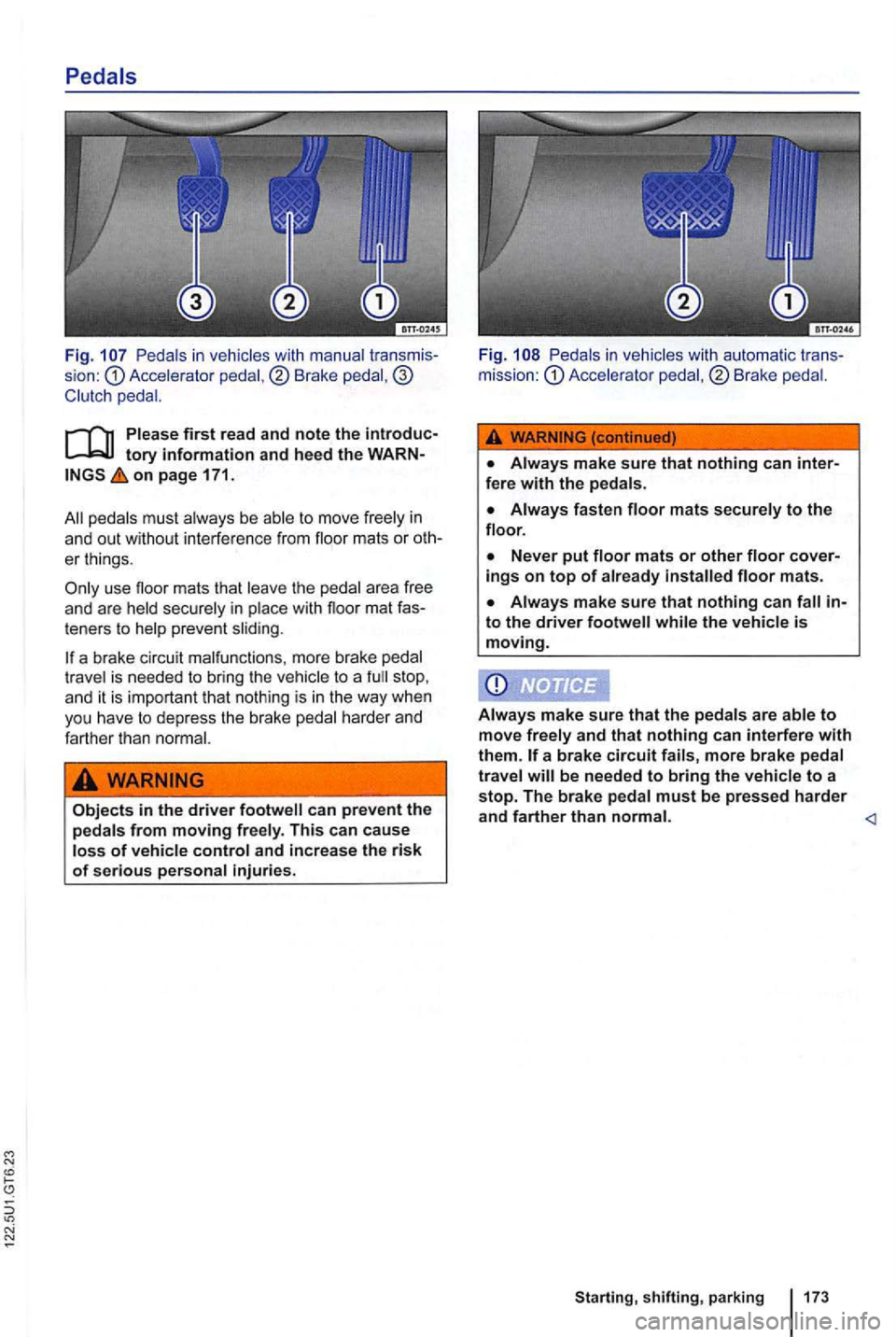
Pedals in vehicles with manual sion : Accele rator pedal ,® Brake
on page 171.
peda ls must always be able to move freely in
a n d out without interference from floor mats or oth
er thing s.
te ners to help preve nt slid ing.
a brake circu it malfunct ions, more brake pedal
tr ave l is needed to bring the ve hic le to a stop ,
and it is important that noth ing is in the way when
yo u have to depress the brake pedal harde r and
farth er than
Objects in the driver footwell can prevent the pedals from moving freely . This can cause loss of vehicle control and increase the risk of serious personal injuries. Fig.
Pedals
in vehicles with au tomatic Acce le rator pedal ,® Brake
a brake circuit fails, more brake pedal
travel will be needed to bring the vehicle to a
stop. The brake pedal must be pressed harder and farther than normal.
Starting, shifting, parking