2012 TOYOTA VERSO roof
[x] Cancel search: roofPage 144 of 588

144 1-7. Safety information
VERSO_WE_OM64524E
CAUTION
SRS airbag precautions
Do not touch any of the component parts immediately after the SRS air-
bags have deployed (inflated) as they may be hot.
If breathing becomes difficult after the SRS airbag has deployed, open a
door or window to allow fresh air in, or leave the vehicle if it is safe to do
so. Wash off any residue as soon as possible to prevent skin irritation.
Vehicles without SRS curtain shield airbags: If the areas where the SRS
airbags are stored, such as the steering wheel pad, are damaged or
cracked, have them replaced by any authorized Toyota dealer or repairer,
or another duly qualified and equipped professional.
Vehicles with SRS curtain shield airbags: If the areas where the SRS
airbags are stored, such as the steering wheel pad and front and rear pillar
garnishes, are damaged or cracked, have them replaced by any
authorized Toyota dealer or repairer, or another duly qualified and
equipped professional.
Modification and disposal of SRS airbag system components
Do not dispose of your vehicle or perform any of the following modifications
without consulting any authorized Toyota dealer or repairer, or another duly
qualified and equipped professional.
The SRS airbags may malfunction or deploy (inflate) accidentally, causing
death or serious injury.
Installation, removal, disassembly and repair of the SRS airbags.
Repairs, modifications, removal or replacement of the steering wheel,
instrument panel, dashboard, seats or seat upholstery, front, center and
rear pillars or roof side rail.
Repairs or modifications of the front fender, front bumper, or side of the
occupant compartment.
Installation of snow plows, winches, etc. to the front grille (bull bars, kan-
garoo bar etc.).
Modifications to the vehicle’s suspension system.
Installation of electronic devices such as RF-transmitter radios or CD play-
ers.
Page 151 of 588
151 1-7. Safety information
1
Before driving
VERSO_WE_OM64524E
CAUTION
Using a child restraint system
The use of a child restraint system not suitable for the vehicle may not prop-
erly secure the infant or child, resulting in serious injury or even death.
Child restraint precautions
For effective protection in automobile accidents and sudden stops, a child
must be properly restrained, using a seat belt or child restraint system
depending on the age and size of the child. Holding a child in your arms is
not a substitute for a child restraint system. In an accident, the child can be
crushed against the windshield, or between you and the vehicle’s interior.
Toyota strongly urges the use of a proper child restraint system that con-
forms to the size of the child, installed on the rear seat. According to acci-
dent statistics, the child is safer when properly restrained in the rear seat
than in the front seat.
Never install a rear-facing child restraint system on the front passenger
seat when the airbag manual on-off switch is “ON”. (P. 167)
In the event of an accident, the force of the rapid inflation of the front pas-
senger airbag can cause death or serious injury to the child.
A forward-facing child restraint system should be allowed to be installed
on the front passenger seat only when it is unavoidable. Always move the
seat as far back as possible, because the front passenger airbag could
inflate with considerable speed and force. Otherwise, the child may be
killed or seriously injured.
Vehicles without SRS curtain shield airbags: Do not allow the child to lean
his/her head or any part of his/her body against the door or the area of the
seat from which the side airbags deploy even if the child is seated in the
child restraint system. It is dangerous if the side airbags inflate, and the
impact could cause death or serious injury to the child.
Vehicles with SRS curtain shield airbags: Do not allow the child to lean his/
her head or any part of his/her body against the door or the area of the
seat, front and rear pillars or roof side rail from which the side airbags or
curtain shield airbags deploy even if the child is seated in the child
restraint system. It is dangerous if the side airbags and curtain shield air-
bags inflate, and the impact could cause death or serious injury to the
child.
Page 275 of 588
275
2
When driving
VERSO_WE_OM64524E
2-5. Driving information
Cargo and luggage
CAUTION
Things that must not be carried in the luggage compartment
The following things may cause a fire if loaded in the luggage compartment.
Receptacles containing gasoline
Aerosol cans
Take notice of the following information about storage precautions,
cargo capacity and load.
Stow cargo and luggage in the luggage compartment whenever
possible.
Be sure all items are secured in place.
Be careful to keep the vehicle level. Placing the weight as far for-
ward as possible helps maintain vehicle balance.
For better fuel economy, do not carry unnecessary weight.
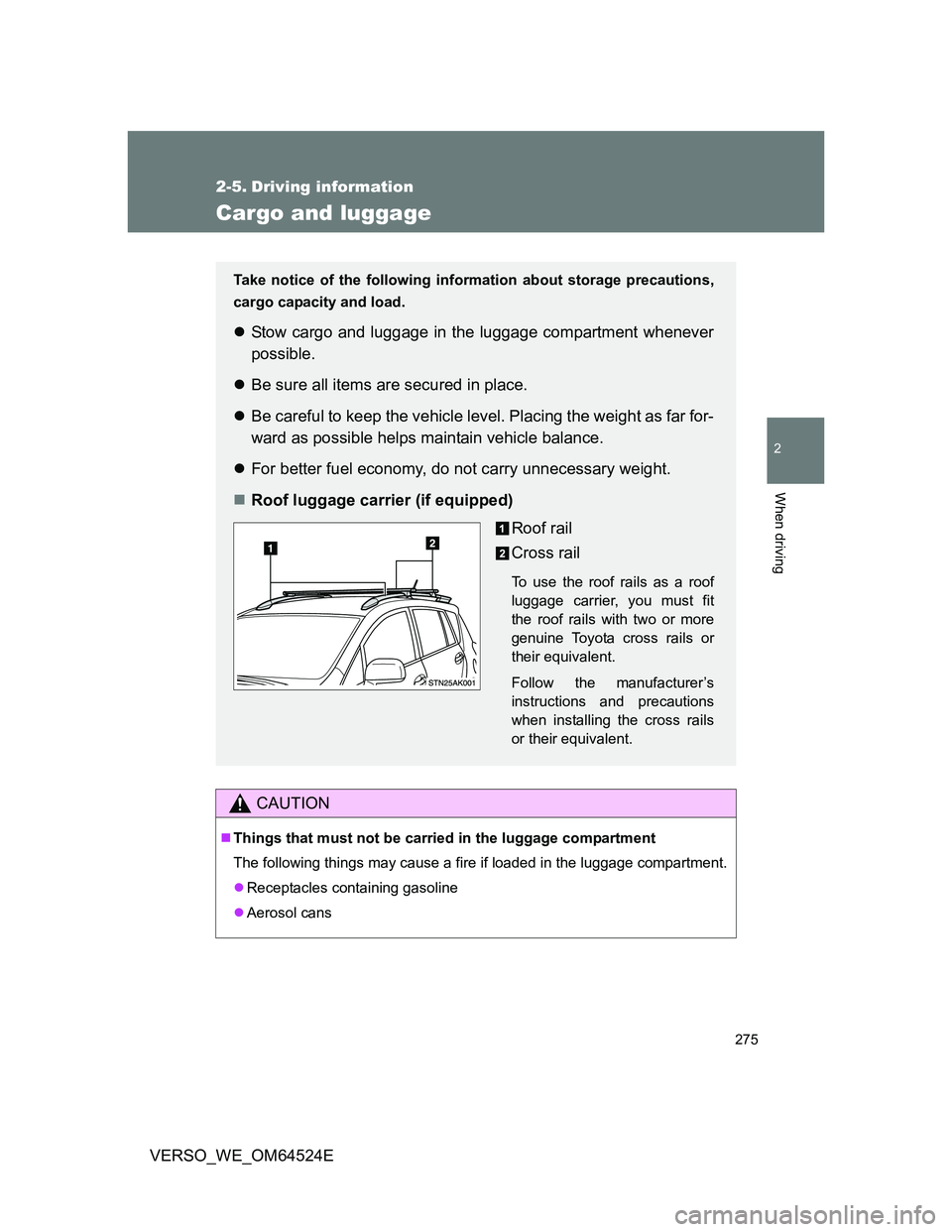
Roof luggage carrier (if equipped)
Roof rail
Cross rail
To use the roof rails as a roof
luggage carrier, you must fit
the roof rails with two or more
genuine Toyota cross rails or
their equivalent.
Follow the manufacturer’s
instructions and precautions
when installing the cross rails
or their equivalent.
Page 277 of 588

277 2-5. Driving information
2
When driving
VERSO_WE_OM64524E
CAUTION
Roof luggage carrier precautions (if equipped)
To use the roof rails as a roof luggage carrier, you must fit the roof rails with
two or more genuine Toyota cross rails or their equivalent.
Follow the manufacturer’s instructions and precautions when installing the
cross rails or their equivalent.
When you load cargo on the roof luggage carrier, observe the following:
Place the cargo so that its weight is distributed evenly between the front
and rear axles.
If loading long or wide cargo never exceed the vehicle overall length or
width.
Before driving, make sure the cargo is securely fastened on the roof lug-
gage carrier.
Loading cargo on the roof luggage carrier will make the center of the vehi-
cle gravity higher. Avoid high speeds, sudden starts, sharp turns, sudden
braking or abrupt maneuvers, otherwise it may result in loss of control or
vehicle rollover due to failure to operate this vehicle correctly and result in
death or serious injury.
If driving for a long distance, on rough roads, or at high speeds, stop the
vehicle now and then during the trip to make sure the cargo remains in its
place.
Do not exceed 100 kg (221 lb.) cargo weight on the roof rails. However, if
the allowable cargo weight of the cross rails is under 100 kg (221 lb.)
observe the load limit and other instructions for the cross rails.
Page 291 of 588

3Interior features
291
VERSO_WE_OM64524E
3-1. Using the air conditioning
system and defogger
Manual air conditioning
system ............................ 292
Automatic air conditioning
system ............................ 297
Power heater .................... 304
Rear window and outside
rear view mirror
defoggers ....................... 306
3-2. Using the audio system
Audio system types .......... 308
Using the radio ................. 314
Using the CD player ......... 319
Playing back MP3 and
WMA discs...................... 324
Operating an iPod............. 330
Operating a USB
memory........................... 336
Optimal use of the audio
system ............................ 343
Using the AUX port ........... 345
Using the steering wheel
audio switches ................ 346
3-3. Using the interior lights
Interior lights list................ 349
• Personal/interior lights
main switch ..................... 350
• Personal/interior lights .... 3513-4. Using the storage features
List of storage features ..... 352
• Glove box ....................... 353
• Console box.................... 354
• Overhead console .......... 355
• Cup holders .................... 356
• Bottle holders.................. 357
• Auxiliary boxes ............... 358
3-5. Other interior features
Sun visors ......................... 361
Vanity mirror ..................... 362
Conversation mirror .......... 363
Portable ashtray................ 364
Cigarette lighter ................ 365
Power outlet ...................... 366
Seat heaters ..................... 368
Armrest ............................. 370
Front seatback table ......... 371
Panoramic roof shade....... 373
Rear side sunshades ........ 376
Floor mat........................... 377
Luggage compartment
features........................... 379
Page 318 of 588
318 3-2. Using the audio system
VERSO_WE_OM64524E
Reception sensitivity
Maintaining perfect radio reception at all times is difficult due to the con-
tinually changing position of the antenna, differences in signal strength
and surrounding objects, such as trains, transmitters, etc.
When is used, automatic station selection and automatic register-
ing of stations may not be possible.
The radio antenna is mounted on the rear roof.
The antenna can be removed from the base by turning it.
Digital Audio Broadcast (DAB) radio
The optional radio antenna and tuner are necessary for the use of Digital
Audio Broadcast (DAB) radio.
NOTICE
To prevent damage, remove the antenna in the following cases
The antenna will touch the ceiling of a garage.
A cover will be put on the roof.
When driving through an automatic car wash.
Any other cases where there is a risk of touching surrounding parts.
Page 373 of 588
373
3-5. Other interior features
3
Interior features
VERSO_WE_OM64524E
Panoramic roof shade
: If equipped
The panoramic roof shade can be operated when
Vehicles without smart entry & start system
The engine switch is in the “ON” position.
Vehicles with smart entry & start system
The “ENGINE START STOP” switch is in the IGNITION ON mode.
Jam protection function
If an object is detected between the panoramic roof shade and the frame
while closing, travel is stopped and the panoramic roof shade opens slightly.
If the panoramic roof shade cannot be closed automatically
Keep the switch depressed.
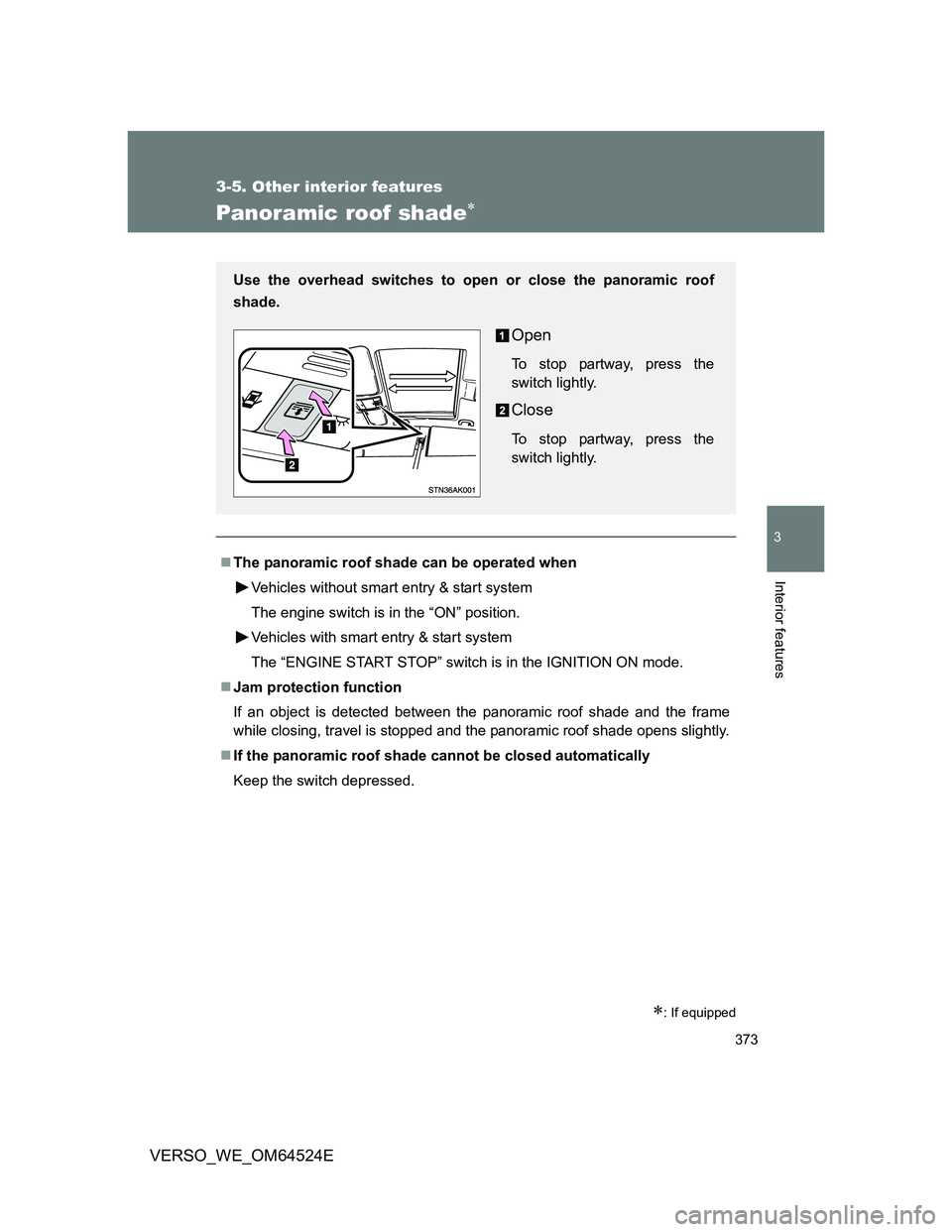
Use the overhead switches to open or close the panoramic roof
shade.
Open
To stop partway, press the
switch lightly.
Close
To stop partway, press the
switch lightly.
Page 374 of 588
374 3-5. Other interior features
VERSO_WE_OM64524E
CAUTION
When closing the panoramic roof shade
Observe the following precautions.
Failing to do so may result in death or serious injury.
Check to make sure that all passengers do not have any part of their bod-
ies in a position where they could be caught when the panoramic roof
shade is being operated.
Do not allow children to operate the panoramic roof shade.
Closing the panoramic roof shade on someone can cause death or serious
injury.
Jam protection function
Never try jamming any part of your body to activate the jam protection
function intentionally.
The jam protection function may not work if something gets caught just
before the panoramic roof shade fully closes.
To prevent burns or injury
Observe the following precautions.
Although the jam protection function has been installed, make sure that
passenger’s hands and faces are not caught in the panoramic roof shade
while it is closing. Also, as there is a chance that the jam protection func-
tion will not react just before closing, make sure not to catch fingers etc. in
the roof.
The opening or closing of the panoramic roof shade can be stopped by
pressing the switch.
If the panoramic roof shade will not close (for example, due to a malfunc-
tion in the jam protection function), the shade can be closed by pressing
and holding the switch.
The jam protection function may operate if a load or impact, similar to that
applied when a foreign object is caught in the roof shade, is applied by
environmental or driving conditions.
The underside of the roof will become hot if the vehicle is left in the direct
sunlight for a long period of time. Do not touch the parts inside the gap
between the roof underside and the roof shade, as you may burn yourself.