Page 561 of 708

561
4-3. Do-it-yourself maintenance
4
Maintenance and care
■When replacing wheels
The wheels of your Toyota are equipped with tire pressure warning
valves and transmitters (except for sp
are tire) that allow the tire pressure
warning system to provide advanced warning in the event of a loss in tire
inflation pressure. Whenever wheels are replaced, the tire pressure
warning valves and transmitters must be installed. ( P. 550)
CAUTION
■When replacing wheels
●Do not use wheels that are a different size from those recommended in
the Owner’s Manual, as this may re sult in loss of handling control.
●Never use an inner tube in a leaking wheel which is designed for a
tubeless tire. Doing so may result in an accident, causing death or seri-
ous injury.
■When installing the wheel nuts
●Never use oil or grease on the wheel bolts or wheel nuts.
Oil and grease may cause the wheel nuts to be excessively tightened,
leading to bolt or disc wheel damage. In addition, the oil or grease can
cause the wheel nuts to loosen and the wheel may fall off, causing an
accident and resulting in death or serious injury. Remove any oil or
grease from the wheel bolts or wheel nuts.
●Be sure to install the wheel nuts with
the tapered end faci ng inward. Install-
ing the nuts with the tapered end fac-
ing outward can cause wheel to
break and eventually cause a wheel
to come off while driving, which could
lead to an accident resulting in death
or serious injury.Tapered
portion
Page 654 of 708
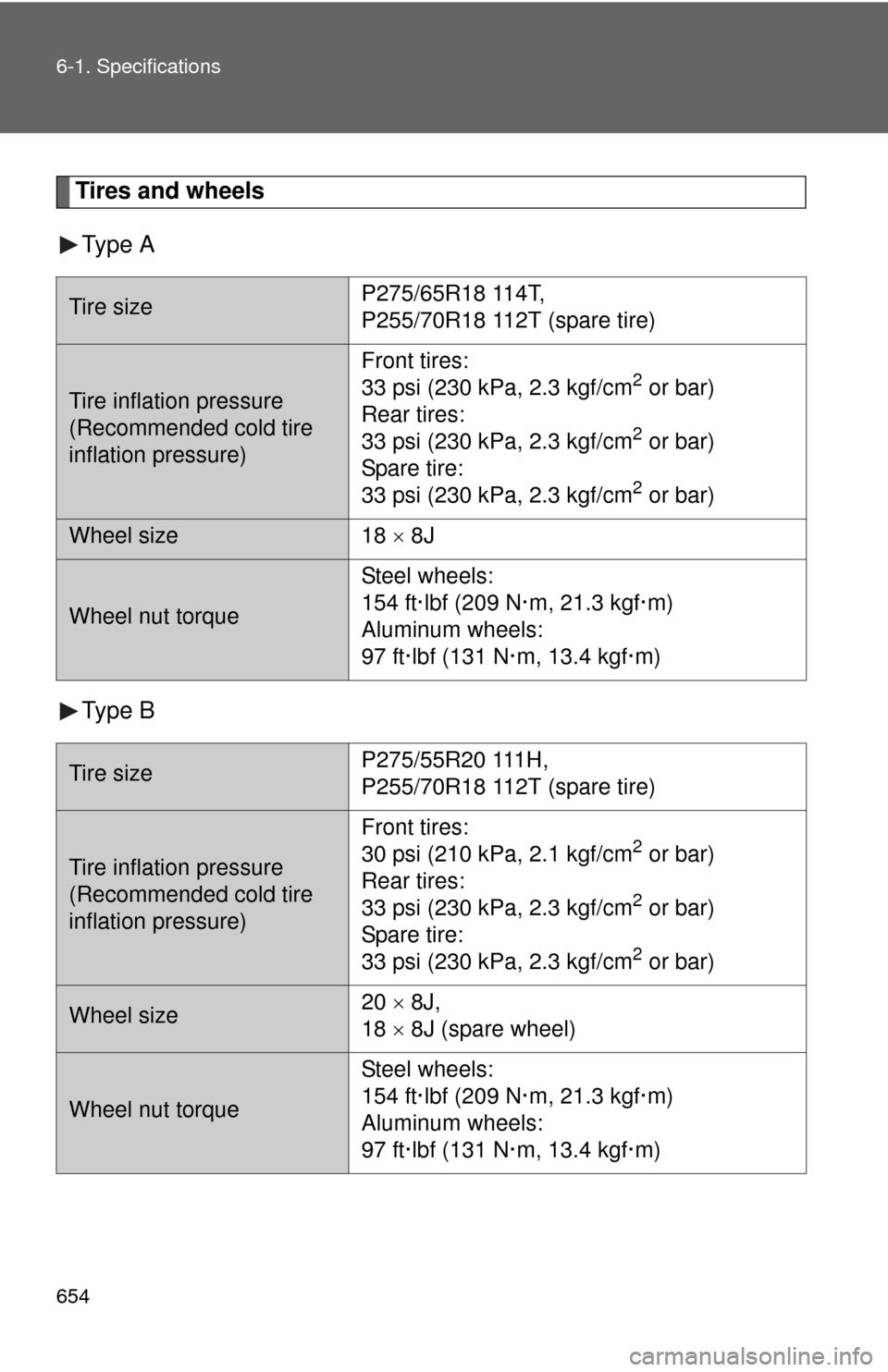
654 6-1. Specifications
Tires and wheelsType A
Type B
Tire size P275/65R18 114T,
P255/70R18 112T (spare tire)
Tire inflation pressure
(Recommended cold tire
inflation pressure)Front tires:
33 psi (230 kPa, 2.3 kgf/cm
2 or bar)
Rear tires:
33 psi (230 kPa, 2.3 kgf/cm
2 or bar)
Spare tire:
33 psi (230 kPa, 2.3 kgf/cm
2 or bar)
Wheel size 18 8J
Wheel nut torque Steel wheels:
154 ft·lbf (209 N·m, 21.3 kgf·m)
Aluminum wheels:
97 ft·lbf (131 N·m, 13.4 kgf·m)
Tire size
P275/55R20 111H,
P255/70R18 112T (spare tire)
Tire inflation pressure
(Recommended cold tire
inflation pressure)Front tires:
30 psi (210 kPa, 2.1 kgf/cm
2 or bar)
Rear tires:
33 psi (230 kPa, 2.3 kgf/cm
2 or bar)
Spare tire:
33 psi (230 kPa, 2.3 kgf/cm
2 or bar)
Wheel size 20
8J,
18 8J (spare wheel)
Wheel nut torque Steel wheels:
154 ft·lbf (209 N·m, 21.3 kgf·m)
Aluminum wheels:
97 ft·lbf (131 N·m, 13.4 kgf·m)
Page 663 of 708
663
6-1. Specifications
6
Vehicle specifications
Tire size
■ Typical tire size information
The illustration indicates typical
tire size.
Tire use
(P = Passenger car,
T = Temporary use)
Section width (millimeters)
Aspect ratio
(tire height to section width)
Tire construction code
(R = Radial, D = Diagonal)
Wheel diameter (inches)
Load index (2 digits or 3 digits)
Speed symbol
(alphabet with one letter)
■ Tire dimensions
Section width
Tire height
Wheel diameter
Page 667 of 708

667
6-1. Specifications
6
Vehicle specifications
Tire related termMeaning
Normal occupant
weight150 lb. (68 kg) times the number of occupants
specified in the second column of Table 1
* that
follows
Occupant distributionDistribution of occupants in a vehicle as speci-
fied in the third column of Table 1
* below
Production options
weight
The combined weight of installed regular pro-
duction options weighing over 5 lb. (2.3 kg) in
excess of the standard items which they
replace, not previously considered in curb
weight or accessory weight, including heavy
duty brakes, ride levelers, roof rack, heavy duty
battery, and special trim
RimA metal support for a tire or a tire and tube
assembly upon which the tire beads are seated
Rim diameter
(Wheel diameter)Nominal diameter of the bead seat
Rim size designationRim diameter and width
Rim type designationThe industry manufacturer’s designation for a
rim by style or code
Rim widthNominal distance between rim flanges
Vehicle capacity
weight (Total load
capacity)The rated cargo and luggage load plus 150 lb.
(68 kg) times the vehicle’s designated seating
capacity
Vehicle maximum load
on the tire
The load on an individual tire that is determined
by distributing to each axle its share of the
maximum loaded vehicle weight, and dividing
by two
Vehicle normal load
on the tire
The load on an individual tire that is determined
by distributing to each axle its share of curb
weight, accessory weight, and normal occu-
pant weight (distributed in accordance with
Ta b l e 1
* below), and dividing by two