Page 366 of 552
366 4-3. Do-it-yourself maintenance
■Adding engine oil
If the oil level is below or near
the low level mark, add engine
oil of the same type as that
already in the engine.
Make sure to check the oil type and prepare the items needed before
adding oil.
Remove the oil filler cap by turning it counterclockwise.
Add engine oil slowly, checking the dipstick.
Install the oil filler cap by turning it clockwise.
Engine oil selection P. 493
Oil quantity
(Low Full) 1.6 qt. (1.5 L, 1.3 Imp. qt.)
Item Clean funnel
STEP1
STEP2
STEP3
Page 367 of 552

367
4-3. Do-it-yourself maintenance
4
Maintenance and care
■
Engine oil consumption
●The amount of engine oil consumed depends on the oil viscosity, the
quality of the oil and the way the vehicle is driven.
● More oil is consumed under driving conditions such as high speeds and
frequent acceleration and deceleration.
● A new engine consumes more oil.
● When judging the amount of oil consumption, keep in mind that the oil
may have become diluted, making it difficult to judge the true level accu-
rately.
● Oil consumption: Max. 1.1 qt./600 miles (0.9 Imp. qt./600 miles, 1.0 L/
1000 km)
● If your vehicle consumes more than 1.1 qt. (1.0 L, 0.9 Imp. qt.) every 600
miles (1000 km), contact your Toyota dealer.
CAUTION
■Used engine oil
●Used engine oil contains potentially harmful contaminants which may
cause skin disorders such as inflammation and skin cancer, so care
should be taken to avoid prolonged and repeated contact. To remove used
engine oil from your skin, wash thoroughly with soap and water.
● Dispose of used oil and filters only in a safe and acceptable manner. Do
not dispose of used oil and filters in household trash, in sewers or onto the
ground. Call your Toyota dealer, service station or auto parts store for
information concerning recycling or disposal.
● Do not leave used engine oil within the reach of children.
Page 368 of 552
368 4-3. Do-it-yourself maintenance
NOTICE
■To prevent serious engine damage
Check the oil level on a regular basis.
■ When replacing the engine oil
●Be careful not to spill engine oil on the vehicle components.
● Avoid overfilling, or the engine could be damaged.
● Check the oil level on the dipstick every time you refill the vehicle.
● Be sure the engine oil filler cap is properly tightened.
Page 442 of 552
442 5-2. Steps to take in an emergency
Stop the vehicle immediately.The following warning indicates the possibility of damage to the vehi-
cle that may lead to an accident. Immediately stop the vehicle in a
safe place and contact your Toyota dealer.
Warning messageDetails
Indicates a malfunction in the hybrid system
A buzzer sounds in accordance with the warning
message that is displayed.
Indicates that the high engine coolant tempera-
ture is too high
Indicates abnormal engine oil pressure
A buzzer also sounds.
The warning message is shown if the engine oil
pressure is too low.
Page 493 of 552
493
6-1. Specifications
6
Vehicle specifications
Hybrid battery (Traction battery)
Lubrication system
*: The engine oil capacity is a reference quantity to be used when changing the
engine oil. Warm up the engine and turn off the hybrid system, wait more
than 5 minutes, and check the oil level on the dipstick.
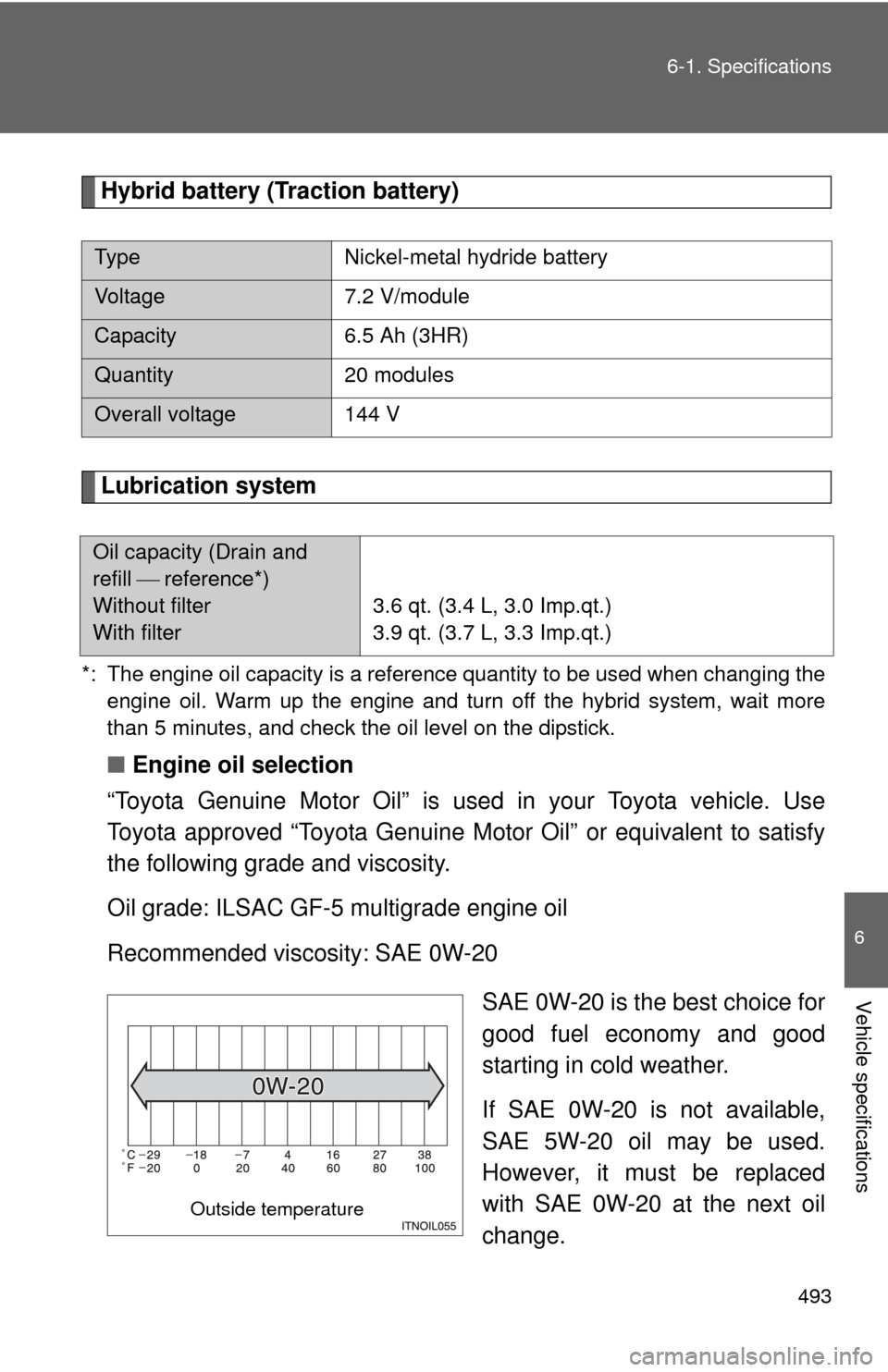
■Engine oil selection
“Toyota Genuine Motor Oil” is used in your Toyota vehicle. Use
Toyota approved “Toyota Genuine Motor Oil” or equivalent to satisfy
the following grade and viscosity.
Oil grade: ILSAC GF-5 multigrade engine oil
Recommended viscosity: SAE 0W-20
SAE 0W-20 is the best choice for
good fuel economy and good
starting in cold weather.
If SAE 0W-20 is not available,
SAE 5W-20 oil may be used.
However, it must be replaced
with SAE 0W-20 at the next oil
change.
TypeNickel-metal hydride battery
Voltage7.2 V/module
Capacity6.5 Ah (3HR)
Quantity 20 modules
Overall voltage 144 V
Oil capacity (Drain and
refill reference*)
Without filter
With filter 3.6 qt. (3.4 L, 3.0 Imp.qt.)
3.9 qt. (3.7 L, 3.3 Imp.qt.)
Outside temperature
Page 494 of 552

494 6-1. Specifications
Oil viscosity (0W-20 is explained here as an example):
• The 0W in 0W-20 indicates the characteristic of the oil which allowscold startability. Oils with a lower value before the W allow for easier
starting of the engine in cold weather.
• The 20 in 0W-20 indicates the viscosity characteristic of the oil when the oil is at high temperature. An oil with a higher viscosity (one with a
higher value) may be better suited if the vehicle is operated at high
speeds, or under extreme load conditions.
How to read oil container label:
The ILSAC (International Lubricant Standardization and Approval
Committee) Certification Mark is added to some oil containers to help
you select the oil you should use.
Cooling system
Capacity Gasoline engine
Power control unit 5.6 qt. (5.3 L, 4.7 Imp. qt.)
1.7 qt. (1.6 L, 1.4 Imp. qt.)
Coolant type Use either of the following:
• “Toyota Super Long Life Coolant”
• A similar high-quality ethylene glycol-based non-silicate, non-amine, non-nitrite,
and non-borate coolant with long-life
hybrid organic acid technology
Do not use plain water alone.
Page 510 of 552

510 6-1. Specifications
Glossary of tire terminology
Tire related termMeaning
Cold tire inflation pres-
sure Tire pressure when the vehicle has been
parked for three hours or more, or has not
been driven more than 1 mile or 1.5 km under
that condition
Maximum inflation
pressure The maximum cold inflated
pressure to which a
tire may be inflated, s hown on the sidewall of
the tire
Recommended infla-
tion pressure Cold tire inflation pressure recommended by a
manufacturer
Accessory weight The combined weight (in excess of those stan-
dard items which may be replaced) of hybrid
transmission, power steering, power brakes,
power windows, power seats, radio and heater,
to the extent that these items are available as
factory-installed equipment (whether installed
or not)
Curb weight The weight of a motor vehicle with standard
equipment, including the maximum capacity of
fuel, oil and coolant, and if so equipped, air
conditioning and additional weight optional
engine
Maximum loaded vehi-
cle weight The sum of:
(a) Curb weight
(b) Accessory weight
(c) Vehicle capacity weight
(d) Production options weight
Normal occupant
weight 150 lb. (68 kg) times the number of occupants
specified in the second co
lumn of Table 1* that
follows
Occupant distribution Distribution of occupants in a vehicle as speci-
fied in the third column of Table 1* below
Page 543 of 552

543
Alphabetical index
Engine oil
Capacity ............................... 493
Checking .............................. 365
Preparing and checking before winter ...................... 229
Engine/power control unit coolantCapacity ............................... 494
Checking .............................. 369
Preparing and checking before winter ...................... 229
Engine switch .................. 158, 162
EPS ........................................... 219
EV drive mode ......................... 170
Event data recorder .................. 18
Floor mat .................................. 337
Fluid Brake .................................... 497
Washer ................................. 374
Fog lights Replacing light bulbs ............ 411
Switch ................................... 206
Wattage ................................ 499
Front fog lights
Replacing light bulbs ............ 411
Switch ................................... 206
Wattage ................................ 499
Front passenger occupant classification system............ 129 Front passenger’s seat
belt reminder light .................433
Front seats Adjustment ..............................76
Front side marker lights
Replacing light bulbs .............411
Switch....................................202
Wattage .................................499
Front turn signal lights Replacing light bulbs .............411
Switch....................................176
Wattage .................................499
Fuel Capacity ................................492
Fuel gauge ............................179
Gas station information .........552
Information ............................500
Refueling ...............................105
Type ......................................492
Fuel door...................................105
Fuel filler door ..........................105
Fuses.........................................400
Gas station information...........552
Gauges ......................................179
Glove box..................................322
Hazard lights
Switch....................................424
Head restraints
Adjusting ................................81
Headlights Replacing light bulbs .............411
Switch....................................202
Wattage .................................499
F
G
H


