Page 19 of 692
19
L/C200_EE (OM60G38E)
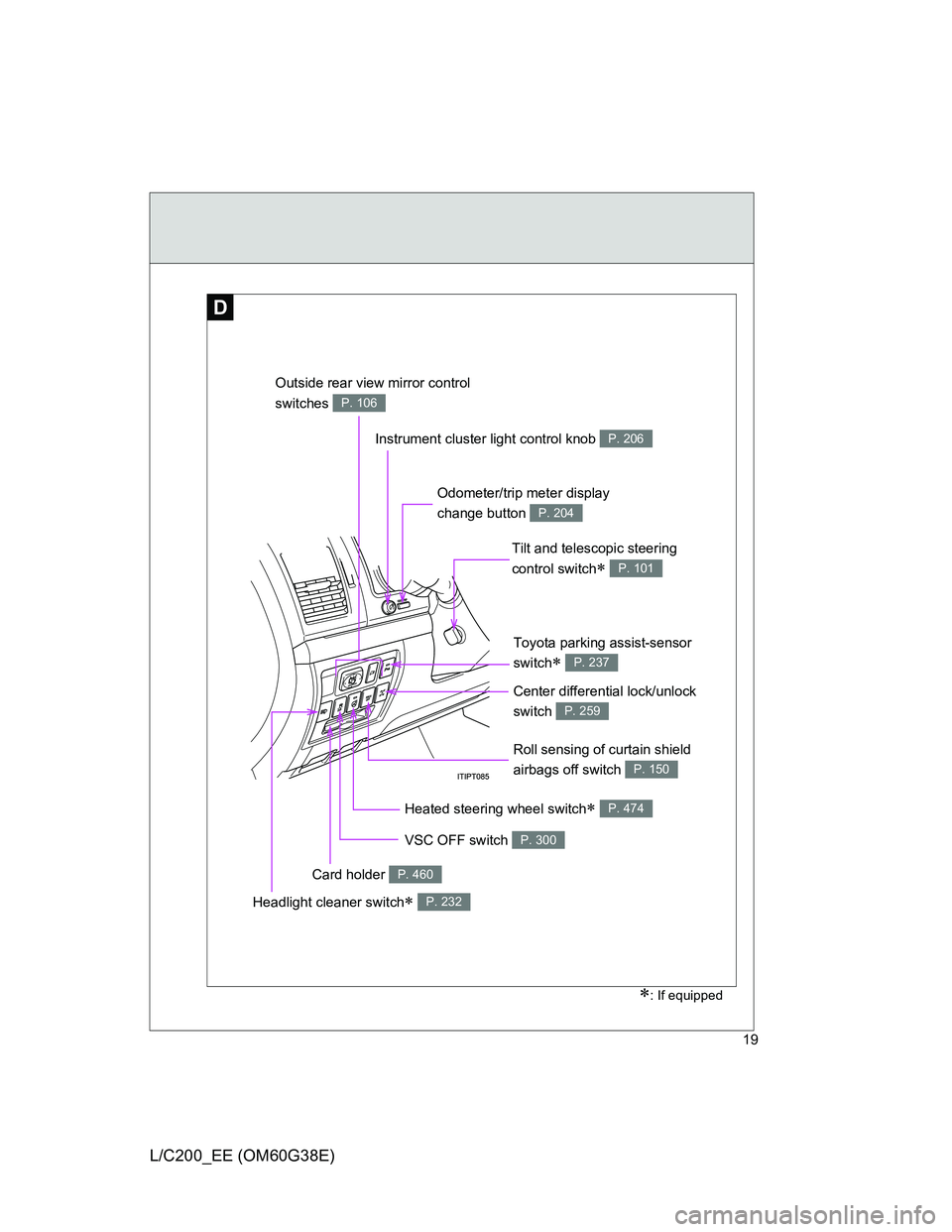
D
: If equipped
Headlight cleaner switch P. 232
Outside rear view mirror control
switches
P. 106
Instrument cluster light control knob P. 206
Odometer/trip meter display
change button
P. 204
Toyota parking assist-sensor
switch
P. 237
Roll sensing of curtain shield
airbags off switch
P. 150
Tilt and telescopic steering
control switch
P. 101
Card holder P. 460
Center differential lock/unlock
switch
P. 259
VSC OFF switch P. 300
Heated steering wheel switch P. 474
Page 29 of 692
29
L/C200_EE (OM60G38E)
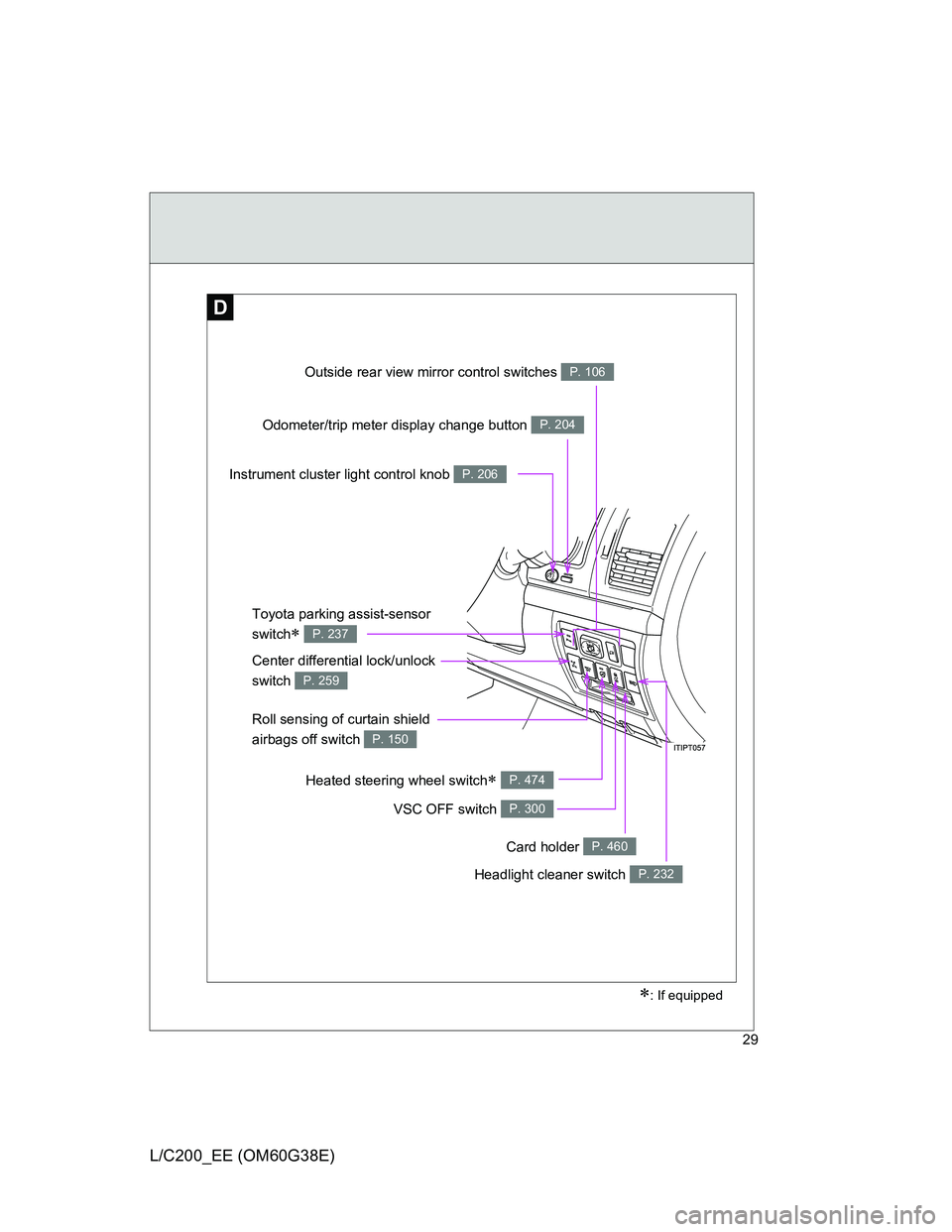
D
: If equipped
Outside rear view mirror control switches P. 106
Headlight cleaner switch P. 232
Roll sensing of curtain shield
airbags off switch
P. 150
Odometer/trip meter display change button P. 204
Instrument cluster light control knob P. 206
Card holder P. 460
Toyota parking assist-sensor
switch
P. 237
Center differential lock/unlock
switch
P. 259
VSC OFF switch P. 300
Heated steering wheel switch P. 474
Page 101 of 692
101
1
1-3. Adjustable components (seats, mirrors, steering wheel)
Before driving
L/C200_EE (OM60G38E)
Steering wheel
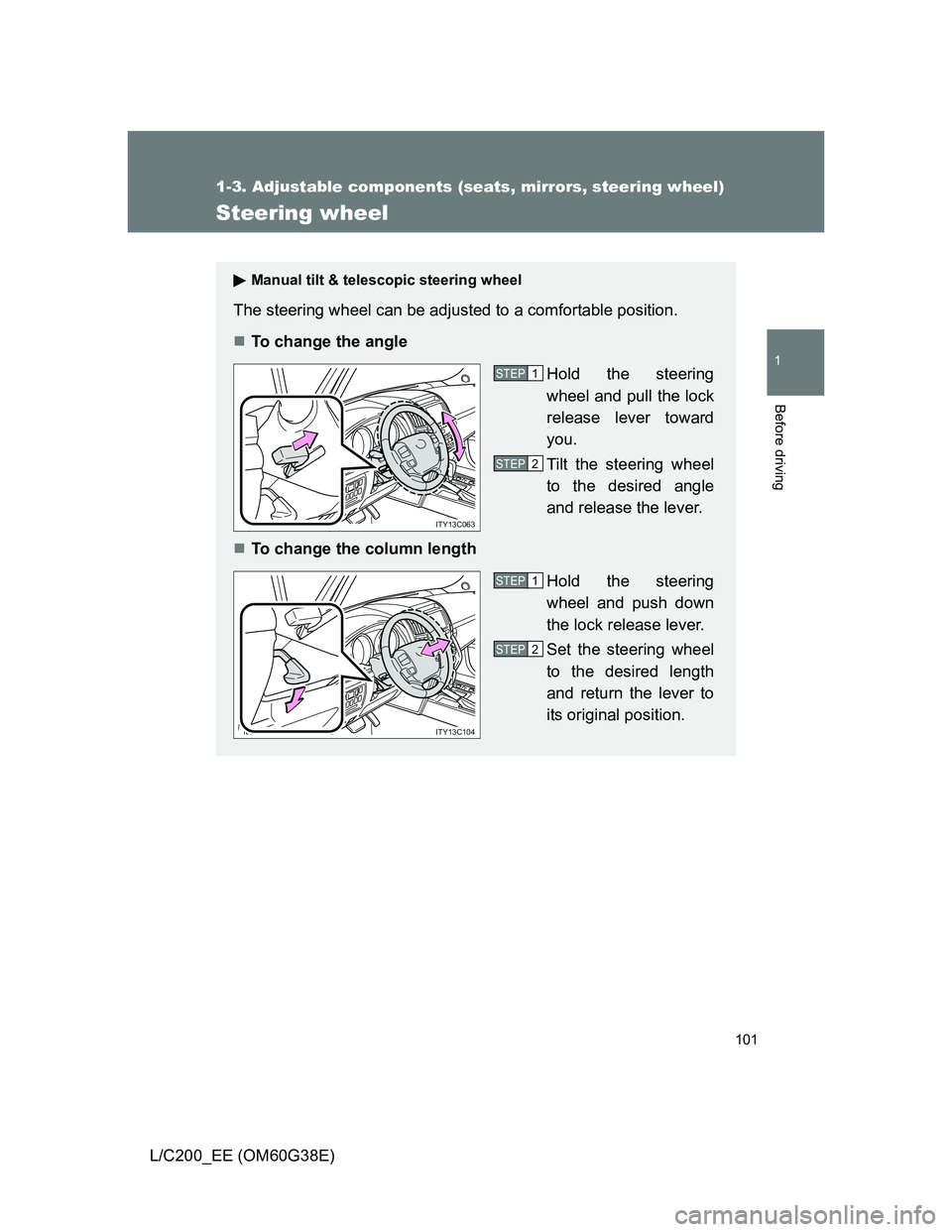
Manual tilt & telescopic steering wheel
The steering wheel can be adjusted to a comfortable position.
To change the angle
Hold the steering
wheel and pull the lock
release lever toward
you.
Tilt the steering wheel
to the desired angle
and release the lever.
To change the column length
Hold the steering
wheel and push down
the lock release lever.
Set the steering wheel
to the desired length
and return the lever to
its original position.
ITY13C063
STEP1
STEP2
ITY13C104
STEP1
STEP2
Page 145 of 692
145 1-7. Safety information
1
Before driving
L/C200_EE (OM60G38E)
CAUTION
SRS airbag precautions
Observe the following precautions regarding the SRS airbags.
Failure to do so may cause death or serious injury.
The driver and all passengers in the vehicle must wear their seat belts
properly.
The SRS airbags are supplemental devices to be used with the seat belts.
The SRS driver airbag deploys with considerable force, and can cause
death or serious injury especially if the driver is very close to the airbag.
Since the risk zone for the driver’s airbag is the first 50 - 75 mm (2 - 3 in.)
of inflation, placing yourself 250 mm (10 in.) from your driver airbag pro-
vides you with a clear margin of safety. This distance is measured from the
center of the steering wheel to your breastbone. If you sit less than 250
mm (10 in.) away now, you can change your driving position in several
ways:
• Move your seat to the rear as far as you can while still reaching the
pedals comfortably.
• Slightly recline the back of the seat.
Although vehicle designs vary, many drivers can achieve the 250 mm
(10 in.) distance, even with the driver seat all the way forward, simply
by reclining the back of the seat somewhat. If reclining the back of your
seat makes it hard to see the road, raise yourself by using a firm, non-
slippery cushion, or raise the seat if your vehicle has that feature.
• If your steering wheel is adjustable, tilt it downward. This points the air-
bag toward your chest instead of your head and neck.
The seat should be adjusted as recommended above, while still maintain-
ing control of the foot pedals, steering wheel, and your view of the instru-
ment panel controls.
Page 184 of 692
184 2-1. Driving procedures
L/C200_EE (OM60G38E)
CAUTION
When stopped on an inclined surface, use the brake pedal and parking
brake to prevent the vehicle from rolling backward or forward and causing
an accident.
Do not adjust the position of the steering wheel, the seat, or the inside or
outside rear view mirrors while driving.
Doing so may result in a loss of vehicle control that can cause accidents
that may result in death or serious injury.
Always check that all passengers’ arms, heads or other parts of their bod-
ies are not outside the vehicle, as this may result in death or serious injury.
Vehicles with the 4-Wheel AHC & AVS: When crossing rivers, turn off
height control after putting the vehicle height in high mode, and drive at
30 km/h (18 mph) or less. Otherwise the vehicle height may change due to
the automatic leveling function, resulting in an accident. (P. 248)
When driving on slippery road surfaces
Sudden braking, acceleration and steering may cause tire slippage and
reduce your ability to control the vehicle, resulting in an accident.
Sudden acceleration, engine braking due to shift changing, or changes in
engine speed could cause the vehicle to skid, resulting in an accident
After driving through a puddle, lightly depress the brake pedal to make
sure that the brakes are functioning properly. Wet brake pads may prevent
the brakes from functioning properly. If the brakes on only one side are wet
and not functioning properly, steering control may be affected, resulting in
an accident.
When shifting the shift lever
Be careful not to shift the shift lever with the accelerator pedal depressed.
This may lead to unexpected rapid acceleration of the vehicle that may
cause an accident and result in death or serious injury.
If you hear a squealing or scraping noise (brake pad wear indicators)
Have your Toyota dealer check and replace the brake pads as soon as pos-
sible.
Rotor damage may result if the pads are not replaced when needed.
It is dangerous to drive the vehicle when the wear limits of the brake pads
and/or those of the rotors are exceeded.
Page 189 of 692
189 2-1. Driving procedures
2
When driving
L/C200_EE (OM60G38E)
NOTICE
If you get a flat tire while driving
A flat or damaged tire may cause the following situations. Hold the steering
wheel firmly and gradually press the brake pedal to slow down the vehicle.
It may be difficult to control your vehicle.
The vehicle will make abnormal sounds.
The vehicle will behave abnormally.
Replace a flat tire with a new one. (P. 601)
When encountering flooded roads
Do not drive on a road that has flooded after heavy rain etc. Doing so may
cause the following serious damage to the vehicle.
Engine stalling
Short in electrical components
Engine damage caused by water immersion
In the event that you drive on a flooded road and the vehicle is flooded, be
sure to have any authorized Toyota dealer or repairer, or another duly quali-
fied and equipped professional check the following.
Brake function
Changes in quantity and quality of oil and fluid used for the engine, trans-
mission, transfer, differentials, etc.
Lubricant condition for the propeller shaft, bearings and suspension joints
(where possible) and the function of all joints, bearings, etc.
Page 248 of 692
248
2-4. Using other driving systems
L/C200_EE (OM60G38E)
4-Wheel AHC (Active Height Control Suspension)
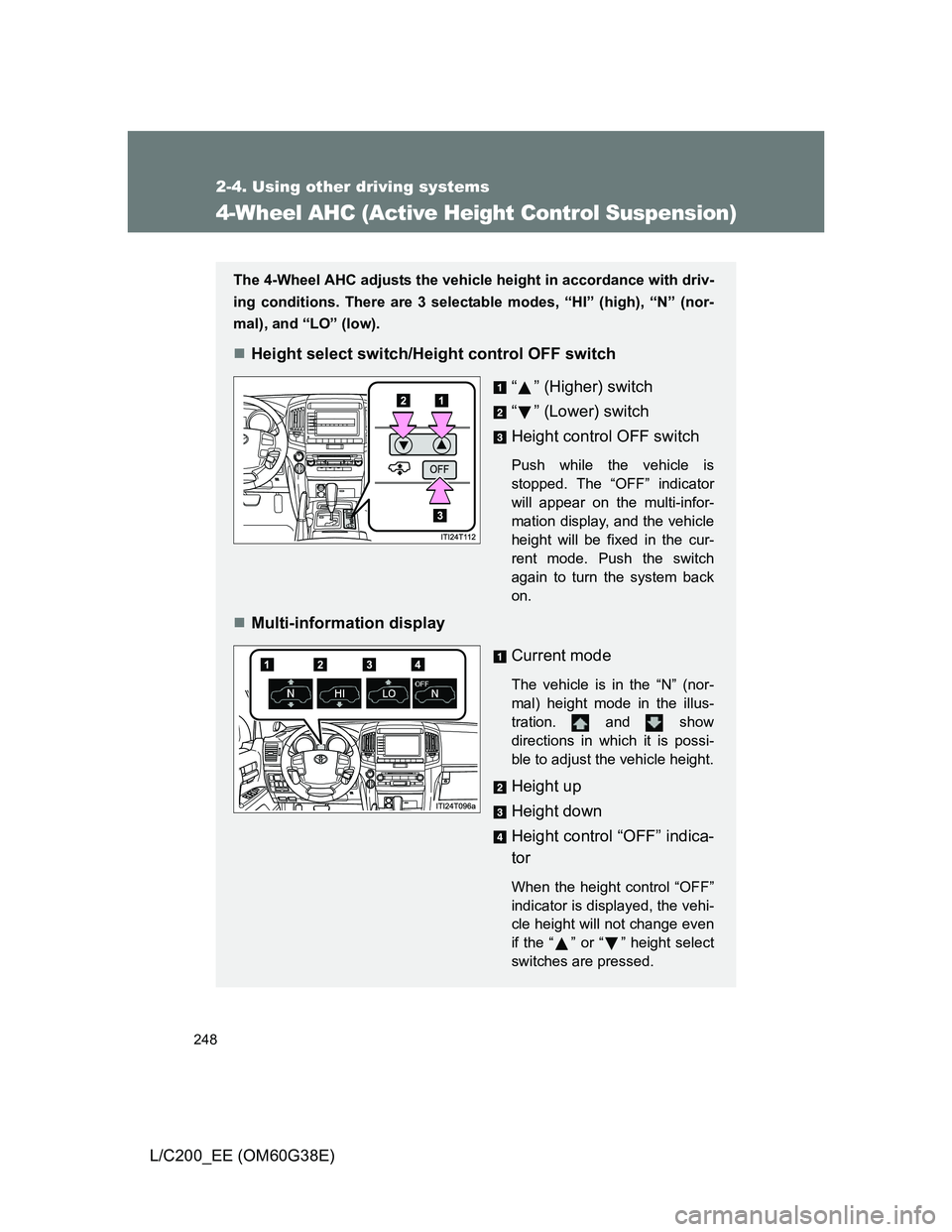
The 4-Wheel AHC adjusts the vehicle height in accordance with driv-
ing conditions. There are 3 selectable modes, “HI” (high), “N” (nor-
mal), and “LO” (low).
Height select switch/Height control OFF switch
“ ” (Higher) switch
“” (Lower) switch
Height control OFF switch
Push while the vehicle is
stopped. The “OFF” indicator
will appear on the multi-infor-
mation display, and the vehicle
height will be fixed in the cur-
rent mode. Push the switch
again to turn the system back
on.
Multi-information display
Current mode
The vehicle is in the “N” (nor-
mal) height mode in the illus-
tration. and show
directions in which it is possi-
ble to adjust the vehicle height.
Height up
Height down
Height control “OFF” indica-
tor
When the height control “OFF”
indicator is displayed, the vehi-
cle height will not change even
if the “ ” or “ ” height select
switches are pressed.
Page 251 of 692
251 2-4. Using other driving systems
2
When driving
L/C200_EE (OM60G38E)
Operating conditions
The engine must be running.
Vehicle height control must be turned off.
All side doors and the back door must be closed.
Switching vehicle height mode while the engine is stopped
If the engine is stopped while the vehicle height is being lowered, lower-
ing will continue.
If any luggage is removed from the vehicle or if any occupants leave the
vehicle within approximately 30 seconds of the “ENGINE START STOP”
switch being turned OFF, the vehicle height may be lowered by the auto
leveling function.
Operating the height select switch will have no effect while the engine is
stopped.
Automatic change in vehicle height when the four-wheel drive control
switch is in the “L4” position
If the vehicle speed exceeds 3 km/h (2 mph) while driving on an uneven
road with the four-wheel drive control switch in the “L4” position, high mode
is automatically selected.
(On even roads, the height mode will not change.)
Automatic change in vehicle height when in the high mode
If the vehicle speed exceeds 30 km/h (18 mph) with the four-wheel drive
control switch in the “H4” position, normal mode is automatically
selected.
If the vehicle speed exceeds 40 km/h (25 mph) with the four-wheel drive
control switch in the “L4” position, the vehicle height is lowered to 25 mm
(1.0 in.) higher than the normal mode height. If the vehicle speed drops
to 20 km/h (13 mph) or less, high mode is automatically resumed.