Page 461 of 636

461
4-3. Do-it-yourself maintenance
4
Maintenance and care
CAUTION
■
When raising your vehicle
Make sure to observe the following to reduce the possibility of death or\
seri-
ous injury.
●When using a floor jack, follow the instructions of the manual provided with
the jack.
● Do not use the jack that was supplied with your vehicle.
● Do not put any part of your body or get underneath the vehicle supported
only by the floor jack.
● Always use floor jack and/or automotive jack stands on a solid, flat, level
surface.
● Do not start the engine while the vehicle is supported by the floor jack.
● Stop the vehicle on level firm ground, firmly set the parking brake and shift
the shift lever in P.
● Make sure to set the floor jack properly at the jack point.
Raising the vehicle with an improperly positioned floor jack will damage
the vehicle and may cause the vehicle to fall off the floor jack.
● Do not raise the vehicle while someone is in the vehicle.
● When raising the vehicle, do not place any objects on top of or underneath
the floor jack.
●Lift up the vehicle using a floor jack
such as the one shown in the illustra-
tion.
Page 463 of 636
463
4-3. Do-it-yourself maintenance
4
Maintenance and care
Engine compar tment
2.7 L 4-cylinder (1AR-FE) engine
Washer fluid tank (P. 477)
Engine oil filler cap ( P. 467)
Engine oil level dipstick ( P. 466)
Engine coolant reservoir ( P. 469)Battery ( P. 473)
Brake fluid reservoir ( P. 472)
Fuse boxes ( P. 499)
Electric cooling fans
Condenser ( P. 471)
Radiator ( P. 471)
Page 464 of 636
464 4-3. Do-it-yourself maintenance
3.5 L V6 (2GR-FE) engine
Washer fluid tank (P. 477)
Engine oil filler cap ( P. 467)
Engine oil level dipstick ( P. 466)
Engine coolant reservoir ( P. 469)Battery ( P. 473)
Brake fluid reservoir ( P. 472)
Fuse boxes ( P. 499)
Electric cooling fans
Condenser ( P. 471)
Radiator ( P. 471)
Page 472 of 636
472 4-3. Do-it-yourself maintenance
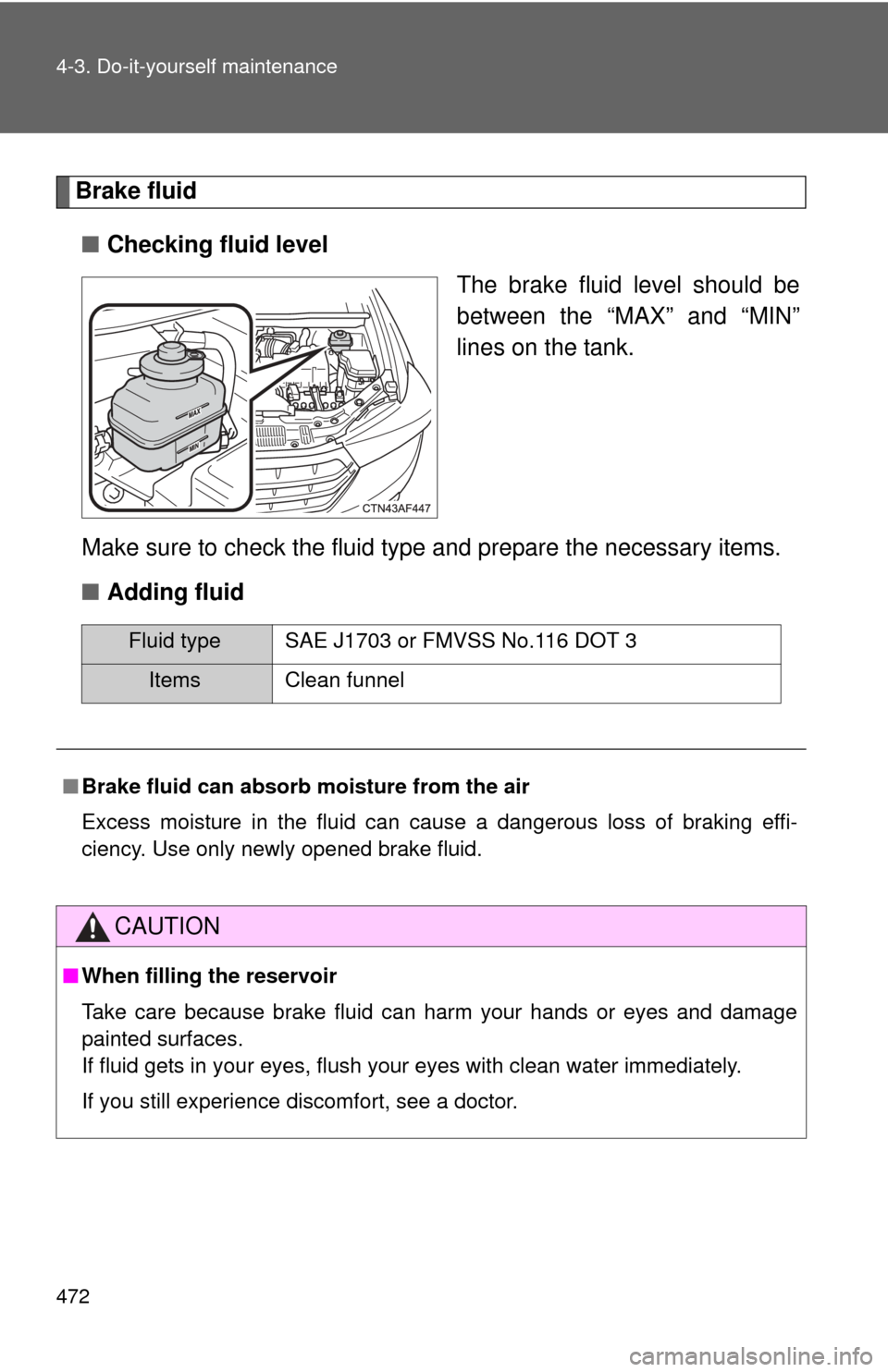
Brake fluid■ Checking fluid level
The brake fluid level should be
between the “MAX” and “MIN”
lines on the tank.
Make sure to check the fluid type and prepare the necessary items.
■ Adding fluid
Fluid type SAE J1703 or FMVSS No.116 DOT 3
Items Clean funnel
■ Brake fluid can absorb moisture from the air
Excess moisture in the fluid can cause a dangerous loss of braking effi-
ciency. Use only newly opened brake fluid.
CAUTION
■When filling the reservoir
Take care because brake fluid can harm your hands or eyes and damage
painted surfaces.
If fluid gets in your eyes, flush your eyes with clean water immediately.
If you still experience discomfort, see a doctor.
Page 473 of 636
473
4-3. Do-it-yourself maintenance
4
Maintenance and care
Battery
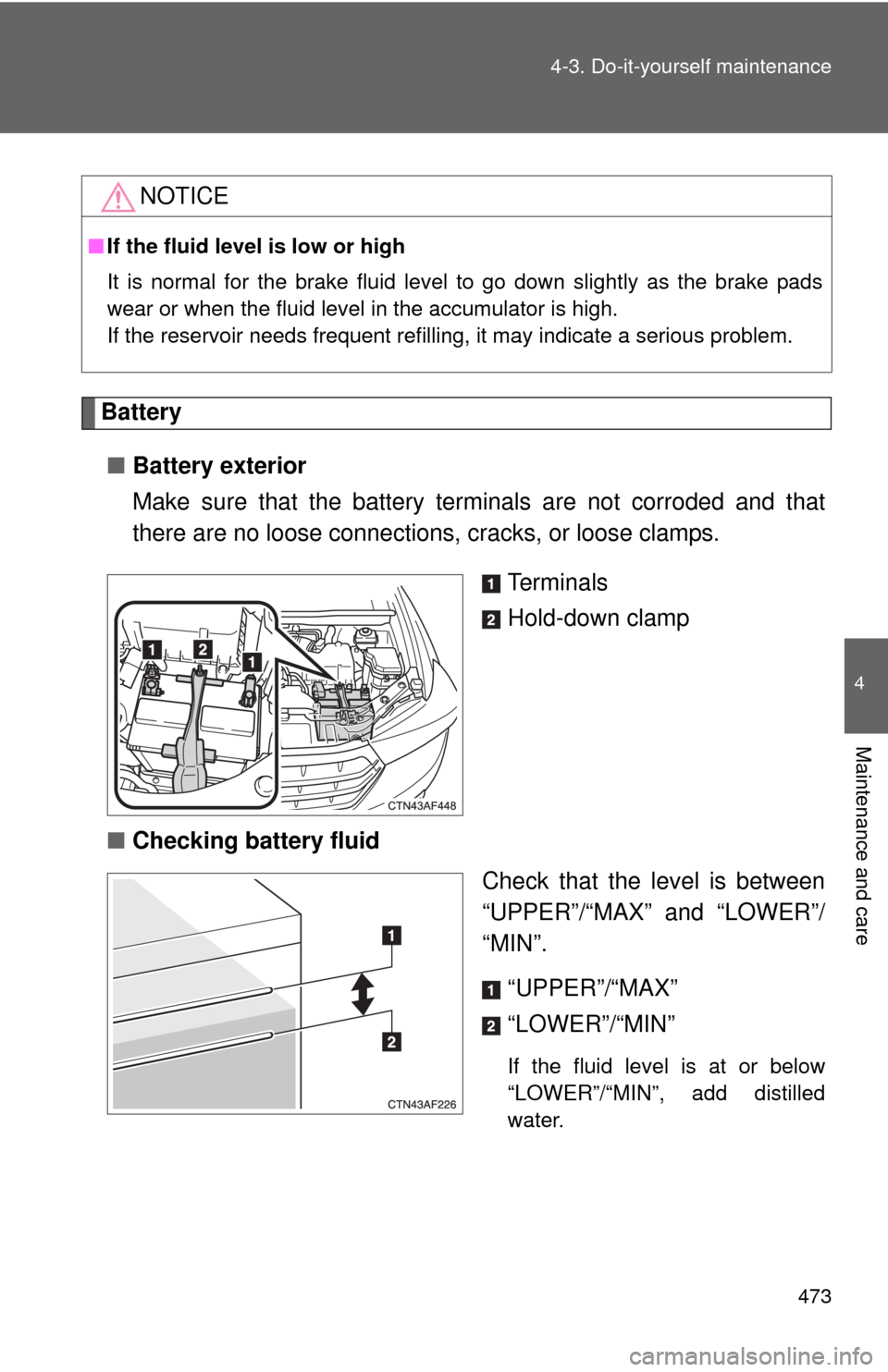
■ Battery exterior
Make sure that the battery terminals are not corroded and that
there are no loose connections, cracks, or loose clamps.
Te r m i n a l s
Hold-down clamp
■ Checking battery fluid
Check that the level is between
“UPPER”/“MAX” and “LOWER”/
“MIN”.
“UPPER”/“MAX”
“LOWER”/“MIN”
If the fluid level is at or below
“LOWER”/“MIN”, add distilled
water.
NOTICE
■If the fluid level is low or high
It is normal for the brake fluid level to go down slightly as the brake pads
wear or when the fluid level in the accumulator is high.
If the reservoir needs frequent refilling, it may indicate a serious pro\
blem.
Page 520 of 636
520 5-1. Essential information
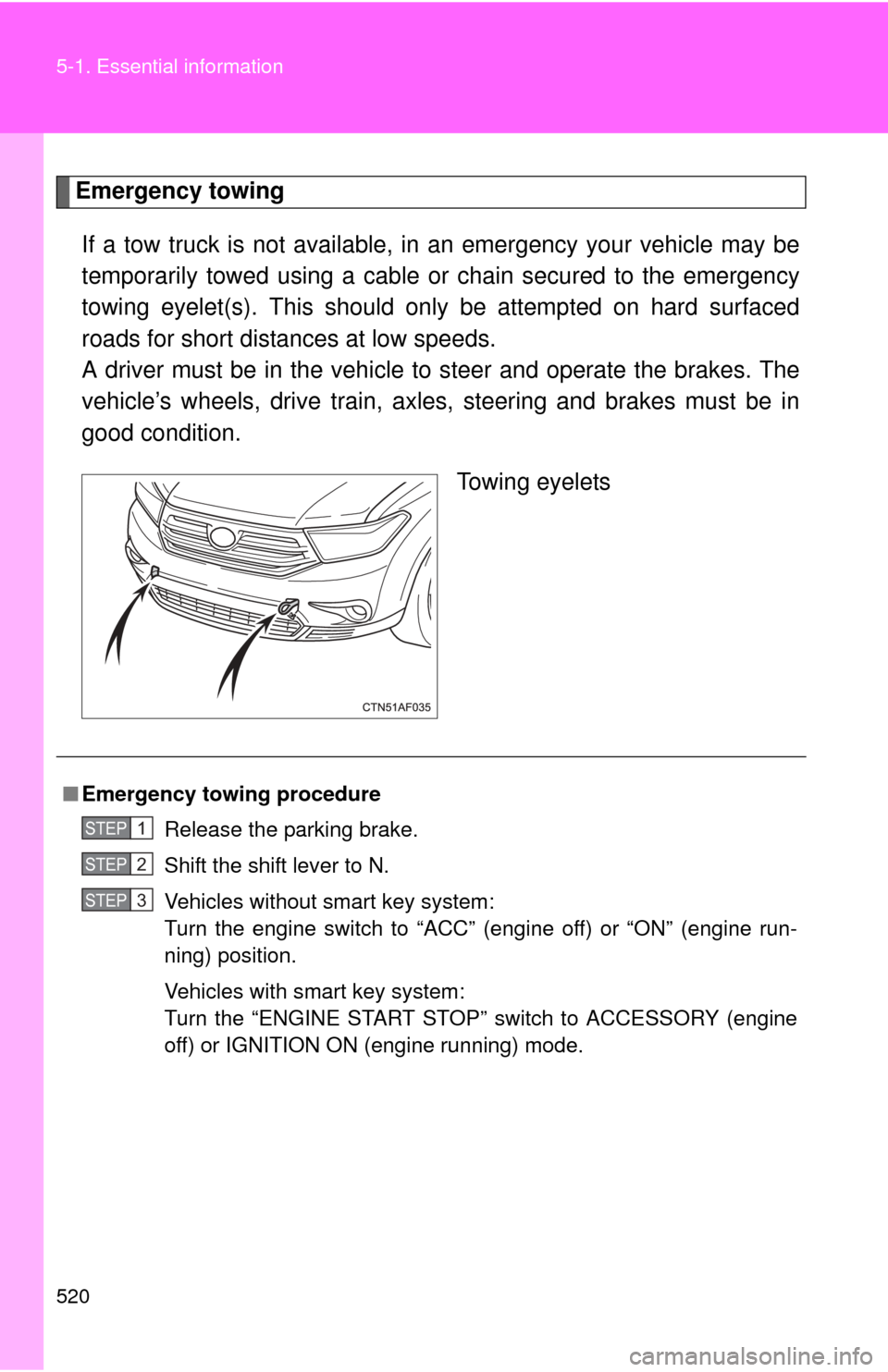
Emergency towingIf a tow truck is not available, in an emergency your vehicle may be
temporarily towed using a cable or chain secured to the emergency
towing eyelet(s). This should only be attempted on hard surfaced
roads for short distances at low speeds.
A driver must be in the vehicle to steer and operate the brakes. The
vehicle’s wheels, drive train, axles, steering and brakes must be in
good condition.
Towing eyelets
■Emergency towin g procedure
Release the parking brake.
Shift the shift lever to N.
Vehicles without smart key system:
Turn the engine switch to “ACC” (engine off) or “ON” (engine run-
ning) position.
Vehicles with smart key system:
Turn the “ENGINE START STOP” switch to ACCESSORY (engine
off) or IGNITION ON (engine running) mode.
STEP1
STEP2
STEP3
Page 521 of 636
5
When trouble arises
521
5-1. Essential information
Installing a towing eyelet
Remove the eyelet cover using a
flathead screwdriver.
To protect the bodywork, place a
rag between the screwdriver and
the vehicle body, as shown in the
illustration.
Insert the towing eyelet into the
hole and tighten partially by
hand.
CAUTION
■Caution while towing
●Use extreme caution when towing the vehicle.
Avoid sudden starts or erratic driving maneuvers which place excessive
stress on the emergency towing eyelets and the cables or chains. Always
be cautious of the surroundings and other vehicles while towing.
● If the engine is not running, the power assist for the brakes and steering
will not function, making steering and braking more difficult.
NOTICE
■To prevent causing serious dama ge to the transmission
Never tow this vehicle from the rear with the front wheels on the ground.
This may cause serious damage to the transmission.
STEP1
STEP2
Page 523 of 636
5
When trouble arises
523
5-1. Essential information
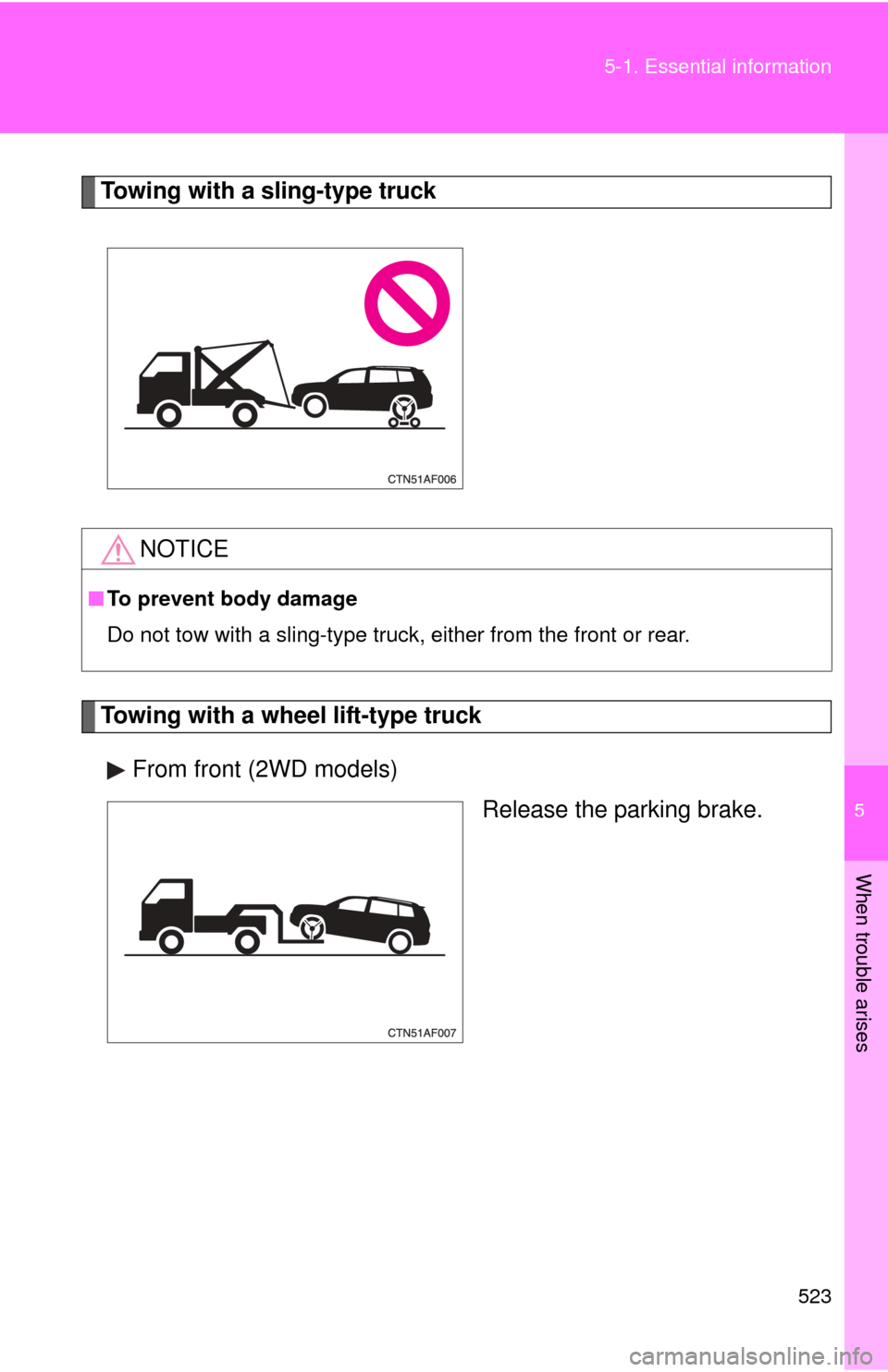
Towing with a sling-type truck
Towing with a wheel lift-type truck
From front (2WD models) Release the parking brake.
NOTICE
■To prevent body damage
Do not tow with a sling-type truck, either from the front or rear.