Page 471 of 636

471
4-3. Do-it-yourself maintenance
4
Maintenance and care
Radiator and condenser
Check the radiator and condenser, and clear away any foreign
objects.
If either of the above parts are extremely dirty or you are not sure of
their condition, have your vehicl e checked by your Toyota dealer.
CAUTION
■When the engine is hot
Do not touch the radiator or condenser as they may be hot and may cause
burns.
■ When the electric coolin g fans are operating
Do not touch the engine compartment.
Vehicles without smart key system: The electric cooling fans may keep rotat-
ing for about 3 minutes after the engine switch is turned to the “LOCK” posi-
tion.
With the engine switch in the “ON” position, the electric cooling fans may
automatically start to run if the air conditioning is on and/or the coolant tem-
perature is high. Be sure the engine switch is in the “LOCK” position when
working near the electric cooling fan or radiator grille.
Vehicles with smart key system: The electric cooling fan may keep rotating
for about 3 minutes even after the “ENGINE START STOP” switch is OFF.
With the “ENGINE START STOP” switch in IGNITION ON mode, the electric
cooling fans may automatically start to run if the air conditioning is on and/or
the coolant temperature is high. Be sure the “ENGINE START STOP” switch
is OFF when working near the electric cooling fans or radiator grille.
Page 480 of 636

480 4-3. Do-it-yourself maintenance
Installing tire pressure warning valves and transmittersWhen replacing tires or wheels, tire pressure warning valves and
transmitters must also be installed.
When new tire pressure warning valves and transmitters are
installed, new tire pressure warn ing valve and transmitter ID codes
must be registered in the tire pressure warning computer and the tire
pressure warning system must be initialized. Have tire pressure
warning valve and transmitter ID codes registered by your Toyota
dealer. ( P. 481)
Initializing the tire pressure warning system
■ The tire pressure warning system must be initialized when the
tire inflation pressure is changed (such as when changing
traveling speed or towing a trailer.)
When the tire pressure warning syst em is initialized, the current tire
inflation pressure is set as the benchmark pressure.
■ How to initialize the tire pressure warning system
Park the vehicle in a safe place and turn the “ENGINE START
STOP” switch or the engine switch OFF.
While the vehicle is moving, in itialization is not performed.
Adjust the tire inflation pressure to the specified cold tire infla-
tion pressure level. ( P. 584)
Make sure to adjust the tire pressure to the specified cold tire
inflation pressure level. The ti re pressure warning system will
operate based on this pressure level.
Turn the “ENGINE START STOP” switch to IGNITION ON
mode (vehicles with smart key system) or the engine switch to
the “ON” position (vehicles without smart key system).
STEP1
STEP2
STEP3
Page 481 of 636
481
4-3. Do-it-yourself maintenance
4
Maintenance and care
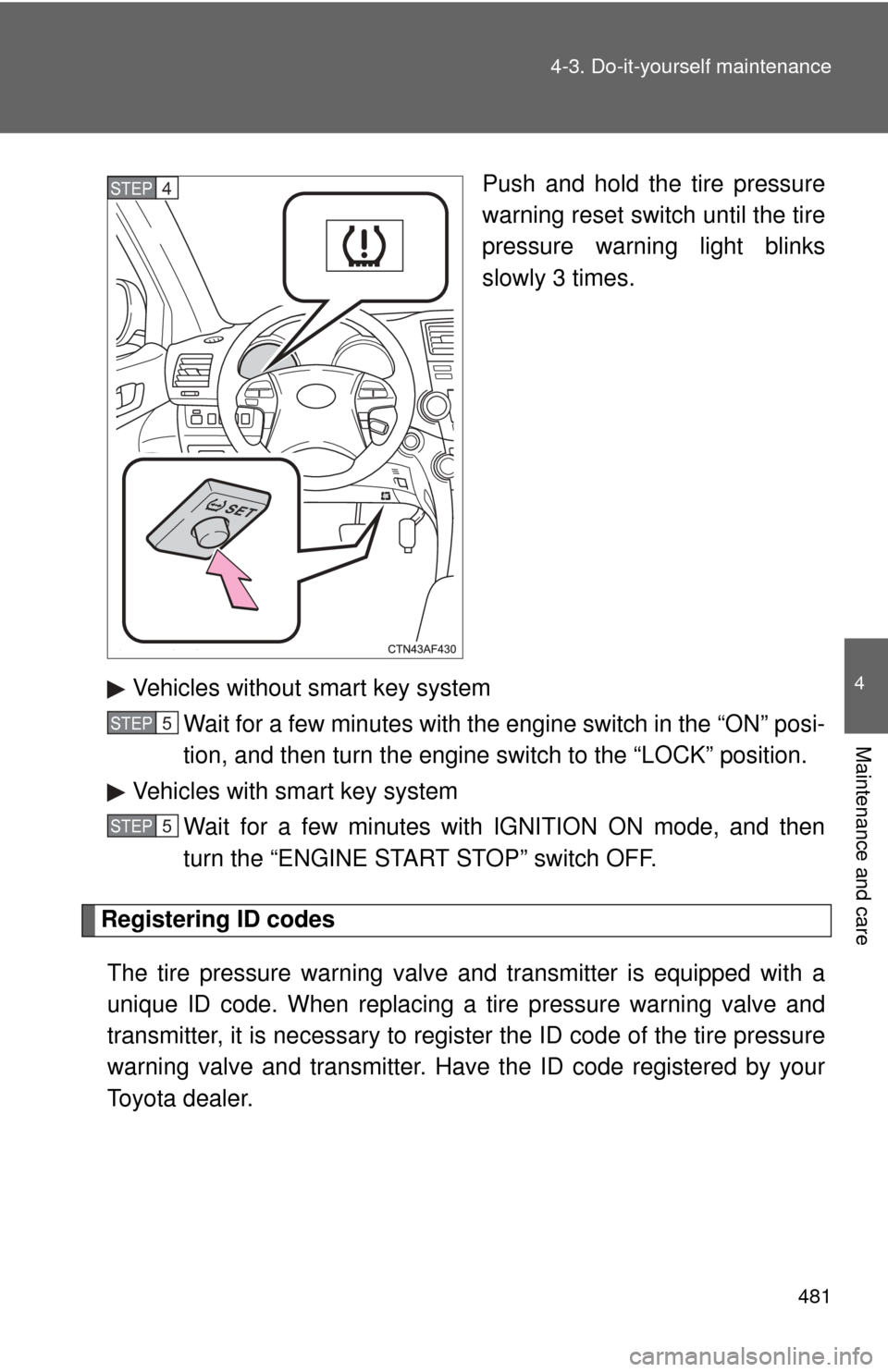
Push and hold the tire pressure
warning reset switch until the tire
pressure warning light blinks
slowly 3 times.
Vehicles without smart key system Wait for a few minutes with the engine switch in the “ON” posi-
tion, and then turn the engine switch to the “LOCK” position.
Vehicles with smart key system Wait for a few minutes with IGNITION ON mode, and then
turn the “ENGINE START STOP” switch OFF.
Registering ID codes
The tire pressure warning valve and transmitter is equipped with a
unique ID code. When replacing a tire pressure warning valve and
transmitter, it is necessary to regist er the ID code of the tire pressure
warning valve and transmitter. Have the ID code registered by your
Toyota dealer.
STEP4
STEP5
STEP5
Page 520 of 636
520 5-1. Essential information
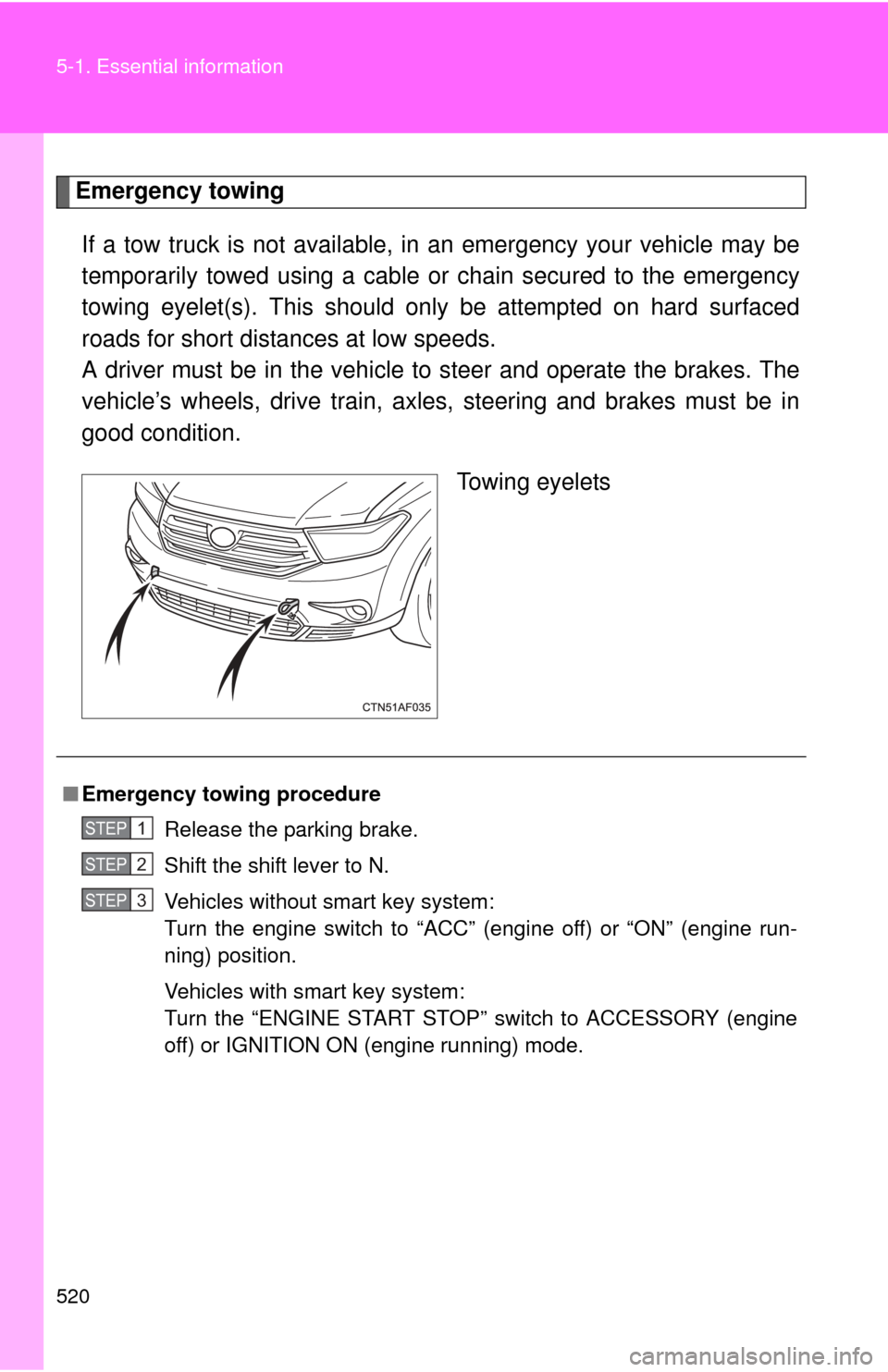
Emergency towingIf a tow truck is not available, in an emergency your vehicle may be
temporarily towed using a cable or chain secured to the emergency
towing eyelet(s). This should only be attempted on hard surfaced
roads for short distances at low speeds.
A driver must be in the vehicle to steer and operate the brakes. The
vehicle’s wheels, drive train, axles, steering and brakes must be in
good condition.
Towing eyelets
■Emergency towin g procedure
Release the parking brake.
Shift the shift lever to N.
Vehicles without smart key system:
Turn the engine switch to “ACC” (engine off) or “ON” (engine run-
ning) position.
Vehicles with smart key system:
Turn the “ENGINE START STOP” switch to ACCESSORY (engine
off) or IGNITION ON (engine running) mode.
STEP1
STEP2
STEP3
Page 536 of 636

536 5-2. Steps to take in an emergency
The tire pressure warning system may be disabled in the following condi-
tions:
(When the condition becomes normal, the system will work properly.)
●If electronic devices or facilities using similar radio wave frequencies
are nearby.
●If a radio set at similar frequencies is in use in the vehicle.
●If a window tint that affects the radio wave signals is installed.
●If there is a lot of snow or ice on the vehicle, in particular around the
wheels or wheel housings.
●If non-genuine Toyota wheels are used. (Even if you use Toyota
wheels, the tire pressu re warning system may not work properly with
some types of tires.)
●If tire chains are used.
●If the spare tire is in a location subject to poor radio wave signal
reception.
●If a large metallic object which can interfere with signal reception is
put in the luggage room.
■If the tire pressure warning light frequently comes on after blinking
for 1 minute
Vehicles without smart key system
If the tire pressure warning light comes on after blinking for 1 minute fre-
quently when the engine switch is turned to the “ON” position, have it
checked by your Toyota dealer. Vehicles with smart key system
If the tire pressure warning light comes on after blinking for 1 minute fre-
quently when the “ENGINE START STOP” switch is turned to IGNITION
ON mode, have it checked by your Toyota dealer.
Page 562 of 636

562 5-2. Steps to take in an emergency
■Starting the engine when the battery is discharged
The engine cannot be started by push-starting.
■ To prevent battery discharge
●Turn off the headlights and the audio system while the engine is turned
off.
● Turn off any unnecessary electrical components when the vehicle is run-
ning at a low speed for an extended period, such as in heavy traffic, etc.
■ When the battery is removed or discharged
●The power back door must be initialized ( P. 6 4 )
● The tire inflation pressure warning system must be initialized. ( P. 480)
■ Charging the battery
The electricity stored in the battery will discharge gradually even when the
vehicle is not in use, due to natural discharge and the draining effects of cer-
tain electrical appliances. If the vehicle is left for a long time, the battery may
discharge, and the engine may be unable to start. (The battery recharges
automatically during driving.)
Vehicles without smart key system:
Maintain the engine speed of the second vehicle, and turn
the engine switch to the “ON” position, then start the vehi-
cle's engine.
Vehicles with smart key system:
Maintain the engine speed of the second vehicle, and turn
the “ENGINE START STOP” switch to IGNITION ON mode,
then start the vehicle's engine.
Once the vehicle’s engine has started, remove the jumper
cables in the exact reverse order in which they were con-
nected.
Once the engine starts, have the vehicle checked at your Toyota
dealer as soon as possible.STEP4
STEP5
Page 581 of 636
581
6-1. Specifications
6
Vehicle specifications
Ignition system
Electrical system
Spark plug
Make
Gap
2.7 L 4-cylinder (1AR-FE) engine
DENSO, SK16HR11
3.5 L V6 (2GR-FE) engine
DENSO FK20HR11
0.043 in. (1.1 mm)
NOTICE
■ Iridium-tipped spark plugs
Use only iridium-tipped spark plugs. Do not adjust gap when tuning engine.
Battery
Open voltage* at
68 F (20 C): 12.6 12.8 V Fully charged
12.2 12.4 V Half charged
11 . 8
12.0 V Discharged
(*: Voltage is checked 20 minutes after the engine
and all the lights are turned off)
Charging rates 5 A max.
Page 627 of 636

627
Alphabetical index
Electric power steering........... 223
Electronic key
If your electronic key battery is discharged .......... 558
Emergency flashers
Switch ................................... 518
Emergency, in case of If a warning message is
displayed ............................ 539
If the back door opener is inoperative ........................... 63
If the electronic key does not operate properly ........... 558
If the engine will not start...... 554
If the shift lever cannot be
shifted from P ..................... 556
If the vehicle has a
discharged battery ............. 560
If the warning buzzer sounds... ........................... 528
If the warning light turns on ....................................... 528
If you have a flat tire ............ 540
If you lose your keys/
wireless remote control
transmitter .......................... 557
If you think something is wrong ................................. 526
If your vehicle becomes
stuck................................... 567
If your vehicle has to be stopped in an
emergency ......................... 569
If your vehicle needs to be towed ................................. 519
If your vehicle overheats ...... 564 Engine
Compartment ........................463
Engine switch ................170, 174
Hood......................................457
How to start the
engine .........................170, 174
Identification number .............573
If the engine will not start ......554
Ignition switch................170, 174
Overheating...........................564
Engine compartment cover.....465
Engine coolant
Capacity ................................580
Checking ...............................469
Preparing and checking before winter .......................243
Engine coolan t temperature
gauge ......................................185
Engine immobilizer system.....113
Engine oil Capacity ................................576
Checking ...............................466
Preparing and checking before winter .......................243
Enhanced vehicle stability control ....................................223
Enhanced VSC .........................223
EPS ............................................223
Event data recorder ...................26E