Page 125 of 636

125
1-7. Safety information
1
Before driving
The main SRS airbag system components are shown above. The
SRS airbag system is controlled by
the airbag sensor assembly. The
airbag sensor assembly consists of a safing sensor and an airbag
sensor.
In certain types of severe frontal or side impacts or vehicle rollover,
the SRS airbag system triggers the ai rbag inflators. A chemical reac-
tion in the inflators quickly fills th e airbags with non-toxic gas to help
restrain the motion of the occupants.
■ SRS warning light
This warning light system monitors the airbag sensor assembly, front airbag
sensors, side and curtain shield airbag sensor assemblies, curtain shield air-
bag sensor assemblies, door sensors, driver's seat position sensor, driver's
seat belt buckle switch, front passenger occupant classification system
(ECU and sensors), “AIR BAG ON” and “AIR BAG OFF” indicator lights,
front passenger’s seat belt buckle switch, front seat belt pretensioner
assemblies, inflators, interconnecting wiring and power sources. ( P. 529)
■ If the SRS airbags deploy (inflate)
●Bruising and slight abrasions may result from contact with a deploying
(inflating) SRS airbag.
● A loud noise and white powder will be emitted.
● Parts of the airbag module (steering wheel hub, airbag cover and inflator)
as well as the front seats, and parts of the front and rear pillars and roof
side rail, may be hot for several minutes. The airbag itself may also be
hot.
● The windshield may crack.
Page 131 of 636
131
1-7. Safety information
1
Before driving
CAUTION
■
SRS airbag precautions
●The SRS front passenger airbag also deploys with considerable force, and
can cause death or serious injury especially if the front passenger is very
close to the airbag. The front passenger seat should be as far from the air-
bag as possible with the seatback adjusted, so the front passenger sits
upright.
● Improperly seated and/or restrained infants and children can be killed or
seriously injured by a deploying airbag. An infant or child who is too small
to use a seat belt should be properly secured using a child restraint sys-
tem. Toyota strongly recommends that all infants and children be placed in
the rear seats of the vehicle and properly restrained. The rear seats are
the safest for infants and children. ( P. 142)
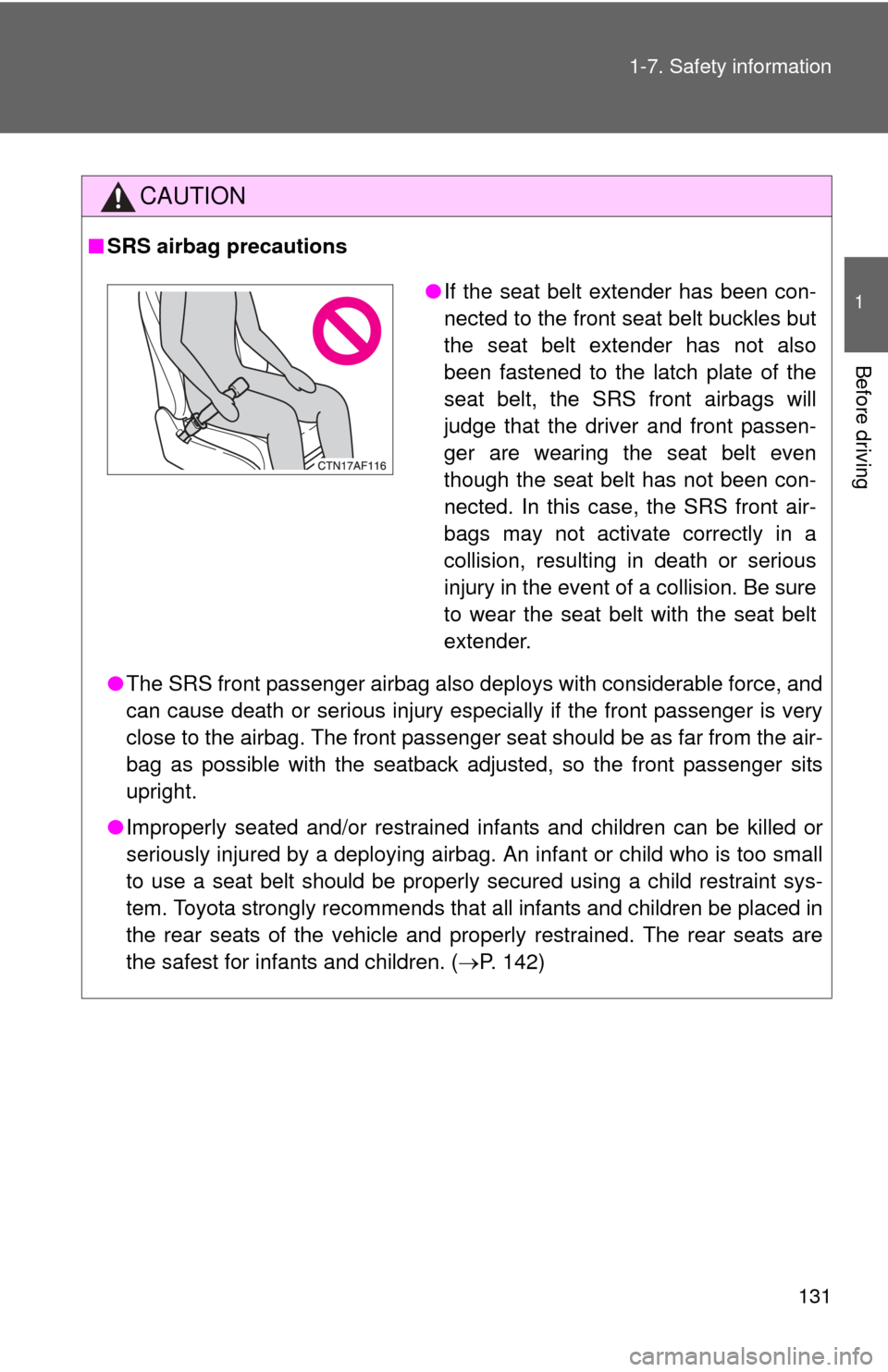
●If the seat belt extender has been con-
nected to the front seat belt buckles but
the seat belt extender has not also
been fastened to the latch plate of the
seat belt, the SRS front airbags will
judge that the driver and front passen-
ger are wearing the seat belt even
though the seat belt has not been con-
nected. In this case, the SRS front air-
bags may not activate correctly in a
collision, resulting in death or serious
injury in the event of a collision. Be sure
to wear the seat belt with the seat belt
extender.
Page 145 of 636
145
1-7. Safety information
1
Before driving
CAUTION
■
Child restraint precautions
●A forward-facing child restraint system may be allowed to be installed on
the front passenger seat only when it is unavoidable. A child restraint sys-
tem that requires a top tether strap should not be used in the front passen-
ger seat since there is no top tether strap anchor for the front passenger
seat. Adjust the seatback as uprights as possible and always move the
seat as far back as possible even if the “AIR BAG OFF” indicator light is
illuminated, because the front passenger airbag could inflate with consid-
erable speed and force. Otherwise, the child may be killed or seriously
injured.
● Do not use the seat belt extender when installing a child restraint system
on the front or rear passenger seat. If installing a child restraint system
with the seat belt extender connected to the seat belt, the seat belt will not
securely hold the child restraint system, which could cause death or seri-
ous injury to the child or other passengers in the event of a sudden stop,
sudden swerve or accident.
● Do not allow the child to lean his/her head or any part of his/her body
against the door or the area of the seat , front and rear pillars or roof side
rail from which the side airbags or curtain shield airbags deploy even if the
child is seated in the child restraint system. It is dangerous if the side air-
bags and curtain shield airbags inflate, and the impact could cause death
or serious injury to the child.
● Make sure you have complied with all installation instructions provided by
the child restraint manufacturer and that the system is properly secured. If
it is not secured properly, it may cause death or serious injury to the child
in the event of a sudden stop, sudden swerve or accident.
■ When children are in the vehicle
Do not allow children to play with the seat belt. If the seat belt becomes
twisted around a child’s neck, it may lead to choking or other serious injuries
that could result in death.
If this occurs and the buckle cannot be unfastened, scissors should be used
to cut the belt.
Page 146 of 636
146 1-7. Safety information
CAUTION
■When the child restrain t system is not in use
● Keep the child restraint system properly secured on the seat even if it is
not in use.
Do not store the restraint unsecured in the passenger compartment.
● If it is necessary to detach the child restraint system, remove it from the
vehicle or store it securely in the luggage compartment. This will prevent it
from injuring passengers in the event of a sudden stop, sudden swerve or
accident.
Page 147 of 636
147
1
1-7. Safety information
Before driving
Installing child restraints
Follow the child restraint system manufacturer's instructions. Firmly
secure child restraints to the r ear seats using the LATCH anchors or
a seat belt. Attach the top teth er strap when installing a child
restraint.
The lap/shoulder belt can be used if your child restraint system is
not compatible with the LATCH (Low er Anchors and Tethers for Chil-
dren) system.
Second seat: Child restraint
LATCH anchors
LATCH anchors are provided
for the rear outer seats. (But-
tons displaying the location of
the anchors are attached to the
seats.)
Seat belts equipped with a
child restraint locking mecha-
nism (ALR/ELR belts except
driver’s seat belt)
Page 149 of 636
149
1-7. Safety information
1
Before driving
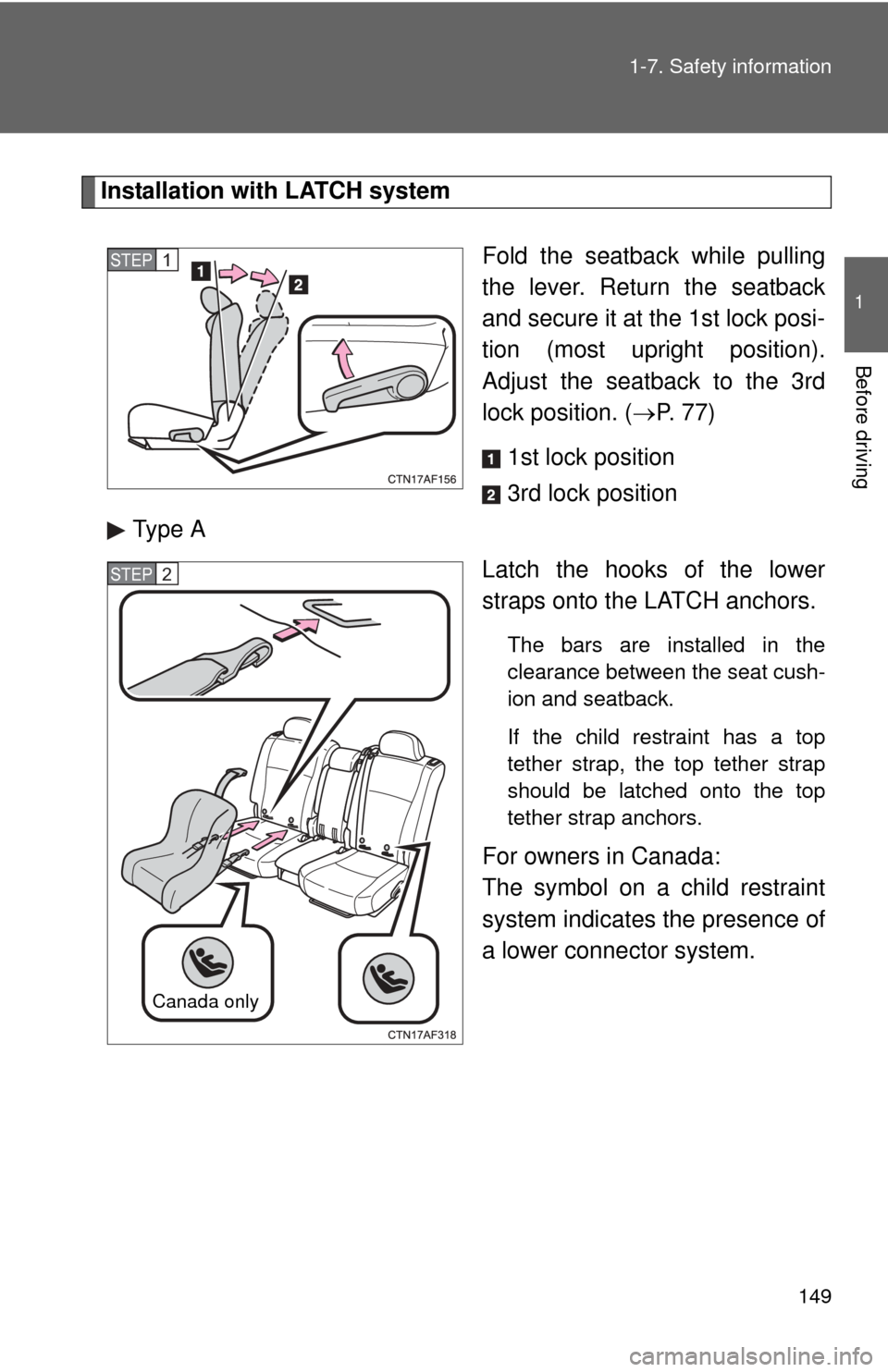
Installation with LATCH system
Fold the seatback while pulling
the lever. Return the seatback
and secure it at the 1st lock posi-
tion (most upright position).
Adjust the seatback to the 3rd
lock position. (P. 77)
1st lock position
3rd lock position
Type A
Latch the hooks of the lower
straps onto the LATCH anchors.
The bars are installed in the
clearance between the seat cush-
ion and seatback.
If the child restraint has a top
tether strap, the top tether strap
should be latched onto the top
tether strap anchors.
For owners in Canada:
The symbol on a child restraint
system indicates the presence of
a lower connector system.
STEP1
STEP2
Canada only
Page 152 of 636
152 1-7. Safety information
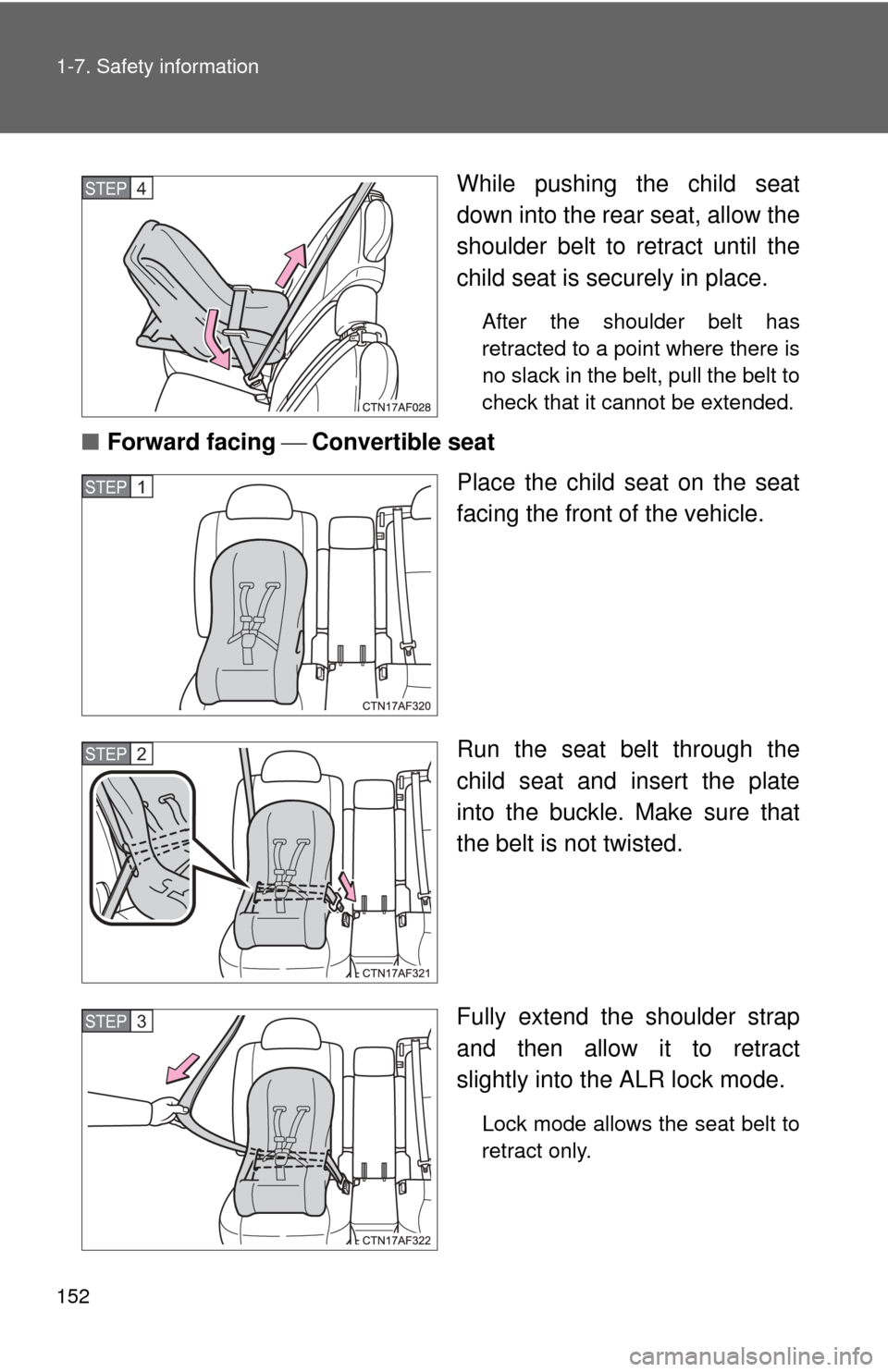
While pushing the child seat
down into the rear seat, allow the
shoulder belt to retract until the
child seat is securely in place.
After the shoulder belt has
retracted to a point where there is
no slack in the belt, pull the belt to
check that it cannot be extended.
■Forward facing Convertible seat
Place the child seat on the seat
facing the front of the vehicle.
Run the seat belt through the
child seat and insert the plate
into the buckle. Make sure that
the belt is not twisted.
Fully extend the shoulder strap
and then allow it to retract
slightly into the ALR lock mode.
Lock mode allows the seat belt to
retract only.
STEP4
STEP1
STEP2
STEP3
Page 153 of 636
153
1-7. Safety information
1
Before driving
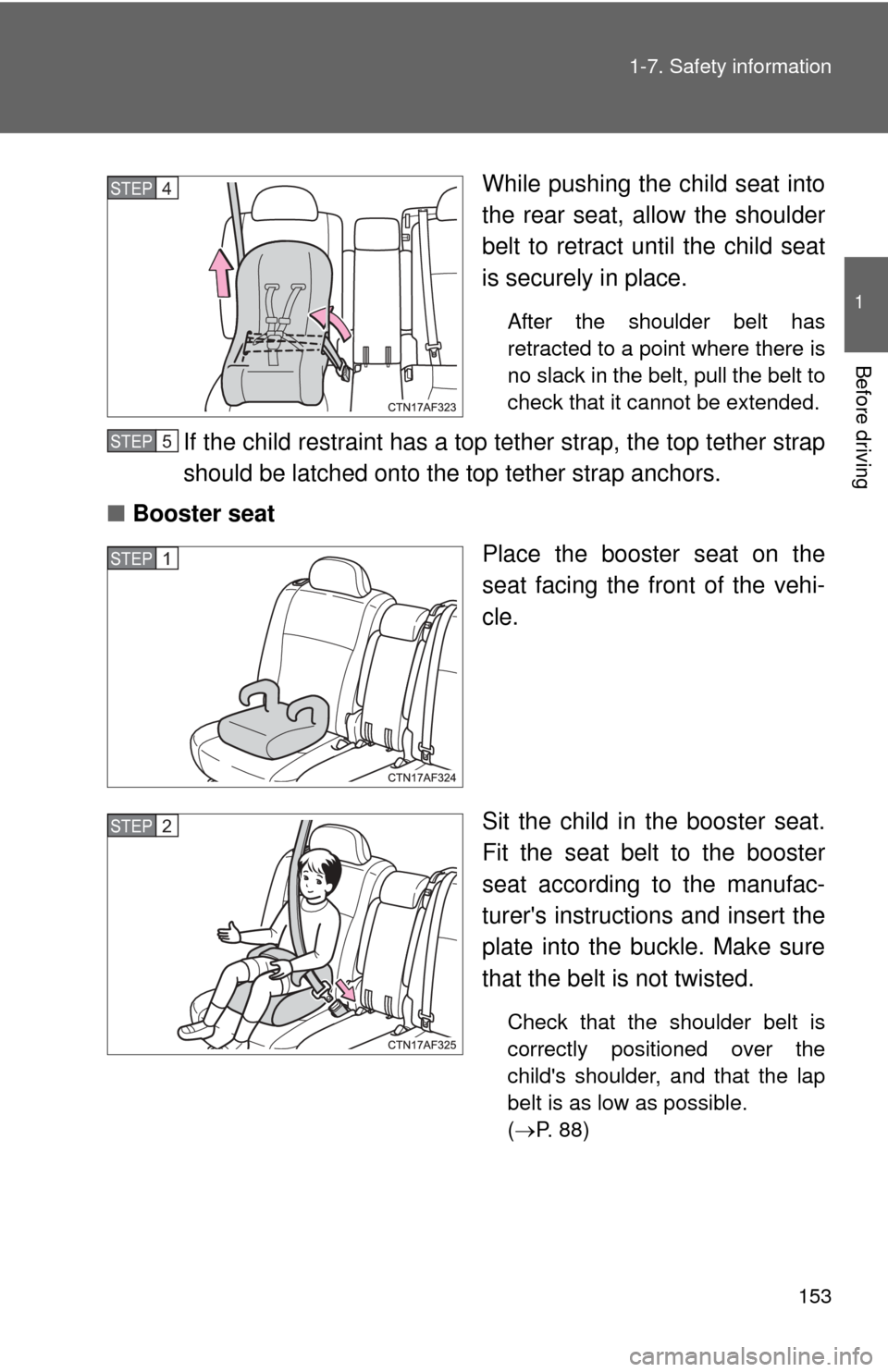
While pushing the child seat into
the rear seat, allow the shoulder
belt to retract until the child seat
is securely in place.
After the shoulder belt has
retracted to a point where there is
no slack in the belt, pull the belt to
check that it cannot be extended.
If the child restraint has a top te
ther strap, the top tether strap
should be latched onto the top tether strap anchors.
■ Booster seat
Place the booster seat on the
seat facing the front of the vehi-
cle.
Sit the child in the booster seat.
Fit the seat belt to the booster
seat according to the manufac-
turer's instructions and insert the
plate into the buckle. Make sure
that the belt is not twisted.
Check that the shoulder belt is
correctly positioned over the
child's shoulder, and that the lap
belt is as low as possible.
(P. 88)
STEP4
STEP5
STEP1
STEP2