Page 397 of 529

397
4-3. Do-it-yourself maintenance
4
Maintenance and care
14 POWER
30 A Power windows
15 SEAT HTR 15 A Seat heater
16 HTR-IG 10 A Air conditioning system
17 WIPER 25 A Windshield wipers
18 WASHER 15 A Windshield washer
19 ECU-IG NO. 1 10 A Automatic transmission, main body
ECU, electric power steering, elec-
tric cooling fan(s), shift lock control
system, anti-lock brake system, tire
pressure warning system, vehicle
stability control system, cruise con-
trol system
20 ECU-IG NO. 2 10 A Back-up lights, charging system,
rear window defogger, air condi-
tioning system, multiport fuel injec-
tion system/sequential multiport
fuel injection system, moon roof
21 OBD 7.5 A On-board diagnosis system
22 STOP 10 AStop lights, high mounted stop-
light, anti-lock brake system, main
body ECU, multiport fuel injection
system/sequential multiport fuel
injection system, shift lock control
system, vehicle stability control
system
23 DOOR 25 A Power door lock system
24 ACC-B 25 A CIG, ACC
25 FR FOG 15 A Front fog lights
26 AM1 7.5 A Starting system, ACC, CIG
FuseAmpereCircuit
Page 398 of 529
398 4-3. Do-it-yourself maintenance
■After a fuse is replaced
●If the lights do not turn on even after the fuse has been replaced, a bulb
may need replacing. ( P. 399)
● If the replaced fuse blows again, have the vehicle inspected by your
Toyota dealer.
■ If there is an overload in the circuits
The fuses are designed to blow, protecting the wiring harness from damage.
CAUTION
■To prevent system breakdowns and vehicle fire
Observe the following precautions.
Failing to do so may cause damage, and possibly a fire or injury.
●Never use a fuse of a higher amperage rating than indicated, or use any
other object in place of a fuse.
● Always use a genuine Toyota fuse or equivalent.
Never replace a fuse with a wire, even as a temporary fix.
This can cause extensive damage or even fire.
● Do not modify the fuse or the fuse box.
NOTICE
■Before replacing fuses
Have the cause of electrical overload determined and repaired by your
Toyota dealer, as soon as possible.
Page 418 of 529
418
5-1. Essential information
If you think something is wrong
If you notice any of the following symptoms, your vehicle probably
needs adjustment or repair. Contact your Toyota dealer as soon as
possible.
■ Visible symptoms
●Fluid leaks under the vehicle
(Water dripping from the air cond itioning after use is normal.)
● Flat-looking tires or uneven tire wear
● Engine coolant temperature g auge needle continually points
higher than normal
■ Audible symptoms
●Changes in exhaust sound
● Excessive tire squeal when cornering
● Strange noises related to the suspension system
● Pinging or other noises related to the engine
■ Operational symptoms
●Engine missing, stumbling or running rough
● Appreciable loss of power
● Vehicle pulls heavily to one side when braking
● Vehicle pulls heavily to one side when driving on a level road
● Loss of brake effectiveness, s pongy feeling, pedal almost
touches the floor
Page 419 of 529
5
When trouble arises
419
5-1. Essential information
Fuel pump shut off system
Follow the procedure below to restart the engine after the system is
activated.
Vehicles with smart key system Turn the “ENGINE START STOP” switch OFF.
Restart the engine.
Vehicles without smart key system Turn the engine switch to the “ACC” or “LOCK” position.
Restart the engine.
NOTICE
■Before starting the engine
Inspect the ground under the vehicle.
If you find that fuel has leaked on to the ground, the fuel system has been
damaged and is in need of repair. Do not restart the engine. Have the vehi-
cle checked and repaired by your Toyota dealer.
To minimize the risk of fuel leakage when the engine stalls or an air-
bag inflates upon collision, the fu el pump shut off system stops sup-
plying fuel to the engine.
STEP 1
STEP 2
STEP 1
STEP 2
Page 421 of 529
5
When trouble arises
421
5-2. Steps to take in an emergency
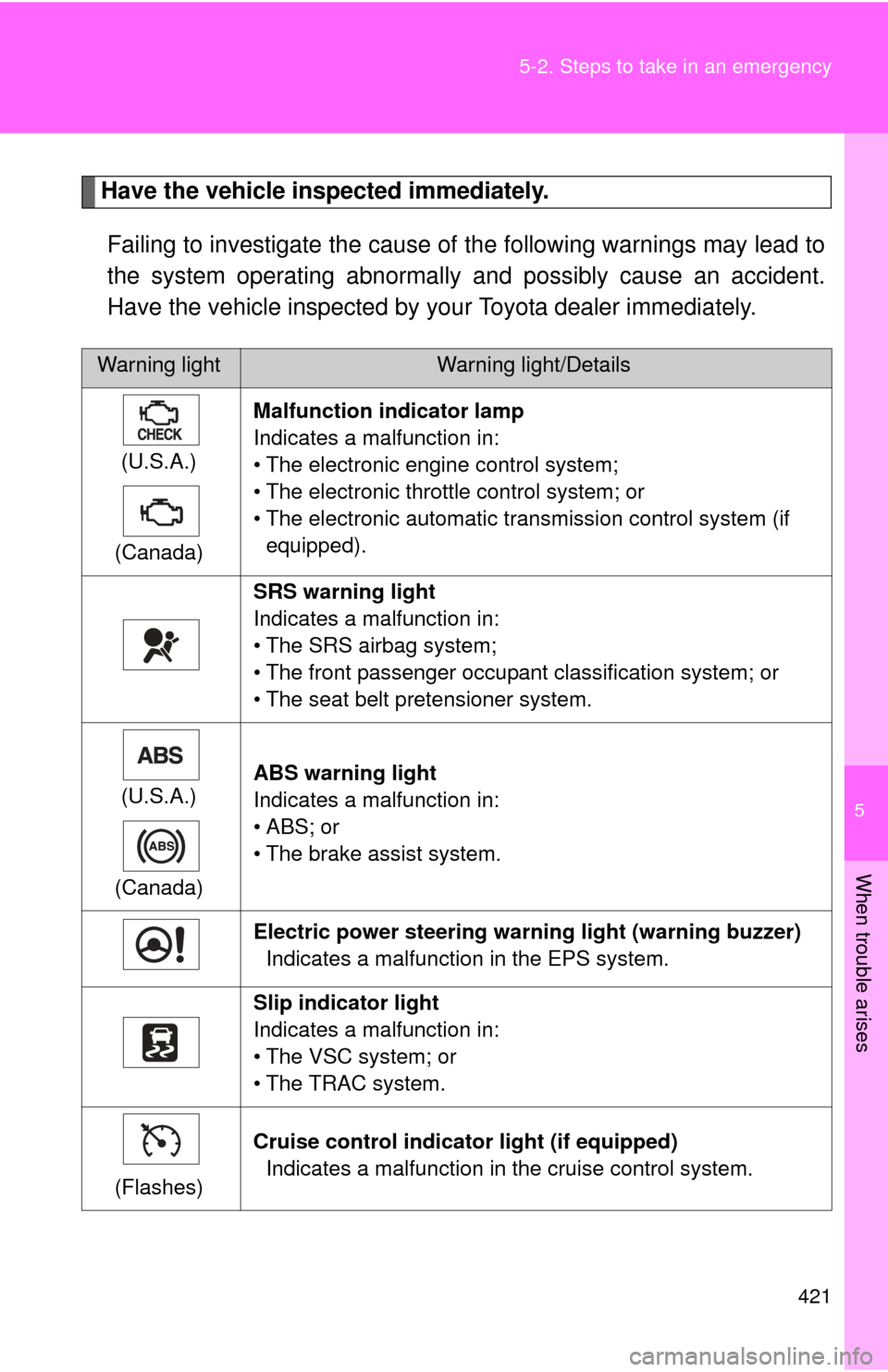
Have the vehicle inspected immediately.
Failing to investigate the cause of the following warnings may lead to
the system operating abnormally and possibly cause an accident.
Have the vehicle inspected by your Toyota dealer immediately.
Warning lightWarning light/Details
(U.S.A.)
(Canada) Malfunction indicator lamp
Indicates a malfunction in:
• The electronic engine control system;
• The electronic throttle control system; or
• The electronic automatic transmission control system (if
equipped).
SRS warning light
Indicates a malfunction in:
• The SRS airbag system;
• The front passenger occupant classification system; or
• The seat belt pretensioner system.
(U.S.A.)
(Canada) ABS warning light
Indicates a malfunction in:
•ABS; or
• The brake assist system.
Electric power steering warning light (warning buzzer)
Indicates a malfunction in the EPS system.
Slip indicator light
Indicates a malfunction in:
• The VSC system; or
• The TRAC system.
(Flashes) Cruise control indicator light (if equipped)
Indicates a malfunction in the cruise control system.
Page 425 of 529

5
When trouble arises
425
5-2. Steps to take in an emergency
■
SRS warning light
This warning light system monitors the airbag sensor assembly, front airbag
sensors, side and curtain shield airbag sensors, curtain shield airbag sen-
sors, driver's seat position sensor, driver's seat belt buckle switch, front pas-
senger occupant classification sy stem, “PASSENGER AIR BAG ON”
indicator light, “PASSENGER AIR BAG OFF” indicator light, front passen-
ger's seat belt buckle switch, seat belt pretensioner assemblies, inflators,
interconnecting wiring and power sources. ( P. 86)
■ Front passenger detection sensor and passenger seat belt reminder
● If luggage is placed on the front passenger seat, the front passenger
detection sensor may cause the warning light to flash, even if a passen-
ger is not sitting in the seat.
● If a cushion is placed on the seat, the sensor may not detect a passen-
ger, and the warning light may not operate properly.
■
When the tire pressure warning light comes on
Check the tire inflation pressure and adjust to the appropriate level.
Pushing the tire pressure warning reset switch does not turn off the tire
pressure warning light.
■The tire pressure warning light may turn on due to natural causes
The tire pressure warning light may turn on due to natural causes such
as natural air leaks or tire inflation pressure changes caused by temper-
ature. In this case, adjusting the ti re inflation pressure will turn off the
warning light (after a few minutes).
Page 426 of 529
426 5-2. Steps to take in an emergency
■When a tire is replaced with a spare tire
The compact spare tire is not equipped with the tire pressure warning
valve and transmitter. If a tire goes flat, the tire pressure warning light will
not turn off even though the flat tire is replaced with the spare tire.
Replace the spare tire with the repair ed tire and adjust the proper tire
inflation pressure. The ti re pressure warning light will turn off after a few
minutes.
■If the tire pressure warning system is inoperative
The tire pressure warning system will be disabled in the following condi-
tions:
(When the condition becomes normal, the system will work properly.)
●If tires not equipped with tire pressure warning valves and transmit-
ters are used.
●If the ID code on the tire pressure warning valves and transmitters is
not registered in the tire pressure warning computer.
●If the tire inflation pressure is 73 psi (500 kPa, 5.1 kgf/cm2 or bar) or
higher.
The tire pressure warning system may be disabled in the following condi-
tions:
(When the condition becomes normal, the system will work properly.)
●If electronic devices or facilities using similar radio wave frequencies
are nearby.
●If a radio set at similar frequencies is in use in the vehicle.
●If a window tint that affects the radio wave signals is installed.
●If there is a lot of snow or ice on the vehicle, in particular around the
wheels or wheel housings.
●If non-genuine Toyota wheels are used. (Even if you use Toyota
wheels, the tire pressu re warning system may not work properly with
some types of tires.)
●If tire chains are used.
Page 427 of 529

5
When trouble arises
427
5-2. Steps to take in an emergency
■If the tire pressure warning light frequently comes on after blinking
for 1 minute
If the tire pressure warning light frequently comes on after blinking for 1
minute when the “ENGINE START STOP” switch or engine switch is
turned ON, have it checked by your Toyota dealer.
■
Customization that can be co nfigured at Toyota dealer
The vehicle speed linked seat belt reminder buzzer can be disabled.
(Customizable features P. 491) However, Toyota recommends that the
seat belt reminder buzzer be operational to alert the driver and front passen-
ger that the seat belts are not fastened.
CAUTION
■If the tire pressure warning light comes on
Be sure to observe the following precautions. Failure to do so could
cause loss of vehicle control and result in death or serious injury.
●Stop your vehicle in a safe place as soon as possible. Adjust the tire
inflation pressure immediately.
●If the tire pressure warning light comes on even after tire inflation pres-
sure adjustment, it is pr obable that you have a flat tire. Check the tires.
If the tire is flat, change to the spare tire and have the flat tire repaired
by the nearest Toyota dealer.
●Avoid abrupt maneuvering and braking. If the vehicle tires deteriorate,
you could lose control of the steering wheel or the brakes.
■If a blowout or sudden air leakage should occur
The tire pressure warning syste m may not activate immediately.