Page 246 of 750
2444-1. Before driving
UK_AURIS/AURIS_HV_EE (OM12E33E)
Weight limits
Check the allowable towing capacity, GVM (Gross Vehicle Mass),
MPAC (Maximum Permissible Axle Capacity), and permissible
drawbar load before towing. (P. 696)
Towing hitch/bracket
Toyota recommends the use of the Toyota hitch/bracket for your
vehicle. Other products of a suitable nature and comparable quality
may also be used.
To prevent an accident
The handling of the vehicle will feel different when towing a trailer.
Beware of the 3 most common causes of towing-related accidents:
driver error, excessive speed, and overloading.
Trailer towing (except hybrid model)
The strain of towing a trailer will have a negative impact on the
running performance, handling, fuel consumption and endur-
ance of your vehicle. Use the vehicle features in the correct
manner and operate the vehicle with care for safer driving and
optimal comfort. Damage and/or malfunctions that occur as a
result of towing performed for commercial purposes are not
covered by the Toyota warranty.
Contact any authorized Toyota dealer or repairer, or another duly
qualified and equipped professional for further information
about additional requirements such as towing kits, etc.
Page 247 of 750
2454-1. Before driving
UK_AURIS/AURIS_HV_EE (OM12E33E)
4
Driving
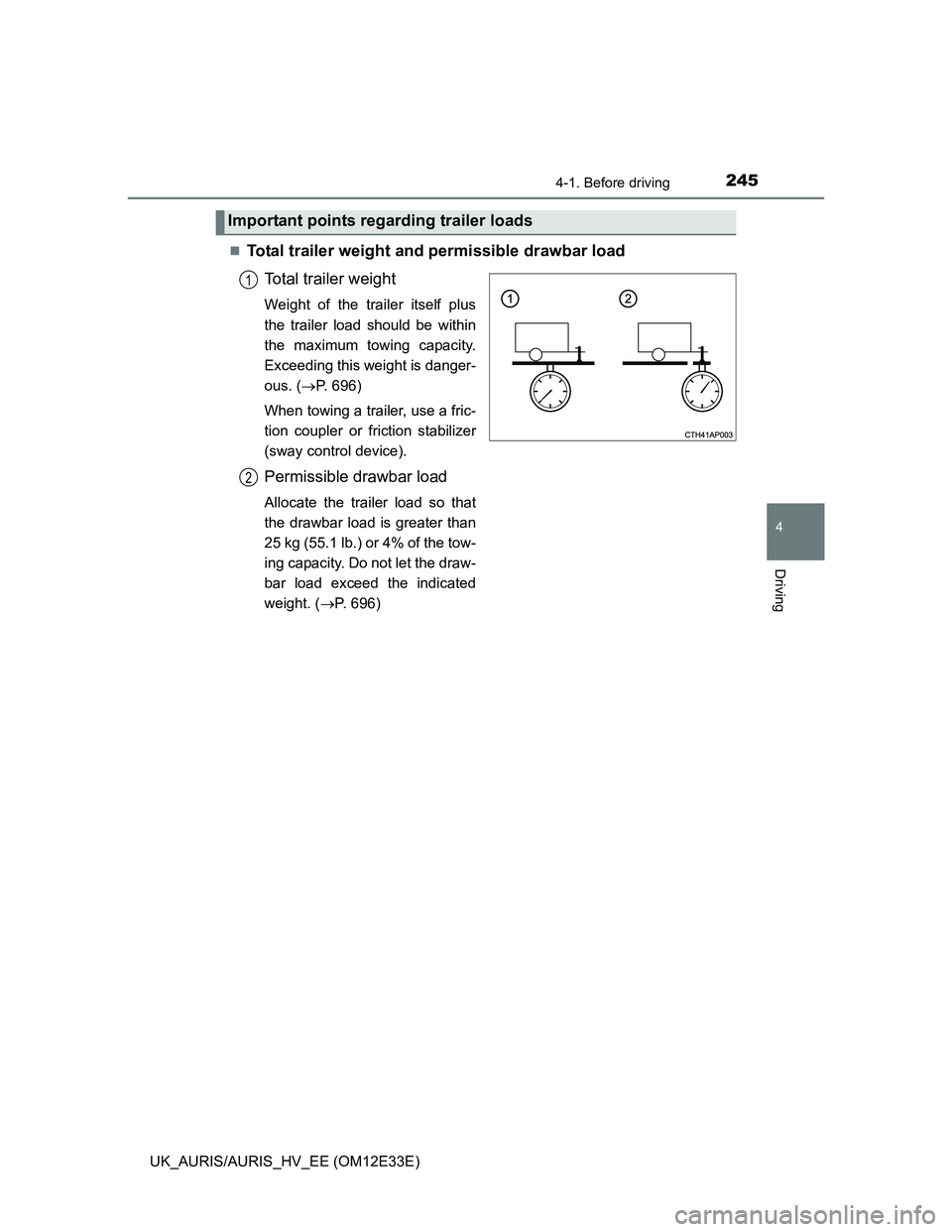
Total trailer weight and permissible drawbar load
Total trailer weight
Weight of the trailer itself plus
the trailer load should be within
the maximum towing capacity.
Exceeding this weight is danger-
ous. (P. 696)
When towing a trailer, use a fric-
tion coupler or friction stabilizer
(sway control device).
Permissible drawbar load
Allocate the trailer load so that
the drawbar load is greater than
25 kg (55.1 lb.) or 4% of the tow-
ing capacity. Do not let the draw-
bar load exceed the indicated
weight. (P. 696)
Important points regarding trailer loads
1
2
Page 248 of 750
2464-1. Before driving
UK_AURIS/AURIS_HV_EE (OM12E33E)
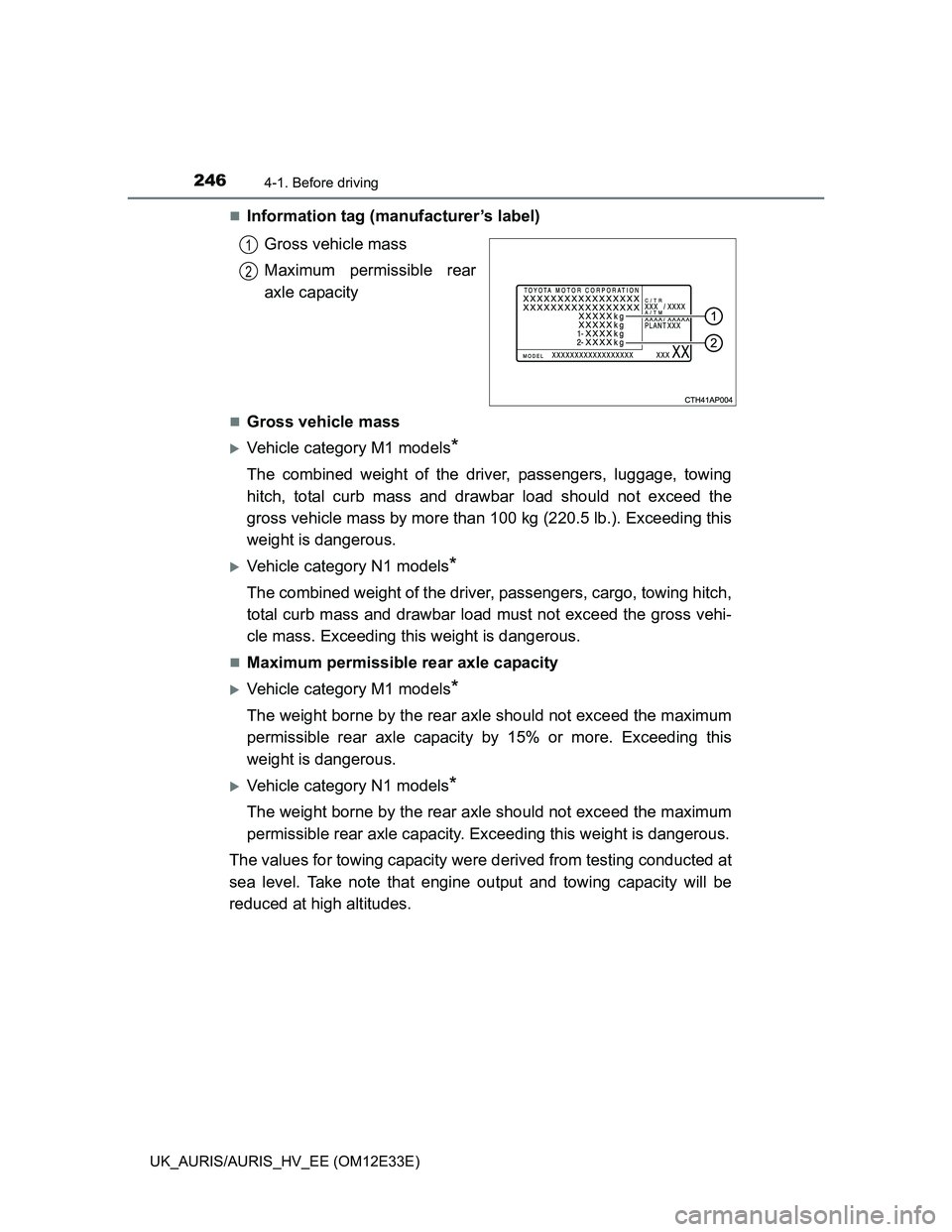
Information tag (manufacturer’s label)
Gross vehicle mass
Maximum permissible rear
axle capacity
Gross vehicle mass
Vehicle category M1 models*
The combined weight of the driver, passengers, luggage, towing
hitch, total curb mass and drawbar load should not exceed the
gross vehicle mass by more than 100 kg (220.5 lb.). Exceeding this
weight is dangerous.
Vehicle category N1 models*
The combined weight of the driver, passengers, cargo, towing hitch,
total curb mass and drawbar load must not exceed the gross vehi-
cle mass. Exceeding this weight is dangerous.
Maximum permissible rear axle capacity
Vehicle category M1 models*
The weight borne by the rear axle should not exceed the maximum
permissible rear axle capacity by 15% or more. Exceeding this
weight is dangerous.
Vehicle category N1 models*
The weight borne by the rear axle should not exceed the maximum
permissible rear axle capacity. Exceeding this weight is dangerous.
The values for towing capacity were derived from testing conducted at
sea level. Take note that engine output and towing capacity will be
reduced at high altitudes.
1
2
Page 251 of 750
2494-1. Before driving
UK_AURIS/AURIS_HV_EE (OM12E33E)
4
Driving
Tire information
Increase the tire inflation pressure to 20.0 kPa (0.2 kgf/cm
2 or bar, 3 psi)
greater than the recommended value when towing. (P. 714)
Increase the air pressure of the trailer tires in accordance with the total
trailer weight and according to the values recommended by the manufac-
turer of your trailer.
Break-in schedule
Toyota recommends that vehicles fitted with new power train components
should not be used for towing trailers for the first 800 km (500 miles).
Safety checks before towing
Check that the maximum load limit for the towing hitch/bracket and hitch ball
is not exceeded. Bear in mind that the coupling weight of the trailer will add
to the load exerted on the vehicle. Also make sure that the total load exerted
on the vehicle is within the range of the weight limits. (P. 245)
Ensure that the trailer load is secure.
Supplementary outside rear view mirrors should be added to the vehicle if
the traffic behind cannot be clearly seen with standard mirrors. Adjust the
extending arms of these mirrors on both sides of the vehicle so that they
always provide maximum visibility of the road behind.
Maintenance
Maintenance must be performed more frequently when using the vehicle for
towing due to the greater weight burden placed on the vehicle compared to
normal driving.
Retighten all bolts securing the hitching ball and bracket after towing for
approximately 1000 km (600 miles).
NOTICE
When the rear bumper strengthening material is aluminum
Ensure the steel bracket part does not come directly in contact with that
area.
When steel and aluminum come into contact, there is a reaction similar to
corrosion, which will weaken the section concerned and may result in dam-
age. Apply a rust inhibitor to parts that will come in contact when attaching a
steel bracket.
Page 254 of 750

2524-1. Before driving
UK_AURIS/AURIS_HV_EE (OM12E33E)
When parking the vehicle
Always place wheel chocks under the wheels of both the vehicle
and trailer. Firmly set the parking brake and shift the shift lever to P
(Multidrive), E, M or R (multi-mode manual transmission) and 1 or R
(manual transmission).
CAUTION
Follow all the instructions described in this section. Failure to do so could
cause an accident resulting in death or serious injury.
Trailer towing precautions
When towing, make sure that none of the weight limits are exceeded.
(P. 245)
Vehicle speed in towing
Observe the legal maximum speeds for trailer towing.
Before descending hills or long declines
Reduce speed and downshift. However, never downshift suddenly while
descending steep or long downhill grades.
Operation of the brake pedal
Do not hold the brake pedal depressed often or for long periods of time.
Doing so may result in the brake overheating or reduce braking effects.
To avoid accident or injury
Do not use cruise control when you are towing.
Do not tow the vehicle with the compact spare tire installed.
NOTICE
Do not directly splice trailer lights
Directly splicing trailer lights may damage your vehicle's electrical system
and cause a malfunction.
Page 524 of 750
5226-3. Do-it-yourself maintenance
UK_AURIS/AURIS_HV_EE (OM12E33E)
Effects of incorrect tire inflation pressure
Driving with incorrect tire inflation pressure may result in the following:
Reduced fuel efficiency
Reduced driving comfort and tire life
Reduced safety
Damage to the drive train
If a tire needs frequent inflating, have it checked by any authorized Toyota
dealer or repairer, or another duly qualified and equipped professional.
Instructions for checking tire inflation pressure
When checking tire inflation pressure, observe the following:
Check only when the tires are cold.
If your vehicle has been parked for at least 3 hours or has not been driven
for more than 1.5 km or 1 mile, you will get an accurate cold tire inflation
pressure reading.
Always use a tire pressure gauge.
The appearance of the tire can be misleading. In addition, tire inflation pres-
sure that is even just a few pounds off can affect ride quality and handling.
Do not reduce tire inflation pressure after driving. It is normal for tire inflation
pressure to be higher after driving.
Never exceed the vehicle capacity weight.
Passengers and luggage weight should be placed so that the vehicle is bal-
anced.
Tire inflation pressure
Make sure to maintain proper tire inflation pressure. Tire infla-
tion pressure should be checked at least once per month. How-
ever, Toyota recommends that tire inflation pressure be checked
once every two weeks. (P. 714)
Page 526 of 750
5246-3. Do-it-yourself maintenance
UK_AURIS/AURIS_HV_EE (OM12E33E)
When replacing wheels, care should be taken to ensure that they are
equivalent to those removed in load capacity, diameter, rim width and
inset
*.
Replacement wheels are available at any authorized Toyota dealer or
repairer, or another duly qualified and equipped professional.
*: Conventionally referred to as “offset”.
Toyota does not recommend using the following:
Wheels of different sizes or types
Used wheels
Bent wheels that have been straightened
Use only Toyota wheel nuts and wrenches designed for use with
your aluminum wheels.
When rotating, repairing or changing your tires, check that the
wheel nuts are still tight after driving 1600 km (1000 miles).
Be careful not to damage the aluminum wheels when using tire
chains.
Use only Toyota genuine balance weights or equivalent and a plas-
tic or rubber hammer when balancing your wheels.
Wheels
If a wheel is bent, cracked or heavily corroded, it should be
replaced. Otherwise, the tire may separate from the wheel or
cause a loss of handling control.
Wheel selection
Aluminum wheel precautions (if equipped)
Page 698 of 750
696
UK_AURIS/AURIS_HV_EE (OM12E33E)
8-1. Specifications
Except hybrid model
Maintenance data (fuel, oil level, etc.)
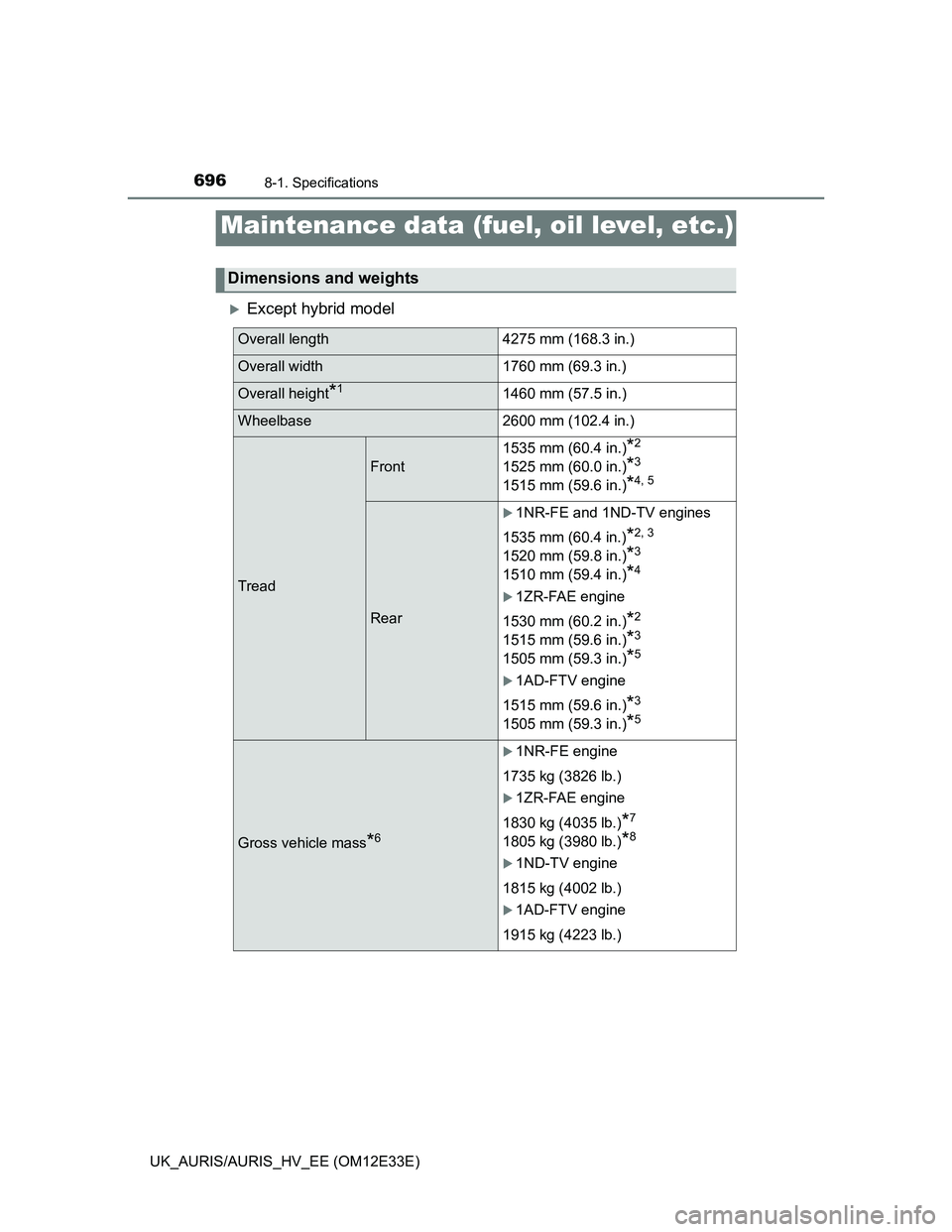
Dimensions and weights
Overall length 4275 mm (168.3 in.)
Overall width 1760 mm (69.3 in.)
Overall height*11460 mm (57.5 in.)
Wheelbase 2600 mm (102.4 in.)
Tread
Front1535 mm (60.4 in.)
*2
1525 mm (60.0 in.)*3
1515 mm (59.6 in.)*4, 5
Rear
1NR-FE and 1ND-TV engines
1535 mm (60.4 in.)
*2, 3
1520 mm (59.8 in.)*3
1510 mm (59.4 in.)*4
1ZR-FAE engine
1530 mm (60.2 in.)
*2
1515 mm (59.6 in.)*3
1505 mm (59.3 in.)*5
1AD-FTV engine
1515 mm (59.6 in.)
*3
1505 mm (59.3 in.)*5
Gross vehicle mass*6
1NR-FE engine
1735 kg (3826 lb.)
1ZR-FAE engine
1830 kg (4035 lb.)
*7
1805 kg (3980 lb.)*8
1ND-TV engine
1815 kg (4002 lb.)
1AD-FTV engine
1915 kg (4223 lb.)